Gaza: Changing The Middle East Face

By Mohammad Abu Rumman

The Al-Aqsa Flood operation marked a turning point in the modern political history of the Middle East. Its repercussions have gone far beyond the Palestinian and regional arenas, extending to the international system and reshaping the foreign policies of global powers toward the region.

The timing of the operation was particularly significant: it came at a transitional moment in the regional order, in the absence of consensus among international and regional actors on the rules of the game. While a fragile balance of deterrence existed between the so-called “Axis of Resistance”—led by Iran (alongside the Syrian regime, Hezbollah, Shiite political forces in Iraq, the Houthis in Yemen, and Hamas and Islamic Jihad)—and Israel, the latter was in the midst of a new phase of regional integration through the Abraham Accords.

Several Arab capitals had already normalized relations, and others were on their way, creating an unprecedented political landscape. This shift coincided with the declining influence of traditional Arab powers such as Egypt, Iraq, and Syria, and the rising centrality of the Gulf states. Many analysts began describing this new configuration as a “New Middle East”: wealthy, economically driven, and detached from historical conflicts—unlike the “Old Middle East,” where entrenched crises defined politics.

Turkey, meanwhile, had entered its own phase of recalibration. Once a champion of the Arab Spring and regional Islamist movements, Ankara sought reconciliation with Arab states, even attempting to restore ties with Bashar al-Assad’s regime (though rebuffed by Damascus), while focusing more narrowly on national security and northern Syria.

On the Palestinian front, Israel had grown complacent toward Gaza, convinced Hamas had no incentive to disrupt the status quo. Tensions, however, were mounting in the West Bank, with small armed groups emerging in places like Nablus, Tulkarm, and Jenin. Within Israeli and Western policy circles, talk was spreading about the prospect of a “mini-state in Gaza” as a substitute for a Palestinian state.

At the international level, President Joe Biden’s administration lacked enthusiasm for either the Abraham Accords or Trump’s “Deal of the Century,” yet it effectively followed the same trajectory: pursuing “regional peace” by integrating Israel into a new economic order and reducing the Palestinian question to daily livelihood concerns—employment, services, and economic relief in Gaza and the West Bank—rather than a political resolution.

The Al-Aqsa Flood and the subsequent two-year genocidal war in Gaza shattered these calculations and fundamentally restructured strategic assumptions. Whether the outcome will ultimately benefit or harm the Palestinian cause remains too complex to assess in simple terms, but what is clear is that the pre-October 7 regional order no longer exists.

From a Palestinian perspective, the conflict has restored international attention to the cause, leading to a renewed recognition of its centrality. In the Gulf, the previously dominant security paradigm—which cast Iran as the chief threat while framing Israel as a potential partner—collapsed entirely. A new consensus has emerged: Gulf security is inseparable from the Palestinian issue, and the notion of Israel as a “strategic friend” has been critically reassessed.

Skeptics may argue that these shifts have not altered the balance of power on the ground, and they are partially correct. Yet the strategic narrative has changed. Before October 7, the trajectory was toward the erasure of the Palestinian cause (closing UNRWA, moving the U.S. embassy to Jerusalem, normalization, and de facto annexation of the West Bank). Today, there is growing recognition—regionally and internationally—that Israeli policies themselves are the root of instability, not Iran or other regional actors. As Emirati political scientist Abdulkhaleq Abdulla put it on X (September 25): “When weighing who poses a greater threat to Gulf security and regional stability—Iran or Israel—the evidence points clearly to Israel. Israel’s brutal behavior has made it more dangerous than an exhausted Iran. The Gulf needs a new defensive and geopolitical strategy for the Middle East beyond Iran.”

Israel, however, now perceives a surplus of power and is pressing for a new political and security order that extends beyond the occupied territories. With the partial unraveling of the Iranian alliance and the breakdown of the “Syrian corridor” that once linked Tehran to the Mediterranean, Israel has set its sights on even more ambitious goals, including the proposed “David Corridor” and establishing buffer zones around its borders in Syria, Lebanon, and Gaza.

In response, a tentative regional coalition has begun to take shape, bringing together Saudi Arabia, Egypt, Jordan, and Qatar, with notable support from Turkey and Pakistan. The latter signed a defense pact with Saudi Arabia following Israel’s strike on Qatar and has since become more engaged in regional diplomacy. While fragile and constrained, this alignment presents a rare historic opportunity to rebuild a regional balance of power and establish a new deterrence framework.

Another striking development is the shift in Europe’s stance toward Israel. For the first time, Israel has lost significant ground in Western public opinion and media narratives, particularly among younger generations and in universities. This has pushed Israel closer to isolation—a position from which former U.S. President Donald Trump had tried to rescue it through his proposed Gaza peace plan, which was largely about securing U.S. and Israeli interests, without offering real guarantees for Palestinian statehood or ending the occupation.

In conclusion, it is still too early to judge the full strategic consequences of the Al-Aqsa Flood and the war in Gaza. Scenarios remain open, and outcomes uncertain. Yet one thing is indisputable: the region today is no longer what it was before October 7.

Abu Rumman is an Academic Advisor of the Politics and Society Institute and Professor of Political Science in The University of Jordan and published this article in The Jordan Times.

Continue reading
Hamas, Trump and The Ceasefire

By Dr Marwan Asmar

CROSSFIREARABIA – The USA wants a ceasefire on Gaza, yet it maintains its supplies of weapons to Israel which the latter uses to beat Palestinians with. This was the case with the former Joe Biden administration.

However, it is the Donald Trump administration that is now in the front brokerage seat, talking, and for the first time, to Hamas directly, face-to-face about ending the genocidal, destructive Israeli war on Gaza.

Benjamin Netanyahu is downright angry about this fact, yet he is making sure that he doesn’t upset Trump by his extremist utterances despite the fact that he is on record for wanting to continue the deadly war on the civilians of Gaza under the pretext of destroying Hamas and its military wing.

However, it has been clear, and at least for the past month that direct negotiations between US presidential envoy Steve Witkoff and his team including Adam Boehler have been taking place with top members of Hamas despite the fact that Israel has stepped up its war on Gaza with its mass killing of its starving 2.2 million-population.

The recent breakthrough achieved by the two sides, Monday, is awaiting final approval by the Israeli government which is sending out mixed signals of agreements and discord. However, there is circulating news that Netanyahu is finally ready.

The new deal agreed upon with the American team is that Hamas would agree on a 60-day-ceasefire where the Islamic movement would free 10 alive and dead prisoners (five of each) on the first day of the deal and 10 (also alive and dead) at the end of 60 days.

The American-sponsored deal includes the lifting of the Israeli siege on Gaza and allowing the entry of 100 aid trucks per day to enter the territory. Meanwhile Witkoff says that during those 60 days talks would continue to negotiate a ceasefire on a permanent basis.

However, Israel is still mulling on the fact because it says the ceasefire negotiations originally agreed on with Witkoff last January are different than what the present US-Hamas is talking about. The Israeli side, mainly Netanyahu, states that they want Hamas out of Gaza but first of all they must lay-down their arms and stashed weapons. Finally, the Gaza Strip must be a free area from any weapons.

These are intractable issues although Hamas and directly talking with the Americans, has previously stated it would entertain the idea of Gaza being run by an independent committee. Such flexibility may be one indication why the American administration is talking to Hamas officials and which is unprecedented as no US government, including Trump in his first presidential term, talked to an organization that is on their “terrorist list”.

The latest breakthrough to achieve a ceasefire on Israel’s war on Gaza, relaunched on 19 March maybe seen as another hope-to-be-dashed as in previous long-talks in Cairo and Doha turned out to nothing and were no more than “talking shops” with the Israelis, especially Netanyahu unwilling to end the war on Gaza, and not least of all of what was regarded as weak US president in the form of Joe Biden and his Middle East roving Secretary of State Anthony Blinken.

All this appear to be changing now for Trump wants to end all global wars and doesn’t want to pay American money around the globe as in the case with Biden and his support for Ukraine where billions of dollars were spent. He has already stopped the war with the Houthis after “massacring” the country for a little more than a month and costing the American treasury around a $1 billion.

The American president is talking to Iran on a new nuclear deal and is now talking to Hamas with a real possibility of achieving a deal to end the war and allow UN aid trucks to feed the hungry of Gaza who are once again dying of Israeli-imposed starvation.

To prove his point on wanting to achieve a ceasefire in Gaza, Trump sacked his National Security Advisor Mike Waltz for talking to Netanyahu behind his back last April when delicate talks was being pursued between Trump administration officials and Hamas.

Tide turns

The tide is turning against Israel. As well as less endearing developments in the White House against Israel, many countries around the world, including states in the European Union like Britain, France, Spain, Holland, Belgium, Norway, Sweden and many more are today calling for the stopping of the war on Gaza with many openly saying they would support the creation of an independent Palestinian state.

This is something which is making Israel’s government extremely jittery. Israeli Foreign Minister Gideon Sar is today, adopting a threatening attitude. He says if these countries take this step Israel would declare its sovereignty on many areas of the occupied West Bank.

All this, together with the latest negotiations, may finally persuade Israel to accept a deal rather than hold out and be prepared to be called an international pariah. Regardless however, many say that international pressure must be maintained from Trump in the United States as well as Europeans and the EU Union.

Continue reading
Middle East Psychosis

By Dr Khairi Janbek

As far as one is concerned, the Middle East has been for a long time a matter of balance of power overlapping with strategic reluctance to change its status quo. But the advent of US President Donald Trump is ushering a new era with all sorts of possibilities.

On the microcosm level for instance, Arafat’s Fateh movement in the PLO was checked in a formula of a balance of power by the leftists organizations as well as the Palestinian organizations sponsored by some Arab countries, the affiliation of all in the PLO created the sense of a balance of power.

However, with the emergance of the PNA and the affiliation of the Palestinian groups in it, albeit with variable influence, created a unit which under the balance of power notion, necessitated the creation of a check and balance on its power.

Consequently Hamas was created, and what seemingly appeared as contradiction between them, turned out to be a symbiotic relationship between them. Now, one cannot say with certainity what will happen next, however, if the objective is to maintain the balance of power by just weakening Hamas, this will require symbiotically weakening the PNA as well, but if the objective is to eleminate Hamas, the next step will be to eleminate the PNA.

As for the macro level, and as one often repeats, the Middle East, has at least for the last five decades was strategically governed by the famous triangle, Iran-Israel-Turkey, with the Arab world having little say in their own affairs , if at all.

However, since the fall of the Shah regime in Iran, the search started for a third angle to replace Iran in governing the Middle East, considering the open hostility of Iran towards West. Consequently some Arab countries jumped into the frey as possible candidates, like Egypt, then Qatar, UAE and Saudi Arabia. But as it seems, a preference for the old triangle was decided upon by the world powers, accepting the inconvenience of having to negotiate with Iran.

Now, we can see a new development that breaks the taboo of the old balance of power in the region.

Starting mid-way from the Biden administration, and with the start of the second Trump administration, the notion of balance of power by the usual triangle has turned into a balance of aggressiveness in the region, as Israel and Iran “bombard” each other, Turkey’s involvement in toppling Assad, and now the distinct possibility of confrontation with Israel in Syria, while being threatened itself by Iran if it cooperates in any possible American attack on Persia. Thus the stability which this triangle had sustained itself, is no more.

From appearances, at least how things look like: It seems Israel is being supported by Trump explicitly and by many other international parties implicitly, to be either the major power that has a say in Middle Eastern affairs. This means that Iran’s grip on the region will be curtailed through negotiations at least if not war; and here the symbiotic issue appears again, with Turkey’s role curtailed through pressures and/or and economic threats.

Here, as well, the aim is to designate Israel as only point of compass on the map of the Middle East, which Arabs are expected to flock to and normalise with.

In this case events will inevitably take a nasty symbiotic turn, meaning Iran will have to be attacked and taken out altogether with its surrogates from the power relations of the Middle East, and Turkey forced to take a more insular step from the affairs of the region, even with a regime change if required.

But we will have to wait and see what lies in store!

Dr Janbek is a Jordanian writer based in Paris, France.

Continue reading
Talking to Hamas: What is Trump up to?

There are not enough leaks about the “backchannel” that began late last month in Doha between Trump’s envoy for hostage affairs, Adam Boehler, and leaders of Hamas’ political bureau (reports indicate that the Hamas delegation was led by Khalil al-Hayya). However, what is striking is that these talks coincided with an escalation in threats from both Trump and Netanyahu toward Hamas, warning of a resumption of war and a more severe course of action. Moreover, Israeli security sources indicate that there is a plan to begin the practical implementation of the displacement scheme announced by Trump!

The key question here is what lies behind the Trump administration’s decision to open a secret channel with Hamas at this specific time, especially when negotiations between Hamas and Israel regarding the second phase are stalling. This is particularly intriguing given that the Trump administration has shown a tougher stance toward Hamas than his predecessor, Joe Biden. Moreover, the Doha meetings coincided with Trump receiving a number of former detainees held by Hamas and issuing a strongly worded message, what he described as a serious threat. What is the significance of these parallel and simultaneous steps taken by the Trump administration toward Hamas?

Those close to the Trump administration suggest that this move is nothing more than a “tactical shift” in the US approach without any fundamental changes. The goal is to ensure that Hamas receives the message directly and forcefully, without intermediaries or misinterpretation. This explanation is logical and, in fact, the most likely scenario, as there are no real initiatives or substantial shifts in the US administration’s position. This is especially evident in the fact that the only stance issued by the U.S. National Security Council rejected the Egyptian-Arab proposal, reaffirming President Trump’s commitment to his plan.

So what message did Boehler convey to Hamas leaders? Or, in other words, what is the deal being offered to them? It is clear that the U.S. offer revolves around extending the first phase, or even calling it the second phase, in exchange for the release of all prisoners held by Hamas, including Americans, as well as the safe exit of Hamas and Qassam Brigades leaders from Gaza and the establishment of a long-term ceasefire in the Strip. However, does this include details about the day after the war? It remains unclear whether the U.S. message addressed that issue. 

Nevertheless, the American stance remains unchanged, ending Hamas’ rule, disarming the movement, or effectively abandoning its military wing. It is also unknown whether the US has a specific policy if Hamas decides to transition into a political party that adopts peaceful resistance, for example.

Of course, the alternative Trump offers Hamas, should they reject these conditions, is the resumption of war, greater destruction in Gaza, and a forced displacement campaign against Palestinians. But the question that Hamas leaders are likely posing to Trump’s envoy is: What is the value of this threat if, in the end, what you are offering is nothing but the displacement of Palestinians? Why should we accept your terms, release the prisoners, lay down our arms, and leave Gaza if the outcome in both cases is the same? It is unclear whether Boehler had an answer to this question, or perhaps why Trump refuses the Arab plan, which is the most realistic and logical proposal presented so far.

On the other side, an important question arises: Is Hamas’ position unified between Doha and Gaza? There is significant room for interpretation and differences in the language coming from the Qassam Brigades on one hand and Hamas’ political bureau, particularly from one of the movement’s senior politicians, Mousa Abu Marzouk, on the other. It is also unclear whether Khalil al-Hayya is truly authorized to make such a crucial decision for the movement or what the limits of his mandate are. Is there any acceptance of the idea of a safe passage for the movement’s leaders in Gaza or laying down arms and transitioning into a peaceful movement? Or does Hamas still insist on maintaining both political and military strategies despite the severe imbalance of power and the massive destruction inflicted on Gaza and its people? All the choices are harsh and difficult.

Mohammad Abu Rumman is a columnist in the Jordan Times

Continue reading
To Piers Morgan: How Can The Killing of Women Children Be Justified as a ‘Moral Right’

British broadcaster and journalist Piers Morgan said Israel’s killing of Palestinian civilians in Gaza, including women and children, could be justified as a “moral right.”

In an interview this week with journalist Tucker Carlson on a rooftop in Saudi Arabia’s capital, Morgan discussed several topics, including the Israeli assault in Gaza and whether the U.S. should be funding it.

Carlson condemned Israel’s bombardment of civilians for over a year, which Morgan questioned as he said such bombing ‘wasn’t evil.’

Carlson said: ‘If you’re intentionally killing civilians, you probably shouldn’t beat your chest and brag about it… maybe you can make the case that you had to do it, but you should weep.’

‘Is it evil though?’ Morgan responded, to which Carlson argued: ‘To kill civilians on purpose? I think it is. Kids and children? Yeah.’

Morgan said he could see there being a ‘moral right’ to civilian deaths in wartime, saying: ‘If there is a world war that threatens the entire world, yes.’

When Carlson called his view ‘disgusting’, he walked back and said it could be justified ‘in a pure defensive action’ as the two journalists sparred over the assault.

‘To intentionally kill noncombatants, women and children, I think we can say that’s wrong,’ he concluded.

The two journalists moved onto the issue of whether the US should continue funding Israel’s assault in Gaza, after former President Joe Biden sent at least $17.9 billion in military aid since the start of the Israeli genocide in October 2023.

After Carlson repeated his calls for the US to stop supplying aid to Ukraine in its conflict with Russia, Morgan questioned: ‘Why do you support Israel against Hamas? Why do you support giving them billions of dollars?’

‘I don’t,’ Carlson snapped back.


‘I support Israel in the sense that I really like Israel, I brought my family on vacation there… but (I support Israel) only to the extent that it helps the United States.’

Morgan said this was a hypocritical stance given his criticism of aid to Ukraine, saying his support merely ‘depends on which country’.

‘I don’t see a difference between (Israel’s bombing of Gaza) and what is happening in Ukraine,’ Morgan continued.

‘This is a long way away from America, there is no direct involvement with America or no mainland involvement, and yet you think it’s right that America supports Israel, but you don’t think it’s right that America supports Ukraine.’

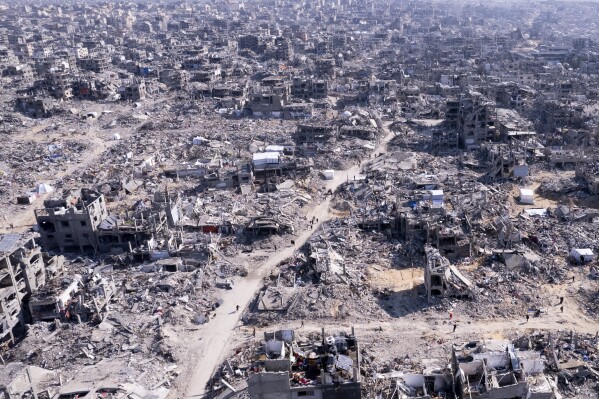
Fifteen months of Israeli bombardment have reduced buildings to rubble and ash, leaving large areas of Gaza uninhabitable. More than 47,400 Palestinians were killed during the Israeli assault, with 70 percent of the victims being women and children, according to Gaza’s Health Ministry.

Continue reading