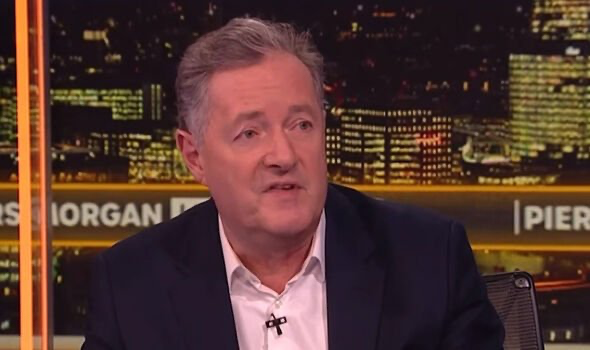
British broadcaster and journalist Piers Morgan said Israel’s killing of Palestinian civilians in Gaza, including women and children, could be justified as a “moral right.”
In an interview this week with journalist Tucker Carlson on a rooftop in Saudi Arabia’s capital, Morgan discussed several topics, including the Israeli assault in Gaza and whether the U.S. should be funding it.
Carlson condemned Israel’s bombardment of civilians for over a year, which Morgan questioned as he said such bombing ‘wasn’t evil.’
Carlson said: ‘If you’re intentionally killing civilians, you probably shouldn’t beat your chest and brag about it… maybe you can make the case that you had to do it, but you should weep.’
‘Is it evil though?’ Morgan responded, to which Carlson argued: ‘To kill civilians on purpose? I think it is. Kids and children? Yeah.’
Morgan said he could see there being a ‘moral right’ to civilian deaths in wartime, saying: ‘If there is a world war that threatens the entire world, yes.’
When Carlson called his view ‘disgusting’, he walked back and said it could be justified ‘in a pure defensive action’ as the two journalists sparred over the assault.
‘To intentionally kill noncombatants, women and children, I think we can say that’s wrong,’ he concluded.
The two journalists moved onto the issue of whether the US should continue funding Israel’s assault in Gaza, after former President Joe Biden sent at least $17.9 billion in military aid since the start of the Israeli genocide in October 2023.
After Carlson repeated his calls for the US to stop supplying aid to Ukraine in its conflict with Russia, Morgan questioned: ‘Why do you support Israel against Hamas? Why do you support giving them billions of dollars?’
‘I don’t,’ Carlson snapped back.
‘I support Israel in the sense that I really like Israel, I brought my family on vacation there… but (I support Israel) only to the extent that it helps the United States.’
Morgan said this was a hypocritical stance given his criticism of aid to Ukraine, saying his support merely ‘depends on which country’.
‘I don’t see a difference between (Israel’s bombing of Gaza) and what is happening in Ukraine,’ Morgan continued.
‘This is a long way away from America, there is no direct involvement with America or no mainland involvement, and yet you think it’s right that America supports Israel, but you don’t think it’s right that America supports Ukraine.’
Tucker Carlson condemns Ben Shapiro and calls Israel ‘evil’ for intentionally targeting and killing thousands of women and children in the Gaza genocide…
Piers Morgan in a shocking moment actually defends the intentional targeting of women and children and tries to justify it. pic.twitter.com/mUJ56jQ1jr
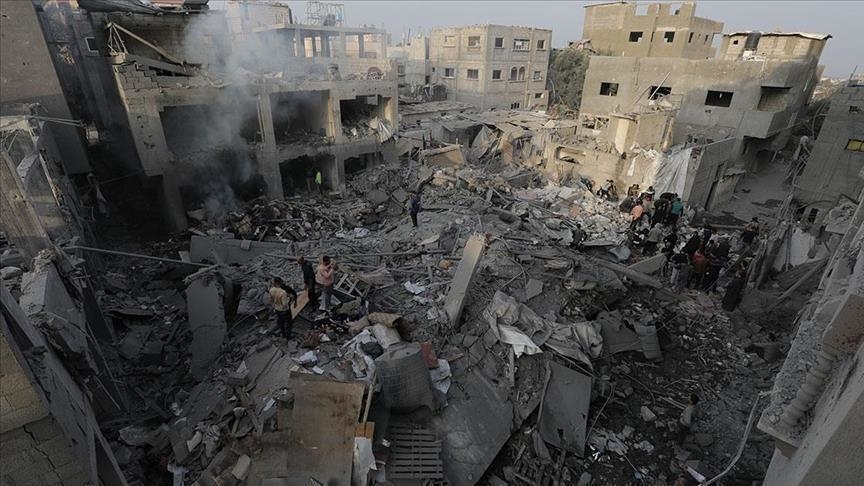
Fifteen months of Israeli bombardment have reduced buildings to rubble and ash, leaving large areas of Gaza uninhabitable. More than 47,400 Palestinians were killed during the Israeli assault, with 70 percent of the victims being women and children, according to Gaza’s Health Ministry.
US President Donald Trump, Saturday, proposed relocating Palestinians from Gaza to neighboring countries like Egypt and Jordan. This is an unusual proposal that was opposed by the former administration of Joe Biden.
Speaking to reporters aboard Air Force One towards Miami, the president said he raised the matter during a telephone call with King Abdullah II of Jordan, and he might talk with Egyptian President Abdel-Fattah al-Sisi on Sunday.
“I said to him (Jordan’s king) that I’d love you to take on more because I’m looking at the whole Gaza Strip right now and it’s a mess, it’s a real mess,” said Trump. “I’d like him (Jordan’s king) to take people”.
“I’d like Egypt to take people. I’m talking to Gen. Al Sisi tomorrow sometime I believe. I’d like Egypt to take people. And I’d like Jordan to take people,” Trump continued.
“You’re talking about a million and a half people, and we just clean out that whole thing. You know over the centuries it’s had many, many conflicts. And I don’t know, something has to happen,” he added.
Describing Gaza as “a demolition site,” the US president said: “Almost everything is demolished and people are dying there. So l’d rather get involved with some of the Arab nations and build housing at a different location where they can maybe live in peace for a change.”
He added that the move “could be temporary or could be long-term.”
The Biden administration opposed relocating Gaza residents outside the enclave, advocating a return of Gazans to their homes in the aftermath of a potential peace and a two-state solution.
Israel’s genocidal war has killed more than 47,000 Palestinians, most of them women and children, and injured over 111,000 since Oct. 7, 2023.
Since Jan. 19, a ceasefire is in place to bring respite to civilians in the Palestinian enclave, but Trump said last week he is not confident that the truce will hold.
“It’s not our war. It’s their war. I think they are very weakened on the other side,” Trump told reporters in the Oval Office. “I looked at a picture of Gaza. Gaza is like a massive demolition site. That place is. … It’s really got to be rebuilt in a different way,” he said.
“Gaza is interesting. It’s a phenomenal location on the sea, best weather, you know, everything’s good. It’s like some beautiful things could be done with it, but it’s very interesting, but some fantastic things could be done with Gaza,” Trump added according to Anadolu.
With the fall of the Assad regime, Syria has turned a new page, with the opposition forces now holding the reins of the country .
An 11-day-long opposition blitzkrieg forced Bashar al Assad to flee to Moscow, dealing a death blow to the regime after 13 years of the brutal war.
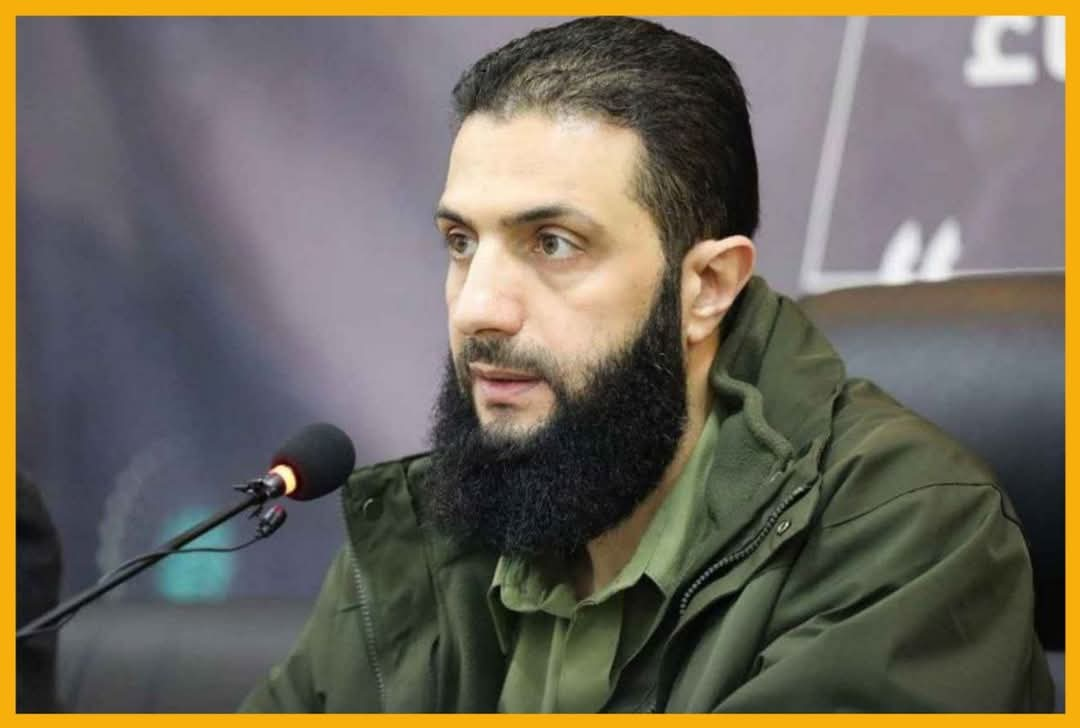
Though various revolutionary groups fought for this decisive moment, Hayat Tahrir al-Sham (HTS), which means Levant Liberation Committee, emerged as a dominant force under the leadership of Ahmed al Sharaa, also known by his nom de guerre Abu Mohammed al Jolani.
The US and its Western allies has designated the HTS as a terrorist organisation, putting a bounty of $10 million on his head, which was lifted recently.
But the 42-year-old Syrian leader has emerged as an indispensable force, wielding strong influence over the war-ravaged country. In late December, Sharaa met Turkish and Ukrainian foreign ministers as well as top diplomats from the US and the UK, signalling that he is the de facto leader of the new Syria.
Sharaa had a joint press conference with Turkish Foreign Minister Hakan Fidan, during which the top Turkish diplomat “thanked” the Syrian leader for his “friendly” welcome to the country.
“I saw that he (Sharaa) and his friends had very clear ideas about the establishment and transition process of the new system,” said Fidan, referring to the transition process from the Assad regime rule to the new government.
Fidan and Sharaa also sat down for a tea stop in Damascus’s famous Mount Qasioun, which overlooks the capital. Mount Qasioun is believed to be the site of legendary events, such as the Biblical and Quranic figure Abel’s murder by Cain.
From a fighter in battle fatigues to a statesman in a Western suit and a trimmed beard, Sharaa’s transformation reflects the changes in the country since the fall of the Assad regime.
Since the beginning of the 11-day lightning offensive against the Assad regime, Sharaa has given several interviews and statements from CNN to Saudi state-owned Al Arabiya TV, reflecting a fair degree of moderation in his worldview.
He has pledged to ease sectarian tensions and rebuild the country along the margins of justice and equality. The HTS leader also sent a message to the Western camp saying that “your interests are understood in the new Syria.”
He suggested working with Russia, an ally of the Assad regime, and sent a conciliatory message to Iran, in which he offered to develop a positive relationship even though Tehran fiercely backed Bashar al Assad in the past.
“This new triumph, my brothers, marks a new chapter in the history of the region, a history fraught with dangers (that left) Syria as a playground for Iranian ambitions, spreading sectarianism, stirring corruption,” he said, during one of his first speeches after the overthrow of the Assad regime in Damascus’s Umayyad Mosque, one of the most decorated and oldest Muslim religious structures.
In his latest interview,Sharaa suggested that elections and drafting a new constitution replacing the current Baathist charter will take several years due to the fact that the civil war has led to a large displacement and a lot of disruption in many public services.
A moderate leader?
The Biden administration has also signalled that depending on Sharaa’s path, Washington might consider removing the HTS from the US terror list.
“We have taken note of statements by the leaders of these rebel groups in recent days, and they’re saying the right things now, but as they take on greater responsibility, we will assess not just their word, but their actions,” Biden said on Dec. 8.
In a recent interview, Sharaa urged the Western leadership to lift sanctions because they were “issued based on the crimes” of the Assad regime, which is gone after the opposition victory. As a result, “these sanctions should be removed automatically”, he said.
Not only the US but also regional powerhouses like Türkiye, which has backed the opposition’s democratic aspirations against the Assad regime, also closely watching Sharaa and the new Syrian administration’s ongoing policies.
With an overwhelming majority of Syrians having lost so many loved ones in the brutal war, they are now hoping for a long-lasting peace and a life with dignity and honour.
“I have an advice for him (Sharaa/Jolani), I hope he is smart enough to know it by himself: don’t even try to be the new Assad. The Syrians who did a revolution against Assad, can do it again easily against you as well,” says Omar Alhariri, a Daraa-based Syrian journalist.
“We are looking for the future, being a good part of it. We are waiting for justice,” Alhariri tells TRT World, adding that Sharaa should lead a process in which “Syrians themselves should choose their leaders” in a democratic process.
Sharaa has recently shown his openness to a democratic order, saying the HTS and its armed allies intend to form a “council chosen by the people” and a state operating through institutions.
In March, however, he faced large protests in his previous stronghold Idlib, where protesters accused him of corruption and suppression. It remains to be seen whether his moderate rhetoric will match his future actions.
What is his background?
Born in Saudi Arabia to Syrian parents who are from the Israel-occupied Golan Heights, Sharaa grew up hearing the stories of his family’s displacement.
During the infamous Arab-Israeli War of 1967, Israel occupied the Golan Heights, rendering its inhabitants, including Sharaa’s family, homeless.
Assad’s ouster under the leadership of Sharaa is, in a way, life coming full circle. His father Hussein al-Sharaa was a pan-Arab nationalist, who was imprisoned in the 1970s by Bashar al Assad’s father Hafez al Assad. After his release, Sharaa’s father sought asylum in Saudi Arabia where he worked as an oil engineer.
In 1989, when he was seven-years-old, the Sharaa family returned to Syria’s Damascus. The young Sharaa pursued journalism, studying media.
In the 2000s, the Second Intifada left indelible marks on Sharaa’s life. While his father had cultivated strong ties with the Palestinian armed groups affiliated to the Palestine Liberation Organization (PLO), the young Sharaa established contacts with radical groups like Al Qaeda.
“I started thinking about how I could fulfil my duties, defending a people who are oppressed by occupiers and invaders,” he said during an interview with Frontline in 2021, referring to the Palestinian resistance against Israel.
In the preceding months of the US invasion of Iraq in 2003, he joined the Al Qaeda ranks, fighting against the American occupation.
By the mid-2000s, he was imprisoned by US authorities in Iraq and subjected to difficult conditions in America’s notorious dark sites for at least five years. On his release in 2011, Sharaa stepped into a different world.
The Arab Uprisings were spreading across the Middle East, reaching Syria too. Sharaa quickly joined hands with the anti-regime forces, launching another battle against the Bashar al Assad’s rule in Syria.
Toward being a top operative
After his move to Syria, Sharaa formed Jabhat al Nusra, the Syrian wing of Al Qaeda. In 2013, when Daesh wanted to annex Syria and merge it with the parts it had captured in Iraq, Sharaa rebelled, triggering a fight between the two groups.
While Daesh lost control across both Syria and Iraq thanks to an American-led coalition interference, Sharaa’s Nusra Front survived, partly due to its anti-Daesh stance.
In 2016, Sharaa rebranded his group Jabhat Fateh al-Sham (Front for the Conquest of Syria), indicating that the new structure has its own agenda, straining its ties with Al Qaeda. The next year, he once again changed the group’s name to its current format, publicly saying that the HTS has no connections with al Qaeda.
In the last seven years, Sharaa’s HTS has focused on Syria, increasing its hold over the Idlib province, which was the last opposition stronghold in the country prior to November 27, when the 11-day offensive against the Assad regime began.
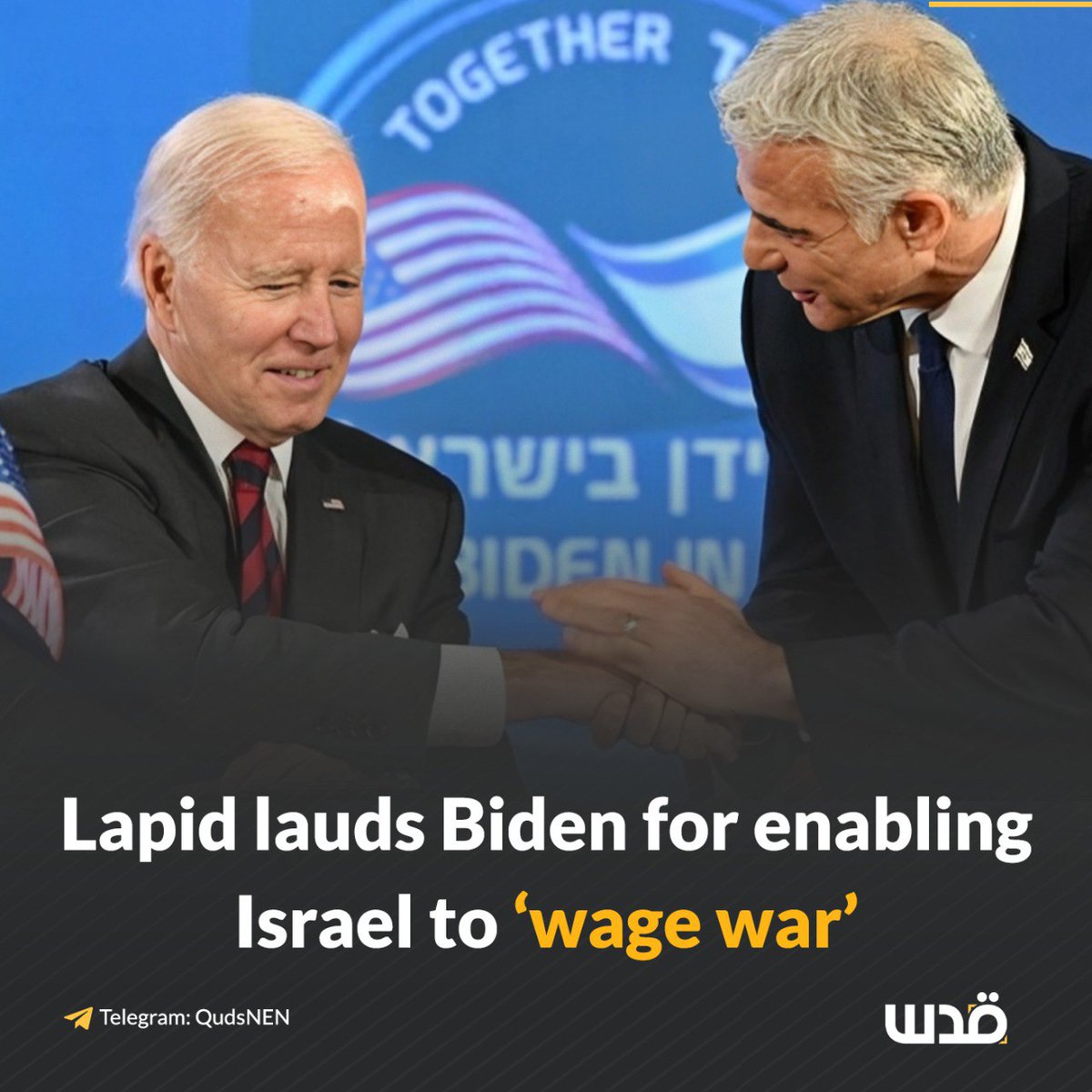
Israeli opposition leader Yair Lapid thanked the Biden administration for allowing Israel to wage a war on Gaza, supporting Israel with ammunition during the past 15 months. His post on X comes after Biden provided $8bn boost in military aid to Israel as a genocide is under way in Gaza.
A further $8 billion to pulverise Palestinians into the dust of the stinking rubble the billions already sent have created. This is what the American empire will be remembered for long after the footling Biden & Blinken are gone.
In the midst of the Spanish Civil War, some time in 1937, fascist dictator Francisco Franco’s regime bombed the Basque town of Guernica, with the help of Germany and Italy. In less than four hours, and after bombs weighing a total of 22 tons were dropped on it, the town was completely destroyed.
Hundreds were killed in the bombardment, which shocked the entire world and became a symbol of the cruelty of those times. Guernica was immolated in the fire of fascistic propaganda and in historical memory it is testimony to the fragility of justice during war. Pablo Picasso’s famous masterpiece, “Guernica,” has become a symbol of the destruction and horror of war.
In the bombing of Guernica, no pilot refused to obey orders. They flew – and carried out their job as dictated. Obedient soldiers. Eighty-seven years later, it is the same old song. No Israeli pilot has stood up and said “No.” “This is the limit.”
The bombardments in the Gaza Strip have hit and damaged hospitals, schools, kindergartens, mosques and churches, bakeries, public buildings and entire neighborhoods – leaving behind tragedies too numerous to elaborate – and not a single pilot has said “No.”
The pilots, who in their private lives are apparently considered by themselves and their surroundings moral men of integrity and values, sons of parents, fathers of children, good friends to their buddies – have made themselves a major part of the well-oiled killing machine that knows no mercy. Or limits.
During the past 14 months, and after multiple Guernicas in Gaza – human morality is facing yet another test. Since the war began, tens of thousands of children, women and men have lost their lives, and entire towns – like Beit Hanoun, Beit Lahia and Jabalya – have been wiped off the face of the earth in bombings by the IDF.
Cities comparable in population size to Herzliya and Dimona have been bombed into rubble. And the world, with its silence and its armaments and materiel support, is supporting this. The media in Israel wobbles between total denial and depicting the actions as heroic, justified, essential deeds.
How can a pilot be proud of this? How does he sleep at night? Killing 17,000 children and wounding about 100,000. Killing masses of civilians is not “self defense” even in the face of the horrors of the killing of dozens of children alongside hundreds of other civilians in the Gaza border communities.
Jabalia refugee camp in northern Gaza has become a “ghost town” due to Israel’s ongoing attacks, with 70% of the camp’s buildings completely destroyed, according to Israeli newspaper Haaretz.
Haaretz stated in a report on Sunday that “none of the army’s other military operations… pic.twitter.com/sRtxFG9GTL
We have arrived at an absurd rule: Nothing justifies October 7 – but in the name of October 7 everything is justifiable. There is no security justification for such massive bombing. No military action can justify bombing helpless human beings, or the eradication of Beit Lahia, Beit Hanoun and Jabalya from the face of the earth. This ethnic cleansing is reminiscent of the ethnic cleansing of 530 villages in 1948.
In the Israel of 2024, after 14 months of nearly constant bombardment, day and night – the voice of refusal has gone silent and is unheard. In the Jewish Israeli public, voices of protest and resistance are hardly audible.
The planes thunder and morality is silenced – and there are even those who are demanding yet more bombing and even more destruction. The few who refused to be conscripted this year – for example, Ido Ilam – and kudos to him for that – can be counted on the fingers of one hand, and the letters of refusal and resistance actions on the fingers of two, but no more than that.
Conscientious objection is entirely a personal gesture: It is a political act of resistance to the system. It is a refusal to commit war crimes in the name and for the sake of the system, a refusal to be part of a process of destruction and ruin. A refusal to kill. A refusal to steal. To destroy. To burn down a home. To rob. To deprive. And to ruin. But refusal only because of a judiciary reform is not enough.
Without refusal to take part wholesale military destruction, human society sinks ever deeper into its moral darkness, which has no limits.
“The West,” which for years fought for the values of democracy and human rights, is choosing to turn a blind eye to the horrors of Gaza. Under cover of “the right to self-defense” – as though Israel were not a regional military superpower and lacked might and means – the West is allowing it almost unlimited freedom of action and giving it a green light to destroy Gaza and deepen the occupation of the Syrian Golan Heights.
The ethnic cleansing taking place before our very eyes, and which is being broadcast live on social media, is made possible under the auspices of the Western countries that are enlightened only in their own eyes.
And the administration of the Democrats in the United States, led by President Joe Biden and Secretary of State Antony Blinken, will be remembered forever in disgrace, alongside Prime Minister Benjamin Netanyahu, as the destroyers of Gaza, perpetrators of ethnic cleansing and mass murder of women and children.
What will they say about this a few decades hence? What will you tell your children? Your grandchildren?
Ultimately, every individual’s morality – including a pilot’s morality – is measured by his deeds. What he agrees to do and what he refuses to do. Are you prepared to press the button that will kill scores of children? That will burn to death three generations of a single family? Can you look in the mirror after you have bombed an entire neighborhood?
Do you love the person the mirror reflects back to you in the morning? Gaza, like Guernica, did not ask to be a moral test and a symbol of the human cruelty of these times. Above all, it is a place, a home to millions of people – men, women and children – who want to live outside the walls of the biggest prison in the world. A prison that has become the biggest graveyard in the world.
Gaza, like Guernica, reminds us how important it is to resist and refuse to participate in injustice – loudly and clearly, even at a steep personal price. Where there is resistance, there is hope, and where there is hope there is a future for all of us.
Dr Ahmad Al Tibi is a Palestinian-Israeli politician and has been a member of the Knesset since 1999. This opinion was reproduced from the Israeli Haaretz.

 CrossFireArabia