Israel Fears Hamas Ambushes in Gaza

The Palestinian resistance has begun to translate into reality the warnings issued by the Israeli occupation army, a few days ago, of the possible escalation of operations against its forces inside the Gaza Strip, according to military expert Major-General Fayez al-Duwairi.

Al-Duwairi explained on Al Jazeera the military operations in al-Tuffah area, east of Gaza City, the “Breaking the Sword” ambush east of Beit Hanoun, followed by another ambush in the same location falls within the context of these warnings.

He said the resistance is still able to survive because of the method of battle it is waging and adapting to the movements of the Israeli army. He noted the resistance forces “are not operationally offensive, but rather tactically offensive…”

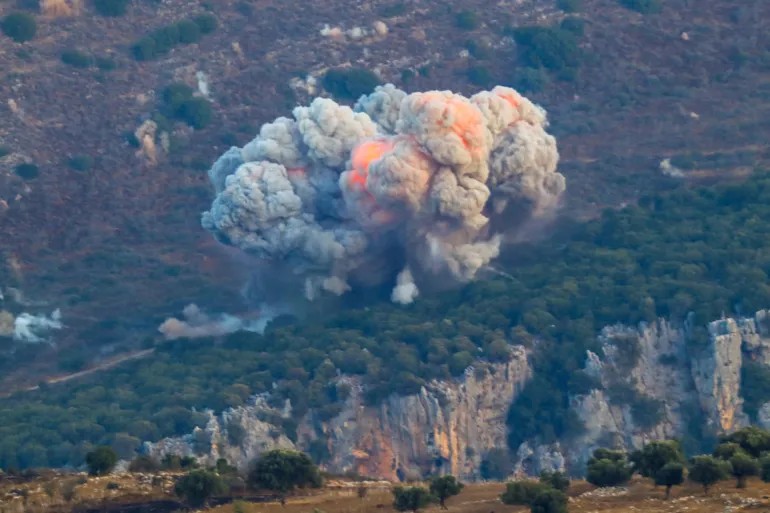
Al-Duwairi’s statement comes after the Hamas al-Qassam Brigades, announced, Sunday, it detonated an anti-personnel bomb targeting a number of Israeli soldiers, confirming they were killed and wounded east of the al-Tuffah neighborhood.

As the Qassam Brigades announced the targeting of an Israeli Merkava 4 tank with an Al-Yassin 105 missile east of Tuffah, the Al-Quds Brigades of Islamic Jihad targeted a military barracks and a number of Israeli soldiers in a house with a guided missile.

The military expert emphasized the resistance factions maintain a high level of preparedness, “albeit varying from one battalion to another,” in his comment on the intensification of operations against the Israeli army.

According to Al-Duwairi, the new Israeli Chief of Staff Eyal Zamir came up with exaggerated expectations and an approximation of “zero losses,” based on the deployment of forces in the buffer zone and then a cautious and gradual advance under intense fire.

But, the resistance began targeting Israeli forces and vehicles with ambushes and anti-personnel and anti-tank missiles as the Israeli army began to deepen its incursion into built-up areas and their rubble.

A few days ago, the Israeli Walla news website quoted military sources as saying the Israeli army reinforced its defenses at its military positions in the area.

According to these sources, the army warns of a possible escalation of Hamas operations against its forces, as the movement’s militants are expected to launch guerrilla-style operations.

The Israeli army estimates, according to Walla, that Hamas is likely to launch targeted sniper attacks, ambushes, and other complex operations.

Continue reading
‘Not A Single Mosque Remains Standing’

Not a single historic mosque in Gaza remains untouched following months of relentless Israeli bombardment, according to British archaeologist Claudine Dauphin.

“Every historic mosque in Gaza has been either partially or completely destroyed,” said Dauphin, who is affiliated with several archaeological missions in the region.

Among the most significant losses are the Omari Mosque and the KatibWilaya Mosque, both located in the Zaytun quarter of Gaza’s Old City. The KatibWilaya Mosque was originally constructed with funding from Ahmad Bey, the province’s chief secretary (katibwilaya) in 1586 during the Ottoman period. 

Its minaret once stood beside the bell tower of the Church of St. Procopius, symbolizing centuries of Muslim-Christian coexistence in Gaza—a connection also evident in the mosaic floors of the nearby Jabaliya Church.

“In the Shuja’iyya quarter, the Mamluk-era Zafardamri Mosque, built in 1360, was deliberately leveled in an airstrike,” Dauphin added. “The Mahkama Mosque, also Mamluk in origin, was similarly destroyed during the 2014 assault and again in the current offensive.”

The destruction extended beyond Mamluk and Ottoman heritage. The Othman Bin Qashqar Mosque was struck during an air raid in December 2023, and the Sayyid Hashim Mosque, built in Ottoman style and covering 2,400 square meters, was razed in the Daraj quarter.

Shrines, too, have been systematically targeted. The shrine of the Prophet Yusuf near Jabaliya, destroyed in 2014, was followed by widespread losses since October 2023. 

Among the shrines destroyed are the Al Husseini, Abu Al Azim, Ali Abu Al Kass, and Ali ibn Marwan shrines in Gaza City, as well as the Sheikh ‘Ali Al Mintar and Shaykh Radwan shrines on Tel Al-Mintar. Numerous other maqamat (shrines) in Al Shaykh ‘Ajlun were also obliterated.

Of special cultural and interfaith significance was the shrine of Al Khidr in Rafah, which held particular meaning for Christians who believed it housed the tomb of St. Hilarion, founder of Palestinian monasticism.

Modern mosques, built after the Ottoman period, were not spared. According to a January 2024 report by the Palestinian Ministry of Awqaf and Religious Affairs, at least 1,000 of the 1,200 modern mosques in the Gaza Strip have been partially or entirely destroyed.

“Among the losses in Gaza City are the Ali Ibn Marwan, Shaikh Zakaria, Al Mughrabi, and Sett Ruqayya mosques,” Dauphin noted.

Cultural and educational institutions were also hit. The Al Kamiliya Madrasa, built in 1237 by Ayyubid Sultan Al Kamil and featuring a central courtyard and two floors, was the last historic madrasa still standing in Gaza before it was destroyed. It had served both as a Quranic school and a shelter for poor students and travelers until 1930.

Cemeteries have not been spared either. At least 16 Muslim cemeteries across the Gaza Strip have been damaged or destroyed since October 2023. Among them is the Beit Hanoun Cemetery near Khan Yunis, which was reportedly excavated by Israeli forces. 

The Israeli military claimed they were searching for a Hamas tunnel or hostages, but provided no evidence, and independent verification of the alleged tunnel has not been possible.

“These sacred spaces, mosques, shrines, schools, and cemeteries, are not only part of Gaza’s cultural fabric,” Dauphin said. “Their destruction represents a profound loss of historical heritage, not just for Palestinians but for humanity.”

This report was written by Saeb Al Rawashdeh for The Jordan Times

Continue reading
‘Zionism a Mistake’ – Israeli Historian Tom Segev

Tom Segev, one of Israel’s most renowned historians, has broken a decades-long silence. On his 80th birthday, he declared that Zionism—Israel’s founding ideology—was a mistake.

In a deeply personal interview with Haaretz, Segev said, “Zionism is not such a great success story. It also doesn’t provide security to Jews. It’s safer for Jews to live outside Israel.” He added that Zionism created myths instead of solutions.

Born in Jerusalem in 1945 to Jewish German parents who fled the Nazis, Segev has spent more than 50 years researching Israel’s history. His books include 1967, The Seventh Million, and Soldiers of Evil, all known for challenging Israeli narratives.

In the interview, Segev shared a painful truth about his father’s death. He grew up believing his father was killed by an Arab sniper during the 1948 war. “I was able to say that he was killed during the War of Independence and that I was a war orphan.”

But later, Segev’s sister revealed a different story. Their father had actually died in a freak accident—falling from a drainpipe while trying to deliver coffee to guards. He stated that he was brought up on a lie.

This moment of reckoning made him question everything—including the stories Israel tells about itself.

Segev now says the Zionist project was never meant for people like his parents. “My parents started to plan their return to Germany”, he revealed. “They were never Zionists and they wanted to go home. A month after the last letter my father wrote to a friend about how much he wanted to go back – he was killed.”

Despite growing up in Israel, Segev never fully embraced Zionist ideals. He stressed that much of what Israelis were told was myth.

In his academic work, Segev often turns to documents rather than oral testimonies. He famously challenged former Prime Minister David Ben-Gurion in a 1968 interview, questioning the idea that Ben-Gurion became Zionist at age three.

Segev believes the Holocaust has been politically weaponized. In The Seventh Million, he argued that instead of teaching democracy and human rights, Israel used the Holocaust to fuel fear and justify wars.

He also criticized internal discrimination within Israeli society. In his book 1949: The First Israelis, Segev exposed how Jewish colonial settlers from Arab countries were pushed into camps, while Europeans were given hotels.

Segev insists he isn’t ideological. “People have also said I am anti-Zionist, but I am not an ideologue and not a philosopher, and I don’t think in terms of ideologies,” he says. “It was said that I want to shatter myths. But that’s not true, either. I was not part of the ‘New Historians’ but rather of the ‘First Historians.’ With respect to the state’s establishment there was no history here – just mythology and a great deal of indoctrination. In the 1980s we opened documents in the archives and said, ‘Wow, this isn’t what we were taught in school.’”

“We need to remember that the majority of the Holocaust survivors did not come to live in Israel and that the majority of Jews in the world are not coming to Israel”, he stressed. “They can, but they don’t want to live in this country. So Zionism is not such a great success story. It also doesn’t provide security to Jews. It’s safer for Jews to live outside Israel,” as reported in the Quds News Network.

Continue reading
Analysts: US Fails on Houthis After Six Weeks of Bombing

After nearly six weeks of intensive US airstrikes on different areas and cities of Yemen the Houthi Ansar Allah continues to assert that its military operations in the Red Sea and against Israeli targets will not stop until the ongoing Israeli war on the Gaza Strip ends.

Houthi military spokesman Yahya Saree, Saturday, announced the targeting of the Israeli Nevatim Air Base in the Negev with a ballistic missile, as well as two other sites in the Tel Aviv and Ashkelon areas and the targeting of warships on the US aircraft carrier SS Harry Truman in the northern Red Sea are just part of the continuing ongoing military strikes.

However in response to these attacks the US aircraft launched two airstrikes last Friday night on the Ras Isa oil port in the coastal province of Al Hudaydah, which Washington considers a major source of fuel used to finance the Ansar Allah group’s activities.

According to Dr Liqaa Makki, senior researcher at the Al Jazeera Center for Studies, the USA has failed miserably in its strikes against the Houthis because of its inability to move to the second phase. He said that as a result they are  discussing an alternative scenario for this military campaign against the Houthis.

Makki believes that US President Donald Trump has reached a dead end, and that the ceiling he set regarding the Houthis is proven unrealistic, pointing out the United States, despite its military strength, is failing in Yemen because it is fighting a group, not a state.

On the other hand, military and strategic expert Brigadier-General Elias Hanna, believes that both sides are losing, whilst the image of the United States is being damaged, given the scale of the US military campaign and Trump’s engagement with the Houthis, who previously declared that  “we [US] will withdraw from all the world’s wars.”

Reports estimate the cost of the airstrikes carried out by the US military on Houthi positions amounted to approximately $1 billion in the first three weeks of the military campaign alone.

The Associated Press reported the value of the seven downed American drones made by the Houthis exceed $200 million, and the continued loss of American drones makes it difficult for the US leadership to accurately determine the extent of the damage to the Houthis’ weapons stockpiles.

Brigadier-General Hanna said that Washington lacks a comprehensive strategy in its dealings with the Houthis, and that the political goal it announced—restoring deterrence and opening shipping lanes—has not been achieved.

He also pointed out the US military is targeting the centers of gravity within the Houthi military system to disrupt it, a strategy Israel has used with the Palestinian resistance but has failed to achieve.

Appeasing the Houthis

In light of Washington’s inability to achieve its goals against the Houthis, Brigadier-General Hanna believes the pressure being exerted on Israeli Prime Minister Benjamin Netanyahu regarding the entry of aid into the Gaza Strip is part of an effort to appease the Houthis so that they will halt their operations in the Red Sea and against Israeli targets.

Trump’s upcoming visit to the region also requires a de-escalation. According to the military and strategic expert, the US president cannot arrive while the Houthis are launching missiles.

In the same context, the senior Al Jazeera’s Makki expects  that a Gaza ceasefire will soon be reached before Trump’s visit, allowing the Houthis to halt their operations as they have initially linked the cessation of their operations to an end to the war on Gaza and to the cessation of US strikes against them.

American officials have previously revealed to CNN that the US military has struck more than 700 Houthi targets and carried out 300 airstrikes since the campaign began in mid-March, “forcing them underground and creating confusion and chaos within their ranks.”

Continue reading