Katz: UN Secretary-General Persona Non Grata, Banned From Israel

Israel has made it clear countless of times that it doesn’t like the United Nations for speaking the truth on Palestine.

This time Israeli Foreign Minister Yisrael Katz declared, Wednesday, UN Secretary General Antonio Guterres a not “wanted person in Israel”, and banned him from entering the country. Why? Katz is now claiming Guterres has not “clearly” condemned the Iranian missile attack on Israel, Tuesday night.

In an Israeli Foreign Ministry statement Katz said “anyone who cannot unequivocally condemn the Iranian criminal attack on Israel is not fit to set foot on Israeli soil.”

Katz goes further saying “this Secretary General who hates Israel, who provides support to terrorists, rapists and murderers, will remain in memory as a disgrace in the history of the United Nations,” according to Al Jazeera.

Katz’s decision was based on the fact as he claims the UN Secretary-General “did not mention the name of Iran and did not condemn it in any way, and did not categorically condemn its dangerous aggression.”

Katz also alleged that Guterres’s comment on the Iranian attack is part of his “continuation of his anti-Israel policy since the beginning of the war”, stressing the UN Secretary-General did not make any initiatives to “declare Hamas, Hezbollah and the Houthis terrorist organizations”.

Tuesday evening Iran fired about 180 ballistic missiles at Israel, causing human casualties and material damage and closing the airspace, while millions of Israelis rushed to underground shelters as sirens blasted all over Israel.

Continue reading
‘Crushing Attack’

Israeli media sources reported on Tuesday evening, citing military sources, that Israel “will respond strongly” to the Iranian attack on multiple Israeli military targets. Iran’s Islamic Revolutionary Guard Corps (IRGC) further vowed that Israel will face “crushing” attacks if it responds to the missile barrage.

Earlier Tuesday, Iran launched dozens of ballistic missiles against Israeli important security and military targets, stating that, “the operation was based on a decision from the Supreme National Security Council and with the support of the army.”

Continue reading
‘Fleeing My Home Under Airstrikes and Fire’

Maryam Srour, a field communications manager for Médecins Sans Frontières (MSF) from Beirut, Lebanon, reported from a car as she fled, describing scenes of chaos in the southern suburbs of Beirut.

On Friday 27/09/2024, we heard and felt a huge series of blasts while we were in meetings at the office.

We wrapped up work and got stuck in heavy traffic. I had just relocated to a safer place since the bombing around Beirut and across the country intensified on Monday. When I reached my new home around 10 p.m., my relatives had already joined us – leaving their homes, thinking it would be safer where we were.

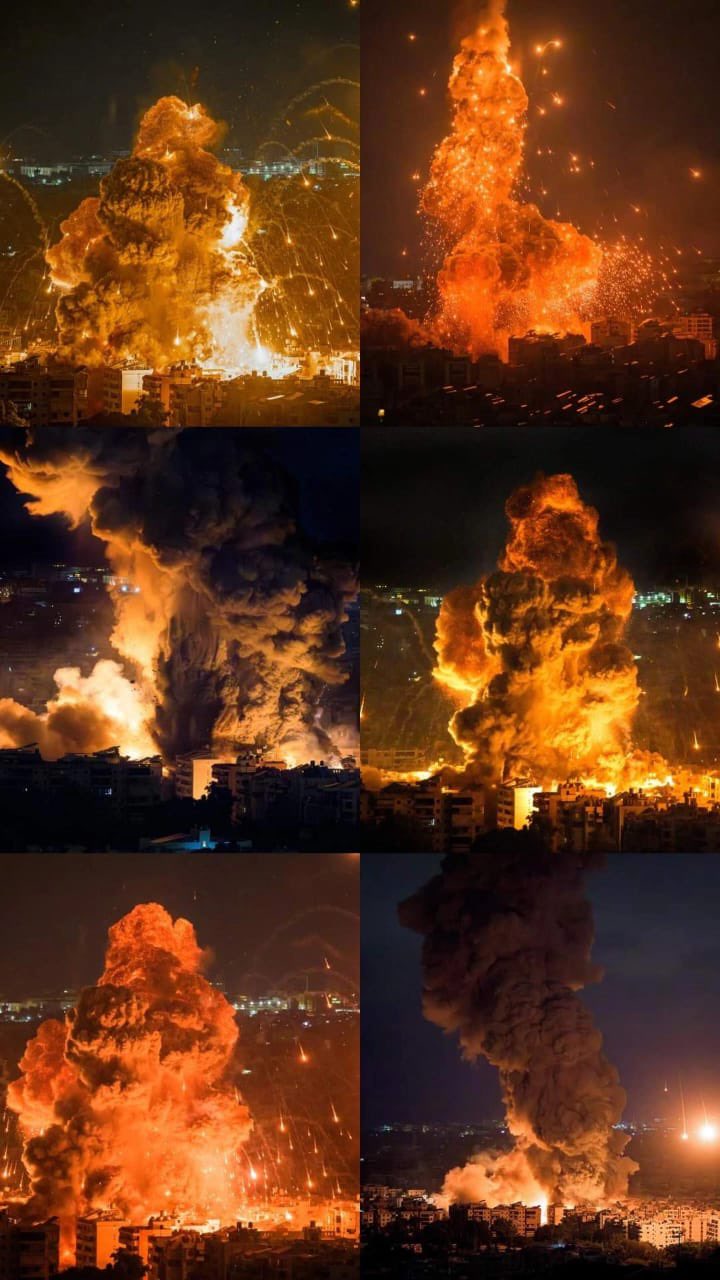
From my balcony, I saw dozens and dozens of people walking in the streets carrying what they could, plastic bags, backpacks, or nothing. People in the southern suburbs around ours had received evacuation orders from the Israeli armed forces. We saw people fleeing on foot, some walking with sticks, young and elderly. Some people were in cars. We were not in the neighborhood that was targeted but we heard drones and planes. We felt them close by.

Suddenly, there was darkness all around and bombing started everywhere. There was heavy smoke and people in the streets were coughing. I was with my mum, brother and sister, and trying to figure out what to do next. Are the roads safe? Where do we go?

I had just left my house in *Dahieh—* the southern suburb of Beirut—a few days ago because of the heavy bombardments and moved to this one. We thought we would be safer here. Now we had to leave again. I grabbed a bag of essential items I had at hand. We were told that it’s better to bring mattresses, so we stuffed two in our car and took a pack of water bottles. I didn’t know what to do. There were fires everywhere following the airstrikes, and I heard a huge blast. We heard, felt and saw the strikes. Our building was shaking. There was a huge blast in a place with no advance warning for evacuation.

Surrounded by fire and smoke, I was repeating to myself, “all we need is a plan and to take action, a plan and take action; do not wait here.” We just left the place as fast as we could. I don’t know what happened to my own house, or the new house. We kept calling around and drove for a couple of hours before we figured out where to go. Around 5 a.m, we found a place on the other side of the mountains.

We were very lucky that we left when we did because the fires after the airstrikes were still raging where we had been. We just needed a place to rest a little, to see where to go next, and we still haven’t slept.

Some people are still in cars. Now we’re watching the news and shocking footage of what is happening. I know that my colleagues, MSF teams, are in the field, supplying water by trucks to shelters and schools in Beirut and Mount Lebanon, where displaced families are staying. Some people are lying down on the sidewalks. MSF managed to provide 86,000 liters of water in 24 hours, and is also distributing kits containing basic hygiene and relief items, as well as mattresses to the displaced people.

Our mental health teams are on the streets providing psychological first aid to people who are traumatized and to people seeking refuge in schools. I am used to being a humanitarian worker, but now I am also a person displaced by air strikes in my own country. We are in a safe place, for now.

Reliefweb

Continue reading
90% of Iran’s Missiles Reached Their Targets in Israel

Iran’s defense minister says the Islamic Republic’s recent retaliatory operation against the Israeli regime, dubbed Operation True Promise II, has been more than 90% successful.

Brigadier General Aziz Nasirzadeh made the remarks, Wednesday, after Iran launched a barrage of long-range ballistic missiles towards the Israeli occupied territories, in response to the assassination of top resistance leaders, Sayyed Hassan Nasrallah and Ismail Haniyeh, and Abbas Nilforoushan, a senior IRGC commander, by the Zionist regime as reported by Iran’s Press TV.

“Operation True Promise II was carried out with more than 90% success and was fully in line with international law,” Nasirzadeh said.

Continue reading