Trump, Witkoff Need To Stop The Netanyahu Tune

By Michael Jansen

Israeli Prime Minister Benyamin Netanyahu has said, “There is no policy of starvation in Gaza, and there is no starvation in Gaza.” Israel has enabled “humanitarian aid throughout the duration of the war to enter Gaza – otherwise, there would be no Gazans.”

However, Gaza’s government media office told Al-Jazeera that only 674 aid trucks have entered Gaza since Israel eased restrictions on July 27, averaging just 84 laden trucks per day. This is only 14 per cent of needs as humanitarian organisations say at least 600 trucks of water, food, medicine and fuel are required at a minimum.

Echoing Netanyahu, US regional envoy Steve Wikoff proclaimed there is “no starvation” in Gaza after a brief visit to one of the aid delivery hubs in the Strip. “There is hardship but no starvation,” he said. His assessment appeared to contradict his boss Donald Trump who had said there is “real starvation.”

“Once we refute this Hamas claim, we can continue new actions to end the war and bring back all the hostages” held by Hamas, Witkoff said. He added that Trump believes piecemeal deals do not work and so a new arrangement is needed that would free the hostages all at once.

However, Witkoff argued that only Hamas “total surrender” and disarmament would be accepted. Writing in Haaretz daily on 2 August, Amir Tibon decries Netanyahu’s decision to carry on with the war, despite opposition from most Israelis and Israel’s foreign friends. “Israel’s military leadership admits today that the last five months have been a wasted effort, and that it would have been preferable for Israel to continue the January 2025 ceasefire, get the rest of the hostages out of Gaza in an agreement, and conclude the war.”

He is sharply critical of the Trump administration which “gave Netanyahu total backing for this disastrous policy, including his decision to block all aid from coming into Gaza, which caused the humanitarian crisis there. “Consequently, Witkoff’s latest visit has been met with popular Israeli “disappointment over the Trump administration’s failure to rein in Netanyahu and bring the Gaza war to an end.”

This means that there will be no quick fix under pressure from starvation even though Israelis held captive by Hamas are suffering the same lack of nourishment as their captors. The International Committee of the Red Cross has been asked to provide food for the captives but not the 2.3 million hungry Palestinians in Gaza.

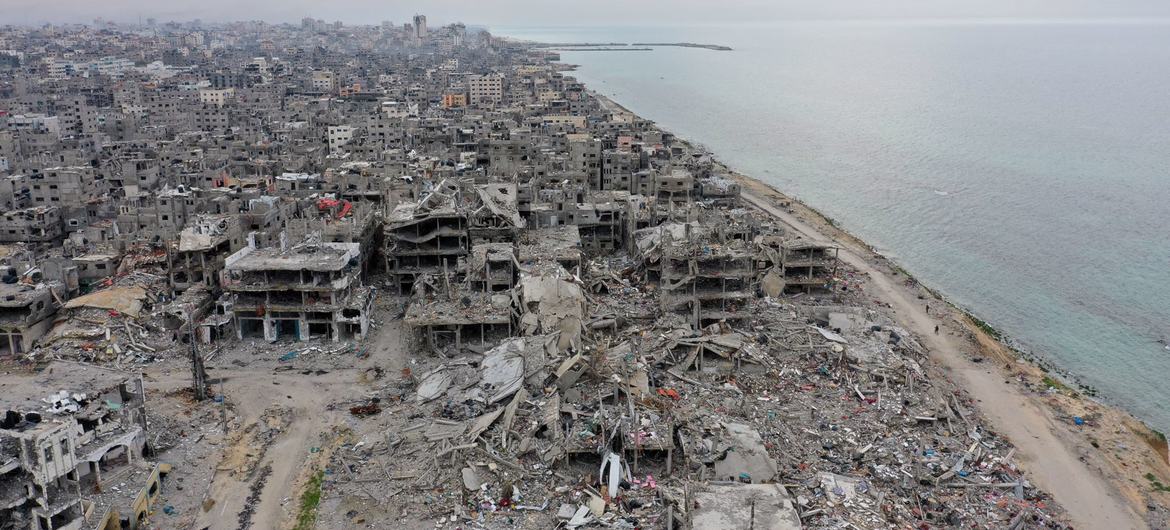
Witkoff has been contradicted by the UN-supported Integrated Food Security Phase Classification” (IPC) which has warned that “the worse-case scenario of famine” is unfolding as 60,000 Palestinians died from bombs and bullets and an untold toll, especially among children, is being gripped by hunger and malnourishment. IPC called for a ceasefire to avert further “catastrophic human suffering.” The total number of people who have died from hunger-related causes since the start of the war in October 2023 has risen to more than 181, including 94 children. This does not include the 1,400 who have been killed by Israeli army fire when trying to secure aid at the highly controversial US-Israel Gaza Humanitarian Foundation which has not alleviated starvation but given a false image of US and Israeli efforts to deliver food.

UN Secretary-General Antonio Guterres said the IPC alert “confirms what we have heard. The facts are in and they are undeniable. Palestinians in Gaza are enduring a humanitarian catastrophe of epic proportions. This is not a warning. It is a reality unfolding before our eyes.”

Australian Prime Minister Anthony Albanese declared it was “beyond comprehension” for Israel to claim starvation was not an issue in Gaza and accused Israel of breaching international law by blocking aid.

Netanyahu is personally responsible for torpedoing January’s ceasefire agreement which would have led to the release of Israeli captives in exchange for Palestinian prisoners, Israel military withdrawal from Gaza, and an end to the war. Instead on 2 March, he imposed the blockade and on 18 March, he resumed the war. Tibon summed up, “Netanyahu, for political reasons, chose to blow up the deal, restart the war, and bring us to where we are today: Our hostages are being starved and tortured, our soldiers are dying, and the entire world is turning against us due to the broader humanitarian catastrophe in Gaza.”

As the 15 August 20th anniversary approaches of the beginning of Israel’s withdrawal of settlers and soldiers from Gaza, 600 retired Israeli security officials have written to Trump to ask him to pressure Netanyahu to end the war. This group included former Mossad chief Tamir Pardo, former Shin Bet chief Ami Ayalon, former Prime Minister Ehud Barak, and former Defence Minister Moshe Yaalon.

Ayalon argued: “At first this war was a just war, a defensive war, but when we achieved all military objectives, this war ceased to be a just war…It is our professional judgement that Hamas no longer poses a strategic threat to Israel,” the officials stated. “Your credibility with the vast majority of Israelis augments your ability to steer [Netanyahu] and his government in the right direction: End the war, return the hostages, stop the suffering.”

On the political front, this policy has contributed to decisions by Britain, France, Canada and half a dozen other countries to recognize the state of Palestine during next month’s opening of the 80th UN General Assembly session. Although recognized by 147 of the 193 UN members, many Western countries have delayed recognition. The addition of Britain and France will mean four of the five permanent members of the UN Security Council (which includes China and Russia) will recognize Palestine while the US will remain the outlier as it is on any effort to criticize or rein in Israel.

Michael Jansen is a columnist for The Jordan Times

CrossFireArabia

CrossFireArabia
Dr. Marwan Asmar holds a PhD from Leeds University and is a freelance writer specializing on the Middle East. He has worked as a journalist since the early 1990s in Jordan and the Gulf countries, and been widely published, including at Albawaba, Gulf News, Al Ghad, World Press Review and others.

Related Posts

An Unholy War!

By Robert Stephen Ford

Presidents and popes have disputed wars in the past. Pope Paul VI criticized the American war in Vietnam, saying that America was losing its moral standing. Pope John Paul II called the American invasion of Iraq in 2003 unjust and illegal. However, the clash between US President Donald Trump and Pope Leo XIV, who are the two most influential Americans in the world, about the war against Iran is without precedent.

The rift that preceded the war

The relations between the Vatican and the Trump administration were difficult even before the Iran war. Before the appointment of Pope Leo, Pope Francis in 2025 criticized Donald Trump’s restrictions against immigration and the treatment of refugees and immigrants in American detention centers. In January 2026, three top Catholic Church leaders in the United States issued a report stating that American foreign policy was immoral. They pointed to reduced assistance to world health programs that have harmed tens of millions of people worldwide.

The American surprise attack on Iran on February 28 sharpened the dispute between the Vatican and the White House. The Trump administration portrays the war as a kind of holy crusade blessed by God. In his April 7 social media message threatening to destroy Iranian civilization, Trump exclaimed, “Glory to God!” while also saying that God ensured the success of the mission to rescue an American pilot whose plane was shot down over Iran. On March 26, US Defense Secretary Pete Hegseth told a press conference that military strikes against Iran enjoyed protection from God, and at a religious service in the Pentagon on April 1, he quoted from the Old Testament, asking God to “break the enemy’s teeth.”

The Pope responded on April 6 that Jesus called for peace and reconciliation, and he rejected politicians using God to justify war. His rebuke generated sharp counterattacks from Trump and some Republican Party leaders. Vice President JD Vance and Speaker of the House of Representatives Mike Johnson said the pope appeared not to understand the Catholic Church theory of just war. Several American bishops close to Pope Leo responded that it was ridiculous to suggest that the pope did not understand the theology and the theory of just war since Leo himself is from the branch of the Catholic Church founded by Augustine, the Christian thinker who, 1,600 years ago, first set down the principles of a just war. The surprise American attack in the middle of negotiations, the American failure to avoid striking civilian targets and the ambiguous American government goals of the Iran war did not meet the standards of a just war, they noted.

Politics dressed as theology

Trump and the Republicans are politicians, not theologians. They portray the war against Iran as holy because they understand that the war is unpopular in the United States and they need the support of Christian conservatives in their political base. Notably, most Catholics, who are about 20% of the American population, voted for Trump in 2024. Opinion polls since late March have shown that most Americans doubt the war is in America’s national interests. After Trump’s threat to destroy Iranian civilian infrastructure and civilization on April 6-7, the pope called the threats “unacceptable” and would violate international law. He even urged American citizens to contact their representatives in Congress to demand that the war stop. It was unprecedented for a pope to urge Americans to mobilize this way, and it directly touched a big part of the Republican Party base. Trump responded five days later with his social media message alleging that the pope appears to accept that Iran can have nuclear weapons and does not understand foreign policy. No American president had attacked a pope so personally. With economic damage from the Iran war and opinion polls indicating Democratic Party victories in the November congressional elections, the White House and Republicans are especially sensitive to criticisms towards their war policy.

The pope enjoys a big advantage over Trump in opinion polls in the United States, and Trump over the past four days has retreated a little. He said on April 16 that while he respected the pope’s right to say what he thinks, Trump insisted that he would continue to say and do what he thinks is right. The pope, meanwhile, said on April 18 that he did not want to debate the president. The pope’s role in the end is not to descend to politics but rather to stay on a high level focused on how people should live according to the principles of Christianity. This round of arguments has been winding down, but the Trump administration’s use of Biblical scripture and symbols to justify controversial policies will trigger new fights with the Catholic Church in the months ahead, especially if the war escalates.

The writer is a former US Ambassador to Algeria and Syria and contributed this article to Anadolu

Continue reading
Can Israel Create A Lebanese Buffer Zone?

By Imad Rizk

Since last Wednesday, the Israeli army has continued targeting the network of roads and bridges that link Lebanon to its south. In addition to pressuring the Lebanese government to make concessions in Lebanon and possibly beyond, the Israeli army claimed that targeting the Qasmiyeh bridge and other bridges is intended to prevent the transfer of military supplies to southern Lebanon. However, military experts questioned this justification, noting that Israeli aircraft maintain intense air dominance over the routes leading to the south, which undermines the credibility of this claim. Sources believe that targeting infrastructure, especially bridges and roads, aims to isolate the southern region in preparation for occupying it and turning it into a “buffer zone”.

After the 1982 invasion, Israel maintained a buffer zone in southern Lebanon for 15 years. It was meant to prevent attacks but instead created local resistance and required constant military presence, ending with a unilateral Israeli withdrawal in 2000.

Buffer zones as a military solution in the region were tested between 1985 and 2000. In the 2006 Lebanon War, Israel avoided re-occupying Lebanon, relying instead on air power and UN peacekeepers (United Nations Interim Force in Lebanon). Now, in 2026, Israel is returning to buffer zone thinking. Current discussions of a 10-15 km buffer zone show that Israel is returning to a doctrine it once abandoned as distancing itself from its enemy is more important than before.

Meanwhile, air raids continue to target the Lebanese capital, Beirut, and its southern suburbs. Residential areas and neighborhoods near Beirut and in the coastal city of Sidon are also being targeted under the pretext of assassinating figures and cadres linked to Iran’s Revolutionary Guard.

On the southern front, the Israeli army has been facing major difficulties in advancing and consolidating its positions since March 2. Hezbollah in Lebanon targeted Israeli troops at dozens of locations.

Ground combat tactics against the Israeli ground maneuver

Hezbollah carried out strikes against concentrations of soldiers and vehicles in different border villages. These attacks were carried out using rockets and artillery shells.

Operations extended beyond the border line, where Hezbollah support units targeted military positions and fixed barracks, as well as newly established sites in Jabal al-Bat and Nimer al-Jamal. Strikes also repeatedly hit the Avivim barracks, as well as Ramot Naftali, Branit, Hounin, Nahal Gershom base, and the Meron Air Surveillance Base.

Both Hezbollah and the Israeli army also carried out psychological and media operations associated with the ground maneuver, including threats, intimidation, low-altitude aircraft flights, and air raids conducted at night or at dawn. Settlers were also used in messaging to suggest that failure to negotiate would expose Lebanon to destruction similar to Gaza, or to incite Lebanese public opinion against a particular sectarian group and the environment that supports confrontation with Israel.

Overall assessment

In summary, the ongoing confrontation since March 2 reveals a gap between Israeli rhetoric and action. Despite statements about deploying three full military divisions, these forces rely heavily on air strikes to flush out Hezbollah fighters positioned inside villages and in the surrounding wooded terrain.

Hezbollah initially responded by targeting troop concentrations with rockets from outside the area south of the Litani River in the early days, and also struck D-9 bulldozers from areas far from the front line, while its special units advanced and seized forward positions. There was also discussion of advances along the Khiam-Marjayoun axis, with the understanding that the advance aimed to encircle the city of Nabatieh in the south and push through the Sahmar axis toward an unspecified town to reach Lake Qaraoun, similar to what Israel did on the Syrian front when it took control of the Yarmouk basin.

A notable development was the use of explosive drones similar to tactics used in Ukraine. On Friday, armed drones were used to strike a rear-area position on the Israeli side. This was considered the second major tactical surprise to enter the battlefield after the previous confrontation in 2024 during the “66-day battle.”

Israeli attacks on Iran and the entry of Iranian missiles targeting Israeli troop concentrations and fortifications around the town of Khiam suggest that the linkage of fronts — from southern Lebanon to Iraq and Iran — indicates that the Khatam al-Anbiya headquarters in Iran is directing a confrontation against Israeli destabilization and US military presence across a theater stretching from the eastern Mediterranean to the Gulf.

The author is the director of the Institute for Strategic and Communication Studies in Lebanon (Isticharia-ISCS). Anadolu

Continue reading

You Missed

Israeli Looters in Lebanon

  • By marwan
  • April 23, 2026
  • 11 views

Ayat, Qamar Bid Farwell to Their Martyr Dad

Ayat, Qamar Bid Farwell to Their Martyr Dad

‘We Killed Our Own Then Blamed Hamas’

‘We Killed Our Own Then Blamed Hamas’

An Unholy War!

An Unholy War!

‘Journalist Khalil Trapped Under Rubble Left to Die’

‘Journalist Khalil Trapped Under Rubble Left to Die’

Israel Kills 38,000 Women, Girls in Gaza

Israel Kills 38,000 Women, Girls in Gaza





