‘Stop Dehumanizing Us’ Palestinian Filmmakers Tell Hollywood

More than 65 Palestinian filmmakers signed a strongly-worded letter in which they accused Hollywood of “dehumanizing” Palestinians on screen over decades.

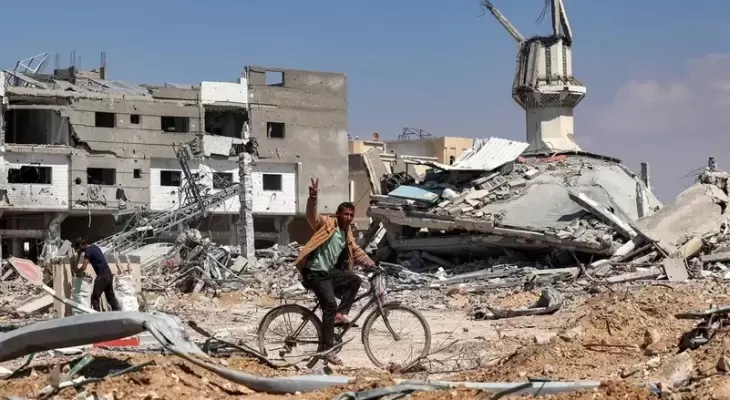
They added this has helped to enable the ongoing devastation in Gaza.

Two-time Oscar nominee Hany Abu Assad, acclaimed director Elia Suleiman, recent BAFTA winner Farah Nabulsi, multiple-award winners including Michel Khleifi, Mai Masri, Najwa Najjar, and the 22-strong list of directors behind the compilation of shorts “From Ground Zero,” Palestine‘s current submission to the Oscars — are among those who signed the letter, first reported by Variety on Wednesday.

The filmmakers have expressed outrage and what it described as the “inhumanity and racism shown by some in the Western entertainment industry towards our people, even during this most difficult of times.”

The letter marks the first collaborative initiative by Palestinian filmmakers since the start of the Israeli genocide war on Gaza soon after  7 October, 2023.

Despite its fierce criticism of Hollywood, the filmmakers in the letter thanked the National Academy of Television Arts and Sciences for “standing up to pressure and insisting on freedom of expression,” by refusing attempts to disqualify a Gaza-focused documentary from the 2024 Emmy nominations.

The Peabody Award-winning “It’s Bisan From Gaza and I’m Still Alive,” by Palestinian journalist, activist, and filmmaker Bisan Owda chronicling her family’s plight as they flee Israeli bombardment of their home, is nominated for the News and Documentary Emmys for Outstanding Hard News Feature Story: Short Form.

However, there were calls by a US-based pro-Israel group for the nomination to be rescinded, with a letter signed by the likes of Debra Messing, Sherry Lansing, Rick Rosen, and Haim Saba falsely accusing Owda of having ties to the Popular Front for the Liberation of Palestine (PFLP), a United States-designated terrorist group.

In response, NATAS president Adam Sharp said that Owda’s nomination would not be rescinded, writing in a letter that the organization had been “unable to corroborate these reports” of Owda’s alleged involvement and “found no grounds, to date, upon which to overturn the editorial judgment of the independent journalists who reviewed the material.”

“Trying to censor Bisan’s voice is only the latest repressive attempt to deny Palestinians the right to reclaim our narrative, share our history, and in this case bring attention to the atrocities our people are facing in the hopes that we can bring an end to them,” said the filmmakers.

“We well understand the power of image and cinema, and for far too long we have been outraged at the inhumanity and racism shown by some in the Western entertainment industry towards our people, even during this most difficult of times,” they added in the letter.

“Through our films, we have tried to present alternative narratives, depictions, and images to reverse the stereotypical, dehumanizing “worthless, disposable beings” image which enables the whitewashing and/or justification of the crimes perpetrated for decades against Palestinians. But why must we always put on our “boxing gloves” to defend our art against ruthless censorship that targets us merely on the basis of our identity, not our creativity?”

The filmmakers have called on “our international colleagues in the film industry, visionaries for the kind of world we would like to live in, to speak out against this genocide and the erasure, racism and censorship that enable it.”

They have also called their colleagues “to do everything humanly possible to stop and end complicity with this unspeakable horror; and to stand against working with production companies that are deeply complicit in dehumanizing Palestinians, or whitewashing and justifying Israel’s crimes against us,” according to the Quds News Network.

CrossFireArabia

CrossFireArabia
Dr. Marwan Asmar holds a PhD from Leeds University and is a freelance writer specializing on the Middle East. He has worked as a journalist since the early 1990s in Jordan and the Gulf countries, and been widely published, including at Albawaba, Gulf News, Al Ghad, World Press Review and others.

Related Posts

Beirut Weeps For a Poet

Lebanon mourns Khatoun Salma, a Lebanese national poet who was killed along with her husband in an Israeli airstrike that targeted their home in the Tallet al-Khayat neighborhood of Beirut Wednesday, 8 April.

Rasha al-Amir, publisher of Dar al-Jadeed, announced that the bodies of Khatoun and her husband were recovered from the rubble, Thursday morning.

Lebanese journalist Maha Salma also mourned her sister Khatoun on her Instagram account, writing: “My dear sister is in God’s care. May God grant me patience in the pain of her loss and the burning of my heart and soul.”

Poet and playwright Yahya Jaber wrote a tribute to Khatoun on Facebook, saying: “Yesterday, the Israeli airstrike cut down a poet with its sharp scissors, a poet of delicate Arabic.” Under the rubble, the conjunction “waw,” the plural “waw,” the feminine plural “nun,” the feminine suffix “ta,” the definite article “al-“: a massacre of language at the hands of language. Jaber attached a picture of the building where Khatoun lived to his post, saying:

“Here is the Khayat Hill building, and here on one of these balconies, we used to stay up late with Khatoun and her husband, Muhammad Karsht, in the late 198s, spinning yarns of laughter and sewing memories. We would recite poetry and remember our city, Tyre, and love Beirut, the capital.”

Lebanese poet Majida Dagher wrote on her Facebook page in mourning for Khatoun: “Under the rubble of her house in Khayat Hill, they found a poet lying among her shattered rhymes. The death of a poet in an airstrike on Beirut makes you feel that war is very, very close. The sound of bones breaking has become louder, and the smell of blood deeper.

Salma fell from the heights of poetry before she could bid farewell to ‘the last inhabitant of the moon.'” She thought Beirut was her tent, Beirut the roof of her poem, where she would hide, “embracing a woman waiting” for the dust to settle. But the dust became the tent of a new Beirut, a Beirut weeping, broken, martyred.

Salma, who studied Arabic literature at the American University of Beirut, published two collections of poetry, “I Embraced a Woman Waiting” in 2009 and “The Last Inhabitants of the Moon” in 2012, both with the Lebanese publishing house Dar Al-Jadeed. She first gained recognition in the 1970s, during her secondary school years, when she won a poetry prize. Later, at the beginning of this century, she became known in cultural circles for her relatively small but distinguished poetic output and her academic pursuits, which included studies in Sufism and Sufi mystics.

She combined profound knowledge with poetic sensitivity. She left her mark on the Lebanese cultural scene with a unique poetic voice, manifested in her literary works that carried the pain of humanity, exile, and memory. With her tragic passing, Lebanon loses a literary and human figure who wrote of the wound in a language that resembled nothing but truth.

Continue reading
Al Bahri: The Man Who Set Palestinian Theater

He is a playwright and author of 12 plays, nearly 20 novels, and numerous translations. Jamil Habib Afara (al-Bahri) was known as the “Father of Theater.” He was born in 1895 in Haifa and his family name dates back to the mid-18th century, as his ancestor owned a merchant fleet that sailed the Mediterranean between Haifa, Acre, and Tripoli. This is where his family name originated.

He showed early interest in literature and writing. He and his brother, Hanna, were keen to revitalize the literary and intellectual scene in Haifa, establishing the National Library there in 1922. He first published the “Zahrat al-Jamil” (The Beautiful Flower) and later “al-Zahra” (The Flower) which was initially a weekly publication that later became a bi-weekly and continued publication for about nine months after his death in 1931. His last piece was

a journalistic investigation into the execution of the three martyrs: Muhammad Jamjoum, Fuad Hijazi, and Ata al-Zeer, in the city of Acre in 1930. He dedicated his time and his newspaper that day to the souls of these martyrs, leading with: “The terrible hour in Haifa and all of Palestine: Let us commemorate those who gave their lives for the homeland.” A large funeral was held for him, and poems and eulogies were recited and published in the Palestinian press, such as the “Al-Karmel” and “Falastin,” newspapers.

The Department of Culture of the Palestine Liberation Organization posthumously awarded him the Jerusalem Medal for Culture and Arts in 1990, and the Palestinian Ministry of Culture reprinted his first book, “The History of Haifa,” in 2022.

Continue reading

You Missed

Trump: Tunes, Ceasefire and Hormuz

Trump: Tunes, Ceasefire and Hormuz

Israeli Looters in Lebanon

  • By marwan
  • April 23, 2026
  • 17 views

Ayat, Qamar Bid Farwell to Their Martyr Dad

Ayat, Qamar Bid Farwell to Their Martyr Dad

‘We Killed Our Own Then Blamed Hamas’

‘We Killed Our Own Then Blamed Hamas’

An Unholy War!

An Unholy War!

‘Journalist Khalil Trapped Under Rubble Left to Die’

‘Journalist Khalil Trapped Under Rubble Left to Die’