CrossFireArabia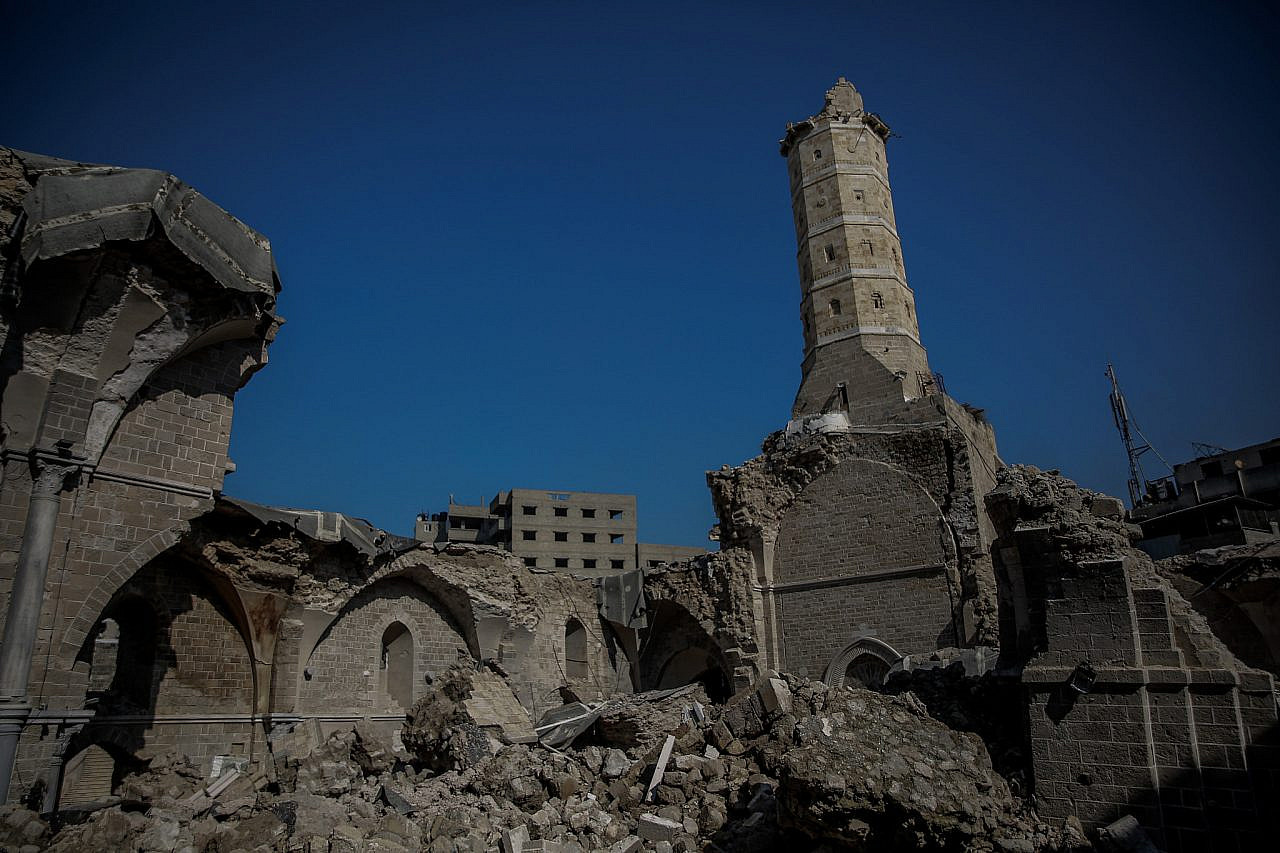
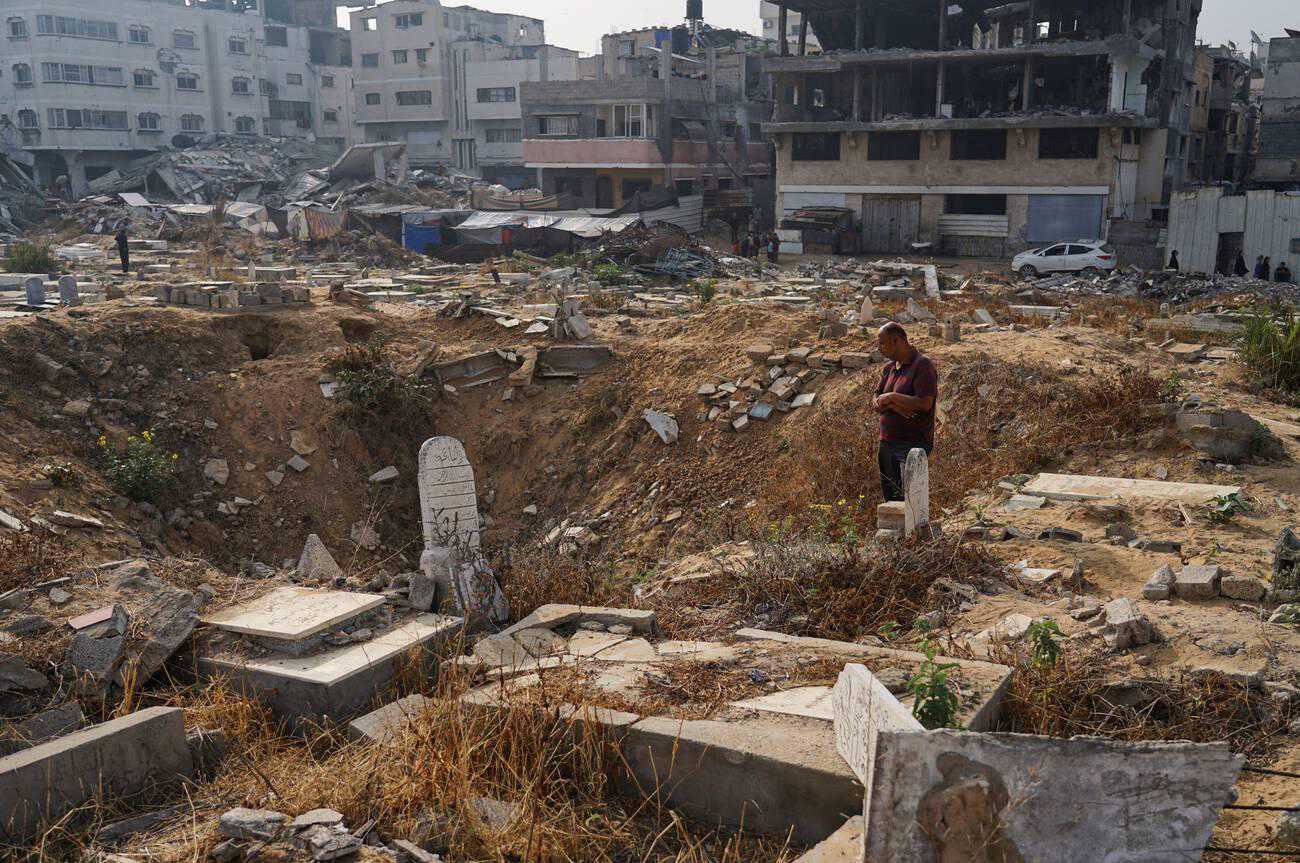
The ongoing war in Gaza, which started in October 2023, is the last phase of a long process of “eradicating Palestinian physical presence” in the Gaza Strip as well as erasing the Arab historical monuments, archaeological sites and sacral architecture.
Gaza has been populated since the Bronze Age and it was an important commercial hub on a trade route that went from the southern tip of the Arabian Peninsula to the Mediterranean. The Gaza Port connected southern Europe and the Greco-Roman world with the incense trade from Hijaz.
Meanwhile, an exhibition opened last week at Paris’s Institut du Monde Arabe (IMA) that showcases a glimpse of Gaza’s archaeological heritage against the relentless warfare and destruction in the region.
The event titled, “Rescued Treasures of Gaza: 5,000 Years of History,” will conclude on 2 November and it features over 130 objects that attest to the rich and complex history of Gaza as a crossroads of culture and commerce between Asia, Africa and Europe.
The density and distribution of its archaeological sites surveyed in 1944 at the end of the British Mandate and updated by the Palestinian Department of Antiquities in 2019 is eloquent.
A total of 130 sites to which should be added the remains of ancient cities and towns within the cities of Gaza, Khan Yunis, Dair Al Balah, Rafah and Bait Hanun, in tens of villages and in eight Palestinian refugee camps, noted a British-affiliated archaeologist Claudine Dauphin.
Bronze and Iron ages
Near the Wadi Gaza ford on the ancient coastal road linking Palestine and Egypt since the Bronze Age, the Way of Horus ancestor of the Roman Via Maris, lie two major Bronze Age sites.
“Rescued from developers in 1997 and excavated by Pierre de Miroschedji on behalf of the French Centre National de la Recherche Scientifique [CNRS], Tel as-Sakan [3,400-2,350 BC] offered a 10 meter high stratigraphic section covering 1000 years of the Early Bronze Age and urban development under Ancient Egyptian impetus,” Dauphin explained.
The archaeologist added that excavated by the British Egyptologist Sir Flinders Petrie (1925-1942) in 1930-1934, Tel El Ajlun (1,900-1,200 BC) yielded in several Bronze Age buildings, including the “Palace”, five large deposits of gold jewelery (1,750-1,550 BC) ranking amongst the greatest Bronze Age finds in the Levant, now in the British Museum and the Rockefeller Museum in Jerusalem.
In 1990 Professor Louise Steel of the University of Wales, Trinity St David’s, Lampeter sifted through the previously excavated soil, unearthing dozens of foundation cones stamped with the cartouche of Pharaoh Thutmosis III (1,481-1,425 BC).
Excavations were resumed by a University of Gothenburg Swedish Mission directed by Peter Fisher in collaboration with Moain Sadeq of the Palestine Department of Antiquities in 1999 and 2000 focusing on Late Bronze Age levels, Dauphin underlined.
“Thus, from the 4th millenium BC ties were established with Egypt before it took Southern Palestine in the Early Bronze Age and ruled over the Egyptian Province of Canaan in the Late Bronze Age. Mentioned as ‘Hazattu’ in an Egyptian text dated to the reign of Pharaoh Thutmosis III [1,484-1,421 BC], Gaza itself was probably founded in the 3rd millennium BC,” Dauphin elaborated.
The archaeologist noted that its region was overseen by a pharaonic Egyptian agent, but the city itself was a kingdom whose ruler pledged allegiance to the pharaoh.
Spectacular and also the earliest (Late Bronze to Early Iron Age, 13th-11th centuries BC) of that particular category of ancient coffins, were 50 anthropoid clay coffins found in 1973 in the excavations of a cemetery south of Dair Al Balah under Israeli occupation (1967-2005).
Coil-built in local clay, the naturalistic face lids were moulded in relief displaying large Egyptian features- almond-shaped-eyes, arched eyebrows, straight noses and full lips, Dauphin said, noting that arms are often thin and stick like, crossed or holding objects such as lotus blossoms.
Grotesque style coffins have eyes, eyebrows, nose, mouth, ears and beard that have been applied separately to the leather-hard clay, this being associated with the construction practices of the Philistines, the scholar underlined, adding that from the dates associated with the finds, it appears that the coffins originated with Egyptian influences in Canaan and were subsequently adopted by the Philistines.
“These burials were typically associated with a large variety of expensive grave offerings: Cypriot, Cananite, Egyptian, Mycenaean and Philistine pottery storage jars, pithoi and cooking pots outside the coffin and smaller, higher quality Cypriot milk bowls, Egyptian alabaster cups, pilgrim flasks and juglets. flasks and juglets inside,” Dauphin highlighted.
Endangering Gaza’s cultural heritage
The cultural heritage of the Gaza Strip has been endangered both indirectly and directly continuously since the creation of Israel in 1948.
It increased significantly during the Israeli occupation of the Gaza Strip (1967-2005) ; the June 2006 Israeli air raids and incursions in retaliations from 2008 until now. A danger to the cultural heritage of Gaza has been both indirect and direct.
Indirect danger
Demographic growth in the Gaza Strip has led to the destruction of archaeological sites by bulldozers preparing the ground for building new homes for the growing population, widening main thoroughfares and providing sports ground for children and youths to evacuate stress, Dauphin said.
The archaeologist noted that, the damage inflicted from the air by Israeli bombs on a sports field at Mukheitin in the Northern Gaza Strip damaged a Byzantine ecclesiastical complex under the surface revealed revealed a small church.
“In the course of three excavation seasons [1998-2002], a three-aisled church, an offertory chapel, and a four-room building with a baptistery were uncovered. A 450 m2 mosaic pavement was restored by the Musée de l’Arles Antique [Museum of the Antique city of Arles in Provence],” the scholar said.
The archaeologist added that 17 Greek inscriptions from the 5th to the mid-8th century AD enabled the identification of this site with a funerary complex for a wealthy Christian family of Gaza. At Abu Baraqeh, the widening in 1999 of the coastal road in Dair Al Balaq revealed a small church on the shore.
Its pavement was lifted by mosaic-restoration experts of the Museum of Arles in Provence and restored in France, the archaeologist added.
Direct Danger
Direct danger is posed both by carpet-bombing and targeting. It is clear from the successive lists of destroyed cultural sites produced by UNESCO that IDF pilots have a predilection for targeting and deliberately target, which is more effective in radically destroying, as emphasized by Hamdan Taha, the founder of the Palestinian Department of Antiquities.
“Since the start of the 2023-24 war on Gaza, Palestinian cultural heritage has undergone widespread destruction from Israeli targeting of ancient sites, historical and religious buildings, museums, cultural and academic buildings, public buildings, and infrastructure,” Taha said.
“More than 100 archaeological sites, 256 historical buildings, many museums, hospitals, libraries, cemeteries, and over 100,000 archaeological objects, were destroyed” [“Destruction of Cultural Heritage in Gaza”, Jerusalem Quarterly 97, Spring 2024, 45-70],” Taha elaborated.
Further damage leading to total eradication is caused by demolition, the movements of military vehicles and the installation of pumps, as at Anthedon (Tel Blakhiyyah) which had been listed on 2 April 2012 as a tentative World Heritage Site, Dauphin concluded.

 marwan