Kuwaiti Media Personality Detained For Seeking Israeli Normalization

The Kuwaiti Public Prosecution issued a decision, Thursday, to detain media personality Fajr Al-Saeed for 21 days in pretrial detention and referred her to the country’s Central Prison, on charges of calling for normalization with Israel.

Local media reported that the case “includes a complaint filed by the Ministry of Interior accusing Al-Saeed of harming the national interests and violating the Unified Law for Boycotting Israel No. 21 of 1964, which criminalizes any dealings or calls for normalization with the Zionist entity.”

Al-Saeed is scheduled to appear before a detention renewal judge in the coming days, to consider whether to continue her detention or release her on bail, until a session is set for her trial.

On 31 May, 1964, the Kuwaiti National Assembly approved the “Unified Law for Boycotting Israel” following the decree issued on 26 May, 1957, by the late Emir of Kuwait Abdullah Al-Salem Al-Sabah, which imposes penalties on those who “deal financially with Israel.”

According to Kuwaiti law, Israel is considered an enemy state, and natural and legal persons are prohibited from concluding agreements or deals with entities or persons residing in Israel, belonging to it by nationality, or working on its behalf or for its benefit according to the Quds Press website.

Continue reading
After 2 ‘Empty’ Years Lebanon Elects a President

After more than two years of political vacuum, the Lebanese parliament, Thursday, elected army chief Joseph Aoun as president.

Aoun won 99 votes during a second round of voting in the 128-seat parliament after only securing 71 votes in the first round.

The presidential seat has remained vacant for over two years since President Michel Aoun left office on Oct. 31, 2022.

Aoun’s election came after intensified international diplomatic efforts by several countries to end the presidential vacancy in Lebanon, a country whose political and security landscape has been significantly impacted by escalating conflicts with Israel.

Thursday’s presidential vote was attended by several foreign diplomats, including the French special envoy Jean-Yves Le Druan and ambassadors of the Quint committee (Egypt, France, the US, Qatar, and Saudi Arabia) that followed up the issue of presidential vacancy in Lebanon.

According to the Lebanese Constitution, the president must be a Maronite Christian, the prime minister a Sunni Muslim, and the parliamentary speaker a Shia Muslim.

The president’s term is six years, and he could be re-elected after six years from his last mandate.


Army commander

Aoun was born on Jan. 10, 1964, in the Sin El-Fil area of the Matn district in eastern Lebanon.

A father of two sons, he had two bachelor’s degrees in political science and military science and speaks English and French languages.

Aoun joined the army as a volunteer in 1983 after which he got promotions to several military ranks until he became army commander in March 2017.

He also participated in several military trainings in Lebanon and abroad, including trainings in the US, the last of which was in 2009.

During his military career, Aoun was awarded more than 15 military honor medals, including the war medal three times, the national unity medal, the military medal of honor, and the medal in the fight against terrorism.

Aoun was not the first army commander to become president in Lebanon. The country previously saw the election of four army commanders as president – Fouad Chehab, Emile Lahoud, Michel Suleiman and Michel Aoun.

Major challenges

Under Aoun’s command, the Lebanese army launched on Aug. 19, 2017, an anti-terror military campaign, known as Fajr al-Joroud, against ISIS (Daesh) affiliates in the eastern border areas with Syria.

The military campaign successfully managed to kick the militants out of the Baalbek area.

The new president is expected to face several challenges due to years-long economic and political crises that affected the living conditions in Lebanon.

The recent Israeli war on Lebanon also left immense destruction across the country that would require effort by the president to secure international grants and donations from countries to help in the rebuilding of the country according to Anadolu.


Army deployment in southern Lebanon

Aoun supervised the deployment of the army forces in southern Lebanon under a cease-fire deal with Israel that took effect on Nov. 27.

The cease-fire agreement aimed to end over 14 months of fighting between the Israeli army and Hezbollah group since the start of the Gaza war in October 2023.

Under the cease-fire terms, Israel is required to withdraw its forces south of the Blue Line — a de facto border — in phases, while the Lebanese army is to deploy in southern Lebanon within 60 days.

Data from the Lebanese Health Ministry indicates that since Israel’s onslaught against Lebanon began on Oct. 8, 2023, at least 4,063 people have been killed, including women, children, and health workers, while 16,664 others injured.

Continue reading
Infant Death Alert as Gaza Hospitals Run Out of Fuel

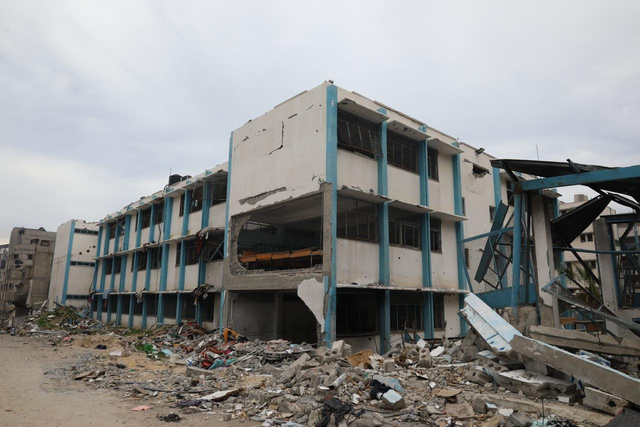
Nasser hospital, Al-Aqsa hospital and European Gaza hospital, in the Gaza Strip, Palestine, are on the verge of closure due to a lack of fuel. This situation is threatening the lives of hundreds of patients, including newborns, who depend on electricity to stay alive, warns Médecins Sans Frontières (MSF). Meanwhile, MSF teams are transferring fuel to Nasser and Al-Aqsa hospitals, serving only as a temporary solution for the next 36 to 48 hours.

As of 8 January, electricity for the MSF-supported Nasser hospital might be cut off in some departments leaving people without lifesaving care. In the neonatal intensive care unit, we are currently treating three children and four newborns with mechanical ventilation, as well as 15 newborns in incubators, all dependent on electricity provided by fuel generators.

MSF is alarmed by this catastrophic situation, which could have tragic and serious consequences as the situation is unlikely to improve. We call on all parties to facilitate the entry of fuel into Gaza and to ensure its safe delivery to medical facilities. The dismantling of the health system by the Israeli blockade, which is endangering the lives of people, must stop immediately.

The babies in incubators rely on constant electricity for the ventilators that are keeping them alive… Putting the lives of children at risk like this is unacceptable and is a consequence of Israel’s ongoing blockade.Pascale Coissard, MSF emergency coordinator

“Without fuel, these newborns are at risk of losing their lives,” says Pascale Coissard, MSF emergency coordinator. “The babies in incubators rely on constant electricity for the ventilators that are keeping them alive.”

“They are already in an extremely vulnerable state, and any transfer to other hospitals would directly endanger their lives,” continues Coissard. “Putting the lives of children at risk like this is unacceptable and is a consequence of Israel’s ongoing blockade and continuous criminal looting of lifesaving supplies.”

Nasser hospital has a capacity of 500 beds, where MSF teams are providing emergency, maternity, paediatric, burn and trauma care. Oxygen provision is one of the hospital’s main fuel requirements. Our teams are treating over 100 cases of pneumonia on average each month, some who need oxygen support. At the same time, we are performing more than 100 caesarean sections each month, all of which require a constant supply of electricity.

“It’s an impossible situation, because even if we prioritise the little fuel that is left to the most urgent departments, we know that they won’t last more than 36 to 48 hours”, says Julie Faucon, MSF medical team leader in Gaza. “While some patients are hanging on by a thread, the lack of sustained electricity is impacting the level of care we can provide to those with burns and trauma.”

In December 2024, an average of only 59 trucks per day holding vital supplies were able to enter Gaza, compared to 500 trucks entering per day prior to 7 October 2023, according to the United Nations. MSF and other organisations have been warning for over a year that the woefully inadequate supply of aid is threatening the lives of people in Gaza. We have now reached a tipping point where one of the last specialized hospitals in the south of Gaza risks of being out of order because of lack of fuel.

Reliefweb

Continue reading
British MPs Call For Expelling Israeli Ambassador

A British lawmaker has called for economic and military isolation of Israel to bring it to “some form of negotiated settlement,” and suggested the Israeli ambassador to the UK should face expulsion.

Independent MP John McDonnell recalled the crippling situation in the Gaza Strip that has been exacerbated during harsh winter conditions.

“We’ve witnessed over the Christmas period when we’re celebrating with our families, the scenes of children starving and freezing to death as a result of Israeli actions,” he said.

Speaking in the House of Commons on Tuesday, McDonnell said that the only solution that they have had in the past is a “total isolation of a country,” economically and militarily, to prevent them performing war crimes in the way Israel has according to Anadolu.

“I think this Government could take a leading role in that isolation of Israel to bring it some form of negotiated settlement,” he noted.

Also touching on Israeli Ambassador to UK Tzipi Hotovely’s controversial remarks and stance, including advocating “Greater Israel.”

“We have an Israeli ambassador who’s an advocate of Greater Israel, refuses to recognize the Palestinian state, defies all the UN resolutions that have been passed about how we can secure that peace, and she still remains in this country. Why aren’t we expelling the Israeli ambassador,” he asked.

Hotovely has sparked anger on multiple occasions since a Hamas attack on Oct. 7, 2023, with controversial remarks such as claiming there is no humanitarian crisis in Gaza and saying Israel is not bombing civilians in Gaza.


‘There is disagreement between British, Israeli governments’

In response, Hamish Falconer, minister for the Middle East, said: “It is tempting to think that, if only we had representatives more to our tastes politically, then things would be easier.”

He added: “There is a disagreement between the British and Israeli governments about the conduct of the war in Gaza and the humanitarian implications that flow from it.”

Falconer went on to say that they will continue to make that disagreement clear through all channels, both through the Israeli ambassador and directly to the Israeli government, and will continue to talk to the Israeli government about these issues.

On Wednesday, Labour Party MP for Coventry South, Zarah Sultana, expressed support to McDonnell for expelling the Israeli ambassador.

“I agree with @johnmcdonnellMP: Expel the Israeli Ambassador NOW,” she wrote on X.

The Israeli army has continued a genocidal war on the enclave that has killed nearly 46,000 people, mostly women and children, since Oct. 7, 2023, despite a UN Security Council resolution calling for an immediate cease-fire.

In November 2024, the International Criminal Court issued arrest warrants for Israeli Prime Minister Benjamin Netanyahu and his former Defense Minister Yoav Gallant for war crimes and crimes against humanity in Gaza.

Israel also faces a genocide case at the International Court of Justice for its war on the enclave.

Continue reading
Wanted Soldier Lands in Israel

Yuval Vagdani, the Israeli soldier who was wanted in Brazil over Gaza war crimes, from where he fled with the help of the Foreign Ministry, landed in Israel.

On Wednesday, the family agreed to publish his name after he landed in Israel. After leaving Brazil he reached Argentina and continued to the U.S. before returning to Israel, according to Israel’s Ynet news.

“We are all excited that he returned home safely,” said Itzik, Yuval’s father.

“He will never return to Brazil again,” added his father. “He will learn from the mistakes he made. The main thing is that he has now returned to Israel and we are all happy that everything is behind us.”

On Saturday, a Brazilian federal court ordered police to investigate Vagdani, as he was in Brazil on vacation, for “war crimes” in Gaza.

The order came after the Hind Rajab Foundation (HRF) announced that it filed a complaint against the soldier.

On Sunday, the Israeli soldier reportedly fled the country. In a statement, the HRF accused Israel of orchestrating his departure to obstruct justice, adding that “there are also indications that evidence is being destroyed”.

Israel’s Foreign Ministry announced that it had helped the former soldier in leaving Brazil on a commercial flight, after what it described as “anti-Israel elements” pushed for an investigation last week. The Ministry also warned Israeli soldiers and officers against sharing pictures or videos of their involvement in Gaza on social media, according to The Washington Post.

The HRF supplied 500 pages of evidence including videos and images showing Yuval Vagdani planting explosives in November, 2024, used to destroy infrastructure and buildings in Gaza.

It said “he had participated in “massive demolitions of civilian homes in Gaza during a systematic campaign of destruction.”
“We call on Brazilian authorities to fulfill their responsibilities, protect their judicial process, and ensure justice prevails,” it added.

Yuval has reportedly told his family that he will no longer upload videos from Gaza.

“This is a historic moment,” said Dyab Abou Jahjah, the group’s chair. “It sets a powerful precedent for holding war criminals accountable.”

Meanwhile, Riad Abu Badwia, a professor of international law, explained that Brazil, as a signatory to the Rome Statute, has the legal authority to prosecute individuals involved in war crimes.

The Brazilian court’s decision could inspire other countries to follow suit and open the door for broader international accountability for Israeli military officials, Abu Badwia added.

In October 2024, the HRF filed a complaint with the International Criminal Court (ICC) against 1,000 Israeli soldiers for war crimes, crimes against humanity and genocide in Gaza.

It said the complaint is “supported by over 8,000 pieces of verifiable evidence – including videos, audio recordings, forensic reports, and social media documentation – demonstrates the soldiers’ direct involvement in these atrocities.”

It noted that soldiers were named and were all “located in Gaza during the genocidal assault, and the evidence reveals their participation in violations of international law.”

It added that it provided evidence that they had taken part in the “destruction of civilian infrastructure … Illegal occupation and looting … Participation in the Gaza blockade … Targeting civilians … Use of inhumane warfare tactics,” which are violations under international law.

The soldiers named include “high-ranking officers and commanders responsible for planning and executing military operations in Gaza,” individuals with dual citizenship, “including 12 from France, 12 from the United States, 4 from Canada, 3 from the United Kingdom, and 2 from the Netherlands,” and soldiers “who have openly boasted about their war crimes on social media,” it explained.

In December, the Israeli military reportedly warned dozens of soldiers against traveling abroad, after some 30 soldiers who served in Gaza genocide had war crimes complaints filed against them. Soldiers have been identified from videos and images they posted online that were taken during their service in Gaza.

Continue reading