Clowning in The Sand

By Ibrahim Isam

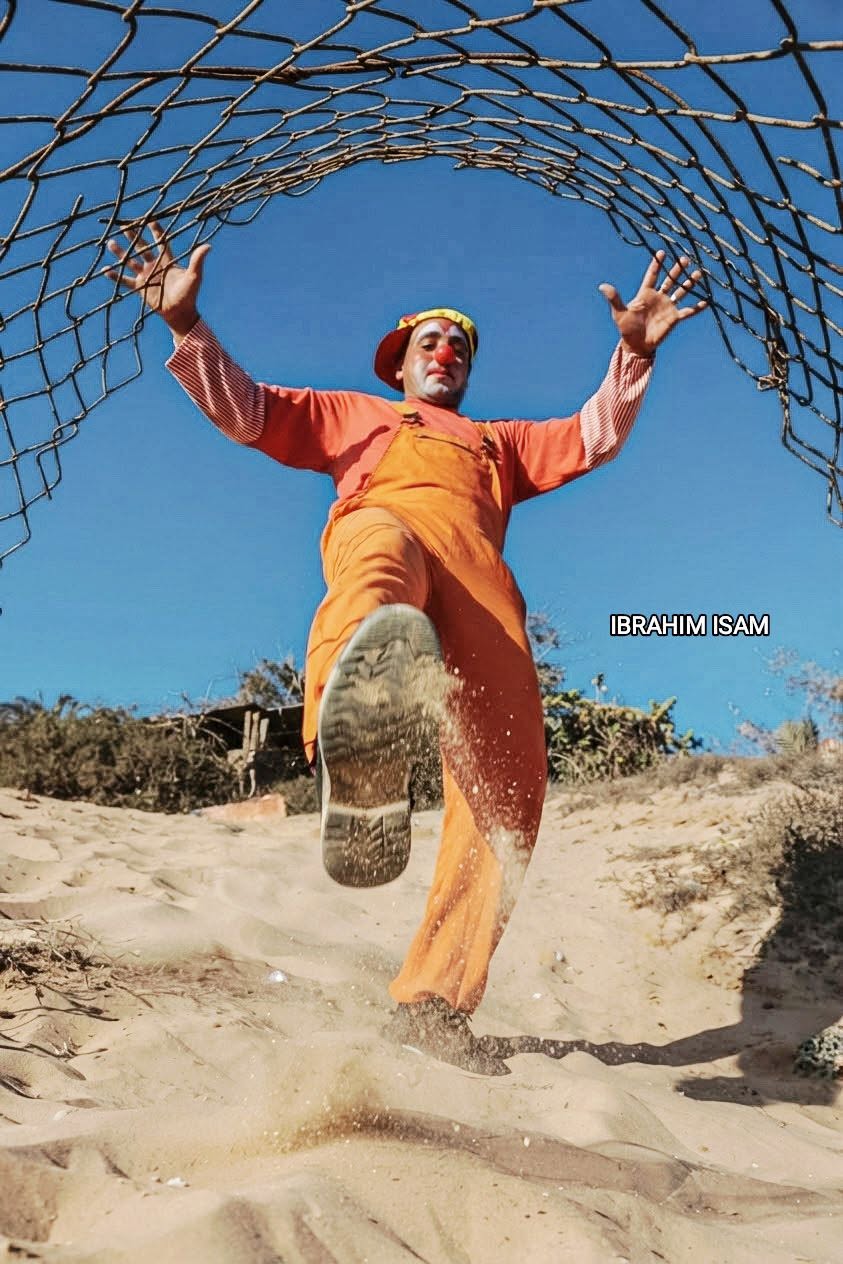
He reaches his hands toward the sky, not to escape the iron, but to give the body another meaning of freedom.

The arch above him narrows the horizon, while the orange opens it from within—a color that knows the soul cannot be confined by lines.

Beneath his feet, the sand shifts, carrying away some of the weight of the day.

Behind him, distant trees remain still; before his eyes, a journey has yet to begin.

In that moment, the clown was not performing only for the children. He was releasing a little of what had been held inside him into the air.

For even when a person gives others a space to laugh, they still need a space of their own to breathe, to loosen the weight within, and to remain human.

The sky is blue. The iron is closed. And the orange keeps moving between them.

Perhaps freedom does not always begin with a road.

Perhaps it begins in the moment the heart remembers how to become light again.

Continue reading
‘My Curious Camera’

By Ibrahim Isam

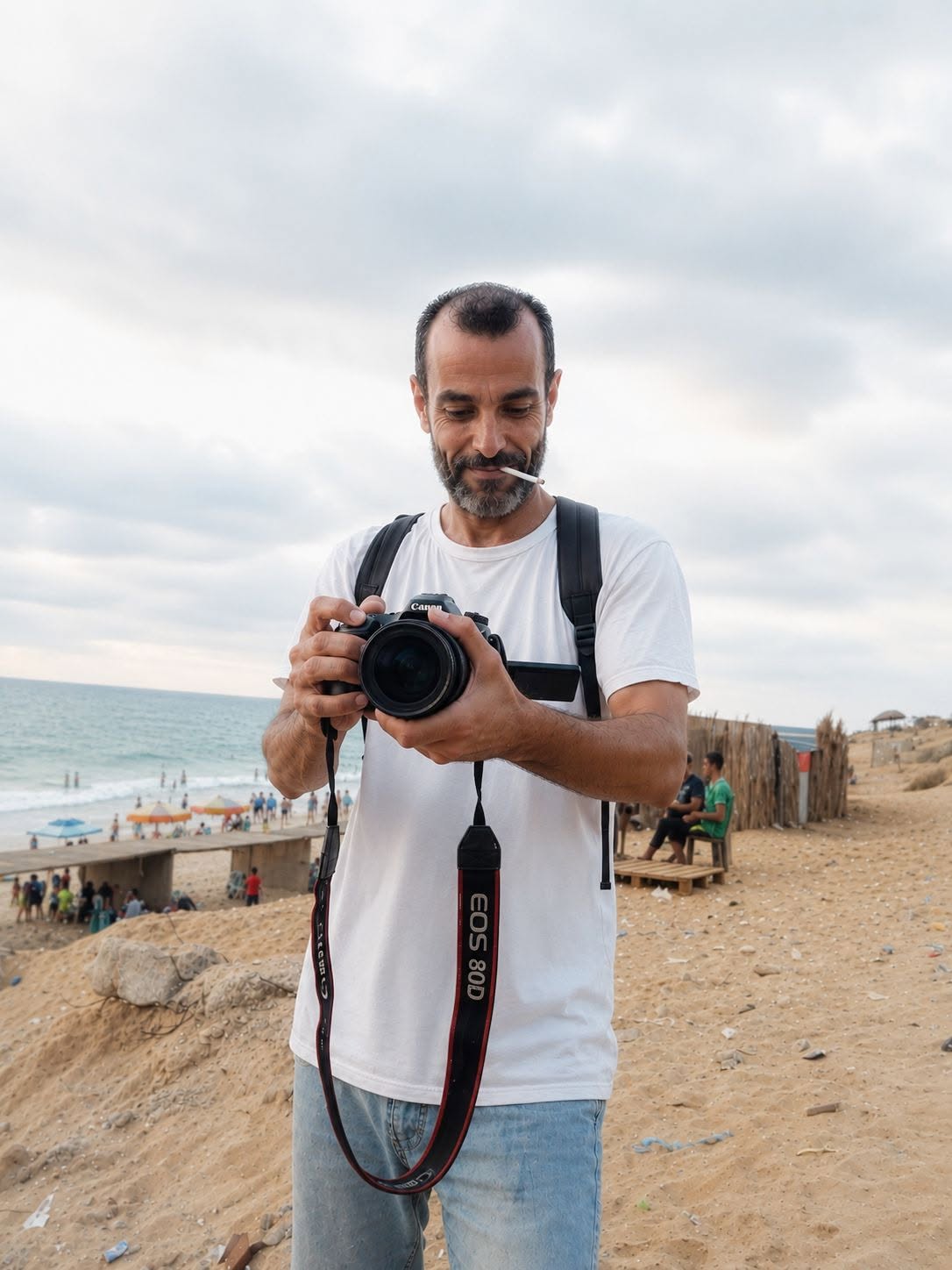
I am not one of those who wear a press vest or a helmet simply to convince people outside Gaza that I am a journalist working under unbearable pressure and therefore in need of help. Nor am I someone who chases trends merely to increase the number of followers, or someone who uses photographs as a means to achieve personal ends.

Since I began photographing, I have had my own visual language, my own way of seeing. What has happened in Gaza has never made me abandon that language in order to follow the tragedy or turn it into a commodity.

I have never searched for the angle that would sell better, nor for the scene that would bring sympathy faster.

And I am certainly not one of those who see a photograph receiving attention today, only to return the next day with the same subject, the same tragedy, but with the latest camera model or the most expensive equipment—as if human suffering needs a technological upgrade before it becomes worthy of being photographed.

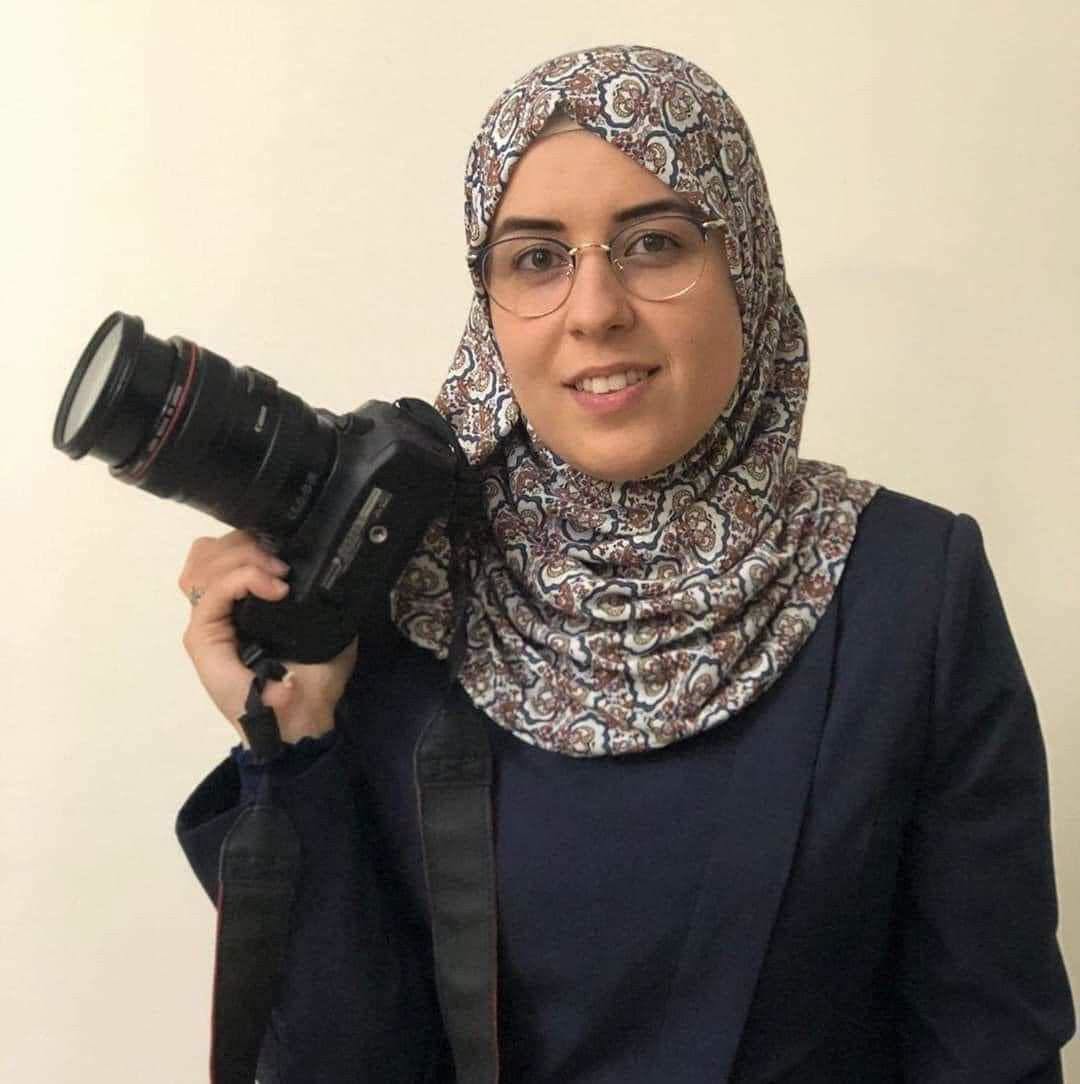
I am not ashamed of my modest cameras. Quite the opposite. I sometimes deliberately photograph myself with them and show exactly what kind of camera I am using.

Perhaps because I want to tell those who are just beginning to explore photography something simple:

The eye matters more than the camera.

A camera can be newer, more expensive, more sophisticated, and more impressive. But none of that makes its owner an artist.

And honestly, if cameras were capable of making artists, camera shops would have become art academies long ago.

I did not translate my texts into English because I wanted to flatter people outside Gaza, nor because I wanted to make myself more acceptable to an audience that does not know me.

I translated them because I want the photograph to travel.
I want the story to cross borders.
I want people to see what I see.

And the photographs I share today are not photographs I suddenly discovered after Gaza became a subject of global attention.

They are the same photographs I shared before, accompanied by Arabic texts, when they did not reach the same number of people, when they did not receive the same attention, and when hardly anyone seemed to notice them.

The photographs did not change.

The world simply began to look.

Nor am I seeking personal gain through these photographs.

I believe you all know that I am perhaps one of the few people in Gaza who continues to work voluntarily, without belonging to any institution or organization, using my own camera and whatever resources I can manage to provide myself.

But there is something even more important to me than all of that:

I do not impose a manufactured tragedy upon a child in order to create a powerful photograph.

I do not ask a child to cry at the right moment, to look into the lens in a way that makes the image more “tragic,” or to rearrange their pain so that it becomes more suitable for publication.

I believe that reality, when left to speak for itself, is far more painful than anything we could manufacture.

A child in a photograph may deserve all the compassion in the world. But when we place that child inside an artificial scene, or subject their reality to poor and exaggerated direction, we do not serve the child, and we do not serve the photograph.

We weaken its credibility.

And more important than anything else:

I respect the viewer.

I respect their eyes, their intelligence, and their right to see reality as it is—not as I want to stage it for them.

Some of you may wonder why I am writing all of this in English when I am, after all, speaking to you.

The answer is very simple:

Because I know you are curious.

And I have a feeling that, sooner or later, you will translate this into Arabic anyway.

So, in a small way, we have saved everyone the trouble.

In the end, I do not claim to possess the whole truth, nor do I believe I am better than anyone else.

I simply know why I hold a camera.

I know why I press the shutter.

And I know why, sometimes, I refuse to take the photograph that others believe would be “the best” one.

Because art, to me, is not a competition over who owns the biggest camera, the newest equipment, or the photograph that receives the most attention.

Art is knowing when to photograph, what to say, and when to step aside and allow reality to speak for
itself.

Continue reading
The Child, Tree and The Dark

By Ibrahim Isam

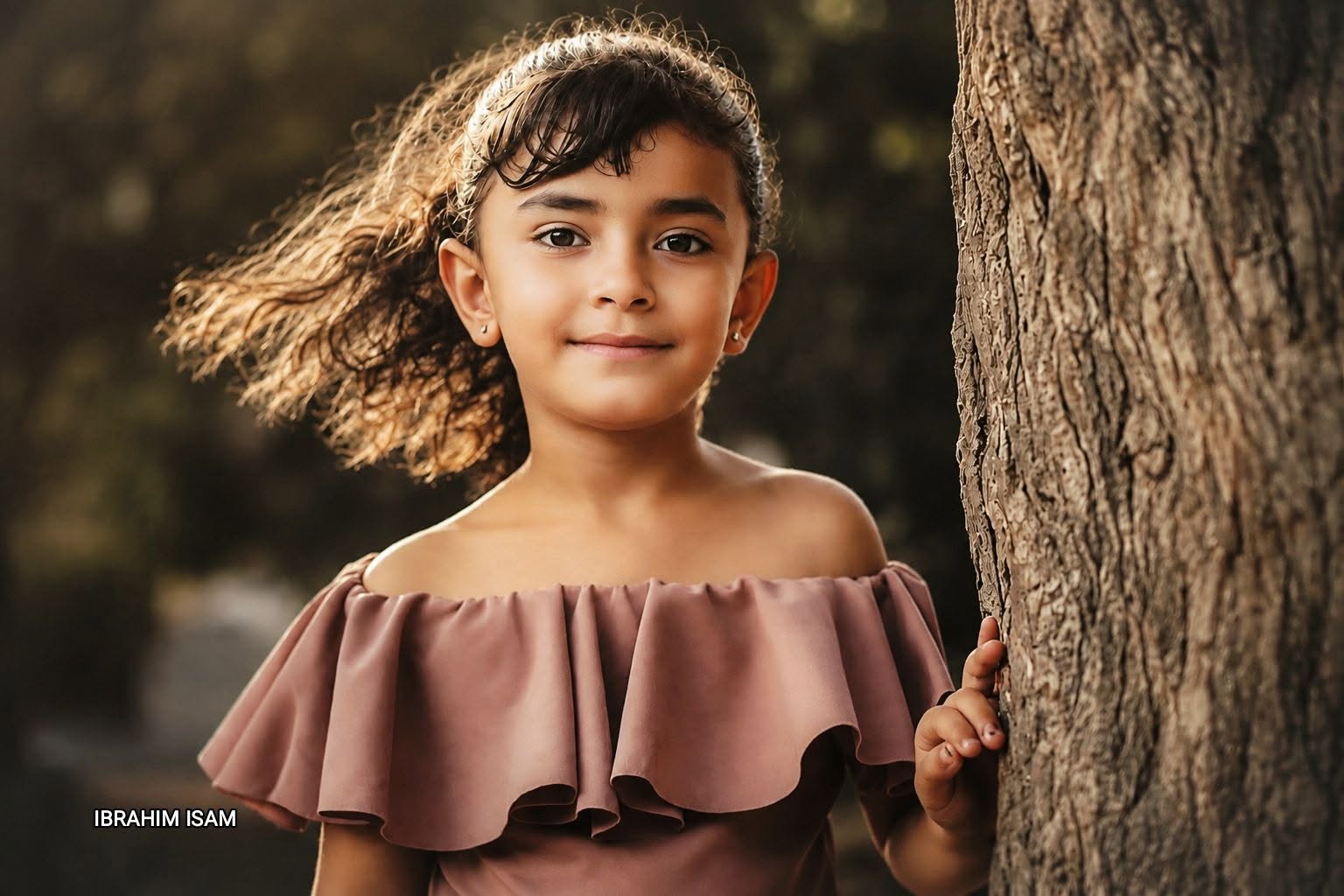
The tree had been there long before she arrived, perhaps waiting for her through a time she could never know. Its ancient trunk carried the scars of seasons upon its skin, as though the years had not simply passed through it, but had written themselves there, layer upon layer. When the little girl placed her hand against its roughness, it felt as though a hand from the future had touched an old memory—or as though childhood itself had come to rest a hand upon the shoulder of time and whisper: Do not be afraid. There is still room for Spring.

She looked at me without asking for anything. There was no answer in her eyes, but that simple question grown-ups have never learned how to answer: Why can the world not be a safe place for every child?

And yet, her gaze was not sad.

There was something beyond sorrow in it; something like the first faith, before a human being learns that tomorrow is something to fear. She looked as though the light approaching was not a promise of some distant future, but something her soul had known since birth.

The wind moved gently through her hair, while the trees around her received the last light of day. In her eyes, that light was reflected as though it had finally found a place worthy of holding it. And for a moment, I felt that light does not always come from the sky. Sometimes it is born in the eyes of a child, and from there finds its way into the darkness of the world.

Perhaps this is why I love children.

They have not yet learned how to justify cruelty, how to turn suffering into a truth, or how to persuade themselves that ruin is inevitable. A child is not born carrying the history of hatred. They arrive with empty hands, a heart that has not yet learned how to hate, and eyes still capable of seeing the world before we teach them how to look at it.

Her hand remained upon the tree, and I wondered if there was a secret between them that I could not understand.

She was at the beginning of the journey; the tree, somewhere near its end. She had not yet known the seasons, while the tree had known enough of them to fall silent. And still, they seemed strangely alike: both standing quietly before time, both knowing, in their own way, that life does not need much to begin again. Sometimes it needs only a little light, a small hand, and a gaze that still believes tomorrow is possible.

Perhaps the tree was not protecting the child from anything.

Perhaps the child was giving the tree another reason to remain.

In that moment, I did not see a photograph of a child beside an old tree. I saw two ages standing beside one another: one that had already passed, and one that had not yet begun. Between them was that quiet light which announces nothing, yet changes everything.

And in her eyes I saw what I have been searching for all this time—not hope itself, but the innocence that makes hope possible.

Perhaps one day this child will grow older, and her heart will become burdened with things no heart should have to carry. Perhaps she will discover that the world is not the way it seemed in her first gaze.

But I hope that, when that day comes, somewhere within her eyes, that first light will still remain. I hope she will remember that once, beside an old tree, the world was—if only for a moment—beautiful enough to believe in.

Perhaps the world does not need a great miracle to be saved.

Perhaps it only needs us to leave childhood its childhood.

And to stop, even for a little while, extinguishing the light that children bring with them.

Continue reading
The Face of Innocence

By Ibrahim Isam

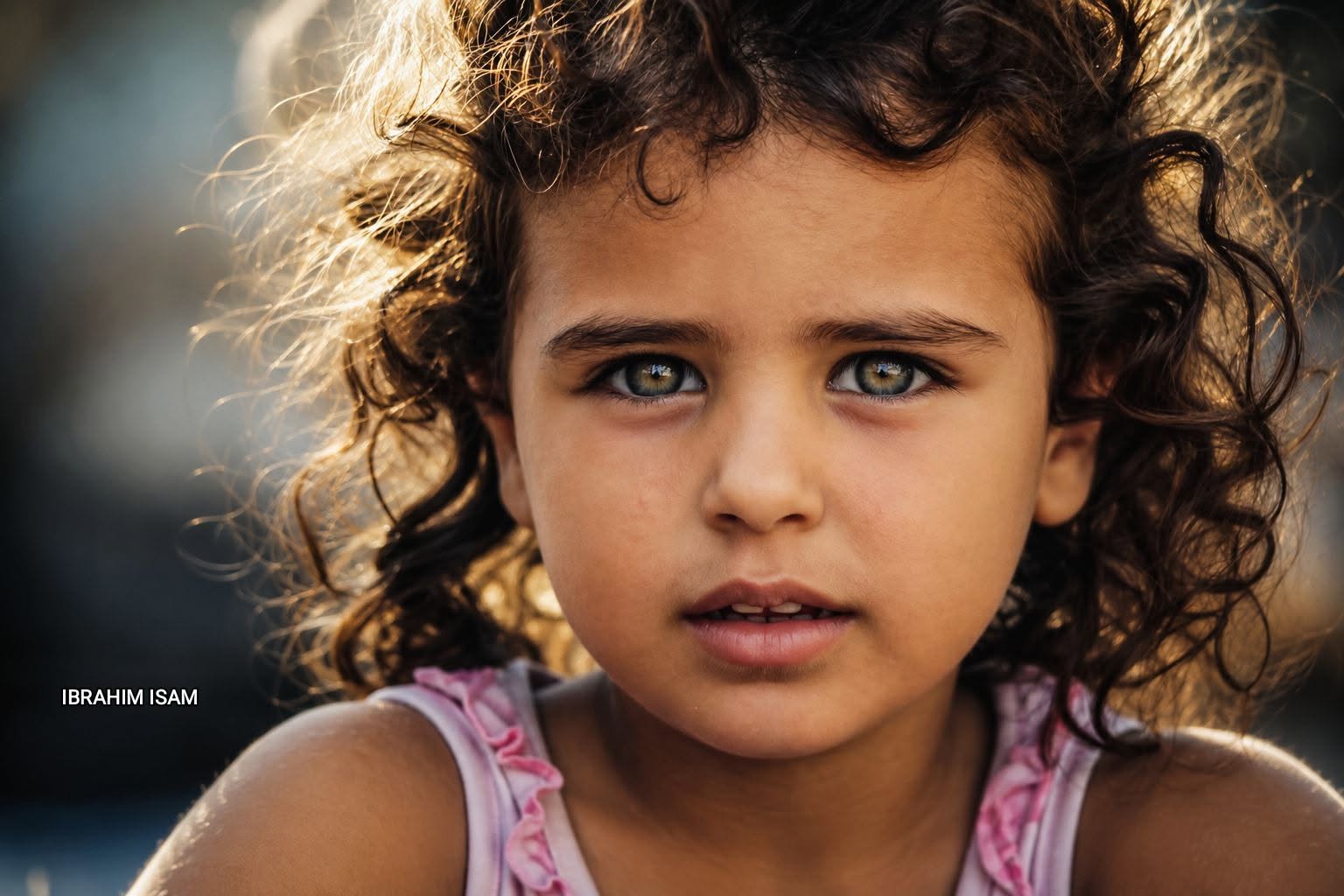
They wake in Gaza searching for water, for a little laughter, for a ball to chase, for the sea to watch, for a home they can still draw even when it no longer stands. And at night, they sleep carrying a quiet image of another morning.
Perhaps that is why this little girl’s gaze feels so distant. It seems to look beyond the camera, beyond the ruins, toward a morning that has not yet arrived.
A child does not want to be a symbol of war, a witness, or a number in a report.
A child simply wants to grow.
A school.
A window.
A friend.
A sea without fear.
A mother saying, “Go. I’ll see you tonight.”
Perhaps hope is not believing that the world will suddenly become kind. Perhaps it is simply refusing to let its cruelty live inside us.
So when a child from Gaza looks at us like this, let us pause.
There is still a morning in those eyes—
one the war has not yet managed to destroy

Continue reading