Gaza: Only 3% of Land Safe to Grow Food

Amid ongoing deadly hostilities in Gaza, the enclave’s farmers face the increasingly difficult challenge of finding safe land to grow their crops.

Satellite images published last Tuesday in news analysis from the UN Food and Agriculture Organization (FAO) and UNOSAT, the UN Satellite Centre, indicate that just three per cent (448 hectares) of the shattered enclave’s farmland remains usable. 

In October 2025, only 601 hectares were accessible and undamaged.

This latest assessment paints a stark picture of the continued deterioration of Gaza’s agriculture sector,” said Rein Paulsen, Director of FAO’s Office of Emergencies and Resilience. “Without urgent action to restore safe access and provide farmers with the support they need, opportunities to restore local food production will continue to diminish.”

Bombed out

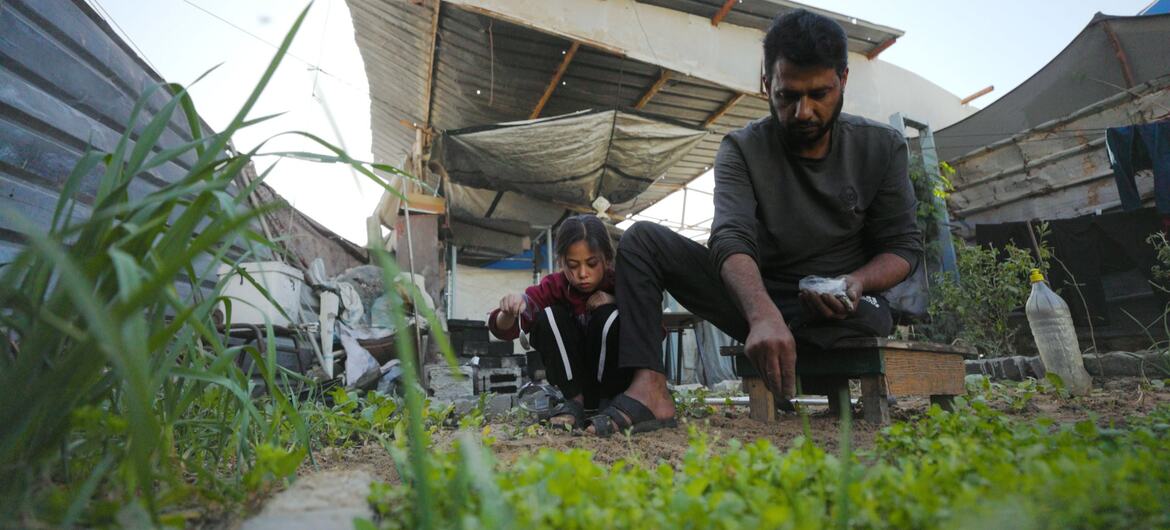
For cucumber and tomato grower Taysir Dahdouh, the war between Hamas fighters and Israel sparked by Hamas’s deadly attacks in October 2023 has been marked by overwhelming loss.

“I had a good income before the war,” he said. “Suddenly, we were left with nothing…Even the steel frames of the greenhouses disappeared, along with our homes, belongings, and irrigation pipes. Nothing was left.”

After returning from displacement, Mr. Dahdouh tried to restore the land using basic tools, working with his family. “We managed to rehabilitate about one dunum (about one-tenth of a hectare) of our land to bring it back to life,” he explained.

Another Gaza farmer, Wajiha Dahdouh, highlighted other equally serious problems: “We came back to support ourselves and return to farming so we could survive. Unfortunately, there is not enough water, there are no fertilizers, no seeds, and none of the basic necessities that would allow people to continue their lives.”

Squeezed out

The reduced growing space for Gaza’s farmers today is mainly the result of a lack of access, rather than additional damage from the war, which was already massive.

In June 2026, just over 4,000 hectares of cropland in Gaza – or 27 per cent – could be reached, but approximately 3,600 hectares of this was unfit for planting.

Farmers in Deir al-Balah and Khan Younis have seen the largest reductions in available land, FAO said. 

This is primarily because of the “westward expansion” of the so-called ‘Yellow Line’ that separates the ceasefire zone from the Israel Defense Forces’ military-controlled area.

Rafah in the far south of Gaza has the highest levels of inaccessible cropland and greenhouse growing areas, at 97.2 per cent and 98.4 per cent respectively.

“The most extensive physical damage remains concentrated in North Gaza and Gaza governorates,” the agency noted. Most damage is in North Gaza and Gaza, satellite images show.

An infographic showing a map of Gaza and a bar chart illustrating the percentage of cropland that is damaged or accessible in 2025 and projected for 2026.
Lucica Matei UN News infographic

The situation for Gazans remains dire. Just this weekend, UN partners reported multiple air strikes and incidents of shelling, gunfire and naval fire, primarily west of the Yellow Line, where most of Gaza’s 2.1 million people are now confined to an area less than half the size of the enclave. UN News
Continue reading
Building Among Destruction: UN Aids Gaza Farmers

The UN is supporting farmers in Gaza who are struggling to rebuild their smallholdings in areas devastated by the Hamas-Israel war.

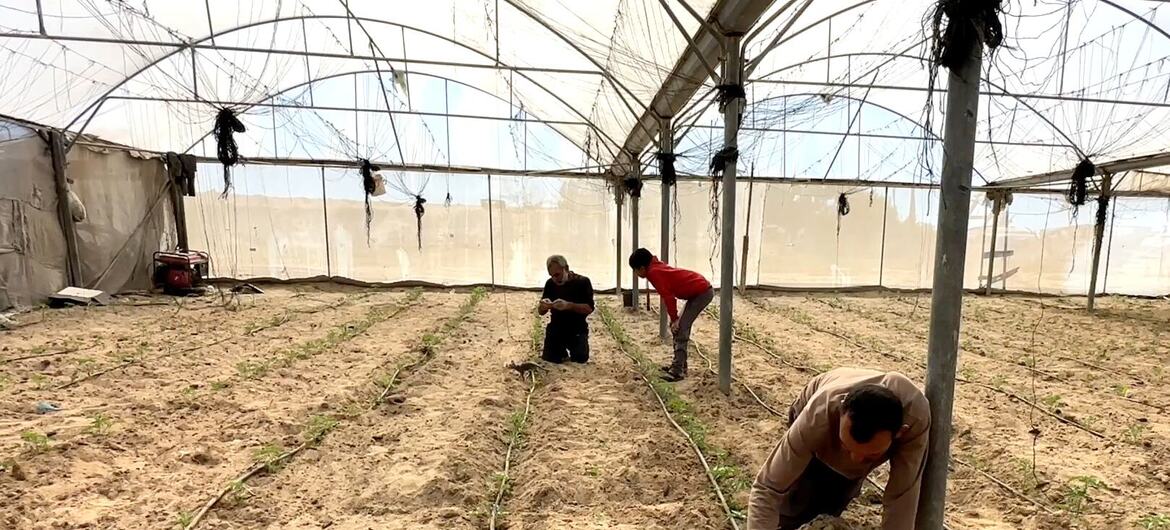
These growers include Taysir Dahdouh, whose farm in the Zeytun neighbourhood, east of Gaza City, is a little smaller than a football pitch. 

His land was once covered with greenhouses, but they’ve been destroyed or lost during the conflict that erupted on 7 October 2023. Today, he needs tools, seeds, fertilizer and water to grow the cucumbers and tomatoes he used to.

200 new homes

Alessandro Mrakic, Head of the Gaza Office for the UN Development Programme (UNDP), told UN News’s correspondent in the enclave that families who had once lived in one heavily bombed area had had to move multiple times before returning. 

“We have provided 200 relief housing units to provide shelter to the families who came back and started, as you see behind me, agriculture – started producing eggplants, tomatoes, molokhia, among others,” he said.

The UN’s Food and Agriculture Organization (FAOsaid on Thursday it has scaled up its cash assistance programme to help around 1,500 Palestinian farmers cultivate land across Gaza during the 2026 planting season, enough to produce fresh vegetables for more than 100,000 people.

Not enough space

But FAO warned that farmers “are squeezed into rapidly shrinking space” amid ongoing Israeli military activity, and it is calling for access to land, sea and production inputs including seeds, fertilizers, irrigation equipment and fishing gear.

Elsewhere, Deputy Special Coordinator for the peace process Ramiz Alakbarov welcomed new commitments worth almost $58 million from eight Member States to the UN Horizon Fund, and called on further partners to join the initiative. 

The World Food Programme (WFP) said people forced to move within Gaza risk losing access to basic services and called for safe access to reach those in need; despite the obstacles, it and its partners reached more than a quarter of a million people across 36 distribution sites in the first 12 days of this month.

Summer respite

Humanitarian partners also distributed more than 5,440 educational kits to support around 217,600 children during summer learning activities.

Children play and swim in the waves at Gaza City's beach to escape the summer heat.
UN News Children play and swim at Gaza City’s beach to escape the intense summer heat.

Turning to the West Bank, a high-level delegation led by aid coordination office OCHA visited Deir Nidham village in the Ramallah governorate on Wednesday, meeting Palestinian families affected by settler violence and the expansion of settlement outposts. 

Settler attacks accounted for around 55 per cent of all Palestinian injuries in the West Bank so far during 2026.

Guterres voices alarm

UN Spokesperson Stéphane Dujarric said the Secretary-General is “deeply alarmed” that Israeli authorities have granted city status to Givat Ze’ev, a settlement northwest of Jerusalem, adding that the designation “does not alter the city’s legal status under international law as part of the Occupied Palestinian Territory.”

All Israeli settlements in the occupied West Bank, including East Jerusalem, are illegal under international law, Mr. Dujarric reiterated, recalling the International Court of Justice’s advisory opinion of July 2024. 

He said settlements remain a major obstacle to a two-State solution, and renewed the Secretary-General’s call on Israel to halt all settlement expansion. UN News

Continue reading