CrossFireArabia
If I Must Die, Let it Bring Hope’ – Remembering Professor Refaat Alareer

By Nurah Tape – The Palestine Chronicle
“Sometimes a homeland becomes a tale. We love the story because it is about our homeland and we love our homeland even more because of the story.”
On Day 3 of Israel’s genocidal assault on the Gaza Strip, intellectual and writer Professor Refaat Alareer said in a live interview from the besieged enclave “I’m an academic. Probably the toughest thing I have at home is an Expo marker. But if the Israelis invade … I’m going to use that marker to throw it at the Israeli soldiers, even if that is the last thing that I would be able to do.”
Nearly three months later, on 6 December, 2023, Alareer was killed in an Israeli airstrike on his sister’s home in northern Gaza. The activist’s sister, Asmaa, along with three of her children, and his brother Salah, with his son Mohammed, were among those also killed in the attack.
As a professor, poet and writer, Alareer’s pen was his weapon. And it continues to defend and tell the story of his people.
Iconic Poem
His poem, If I Must Die, written in 2011 and shared on X a month before his death, has become an iconic reminder of the Palestinian struggle for liberation from Israeli occupation and oppression.
“If I must die, you must live, to tell my story, to sell my things, to buy a piece of cloth and some strings…If I must die, let it bring hope, let it be a tale” the actor Brian Cox delivered a passionate rendition of the poem published by the Palestine Festival of Literature.
On December 4, two days before his death, Alareer wrote in a post on X: “I wish I were a freedom fighter so I die fighting back those invading Israeli genocidal maniacs invading my neighborhood and city.”
“The building is shaking,” he added. “The debris and shrapnel are hitting the walls and flying in the streets. Israel has not stopped bombing, shelling, and shooting. Pray for us. Pray for Gaza.”
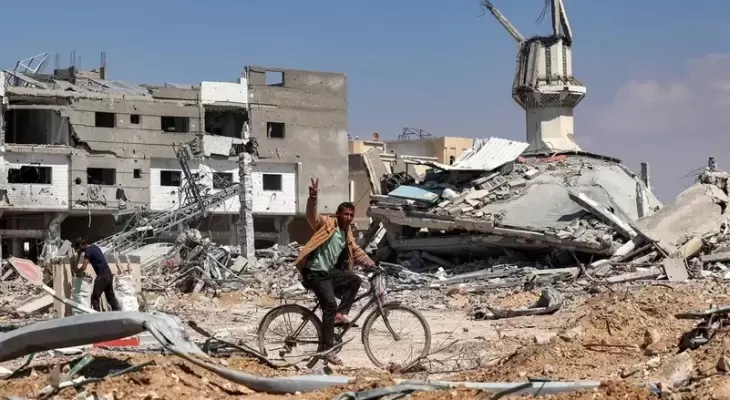
Over a year later, his words echo as the bombing, shelling, and shooting continue unabated.
To date, a total of 44,612 Palestinians have been killed, and 105,834 wounded, according to Gaza’s Ministry of Health.
We Are Not Numbers
As the beloved professor of Literature and Creative Writing at the Islamic University of Gaza and co-founder of the We Are Not Numbers project, Alareer inspired a myriad of young people in the enclave to own their narrative and tell the story of Palestine based on their experiences.
In a TED talk delivered in 2015, Alareer impressed upon preserving oral history and how “stories make us.”
“I realize I am the person I am today because of the stories” told to him by his mother and grandmother, he said, “because my mum was teaching me values, etiquette, to love people, to love my life, to love my country at the same time.”
“Stories are also important in our lives as Palestinians, as people under occupation, as native peoples on this land, not only because they make us, they shape us, they make us the people we are but also because they connect us with our past, they connect us with our present, and they prepare us to the future,” shared Alareer.
He said his grandmother “told us stories (about) when she was a kid, when she was a newly married wife who would spend months plowing her land, harvesting the crops, the land that now we don’t own because it was occupied.
“Although the land is physically occupied, it still lives in our memories, still lives in our hearts, because we can easily visualize this.”
‘Tell Us Stories’
Concluding his talk, Alareer encouraged the audience to “beg” their parents and grandparents to “tell us stories” and share them with “our kids.”
“Because if we don’t do that, if the story stops there, we’re betraying ourselves, we’re betraying the story, we’re betraying our parents and grandparents, and we’re betraying our homeland,” he emphasized.
Born on September 23, 1979, in Shejaiya in Gaza City, Alareer said in a media interview that “every move I took and every decision I made were influenced (usually negatively) by the Israeli occupation”.
“As a kid, I grew up throwing stones at Israeli military Jeeps, flying kites, and reading,” he also said.
‘Gaza Writes Back’
Alareer edited several books, including ‘Gaza Writes Back’ and ‘Gaza Unsilenced’, which according to Palestine Chronicle editor, Ramzy Baroud, “allowed him to take the message of other Palestinian intellectuals in Gaza to the rest of the world.”
“Sometimes a homeland becomes a tale. We love the story because it is about our homeland and we love our homeland even more because of the story,” he wrote in ‘Gaza Writes Back’.
The Geneva-based group, Euro-Med Human Rights Monitor, said Alareer’s killing was “apparently deliberate” and called for an investigation into his death.
“The apartment where Refaat and his family were sheltering was surgically bombed out of the entire building where it’s located, according to corroborated eyewitness and family accounts,” the organization said in a statement.
This came after weeks of death threats that Refaat received “online and by phone from Israeli accounts.”
His Legacy
Husband to Nusayba, Alareer was also a father of six, who had their home bombed previously by Israel in 2014, killing over 30 of his and his wife’s family members, according to Euro-Med Monitor.
Not long after her father’s death, Alareer’s eldest daughter, Shaymaa, gave birth to her first child.
She wrote a note to her deceased father, as conveyed by the Resistance News Network through their Telegram channel:
“I have wonderful news for you, and I wished I could convey it to you face-to-face, handing your first grandson to you… This is your grandson Abdul Rahman, whom I have always imagined you holding. But I never thought that I might lose you too soon, even before you could meet him.”
In April, Shaymaa was killed in an airstrike on her family’s apartment in Gaza City along with her husband and infant son.
‘Haunted by Horrors’
As with many Palestinians who fought and died fighting for a liberated Palestine in which ever manner they could, Alareer’s contribution to that struggle lives on.
In honor of his memory, and to mark the first anniversary of Alareer’s killing, Shahd Ahmad Alnaami, a contributor to We Are Not Numbers writes:
So many of us still
hold our phones, read
your poems — not
losing hope, but
we’re tired of sleeping
in fear, tired
of being displaced,
living in tents,
haunted by horrors
that linger in our minds.
A missile pierced the silence,
burning all the tents —
including you. I have
not forgotten. Nights
become nightmares, children
cry from the cold,
their laughter, once bright,
now a distant echo.
We yearn to return,
free from fear. When
will these bloody nights end?
When will this tragedy stop?
When will our normal lives return,
and our distant dreams come true?
We keep asking, “Will this pass?”
And remember how you
used to say, “It shall pass…
I keep hoping it shall pass…”
Still, we wait for the day
peace will dawn,
and a new chapter
open its bleary eyes.
(The Palestine Chronicle)

– Nurah Tape is a South Africa-based journalist. She is an editor with The Palestine Chronicle.