Israeli Style: Wiping Out Entire Families in Gaza

 The sharp escalation in Israel’s targeting of civilians in the Gaza Strip is deeply alarming. Entire families, including women and children, are being killed at horrific rates, as the international community fails to stop the nearly 19-month-long genocide.

While Israeli Prime Minister Benjamin Netanyahu denied to the media that Israel was targeting civilians, military aircraft continued to carry out airstrikes that deliberately killed women and children in the Gaza Strip. These horrific crimes are no longer the exception to the rule; rather, the recurring pattern of such atrocities demonstrates a systematic Israeli policy defying all international laws and norms.

In just one week — between 20 and 26 April — Israel killed 345 Palestinians and injured 770 others, according to field data indicating that at least 94% of the victims were civilians. Children (51%), women (16%), and the elderly (8%) together accounted for 75% of those killed. Among the remaining victims (adult males), field verification confirmed that at least 63 of 81 worked in civilian jobs or independent professions unrelated to any militant or organizational activity, further reinforcing the predominantly civilian nature of the casualties.

There is no evidence indicating that the adult male victims, for whom detailed data was unavailable at the time of this publication, were involved in hostilities or associated with militant activities. Israel has provided no credible proof to the contrary. As such, the general legal presumption of the victims’ civilian status applies in this situation, granting those targeted full protection under international humanitarian law, with the burden on Israel to prove otherwise.

The unprecedented rise in civilian casualties coincides with Netanyahu’s continued false statements denying the targeting of civilians, which is a blatant attempt to mislead international public opinion and cover up Israeli crimes on the ground. Meanwhile, extensive field evidence, live testimonies, photographs, and direct documentation all confirm that womenand children make up the largest proportion of victims, and that the enclave’s remaining buildings, infrastructure, and shelters are being systematically and intensively bombarded. The intention of the ongoing targeting is unquestionably to kill civilians and destroy the foundations of Palestinian life, accelerating their gradual uprooting from their land.

Over the past few weeks, Euro-Med Monitor’s field team has documented repeated instances of entire families being wiped out, as well as the deliberate targeting of specific families in a pattern suggesting a clear intent to annihilate them. The Israeli government’s continued fostering of false narratives, alongside the escalation of these crimes, reaffirms its systematic policy of covering up violations and protecting perpetrators. Israel and its allies are operating within a framework of complete impunity aimed at undermining justice, and are inadvertently revealing to the world the biased foundations of international law.

Civilian lives, including those of children and women, are not collateral damage to be overlooked; these are real people with personal stories, deliberately and systematically killed without the Israeli acknowledgement of any legal or even moral obligations. Protecting civilian lives and holding those responsible accountable is a legal and moral duty the international community must not evade.

Israeli aircraft bombed a house in Khan Yunis, in the southern Gaza Strip, on 28 April at dawn. The strike killed 12 members of the Kaware’ family, including Zainab al-Majayda and her six children. One of al-Majayda’s brothers had been killed by Israel three months earlier.

The Israeli army has recently intensified its use of suicide drones to target the tents and homes of displaced people. These drones are equipped with advanced surveillance cameras and guidance systems, enabling the precise, real-time tracking of targets. This technology, which allows operators to monitor a target up until the last moment and decide whether to strike or refrain, eliminates any margin for error or randomness. It confirms that this type of targeting is being carried out knowingly and deliberately, in clear violation of the rules for civilian protection under international humanitarian law.

In another recent attack, the Israeli army used a suicide drone to target a tent housing displaced people in the al-Mawasi area of Khan Yunis at approximately 1:50 a.m. on Friday 25 April. The attack wiped out an entire family: Ibrahim Khalil Abu Taima (33), his pregnant wife, Hanadi Shaaban Abu Taima (29), and the couple’s three children, Samira (9), Azem (6), and Raafat (4). On the evening of the same day, Israeli jets bombed the home of the Al-Amour family, nearly wiping them out entirely. The couple and their nine children—including three boys and four girls—were killed, with only one child surviving the massacre.

Following the documentation of several attacks by this type of drone, it has become clear that most of the victims have been children, women, and unarmed civilians. This further demonstrates that Israel is deliberately targeting and killing Palestinian civilians en masse as part of the ongoing genocide in the Gaza Strip.

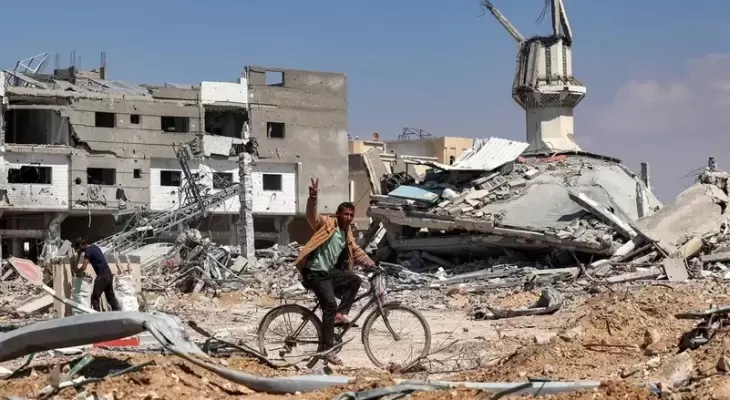
Israel’s deliberate targeting of simple shelters—including makeshift tents and half-destroyed homes—with heavy bombs or suicide drones and without any justified military necessity, reveals a systematic policy aimed at causing the highest possible number of civilian casualties and instilling terror among the Palestinian population. These actions are explicitly prohibited under international law.

Most of Israel’s attacks, which strike purely civilian sites, are not followed by any official attempt to justify the targeting. In some cases, Israeli military sources will claim a member of an armed Palestinian faction was the target. Such flimsy pretexts neither justify the enormous number of civilian deaths nor reflect the scale of the human and material losses caused by theongoing attacks, however.

Israel routinely repeats the same claim whenever international public opinion rises against its crimes, asserting it was targeting “militants” to justify its attacks on civilians without providing concrete, verifiable evidence or allowing any independent party to verify these claims.

Furthermore, the internal investigations Israel announces after committing certain crimes have lacked independence and seriousness. These investigations are obviously not intended to hold perpetrators accountable or achieve justice, and serve mainly to provide formal cover for the soldiers and officers involved. In the rare instances where punitive measures are taken, they are limited to minor administrative actions that in no way reflect the gravity of the crimes committed or the severity of the violations.

Israel’s claims, in and of themselves, do not absolve it of its responsibilities under international law, including the duty to conduct effective investigations, hold perpetrators accountable, and provide redress to victims. Euro-Med Monitor strongly condemns the automatic acceptance of unsubstantiated Israeli allegations, as silent complicity effectively grants Israel a license to continue targeting civilians under a false legal cover, thus undermining the substance and effectiveness of the international legal system.

Even if a combatant were assumed to be present or passing through an area, this would not justify these brutal massacres nor absolve Israel of its obligations under international law and international humanitarian law. Israel remains fully bound to uphold the principles of humanity, distinction, military necessity, proportionality, and precaution. To ensure the minimum possible loss of civilian life and injury, these obligations must be respected during the planning and execution of any military operation, including taking precautions in the choice of methods and means of warfare, without exception.

Israeli massacres against Palestinians have become a familiar sight, met with near-total silence despite the genocide essentially being livestreamed across the globe. It’s as if the killing of Palestinian civilians—openly committed by Israel and its allies without fear of legal or moral consequences—has become an implicitly accepted reality within the international system.

International indifference to this pattern of crimes is not merely a moral failure but a grave breach of the legal obligations of states and the international community. It transforms the mass killing of Palestinians from criminal acts into policies carried out openly before the entire world. Silence in the face of these crimes constitutes a clear failure to fulfil the legal duty to prevent genocide and punish its perpetrators, as mandated by the 1948 Convention on the Prevention and Punishment of the Crime of Genocide.

The Israeli killing methodology reflects a clear policy aimed at eliminating Palestinian civilians across the Gaza Strip, spreading panic, depriving them of shelter or stability, forcing repeated displacements, and subjecting them to deadly living conditions. All of this is compounded by ongoing Israeli bombardment across the Strip, including attacks on areas designated as humanitarian zones, and the targeting of shelters, even those located within UNRWA facilities.

All states, individually and collectively, must fulfill their legal responsibilities by taking urgent action to stop the genocide in the Gaza Strip, through implementing effective measures to protect Palestinian civilians, ensuring Israel’s compliance with international law and the decisions of the International Court of Justice; and holding Israel accountable for its crimes against the Palestinians. The International Criminal Court must reissue arrest warrants for the Israeli Prime Minister and Minister of Defence at the earliest opportunity, in accordance with the principle that there is no immunity for international crimes.

The international community must also impose economic, diplomatic, and military sanctions on Israel for its systematic and grave violations of international law. These sanctions should include an arms embargo; an end to all political, financial, and military support; freezing the assets of officials involved in crimes against Palestinians; imposing travel bans; and suspending trade privileges and bilateral agreements that provide Israel with economic benefits that enable its continued crimes.

CrossFireArabia

CrossFireArabia

Dr. Marwan Asmar holds a PhD from Leeds University and is a freelance writer specializing on the Middle East. He has worked as a journalist since the early 1990s in Jordan and the Gulf countries, and been widely published, including at Albawaba, Gulf News, Al Ghad, World Press Review and others.

Related Posts

Wounders of Arabic

EDITOR’S NOTE: I wrote this article “On Arabic” in 2008 and posted on hackwriters.com. I am reprinting it here for relvance and archival use

Compared with English, Arabic is an easy read if it is written well. When you look at English, the perception of the language, written and oral, took centuries of development from archaic structures associated with the old English of Geoffrey Chaucer, passing to Shakespeare and Christopher Marlow to George Elliot, Charles Dickens, Virginia Wolfe as well as many others and not mentioning the new contemporaries.

With Arabic it’s different. Although there may have been stages of development through out the centuries, it seems the clarity of the Arabic language was a one-time affair, represented in the Holy Koran brought down from the skies through Angel Gabriel to Prophet Mohammad in the 7th century and passed on to the Muslim community.

The Koran represented a basis for the Arabic language as it is spoken and written today. Unlike English, back in the 7th century Arabic was written in a clear, transparent, effective tone that involved action, and designed from every member of the social community, rich and poor, educated and illiterate, a source of knowledge and speech and continued to be so as it passed down through the centuries.

With English it was different. First if all, the language itself was derivative from other linguistic structures like Germanic, Latin, and French, many of which have said this is what made it stronger; Secondly English was helped by the issue of economic development as new inventions, processes and way of doing things required the development of new words, terminologies and syntax which evolved from the 17th century onwards.

Today some have been known to criticize Arabic for failing to be innovative, or developing to meet the needs of modernization and even globalization, with its inability to produce new words and terminologies to pace with the development going on in the region and the world.

However, one of the points that has to be clarified is that as these inventions came from the western countries and as communicated in English, the language proved more flexible in coming up with new words and terms, as opposed to the Arabic language that adopted a reactive approach with linguists from the region acting haphazardly in their word formations rather than following a methodical pattern.

In the process as well, we tend to get used to hearing the words and terminologies in say the English language and when we hear their equivalents in other languages such as Arabic, as there is a sense of word creation even in translations, it becomes odd and foreign simply because our ears have got used to the English pronunciation.


But this is a different view related to globalization, how much are we as Arabs integrated into the international system, how much we take from it, what do we take, what do we buy, our consumer habits and trends and indeed, how much do we produce and contribute to world society.

While this in turn becomes related to our language, its use, how much we mix words, English-Arabic, Arabic-English, the fact of the matter is that the language itself, spoken by about 300 million people in 22 Arab countries and about a 1.5 billion in Muslim countries who read the Koran in Arabic, says a great deal.

Arabic is a cogent force, its simple, attractive and gets the point across in as a logical manner as possible. It’s easy to read and to understand. It’s structure is less complex as say French and German which are grammatically more demanding than the English language.

However, just like any other language, writing in Arabic has to be learnt, it’s a professional skill; that’s why today there is an endless beating about the bush were getting the idea across is deliberately pumped and inflated and there is much hankering because of political considerations relating to ruler, government, state, security apparatuses and so on.


These considerations are over-riding and smack directly with the professionalism of writing and the way the writing of Arabic should be as passed on and continued through out the holy Koran which is sometimes used as a source of criticism by western writers and pedagogics who claim the Arabic language lacks the basis for producing new words as do the other languages.

But when Arabic is spoken and written as part of the social community there is a sense of modernist continuum as expressed in its words, expressions, figures of speech and syntax found in the structure of the language.


Nowhere is this more emphasized than it is in the Koran. Written in the 7th century, the Koran is timeless in its spiritual message, a modernist document in its approach with words, phrases and expressions that apply as much today as when it was handed down, memorized and collectively written.

Words and expression apply as much then as they apply today. The word “car” for instance is used in one of its Suras (chapters) to signify a caravan route whereas its use today implies a vehicle, and striking the reader as if you are reading a modern document about social relations, economy, authority, and kinship.

The style of language appears to be modernist as well and not with case as it is say with the Bible that is written in old English, not as old as the language used by Chaucer, but is hard to fathom just the same.

That has proved problematic for the Koran. When translated into English translators often use the kind of language that is employed by the Bible, which does not reflect the actual modernist style of the Koran for the lucidness of the holy document becomes lost and replaced by an archaic and medieval structure once found in the language, although English has moved on tremendously.

© Marwan Asmar May 2008

Continue reading
Dad Digs For Family After Israel Bombs Their House

Hammad’s house in the Sabra neighborhood was destroyed Dec. 6, 2023, during heavy Israeli bombardment. He said a powerful bomb weighing around 2,000 pounds (907 kilograms) struck the building while the family was inside.

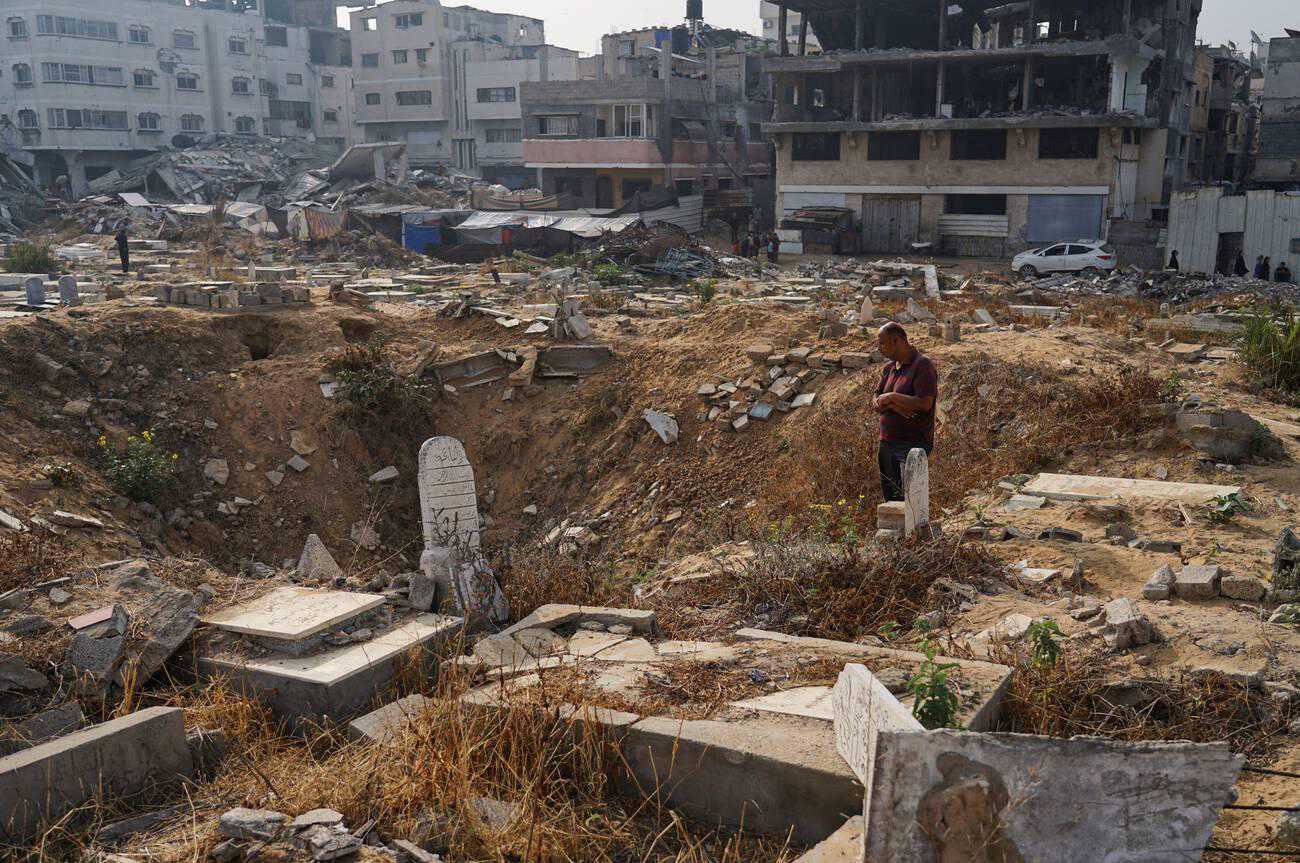
On a mound of sand and shattered concrete that once formed the foundation of his six-story home in Gaza City, Mahmoud Hammad digs methodically through the debris, searching for the remains of his wife and children killed beneath the rubble.

Armed with little more than a small shovel and a metal sieve, the 45-year-old father filters sand by hand, hoping to find bone fragments that would allow him to lay his family to rest.

“In the absence of machinery, this is what we have,” he said, holding up the sieve.

Home reduced to dust

Hammad’s house in the Sabra neighborhood was destroyed Dec. 6, 2023, during heavy Israeli bombardment. He said a powerful bomb weighing around 2,000 pounds (907 kilograms) struck the building while the family was inside.

He lost his wife, six children, his brother, his brother’s wife and their four children.

Hammad survived but sustained severe injuries, including multiple rib fractures and injuries to his shoulder and pelvis. After months of partial recovery, he returned to the site to begin searching for his family’s remains.

“I wanted to bury them properly,” he said.

With the help of neighbors, he managed to retrieve and bury his brother and his brother’s family. But the bodies of his wife and children remain under layers of hardened debris.

“I collect what I can, piece by piece,” he said.

Missing under the rubble

Nearly 9,500 Palestinians are missing beneath destroyed buildings across the territory, according to official estimates in Gaza.

Officials said recovery efforts are severely hindered by the lack of heavy equipment needed to clear the debris. Despite a ceasefire that took effect in October, authorities said the entry of large-scale machinery remains restricted, limiting the ability of rescue teams to reach buried bodies.

Civil defense crews have repeatedly warned that the longer debris remains uncleared, the harder it becomes to recover remains.

Private grief amid mass destruction

Hammad said his wife was pregnant and close to delivery when the strike occurred, as medical services across Gaza were collapsing under the strain of the war.

“She and our unborn child died together,” he said.

Since December, Gaza has been battered by repeated storms that further displaced families living in makeshift shelters after their homes were destroyed.

For Hammad, however, the focus remains on the ruins before him.

Each day, he returns to sift through dust and fragments of concrete, driven by what he describes as a simple duty.

“They deserve to be buried with dignity,” he said.

At least 591 Palestinians have been killed and more than 1,598 injured in Israeli attacks since a ceasefire deal took effect Oct. 10, according to Gaza’s Health Ministry.

​​​​​​​‏Israel’s war on Gaza, which began Oct. 8, 2023, and lasted two years, has killed more than 72,000 Palestinians and wounded over 171,000, most of them women and children, and destroyed about 90% of Gaza’s civilian infrastructure.

By Tarek Chouiref in Istanbul for Anadolu

Continue reading

You Missed

IRGC says Iran started its Operation True Promise 26 by launching missiles and drones against Israel

IRGC says Iran started its Operation True Promise  26 by launching missiles and drones against Israel

Iran Halts Attacks on Neighboring States Unless…

Iran Halts Attacks on Neighboring States Unless…

Iranian govt spokesman: 30% of victims are children; 165 of them killed among 1300 civilians who died by US/Israeli bombing

Iranian govt spokesman: 30% of victims are children; 165 of them killed among 1300 civilians who died by US/Israeli bombing

White House: ‘We destroyed more than 30 Iranian ships and are moving to destroying the navy completely’

White House: ‘We destroyed more than 30 Iranian ships and are moving to destroying the navy completely’

White House: ‘We Have 4 to 6 Weeks to End The Military Operations in Iran’

White House: ‘We Have 4 to 6 Weeks to End The Military Operations in Iran’

IRGC: Iran Has Not Closed The Hormuz Strait Except to Ships Linked to Israel/USA

IRGC: Iran Has Not Closed The Hormuz Strait Except to Ships Linked to Israel/USA