Israeli Army Fails in Ground Campaign in Lebanon

On 1 October, Israel announced the start of its ground military operation into Lebanon, which included air strikes, artillery shelling, and assassinations, but the Israeli occupation army has not yet been able to position itself in any village or town its soldiers have entered due to the resistance from Hezbollah fighters.

High Death Toll

According to Hezbollah the toll of Israeli army losses since the start of what it called the “ground maneuver in southern Lebanon” reached more than 100 dead and 1,000 wounded officers and soldiers, in addition to the destruction of 43 Merkava tanks, 8 military bulldozers, 2 Hummer vehicles, 2 armored vehicles, and 2 personnel carriers, and the downing of 4 Hermes 450 drones, and 2 Hermes 900 drones.

Despite talk of an imminent truce, Israel is still continuing its military escalation and announced the start of a second phase of the “ground incursion” targeting Lebanese villages outside the scope of its first operation in the south of the country.

Military experts told Al Jazeera Israel was surprised by the intensity of the resistance it faced during the ground incursion, despite its success in assassinating a large number of military leaders at the first and second levels.

This partial success prompted it to modify its strategy and shift to a new tactic based on entering areas, booby-trapping buildings, then detonating them, and quickly withdrawing to avoid further human losses, especially after the resistance succeeded in setting up ambushes.

Why has the Israeli army not been able to occupy any Lebanese village despite the military buildup on the northern border for more than a month?

Unable to occupy a single village

Military expert Brigadier-General Hassan Jouni confirmed to Al Jazeera the Israeli military buildup. Despite its five divisions with between 50,000 and 60,000 soldiers according to the Hebrew media, the Israeli army was unable to occupy a single village. He explained there is a fundamental difference in military science between the concepts of raid and occupation.

According to Jouni, a raid is defined as an advance towards a specific target with the aim of detonating or booby-trapping it or carrying out a security or military mission, such as arresting or liquidating someone, followed by a rapid withdrawal. Occupation means controlling a specific target and positioning oneself there, while establishing defensive centres to protect it.

Regarding the events in the south, he considered that what happened was advanced raids targeting specific villages with the aim of destroying them and withdrawing without the intention of remaining.

Jouni pointed out the Israeli decision not to station themselves in those locations came as a result of the fierce resistance their forces faced there, as they realized that any attempt to remain would make them vulnerable to continuous attacks by the resistance, which intensified its targeting of their movements towards the border villages and towns with artillery and missiles.

Does this situation reflect the strength of the Lebanese resistance and/or is it a military strategy followed by the occupation army?

According to Jouni the concentrated ground operation aimed to penetrate deep into Lebanese territory to reach the Litani River, especially after the harsh strikes against the Hezbollah leadership. However, Israel, after believing the resistance had been exhausted, was surprised by its intensity and steadfastness, which prompted it to modify its strategies. Therefore, the actual penetration was less than expected and was limited to a depth of no more than three kilometers.

What is the military significance of the strategy of the occupation army entering border villages and booby-trapping them without completely occupying them?

Blowing up cities

Military expert Brigadier-General Ali Abi Raad told Al Jazeera Net the Israelis seek to achieve two basic goals by blowing up cities. They are:

First, to facilitate the movement of their forces during military operations. In areas that contain buildings, progress becomes more difficult due to the risk of the presence of resistance fighters inside them, which forces them to destroy these buildings to open the way for their movements.

Second, to make these areas uninhabitable, especially those that are considered an “environment for resistance”, such as southern Lebanon. By destroying them, the Israelis isolate the environment that supports the resistance, and punish the residents who may be part of it. This strategy is known as “punitive deterrence”.

Abi Raad confirms that this strategy is not new, but part of the Israeli occupation’s approach in all areas it controls, whether in Gaza, West Bank and/or Lebanon. This approach has been witnessed in several wars, including the 2006 war on Lebanon.

Burned areas?

Is the Israeli occupation seeking to impose a new reality by turning the border areas into burned areas instead of being demilitarized?

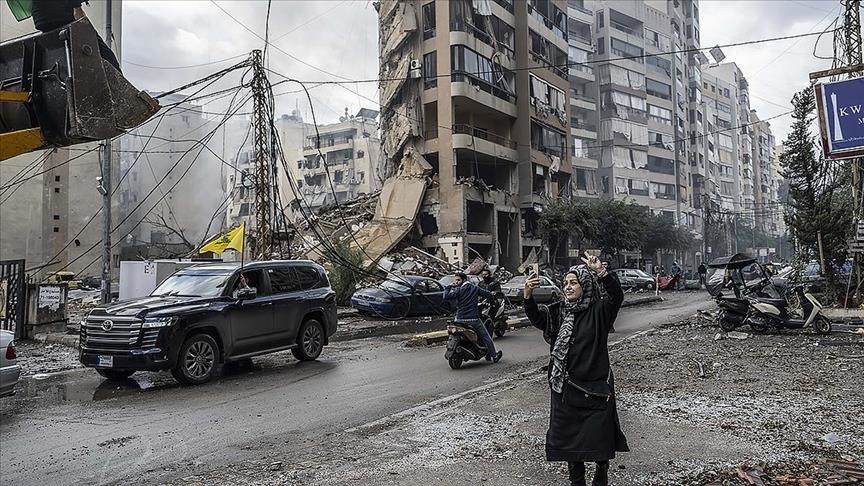
Military expert Abi Raad points out the Israelis are seeking to impose a fait accompli by using internationally banned weapons, such as phosphorous and vacuum bombs, and stated that MK84 bombs were used in the assassination of Hassan Nasrallah, Secretary-General of Hezbollah, and are currently being used in the bombing of the southern suburbs and a number of Lebanese border villages.

He explained that the effects of these shells are clear, as buildings fall completely to the ground and turn into ash, and that the resulting craters reach a width of 3 meters and a length of 7 to 8 meters, or more in some cases, reflecting the extent of the great destruction.

In his opinion, this problem represents a major threat, as the goal of the destruction is to eliminate life in those areas in the long term. He explained that if the war stops now, the reconstruction process is expected to take at least two years, wondering what the situation will be like if the destruction continues and the war worsens?

Do these tactics form part of a strategy aimed at pushing Hezbollah away from the border areas?

Brigadier-General Abi Raad says Hezbollah is part of the population of the south who are closely connected to their land and this war is “defending their lands”, as the border strip is close to homes that were built at huge costs, making it difficult for people to leave them easily, and they will return to them no matter what. Therefore, the idea of ​​​​removing the party from the south or the area south of the Litani is “unrealistic”.

On the political level, he believes an agreement may be reached on stripping  Hezbollah of its weapons in those areas, but the issue is not limited to a range of only 10 or 20 kilometers.

He explained the issue goes beyond the type of weapons the party possesses and the areas in which it is present. When it possesses missiles with a range of up to 100 or even 250 kilometers, then removing it to the north of the Litani will have little effect.

Continue reading
Al-Duwairi: Hamas, Jabalia and Fall of 28 Israeli Soldiers

Retired military, strategic expert Major-General Fayez al-Duwairi said the military operations carried out by the Qassam Brigades recently in Jabalia camp, north Gaza, resulted in the deaths and injuries of at least 28 Israeli soldiers, while the occupation army only announced one or two injuries.

The Hamas military wing, the Qassam Brigades in footage, Saturday showed the destruction of seven Israeli military vehicles in the Jabalia camp; including the targeting of Merkava tanks, military bulldozers, and an armored personnel carrier with shells and missiles from close range.

Injured but fighting

Al-Duwairi explained on Al Jazeera the Qassam footage included several remarkable qualitative operations. He noted what was most surprising was the operation made by one of the injured fighters by targeting a Merkava tank using an explosive charge.

He added: “The first [camera] shot has more than one dimension, as the fighter is talking about his injury, which appeared to be in his hand, prompting him to switch from using a launcher to using a suicide charge, which was more primitive than the previous charges.”

The military expert stressed that what the injured fighter did was an “extraordinary act”, explaining that “no ordinary person or even a trained person can do such an act, especially with an injury to his hand and to get to a tank equipped with all capabilities and potentials”.

In detailing the human losses, Al-Duwairi explained that the armored personnel carrier carries 11 soldiers, and the tank carries a minimum of 4 soldiers with the possibility of the number reaching 10 soldiers, noting the operations included targeting thress tanks, two bulldozers and an armored personnel carrier.

Al-Duwairi pointed out to the nature of the area in which the confrontations took place. He stressed it is a completely rubbled destroyed area were fighters are emerge, adding: “They are a group of fighters, if they had reinforcements the occupation army would not have been able to confront them”.

He pointed out in this situation the large mechanisms of the occupation army “become blindspots”, making their targets possible, but reaching them remains extremely difficult due to the presence of the “quadcopter” aircraft covering the skies of the area.

Continue reading
Expert: Israeli Soldiers in State of ‘War Fatigue’

Military expert Brigadier-General Mohammed Al-Samadi said the killing of five Israeli soldiers in two separate incidents in the Gaza Strip confirms the resistance’s exploitation of the rubble and debris of houses to launch sniper operations against occupation soldiers.

Al-Samadi added Israel imposes a blackout and censorship on its real losses in Gaza, as the operations indicate they are much greater than what is announced, pointing out the morale of the soldiers has declined significantly, because they have come to realize the futility of the war they are fighting.

The military expert cited talk about reducing the periods of service of the occupation forces, saying it confirms attempts to reduce cases of evasion from conscription and perhaps complete abstention from service due to frustration and “war fatigue”.

According to Al-Samadi, the resistance does not need large numbers of fighters to launch its operations, while the occupation army needs entire battalions and brigades in order to continue the war.

He pointed out the danger of the Israeli soldiers’ reluctance to go to war “at this dangerous stage in the life of the state”, and said that it reflects a lack of faith in the political leadership and the usefulness of the war, in addition to the fact that last October was the bloodiest month in the ranks of the occupation army.

Reducing period of service

The Israeli occupation army decided to reduce the period of reserve service from an average of 20 weeks for each soldier to only 9 weeks after the unusual decrease in the number of applicants for service, according to Israeli media.

Israeli media revealed a significant decrease in the number of reserve soldiers joining the Israeli army as a result of the government pushing a bill that allows the continued exemption of religious Jews from military service, as well as due to fatigue.

Yedioth Ahronoth newspaper said that the army is concerned about a decrease of between 15% and 25% in reserve service, and explained that this feeling emerged in recent weeks in the combat brigades in the Gaza Strip, and on the northern front – during the war on Lebanon – stressing that it affects the army’s operational decisions according to Al Jazeera.

Continue reading
Trump Signals New Arab-Israeli ‘Normalization’  

President of the Kuwaiti-based Reconnaissance Center for Research and Studies Abdul Aziz Al-Anjari, confirmed Donald Trump’s return to the White House next January will pave the way for the implementation of a pre-prepared plan to bring about radical changes in the Middle East.

Normalization

Al-Anjari, a member of the National Press Club in Washington, told Quds Press this plan seeks “to push towards almost complete normalization in the region, and to form a ‘new Middle East’ to strengthen Israeli hegemony, and establish the role of the United States as the main guarantor of this trend.”

Al-Anjari pointed out that “the plans are proceeding, despite the hopes of peoples demanding justice, and international human rights movements supporting Palestinian rights, but decisions are ultimately taken at the level of governments, most of which have shown a tendency towards greater rapprochement with Israel, and adopting a security vision that excludes all forms of armed resistance, which governments consider a threat to stability in the region.”

He added that “US-Israeli cooperation includes steps to enhance rapprochement with Israel by imposing laws that limit the boycott of Israeli products, measures that prevent some countries from rejecting Israeli travelers, or restricting the permission of Israeli aircraft to use airspace.

These policies aim to relieve some governments of the embarrassment they feel in front of their people, and to show that they find themselves forced to approach Israel under legal and diplomatic pressures, while the truth is that these plans are known in advance to some governments as part of broad normalization plans,” he said.

Two-state solution

Al-Anjari also touched on the issue of the “two-state solution,” considering it “a mere mechanism for managing the conflict, not resolving it, as this solution, as proposed today, seeks to grant the Palestinians an entity with diminished sovereignty and space, while consecrating the recognition of Israel as a fully sovereign state.”

The Kuwaiti analyst criticized what he described as “the contradiction in the positions of some parties calling for the two-state solution, which “support this solution, but refuse to recognize Palestine as a state,” considering that this “reflects a duality aimed at deceiving public opinion.”

The issue of Palestinian refugees and “two-state solution, if implemented, which is highly unlikely, will ignore the right of return; as Israel categorically rejects this right for fear of affecting its demographic balance, while granting the right of return to every Jew around the world, which leaves millions of Palestinian refugees without their basic rights.”

He added that “this makes the proposed Palestinian state lacking sovereignty, without real control over its borders, and unable to make its decisions freely.”

He pointed to “the possibility of future changes through elections in democratic countries, if their people are able to choose governments that support Palestinian rights.”

Continue reading
Analysis: Hezbollah’s War Strategy Against Israel

Military and strategic expert Fayez al-Duwairi said the resistance’s performance witnessed a qualitative development. He pointed to a recurring pattern pf targeting the Israeli depth reaching a distance of 145 kilometers from the Lebanese border.

He explained that this development is accompanied by an increasing focus on targeting strategic military bases in Israel.

Al-Duwairi continued the resistance has begun to target the main strengths of the Israeli army, specifically the armored forces on the Blue Line and the air bases from which the aircrafts take off from.

He stressed targeting air bases is a strategic priority for them, as hitting a vital part of any base can disable them for hours, which reduces the number of sorties.

In his assessment of missile capabilities, the military expert explained the current range of missiles requires them to be launched from a depth of no less than 160 kilometers, pointing to the diversity of the missile systems used, as the Fateh missiles, for example, have a range of 300 kilometers, while the payload of the explosive warheads ranges between 70 and 500 kilograms.

Dense Barrages

Regarding the tactics used, Al-Duwairi pointed out Hezbollah’s strategy is to flood the skies of Israel with dense barrages of missiles, simultaneously with sending drones.

He pointed out that this tactic exploits the weaknesses of the Israeli Iron Dome system, which has only 10 batteries, while it needs 14-17 batteries to cover the all of the Israeli-occupied Palestine.

The military expert warned of the limited efficiency of the Israeli defense system, which does not exceed 65%, even with its reinforcement by the Iron Beam and the David’s Sling systems.

He explained the resistance exploits these loopholes by launching short-range missiles to flood the batteries, followed by long-range missiles or drones, which are tactics that have proven successful on several occasions.

Al-Duwairi stressed that the success of this strategy depends on precise coordination between different types of weapons and the appropriate timing of attacks, noting that the resistance is demonstrating an increasing ability to manage military operations with high efficiency.

Continue reading