Happy Parents: Premature Babies Returned to Gaza

“I am meeting my daughter for the first time. It’s as if today is the day of her birth. I can’t describe my feelings.”

By Abdel Qader SabbahJawa Ahmad, and Sharif Abdel Kouddous

KHAN YOUNIS, GAZA—Ahmed Al-Harsh waited outside Nasser Hospital in Khan Younis on Monday to meet his son, a toddler and the only other survivor of his entire family.

“I’m waiting for my son Mahmoud. I haven’t seen him in two and a half years except once, before he was transferred to Egypt. I’ve been waiting for two and a half years,” Al-Harsh, 31, told Drop Site News.

Mahmoud is one of 28 Palestinian infants who were evacuated to Egypt as premature babies in November 2023 from the neonatal intensive care unit in Al-Shifa Hospital in Gaza City, as the Israeli military laid siege to the medical complex and raided it. Mahmoud and seven other children were returned to Gaza on Monday to be reunited with their families, or what was left of them.

On October 14, 2023, one week into Israel’s genocidal assault on Gaza, the Israeli military bombed the Al-Harsh’s family home in the Jabaliya refugee camp. Al-Harsh’s entire family was killed in the attack—his four-year-old daughter, his father, mother, brother, sisters-in-law, nephews, and nieces. Al-Harsh initially thought his wife, who was eight months pregnant at the time, had also been killed. He only later learned that she had been gravely injured and had given birth to their son, Mahmoud, in hospital before succumbing to her injuries.

(Left) Ahmed Al-Harsh outside Nasser Hospital in Khan Younis as he waits for his son, Mahmoud, to arrive after 2.5 years in Egypt. (Right) Ahmed Al-Harsh holds up a photo of his son Mahmoud on his phone. March 30, 2026. Screenshots of video provided by Abdel Qader Sabbah.

Al-Harsh was able to see Mahmoud only once before he was taken to the neonatal intensive care unit in Al-Shifa’s hospital for care. He had been staying in Beit Lahia, unable to move amid the escalating Israeli assault. In November, Israel laid siege to Al-Shifa hospital, surrounding the medical complex and cutting it off from the rest of Gaza City before raiding it on November 15. Doctors inside scrambled to keep their patients alive, including the nearly 40 premature babies in the hospital’s neonatal intensive care unit, Mahmoud among them. There was no electricity and incubators were failing. The World Health Organization, which was able to coordinate a one-hour visit to Al-Shifa at the time, described the hospital as a “death zone.”

After much negotiation, 31 premature babies were evacuated from Al-Shifa on November 19 and taken to Rafah. UNICEF said the conditions of the babies had been “rapidly deteriorating” inside the besieged hospital. Five died before they could be evacuated. The next day, 28 of the babies were transported across the border to Egypt for treatment. None were accompanied by family members.

For the past two and a half years, Al-Harsh has seen his son only in photos or videos sent to him from Egypt—first as an infant, then a toddler. “The feeling is indescribable. What can I tell you about this feeling?” he said. “These two years felt like forty, even more—a lifetime. During this time, I was a body without a soul. I couldn’t work or do anything.”

Video of the convoy arriving at Nasser Hospital in Khan Younis bringing eight children who were evacuated from Gaza to Egypt in November 2023. March 30, 2026. Video provided by Abdel Qader Sabbah.

By early afternoon on Monday, the convoy from Egypt finally arrived. A Red Crescent ambulance and UN vehicles escorted a large bus carrying the children. Families crowded around the doors as they pulled up outside Nasser Hospital. The children were passed into the waiting arms of family members, most of them meeting for the first time, in scenes of joy. Al-Harsh appeared overwhelmed with emotion as he held Mahmoud, chubby, bespectacled and crying, in his arms. When Mahmoud grabbed a bottle of water and drank thirstily, Al-Harsh broke down and wept.

“Every human being needs the love of a mother and father. I am 31, I lost my mother and father, and I’m still suffering,” Al-Harsh said. “This boy—where do I find him a mother? Where do I find him his mother? When he grows up and asks about his mother, what do I tell him?”

At least four of the babies who were evacuated to Egypt died while there, Dr. Ahmed Al-Farra, the director of the pediatric department at Nasser Hospital, told Drop Site. He added that the children who returned to Gaza, while healthy, would require additional medical and psychiatric evaluation.

Gaza’s health care system has been systematically destroyed by the Israeli military since October 2023. Every single hospital was attacked and 25 were completely shut down while 13 remain partially functioning, according to Gaza’s Health Ministry. Despite a “ceasefire” that went into effect in October, Israel has continued near daily attacks in Gaza, killing over 700 Palestinians since then. Israel has also continued to severely restrict the amount of humanitarian aid, fuel, medicine and other essentials, allowing in an average of only 200 trucks daily instead of the 600 agreed upon in the deal.

At the onset of the U.S.-Israeli war against Iran on February 28, Israel reinforced a total siege on Gaza, citing “security concerns.” The Kerem Shalom crossing was partially reopened three days later. The Rafah Crossing between Gaza and Egypt—which had only opened in early February for medical evacuations and for Palestinians returning to Gaza—was also closed at the onset of the Iran war and only reopened on March 18. Roughly 20,000 people are on waiting lists for medical evacuation abroad, 4,000 of them children, according to the Health Ministry.

The Gaza Health Ministry this week warned of a severe shortage of generator fuel that threatened hospital operations. The Ministry said that remaining generators are “worn out and prone to repeated breakdowns,” placing critical departments such as intensive care, surgery, neonatal units, and dialysis at risk of shutting down. Israeli forces have allowed the entry of only 1,240 fuel trucks out of the 8,350 that were supposed to enter over the 167 days since the ceasefire agreement took effect—a compliance rate of just 14.8%—according to the latest statistics from officials in Gaza shared with mediators and obtained by Drop Site. The Health Ministry warned that 90 generators are already out of service, while 11 are running on limited supplies. All hospitals in Gaza remain fully dependent on emergency back-up generators, according to OCHA.

Regardless of the continued Israeli siege and daily military assaults, the families who were finally reunited with their children in Gaza on Monday after nearly two and a half years of separation, described the moment as nothing short of miraculous.

Sundus Al-Kurd was among them. She was badly wounded in an Israeli airstrike on her family home in Beit Lahia on October 22, 2023. Her daughter Habibat Al-Rahman was killed in the attack. Eight months pregnant, Al-Kurd was rushed to hospital where doctors operated on her to save her life and conducted an emergency delivery to save her unborn daughter, Bissan.

“On the day I gave birth to my daughter, I lost her only sister,” Al Kurd said.

“When I woke up, I asked, ‘Where is my daughter?’ They told me, ‘Your daughter is fine and doing well,’” she added. “They told me she was in an incubator and that due to my health condition I wouldn’t be able to care for her.”

Al-Kurd continued to recover from her injuries and was unable to see her daughter before the Israeli military attacked Al-Shifa in November 2023.

“I was evacuated from the hospital with difficulty and I asked to take my daughter with me, but they said I wouldn’t be able to care for her due to my medical condition,” she said.

Having lost her other daughter, parents, and two siblings during the war, Al-Kurd said she could not bear the thought of losing Bissan, whom she described as “a gift and compensation from God.” Al-Kurd did not know what had happened to her daughter until much later when she found out she had been among the 28 premature babies evacuated to Egypt.

Sundus Al-Kurd holds up a traditional Palestinian dress she brought for her daughter Bissan, who returned to Gaza after being evacuated to Egypt 2.5 years ago for medical treatment. Khan Younis. March 30, 2026. Screenshot of video by Abdel Qader Sabbah.

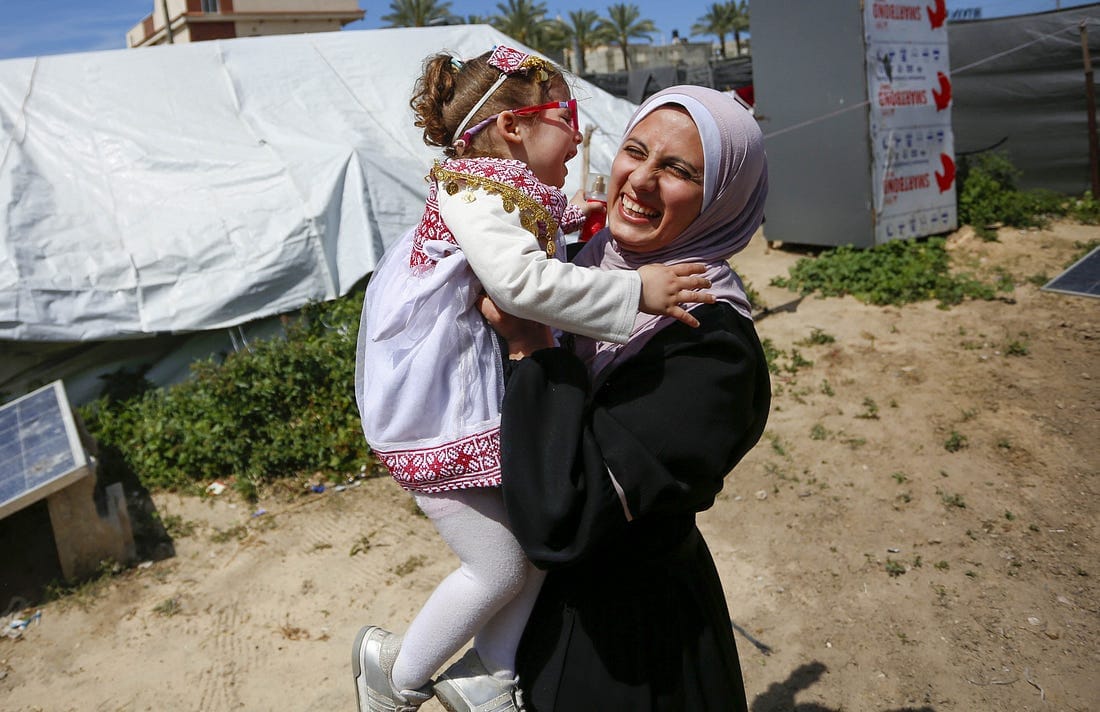
“Today, after two and a half years, God willing, we will be reunited with our daughter,” Al-Kurd said. She brought a traditional Palestinian dress for Bissan to wear. When her daughter finally arrived in the convoy to Nasser hospital, Al-Kurd held her tightly before dressing her in the white and red dress as relatives took turns embracing her.

“I am meeting my daughter for the first time,” she said. “It’s as if today is the day of her birth. I can’t describe my feelings.” Drop Site

Continue reading
Welcome Ramadan

The whole Muslim world— 2 billion people—start fasting just before the sun raises to sun-down as commitment to God and his commands. The Sohour of eating before the sun raise is a religious ritual, designed to give us the strength to carry on the day till sundown when we break the fast.

Ramadan is a commitment to God, one of whose characteristics is to feel with the poor and hungry and realize the Almighty has bestowed upon you greater material things you should appreciate and not over-indulge in or use in excess.

We try to apply the teachings of the Quran and Islam during the holy month, and not indulge in over-eating after the breaking of the fast, but I suppose like anybody else we are guilty of not sufficiently feeling with the poor, despite the fact it is rife, and you see them everywhere men, women and children holding their hand out to you in the street and coming to your shop and asking for money.

But, this is human nature, the way we have been molded, from the day we were first conceived in the womb, that’s why Islam came to us as a source of spiritual salvation, as enlightenment, a methodology, a way of thinking, and a way of life to be connected to God.

I like Ramadan, because for one whole month our lives appear to be turned upside down. Our eating habits change, our sleeping habits change, we start praying on a regular basis, and maybe hear the word of God more often on our lips than we usually do in any other part of the year. Many start praying, the regular five times a day routine.

We are supposed to stop indulging in idle talk and stop talking about other people behind their backs and just keep to one self in spiritual solitude, praying to and thinking about the connection that binds us to God. In Islam, we are constantly told through the Koran to think how we are made, think of the universe, the earth and the skies, and ponder on the vastness and the extraordinary ability of that omnipotent being and examine that eclectic relations where we are supposed to obey commands, and are intrinsically related to the wishes of God, but at the same time have the freewill to make our decisions, and reach conclusions of our own.

I like Ramadan because we don’t spend much, we cut down on our spending habits, we eat what’s in the fridge, and that includes the leftovers, we eat lots of salad, or fatoush (bread and salad) and Qatayeef (small velvety bread with almonds or cheese and sugar) for sweetners, but try not to indulge, buy lots of Qamar Din (apricot drink ) for instance to prevent thirst.

My wife keeps telling me we are not representative of other people, who engage in a spending spree of over-buying food that necessarily goes to waste. We try to stick to basics, although consumption booms during the holy month.


We do however continue to drink Pepsi or Coke with guilt complexes about not boycotting the soft drinks because of being sold freely in Israel that is still widely regarded as an occupation state.

But we try console ourselves by saying the game of boycott is bigger than us, the fizzy soft drink maybe unbearable to resist despite the fact that more and more people maybe shying away. We say it’s a great game of power politics and economics and that the road to non-violent action is long and dreary, and needs commitment. Though many people are tutning to boycott these days because of the Israeli genocide in Gaza.

Instead we limit our devotion to the cultural, religious and spiritual aspects of life, ideas and feelings which we feel we have control over. We like to think of Ramadan as “civilizational”, enriching our soul, with good things in life ones that would please God. In themselves these are deep fulfilling issues but are they enough when so many things are wrong in this world!

Good for the tummy!

Ramadan has practical aspects as well. It is actually good for the stomach, it’s healthy, by a process of denial we are actually enriching our body. By ceasing to eat for one month, you are giving your stomach a rest, from the constant chewing and churning of food, from the everyday wants of avarice, indulging in unnecessary needs and unwanted desires.

As human beings, we constantly drive our selves beyond bodily needs, we eat, drink and copulate in excess, without realizing the damage we are doing to ourselves, our liver, intestines, heart and blood circulation.

In Ramadan our body clock sort of eases down, developing a slower pace to relax and push its muscles in the way it wants, by fasting we are in fact protecting our circulation system, stopping our hands from reaching for the cup of coffee all the time or the pack of cigarettes, from munching from the fridge at all hours of the day. Ramadan is about developing will-power and instituting a method to our life.

In Ramadan the focus shifts from superfluous wants to spiritual needs, with the net result of rejuvenating our bodies both physically and spiritually. Of course as Muslims, we need to increase that spirituality through constant prayers and the utterance of God on our lips which demands a certain amount of will-power to forego immediate pleasures like watching the television and Arabic soap operas which tend to be plenty of in Ramadan. We unfortunately fall guilty to these whims!

If we are fasting for strictly religious reasons, rather than those who just abstain for customary and social reasons—which is the case for quite a lot people—we don’t feel as hungry as the others because there is a purpose, objective and a goal in our fast.

Hunger and thirst is deflected through religious reverence, prayer and ablution that refreshes our very being and increases our will power to help our fellow-beings while devoting our mind, body and soul to a higher being, God.


Ramadan increases our spiritual perception, makes us more pious and in some cases humble. Ramadan lowers our threshold of selfishness, greed, individualism, immediate family interests. It makes the need for togetherness, collectiveness, know the needs of thy neighbor and extend a helping hand that much more greater.


Ramadan is about helping to build the nation and make it strong by making its communities wield together, it’s about kin and folk rather than parochialism and isolationism.

This article was piblished was published on the hackwriters website in 2007.

Continue reading
Wounders of Arabic

EDITOR’S NOTE: I wrote this article “On Arabic” in 2008 and posted on hackwriters.com. I am reprinting it here for relvance and archival use

Compared with English, Arabic is an easy read if it is written well. When you look at English, the perception of the language, written and oral, took centuries of development from archaic structures associated with the old English of Geoffrey Chaucer, passing to Shakespeare and Christopher Marlow to George Elliot, Charles Dickens, Virginia Wolfe as well as many others and not mentioning the new contemporaries.

With Arabic it’s different. Although there may have been stages of development through out the centuries, it seems the clarity of the Arabic language was a one-time affair, represented in the Holy Koran brought down from the skies through Angel Gabriel to Prophet Mohammad in the 7th century and passed on to the Muslim community.

The Koran represented a basis for the Arabic language as it is spoken and written today. Unlike English, back in the 7th century Arabic was written in a clear, transparent, effective tone that involved action, and designed from every member of the social community, rich and poor, educated and illiterate, a source of knowledge and speech and continued to be so as it passed down through the centuries.

With English it was different. First if all, the language itself was derivative from other linguistic structures like Germanic, Latin, and French, many of which have said this is what made it stronger; Secondly English was helped by the issue of economic development as new inventions, processes and way of doing things required the development of new words, terminologies and syntax which evolved from the 17th century onwards.

Today some have been known to criticize Arabic for failing to be innovative, or developing to meet the needs of modernization and even globalization, with its inability to produce new words and terminologies to pace with the development going on in the region and the world.

However, one of the points that has to be clarified is that as these inventions came from the western countries and as communicated in English, the language proved more flexible in coming up with new words and terms, as opposed to the Arabic language that adopted a reactive approach with linguists from the region acting haphazardly in their word formations rather than following a methodical pattern.

In the process as well, we tend to get used to hearing the words and terminologies in say the English language and when we hear their equivalents in other languages such as Arabic, as there is a sense of word creation even in translations, it becomes odd and foreign simply because our ears have got used to the English pronunciation.


But this is a different view related to globalization, how much are we as Arabs integrated into the international system, how much we take from it, what do we take, what do we buy, our consumer habits and trends and indeed, how much do we produce and contribute to world society.

While this in turn becomes related to our language, its use, how much we mix words, English-Arabic, Arabic-English, the fact of the matter is that the language itself, spoken by about 300 million people in 22 Arab countries and about a 1.5 billion in Muslim countries who read the Koran in Arabic, says a great deal.

Arabic is a cogent force, its simple, attractive and gets the point across in as a logical manner as possible. It’s easy to read and to understand. It’s structure is less complex as say French and German which are grammatically more demanding than the English language.

However, just like any other language, writing in Arabic has to be learnt, it’s a professional skill; that’s why today there is an endless beating about the bush were getting the idea across is deliberately pumped and inflated and there is much hankering because of political considerations relating to ruler, government, state, security apparatuses and so on.


These considerations are over-riding and smack directly with the professionalism of writing and the way the writing of Arabic should be as passed on and continued through out the holy Koran which is sometimes used as a source of criticism by western writers and pedagogics who claim the Arabic language lacks the basis for producing new words as do the other languages.

But when Arabic is spoken and written as part of the social community there is a sense of modernist continuum as expressed in its words, expressions, figures of speech and syntax found in the structure of the language.


Nowhere is this more emphasized than it is in the Koran. Written in the 7th century, the Koran is timeless in its spiritual message, a modernist document in its approach with words, phrases and expressions that apply as much today as when it was handed down, memorized and collectively written.

Words and expression apply as much then as they apply today. The word “car” for instance is used in one of its Suras (chapters) to signify a caravan route whereas its use today implies a vehicle, and striking the reader as if you are reading a modern document about social relations, economy, authority, and kinship.

The style of language appears to be modernist as well and not with case as it is say with the Bible that is written in old English, not as old as the language used by Chaucer, but is hard to fathom just the same.

That has proved problematic for the Koran. When translated into English translators often use the kind of language that is employed by the Bible, which does not reflect the actual modernist style of the Koran for the lucidness of the holy document becomes lost and replaced by an archaic and medieval structure once found in the language, although English has moved on tremendously.

© Marwan Asmar May 2008

Continue reading
Dad Digs For Family After Israel Bombs Their House

Hammad’s house in the Sabra neighborhood was destroyed Dec. 6, 2023, during heavy Israeli bombardment. He said a powerful bomb weighing around 2,000 pounds (907 kilograms) struck the building while the family was inside.

On a mound of sand and shattered concrete that once formed the foundation of his six-story home in Gaza City, Mahmoud Hammad digs methodically through the debris, searching for the remains of his wife and children killed beneath the rubble.

Armed with little more than a small shovel and a metal sieve, the 45-year-old father filters sand by hand, hoping to find bone fragments that would allow him to lay his family to rest.

“In the absence of machinery, this is what we have,” he said, holding up the sieve.

Home reduced to dust

Hammad’s house in the Sabra neighborhood was destroyed Dec. 6, 2023, during heavy Israeli bombardment. He said a powerful bomb weighing around 2,000 pounds (907 kilograms) struck the building while the family was inside.

He lost his wife, six children, his brother, his brother’s wife and their four children.

Hammad survived but sustained severe injuries, including multiple rib fractures and injuries to his shoulder and pelvis. After months of partial recovery, he returned to the site to begin searching for his family’s remains.

“I wanted to bury them properly,” he said.

With the help of neighbors, he managed to retrieve and bury his brother and his brother’s family. But the bodies of his wife and children remain under layers of hardened debris.

“I collect what I can, piece by piece,” he said.

Missing under the rubble

Nearly 9,500 Palestinians are missing beneath destroyed buildings across the territory, according to official estimates in Gaza.

Officials said recovery efforts are severely hindered by the lack of heavy equipment needed to clear the debris. Despite a ceasefire that took effect in October, authorities said the entry of large-scale machinery remains restricted, limiting the ability of rescue teams to reach buried bodies.

Civil defense crews have repeatedly warned that the longer debris remains uncleared, the harder it becomes to recover remains.

Private grief amid mass destruction

Hammad said his wife was pregnant and close to delivery when the strike occurred, as medical services across Gaza were collapsing under the strain of the war.

“She and our unborn child died together,” he said.

Since December, Gaza has been battered by repeated storms that further displaced families living in makeshift shelters after their homes were destroyed.

For Hammad, however, the focus remains on the ruins before him.

Each day, he returns to sift through dust and fragments of concrete, driven by what he describes as a simple duty.

“They deserve to be buried with dignity,” he said.

At least 591 Palestinians have been killed and more than 1,598 injured in Israeli attacks since a ceasefire deal took effect Oct. 10, according to Gaza’s Health Ministry.

​​​​​​​‏Israel’s war on Gaza, which began Oct. 8, 2023, and lasted two years, has killed more than 72,000 Palestinians and wounded over 171,000, most of them women and children, and destroyed about 90% of Gaza’s civilian infrastructure.

By Tarek Chouiref in Istanbul for Anadolu

Continue reading
Over 50,000 Foreigners Serve in The Israeli Army

Israeli military data identifies over 50,000 foreign nationals, including Western and Arab citizens, serving during the Gaza genocide.

Key Developments

  • Israeli figures show over 50,000 soldiers hold foreign citizenship alongside Israeli nationality.
  • Largest contingents come from the United States, France and Russia, alongside multiple European states.
  • Rights groups urge investigations under universal jurisdiction laws over Gaza war conduct.
  • Legal complaints already filed in Canada, Belgium and Britain targeting suspected war crimes.

Detailed Nationality Breakdown

Newly disclosed Israeli military data has revealed the extensive multinational composition of its armed forces, with 50,632 soldiers holding at least one foreign nationality in addition to Israeli citizenship.

According to figures published by Yedioth Ahronoth and detailed in regional reporting, the largest contingent consists of 12,135 United States nationals.

They are followed by 6,127 French nationals and 5,067 Russian nationals.

The data further records 3,901 German nationals, 3,210 Ukrainian nationals, 1,686 British nationals, and 1,675 Romanian nationals serving in the army.

Additional figures list 1,207 multi-national US citizens, 337 multi-national French citizens, 102 multi-national Russian citizens, 292 multi-national German citizens, and 56 multi-national Ukrainian citizens.

The list also includes recruits from Poland, Canada, and several Latin American countries, alongside smaller numbers holding Arab nationalities, including Yemen, Tunisia, Lebanon, Syria and Algeria.

Beyond dual nationality status, the data shows 4,440 soldiers hold two additional foreign citizenships, while 162 soldiers possess three or more foreign nationalities.

The publication marks one of the most detailed official disclosures illustrating the global reach of recruitment into the Israeli military across North America, Europe and other regions.

Role During the Gaza War

The presence of foreign nationals has gained particular relevance following the start of Israel’s genocidal war on Gaza in October 2023, during which tens of thousands of dual- and multi-national soldiers participated in military operations.

The multinational composition indicates the conflict extends beyond diplomatic and military support into direct participation by citizens of numerous countries in combat activities.

This has intensified scrutiny over whether individuals may bear personal criminal liability for actions carried out during the war.

Growing Legal Scrutiny

Legal experts say the participation of foreign nationals opens the door to prosecutions under the principle of universal jurisdiction, allowing courts to pursue suspected war crimes regardless of nationality or location.

International organizations including Human Rights Watch and Amnesty International have called for independent investigations and urged governments to examine the conduct of their citizens who served in the conflict.

Several countries have already seen legal action. Canadian federal police opened investigations into suspected war crimes believed to involve dual-national reservists. In Belgium and the United Kingdom, rights organizations filed complaints before national authorities and the International Criminal Court targeting hundreds of individuals, including European citizens.

Political Implications

The disclosures place Western governments under increasing pressure, as many provide political and military support to Israel while also facing potential legal obligations toward their nationals serving abroad.

The issue complicates diplomatic positions, particularly in countries whose domestic law restricts participation in foreign armed forces or mandates prosecution of grave international crimes.

According to Palestinian authorities, more than 72,000 Palestinians have been killed since October 2023 and over 171,000 wounded, while roughly 90% of civilian infrastructure has been destroyed.

Human rights organizations say ongoing documentation efforts and legal cases are likely to expand as evidence from the conflict continues to emerge. – Palestine Chronicle

Continue reading