‘We Will Not Leave But Rebuild Gaza’

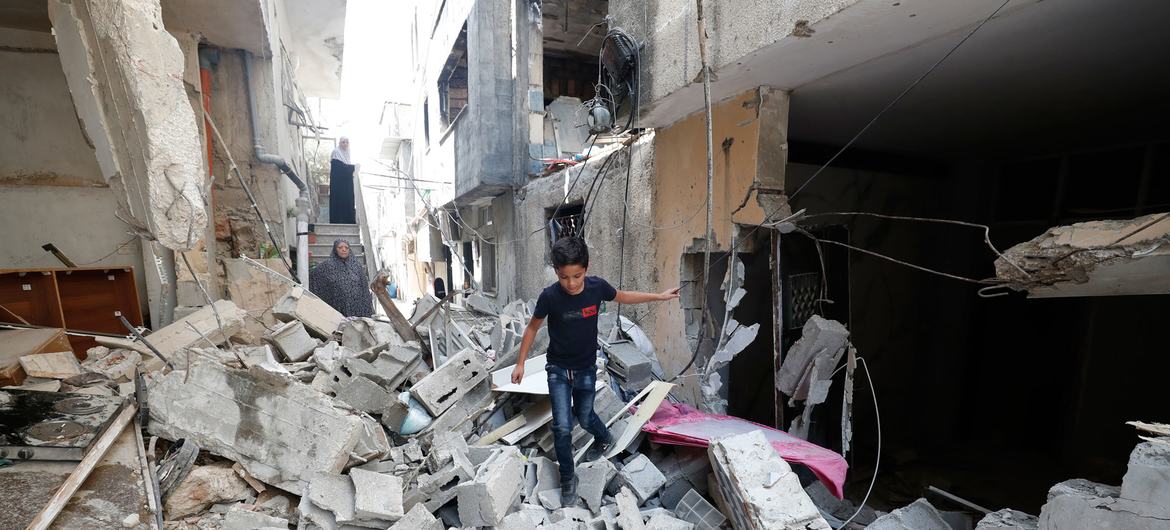
At night he sleeps under a tarpaulin sheet on the ruins of his family home. Like others returning to northern Gaza after months of being displaced by war, Sufian Al-Majdalawi clings to whatever he can find.

Using small tools and his bare hands, he sifts through mounds of twisted debris and dirt to try and unearth belongings and important paperwork such as property deeds to prove he is the legal owner.

He dreams of one day being able to rebuild; in the short-term, he hopes that even the rubble might hold some value.

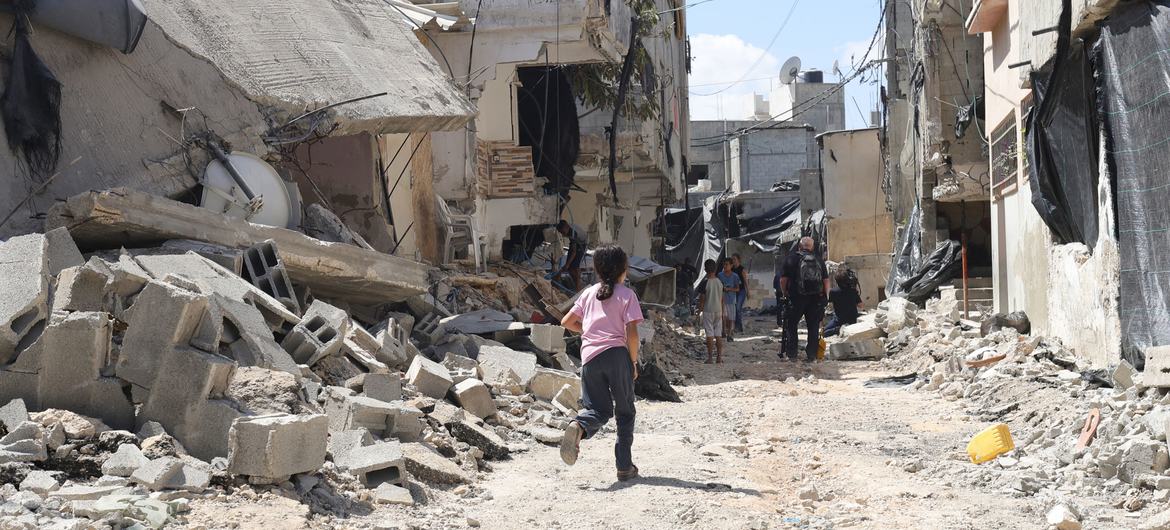
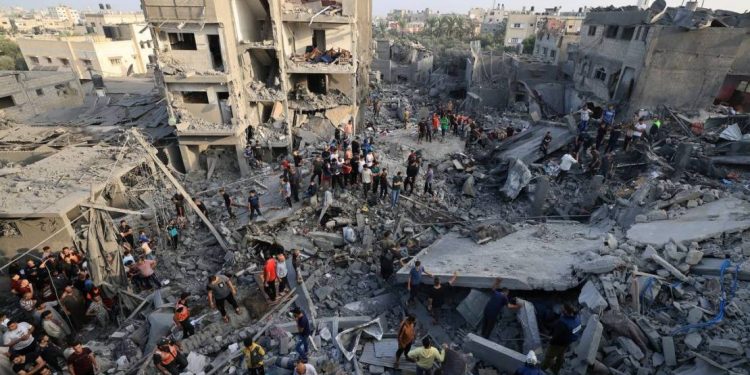
The war in Gaza has left an unprecedented level of destruction, with an estimated 51 million tons of rubble blanketing the landscape where bustling neighborhoods once thrived.

According to a new UN damage and needs assessment report, over 60 per cent of homes – amounting to some 292,000 – and 65 per cent of roads have been destroyed, across the approximately 360 square kilometre enclave.

As the international community ponders Gaza’s future and how to rebuild, Al-Majdalawi is sure of one thing: “We will not leave. That will not happen. This is our land.’’

Watermark

Moving cautiously through the rubble, Yasser Ahmed says: “I am looking for my papers.” His desperate search is made even more daunting because adjacent structures have collapsed in on each other. “Maybe while I am removing the rubble, I will find a human body, an explosive device,’’ he adds, underlining the huge emotional and physical risks of dislodging debris in a war zone.

Working with Palestinian authorities, UN development and environmental agencies and non-governmental organizations are looking at how to safely clear the rubble so that families can rebuild.

With a fragile ceasefire in place, regional talks are underway on rebuilding Gaza after 16 months of conflict. Next Tuesday, UN Secretary-General António Guterres heads to Cairo for a reconstruction summit called by Arab leaders.

Meanwhile, UN staff are drawing on similar experiences in Mosul, Iraq, and the Syrian cities of Aleppo and Latakia, all decimated by war.

Debris and rubble lines the streets of Gaza.

UN News

UNOPS, a UN agency that provides infrastructure, procurement and project management services around the world, is part of Gaza’s ‘Debris Management Working Group.’

The agency has conducted threat and risk assessments throughout the Territory, and has developed advanced GeoAI and remote sensing techniques, including 3D modeling technologies, to enhance explosive hazard evaluation and rubble removal strategies.

UNOPS Executive Director Jorge Moreira da Silva, following a recent trip to Gaza, says explosive hazard education had been provided to 250,000 Palestinians and some 1,000 humanitarian workers, providing “critical knowledge to stay safe and navigate explosive hazards effectively.”

UNDP, which helps countries reduce poverty, build resilience and achieve sustainable development, started removing rubble from Gaza in December 2024, weeks before a ceasefire began.

Sarah Poole Special Representative of the Administrator for UNDP’s Programme of Assistance to the Palestinian People.

UN News

UNDP’s Sarah Poole says about 28,500 tons of rubble were initially removed, and 290 tons of it used for roadworks to enhance humanitarian operations, restoring access to sites such as a hospital, a bakery and a critical water supply plant.

Poole describes the issue of land and property ownership in Gaza as “very complex” – particularly when title deeds, inheritance records and other legal documents are lost or destroyed.

Amjad Al-Shawa, Director of the network of NGOs in the Gaza Strip, says the issue of rubble represents a “major challenge.’’

“We need a mechanism to dispose of the rubble which will take a long time, and which requires resources that are not available in the Gaza Strip,’’ he says.

“Today, this rubble also represents the possessions of the residents. Many disputes may arise between families.’’

Some $7 million has already been made available from various donors to aid the rubble removal – but Poole says an additional $40 million is needed “in this initial phase in order to significantly scale up the work.”

Amjad Shawa, Director of the Palestinian Nongovernmental Organizations Network in Gaza Strip.

UN News

“The issue of access and the ability to bring in some of the heavy equipment that is needed is also absolutely essential,” he adds.

The challenge ahead looks daunting: Once-thriving neighborhoods have been leveled – very little remains. In this Territory where people turning 18 have already lived through five massive armed conflicts, the destruction this time is significantly worse.

The cost of the damage to physical infrastructure has been estimated at some $30 billion, according to the UN. The housing sector was the hardest hit, with losses amounting to $15.8 billion. The costs of recovery and reconstruction are estimated at over $53 billion.

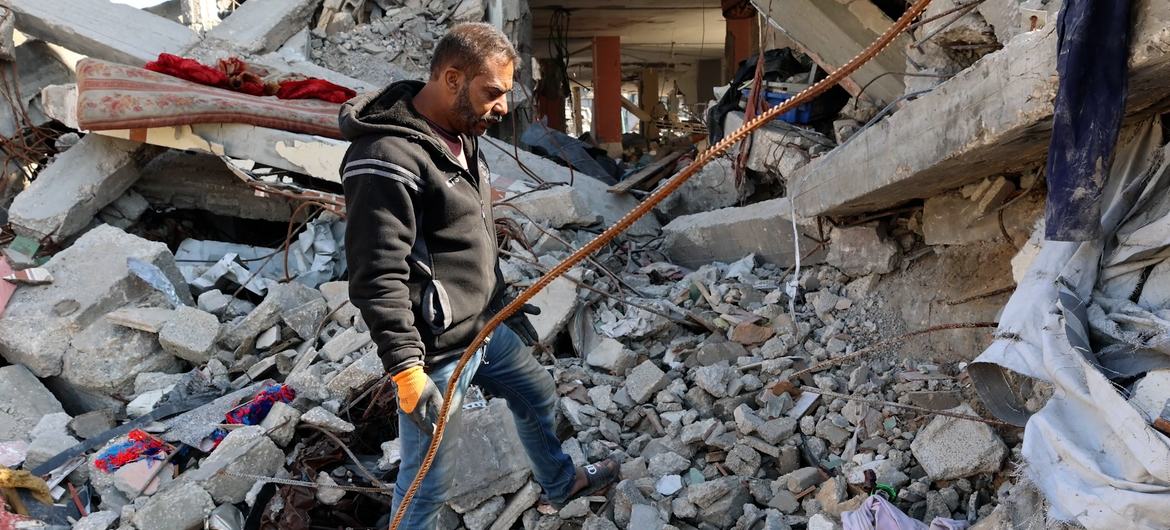
Yasser Ahmed stands in front of his destroyed home in Jabalia, in the north of the Gaza Strip.

UN News

Yasser Ahmed stands in front of his destroyed home in Jabalia, in the north of the Gaza Strip.

“There is no residential life here. I look around and see nothing but destruction,’’ says Ahmed, standing in front of the wreckage of his house. “The hard work of 59 years – the number of years of my life – was lost, and everything is gone.’’

“Everything is under the rubble,’’ he says. “I miss my home … a person is only comfortable in his home and his own place.”

Nearby, Ramadan Katkat sits on the remnants of his home. Living in tents precariously perched atop mounds of rubble, he echoes the despair felt by many: Beneath them could lie a perilous mix of unexploded devices and human remains.

His wish? “We want to live.’’

Al-Majdalawi is adamant, though: “We are capable of rebuilding the land.”

Ramadan Kutkut sits on the rubble of his house in Jabalia, in the northern Gaza Strip.
UN News

Ramadan Kutkut sits on the rubble of his house in Jabalia, in the northern Gaza Strip.
UN News

Continue reading
Is Israel Re-occupying The West Bank?

Weeks of deadly Israeli military raids in the occupied West Bank have turned Palestinian communities into “battlefields” and left 40,000 people homeless, UN humanitarians warned on Wednesday.

The violence has seen exchanges of fire between Israeli troops and Palestinian militants – and the use of bulldozers in refugee camps for the first time in 20 years which have destroyed public services, including vital electricity and water networks.

Israel’s defence minister said on Sunday forces could remain in the camps for the “coming year”. 

Philippe Lazzarini, head of the UN’s Palestine refugee agency, UNRWA, said that “fear, uncertainty, and grief once again prevail. Affected camps lie in ruins…Destruction of public infrastructure, bulldozing roads and access restrictions are common place.” 

More than 50 people including children have been killed since Israeli military raids started five weeks ago, the UN agency said, warning that the West Bank “is becoming a battlefield” where ordinary Palestinians are the first and worst to suffer.

Lethal force

Meanwhile, UN aid coordinating office, OCHA, also condemned the “lethal, war-like tactics” being employed by the Israeli military against Palestinian communities in the occupied West Bank.

OCHA confirmed further civilian casualties and mass displacement after a two-day Israeli military raid in the northern town of Qabatiya in Jenin governorate that ended on Monday.

Palestinians were detained in the operation, OCHA noted, before reiterating deep concerns about the use of excessive force against civilians and the additional humanitarian needs among people left homeless.

Responding to needs

UN partners on the ground are doing their utmost to help people uprooted by the violence despite growing “physical and administrative” challenges, OCHA said.

According to the UN World Food Programme (WFP), it reached 190,000 people in January with cash assistance and has provided one-off cash assistance to more than 5,000 displaced people from the Jenin refugee camp.

Gaza cold kills six children

In neighbouring Gaza, UN and its humanitarian partners have continued to scale up food security and livelihood support, while six children reportedly died from the cold.

Needs remain enormous amid desperate humanitarian conditions caused by 15 months of constant Israeli bombardment sparked by Hamas-led terror attacks on Israel that left 1,200 dead and some 250 people captured as hostages.

Citing the Gazan health authorities, OCHA said that six children from the Gaza Strip have died in recent days because to the severe cold, bringing to 15 the total number of youngsters killed by the winter conditions.

Meanwhile, more than 800 trucks entered the Gaza Strip on Tuesday alone, OCHA said. Since the start of the ceasefire on 19 January, WFP has brought more than 30,000 tonnes of food into Gaza. More than 60 kitchens supported by the UN agency across the Strip have handed out nearly 10 million meals, including in North Gaza and Rafah in the south.

The biggest aid provider in Gaza, UNRWA, has reached nearly 1.3 million people with flour and reached about two million people with food parcels since the start of the ceasefire.

The UN Food and Agriculture Organization (FAO) also reported that it has delivered animal feed to northern Gaza for the first time since the escalation of hostilities.

The aid delivery last week has helped 146 families with livestock in Gaza City alongside another 980 in Deir al Balah.

Between the start of the ceasefire and 21 February, FAO distributed more than 570 metric tonnes of animal feed across the Gaza Strip to some 2,300 families with livestock.

OCHA noted in addition that aid partners working in education have identified additional schools in Rafah, Khan Younis and Deir al Balah that were used as shelters for displaced people. “These schools will be assessed and repaired to prepare for their reopening,” it said. 

UN News

Continue reading
Genocidal Maniacs: A Story of a Massacre

As part of Israel’s ongoing genocide against Palestinians in the Gaza Strip since October 2023, the Israeli army targeted the Juha family’s home without warning or military necessity. The attack resulted in a massacre that killed approximately 90 civilians – including 71 women and children – and injured dozens more.

According to a Euro-Med Monitor investigation, the Israeli military launched a massive assault against Palestinian civilians in the eastern parts of Gaza City shortly after the first truce ended in early December 2023. This assault included an attack on the Juha family building located in the densely populated Sha’af area, which, along with the Shuja’iyya neighbourhood, was a focus of the offensive.

https://twitter.com/EuroMedHR/status/1894041270512656660

In one of the most horrifying massacres carried out by Israel during its genocidal campaign against the Palestinians in the Strip, Israeli warplanes targeted the Juha family’s home in the Tuffah neighbourhood east of Gaza City on the morning of 6 December 2023. At least one bomb was dropped on the house – a compound consisting of two adjacent buildings. The unexpected attack completely destroyed the building, killing all of its occupants.

Investigations revealed that 117 people were living in the building at the time of the attack, with women, children, and the elderly comprising the majority. This count included both the primary occupants and several relatives who had been forcibly relocated from the Zeitoun neighbourhood.

I couldn’t feel anything and found myself buried under the rubble, surrounded by a raging fire. The ceiling was collapsing on us, and they were only able to dig a small hole to reach us   

Liali Juha, a survivor of the massacre who was pulled from under the rubble

Most occupants died as a result of the bombing, while others were injured—some were dragged out from under the debris, and others were thrown outside by the force of the explosion. At least 17 people suffered burns, wounds, and fractures, with some experiencing limb amputations.

The explosion ripped apart the bodies of many victims, leaving their remains lying across the street and even on the roofs of buildings nearby. Over 34 bodies remain buried beneath the debris, while the bodies of approximately 56 people were recovered from beneath it.

During rescue efforts, residents faced significant challenges, particularly because communication with ambulances or civil defence teams was nearly impossible due to disruptions in internet and communications services. With no official response, the Juha family and local residents took it upon themselves to rescue victims using only manpower and basic tools.

The Euro-Med Monitor team conducted multiple field surveys of the main site. The investigations involved gathering testimonies from witnesses and survivors, documenting the extent of the destruction and the types of weapons used, and analyzing the attack in relation to other incidents in the area.

For accurate information, the team interviewed local residents who were eyewitnesses and nine survivors of the massacre. The Euro-Med Monitor team reviewed satellite images and aerial photos that documented the state of the building and the surrounding area before and after the attack, as well as photographs and video clips provided by eyewitnesses. The team found no evidence of military presence, such as military installations or armed elements, inside or near the Juha family home before or during the attack.

Since the publication of the investigation, Israel has not issued any public statements about the targeting or provided proof that there were any military targets within the building when it was bombed.

https://twitter.com/EuroMedHR/status/1893977539531485628

The report concludes that the principles of distinction, proportionality, and the duty to take necessary precautions – standards that Israel is legally required to uphold – were seriously violated. The timing of the attack, the types of munitions used, and the widespread indiscriminate destruction are deemed unjustifiable.

Euro-Med Monitor asserts that the targeting of the Juha family represents a grave violation of international humanitarian law, constituting multiple war crimes against civilians and civilian property. These actions are described not only as fully-fledged crimes against humanity but also as part of a large-scale, organised military assault on the civilian population of the Gaza Strip that began in October 2023.

The report further highlights that, in addition to the systematic and large-scale destruction of homes and shelters, the targeting of the Juha family home is emblematic of a broader pattern. This pattern includes the partial or complete destruction of 436,000 homes (roughly 92% of the homes in the Gaza Strip) and the killing of over 54,000 Palestinians, most of whom were inside their homes – indicating a deliberate strategy to target Palestinian civilians and infrastructure.

These events show a pattern of systematic and recurrent military attacks that are based on a plan that cannot be justified by any military necessity. This pattern indicates that there is a deliberate strategy to attack Palestinian civilians directly and collectively, while simultaneously destroying large numbers of homes and shelters, as two complementary strategies to accomplish a single goal: the elimination of the Palestinian population in the Strip.

Liali Raid Zaki Juha, 14, a survivor of the massacre who was pulled from under the rubble, recounted to the Euro-Med Monitor team: “I was talking with my uncle’s family when, suddenly, I couldn’t feel anything and found myself buried under the rubble, surrounded by a raging fire.”

“The fire was so intense that my uncle’s family melted before me, and there was no one to rescue us. My uncle’s family kept screaming for help—‘Get us out, Dad, get us out!’—with my uncle replying that he couldn’t,” she said. “The ceiling was collapsing on us, and they were only able to dig a small hole to reach us. They began smashing through with a heavy hammer to pull us from under the rubble, and after a lot of struggle, they managed to do it.”

“My mother, Manal Talat Muhammad Juha, 40, lost her leg,” Juha added, “I lost my brother, the family members of my uncle Iyad Zaki Atta Juha and the family members of my grandfather Zaki Atta Saleh Juha, 67, as well as my grandmother, Hadaya Nuzhat Saleh Juha, 51.”

Based on its findings, the Euro-Med Human Rights Monitor urged the relevant international parties to pressure Israel to allow international and UN investigation and inquiry committees into the Gaza Strip, in compliance with international law and the rulings of the International Court of Justice.  The report calls for prompt, independent, and unbiased investigations into the targeting of civilians in the Juha family massacre and all other crimes committed by Israel against Palestinian civilians in the Gaza Strip.

The investigation also urged the International Criminal Court to examine all of Israel’s crimes in the Gaza Strip, including the murder of the Juha family. It also called for the extension of criminal responsibility to all perpetrators, the issuance of arrest warrants, and trials in compliance with international law and the Rome Statute.

In accordance with Article 6 of the Rome Statute, the report called on the International Court to recognise the events in the Gaza Strip as a crime of genocide and to treat Israel’s actions with the seriousness they warrant.

https://twitter.com/NourNaim88/status/1831538877162520783

The report further demands that all nations cooperate with the International Criminal Court’s investigations by providing specialised factual and legal memoranda on the crimes committed by Israel, refraining from interfering with its work, and assisting in executing arrest warrants against Israeli officials, including Prime Minister Benjamin Netanyahu and former Defence Minister Yoav Galant.

Finally, the report calls for political and economic sanctions against Israel, an immediate halt to all arms sales, exports,  and military and intelligence assistance, and the termination of all licences and agreements related to the import and export of weapons – including dual-use materials and technology – that could be used against the Palestinian people.

EuroMed Human Rights Monitor

Continue reading
UN Slams Israel’s ‘Unprecedented Displacement’ on The West Bank

The UN human rights office, OHCHR, on Friday condemned the intensifying Israeli military operation in the northern West Bank, warning that nearly 40,000 Palestinians have been displaced already amid an “alarming wave” of violence and destruction.

Since the start of the offensive on 21 January, Israeli forces have killed at least 44 Palestinians, including five children and two women, in Jenin, Tulkarem and Tubas governorates, and four refugee camps in those areas, according to OHCHR.

Many of those killed were unarmed and posed no imminent threat, said the UN rights office, calling the killings “part of an expanding pattern of Israel’s unlawful use of force in the West Bank where there are no active hostilities.”

‘Unprecedented’ displacement

OHCHR also highlighted an unprecedented scale of mass displacement not seen in decades in the occupied West Bank.

It cited reports from displaced residents of a pattern where they were led out of their homes by Israeli security forces and drones under the threat of violence.

They are then forced out of their towns with snipers positioned on rooftops around them and houses in their neighbourhoods used as posts by Israeli security forces,” the office said.

Testimonies collected by OHCHR describe Israeli forces threatening residents who were told they would never be allowed to return. One woman, who fled barefoot carrying her two young children, said she was denied permission to retrieve heart medication for her baby.

In Jenin refugee camp, bulldozed roads were photographed with new street signs reportedly now written in Hebrew.

“In this regard, we reiterate that any forcible transfer in or deportation of people from occupied territory is strictly prohibited and amounts to a crime under international law,” OHCHR stated.

Legal obligations

The office stressed that displaced Palestinians must be allowed to return to their homes and called for immediate, transparent investigations into the killings.

“Military commanders and other superiors may be held responsible for the crimes committed by their subordinates if they fail to take all necessary and reasonable measures to prevent or punish unlawful killings,” it stated.

OHCHR also reiterated Israel’s obligations under international law, including ending its unlawful presence in the Occupied Palestinian Territory as rapidly as possible and evacuating all West Bank settlements immediately.

“In the meantime, as the occupying power, Israel must ensure the protection of Palestinians, the provision of basic services and needs, and the respect of Palestinians’ full range of human rights,” the office said.

WFP aid trucks cross into Gaza via the Zikim and Kerem Shalom border crossings.

© WFP

WFP aid trucks cross into Gaza via the Zikim and Kerem Shalom border crossings.

Humanitarian update

Meanwhile in Gaza, the UN World Food Programme (WFP) reported on Friday it had reached more than 860,000 men, women and children with food parcels, hot meals, bread and cash assistance since the start of the fragile ceasefire.

UN Spokesperson Stéphane Dujarric told journalists at a regular news briefing in New York that over 19,000 metric tonnes of WFP food have entered Gaza.

The agency has also distributed nutrition packs to some 85,000 people, including children under five, and pregnant and breastfeeding women, and provided more than 90,000 people with cash assistance in the past two weeks.

Efforts are also underway to establish more food distribution points, especially in North Gaza, to reduce travel distances, transport costs and protection risks for families,” Mr. Dujarric said.

Fuel deliveries, schools reopening

In addition, the World Health Organization (WHO) distributed 100,000 litres of fuel to hospitals in Gaza City on Friday, having delivered about 5,000 litres of fuel to Al Awda Hospital, in North Gaza governorate the day before.

In southern Gaza, education partners in Rafah are preparing for the reopening of at least a dozen schools as displaced families return to their home areas, Mr. Dujarric said.

“As you know, schools across the Strip had been used as shelters for Palestinians displaced during 15 months of hostilities. In Khan Younis and Deir al Balah, partners are providing cleaning materials to restart learning activities,” he added.

UN News

Continue reading
After 22 Years in Israeli Jail he Walks Free; A Story of Neglect, Torture

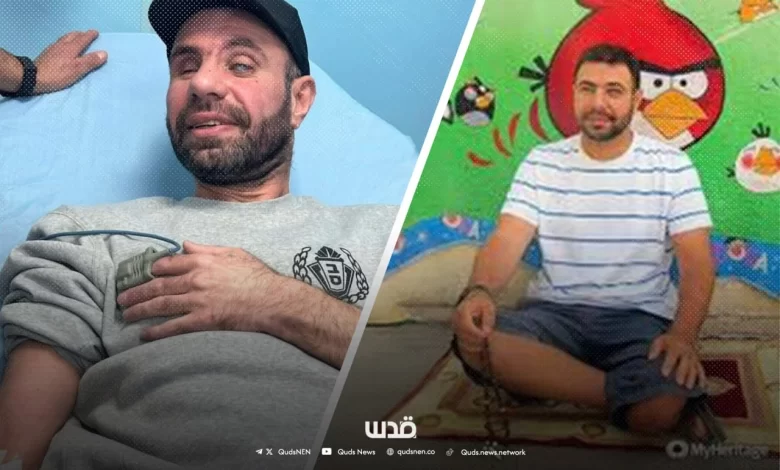
Muhammad Barrash spent 22 years in an Israeli prison, enduring blindness, pain, and medical neglect. On Saturday, he finally walked free.

Barrash’s story is one of unimaginable suffering. In 2002, an Israeli “Energa” shell struck him in the heart of Ramallah in the West Bank. The explosion took his left leg, damaged his right, and left him partially blind. In June 2003, Israeli forces captured him. He was sentenced to three life terms and an additional 40 years.

Prison only deepened his suffering. Within a year of his detention, Barrash lost his eyesight completely. His right eye, already injured, deteriorated due to untreated medical conditions. But he kept this secret from his mother.

“Don’t tell my mother I am blind,” he wrote in a letter from prison in 2012. “She sees me, but I cannot see her. I smile and pretend when she holds up pictures of my brothers and friends. She doesn’t know that darkness has taken over my body.”

For years, Israeli prison authorities denied him medical care. He waited endlessly for a corneal transplant. The procedure never came. His body bore the scars of war—shrapnel embedded in his flesh, his right leg deteriorating. In 2021, he discovered that Israeli prison authorities had been giving him expired cholesterol medication, worsening his condition.

Meanwhile, his mother waited. She fought to visit him. She dreamed of his freedom. And on Saturday, her prayers were answered. Barrash stepped out of prison, no longer behind bars but forever marked by the years of neglect and torment.

His release is part of the first phase of a prisoner exchange deal between the resistance and the occupation state. For many, his story symbolizes the brutal conditions faced by Palestinian detainees in Israeli prisons.

Despite the blindness, the wounds, and the suffering, Barrash survived. He is free. But the scars remain.

Unprecedented Torture

The harrowing experiences of Palestinian prisoners in Israeli detention centers have long been a subject of international concern. Recent reports highlight a disturbing escalation in the severity of torture and mistreatment.

According to the Palestinian Prisoner’s Society (PPS), detainees released as part of the recent prisoner exchange exhibited signs of “unprecedented” torture and starvation. Freed prisoners were observed wearing stained grey prison jumpsuits, bearing physical evidence of prolonged abuse. Testimonies revealed that many endured severe beatings leading to broken ribs, systematic medical neglect, and deliberate starvation. Some suffered from untreated skin conditions like scabies, exacerbated by the harsh prison environment.

Further reports from the Arab Workers Union indicate that Palestinian workers arrested following the October 2023 Israeli genocide in Gaza faced brutal treatment. Legal advisor Wehbe Badarneh disclosed that 34 workers died under mysterious circumstances or from alleged heart attacks while in detention. Testimonies from survivors detailed horrific abuse, including beatings, stripping, and various torture methods. These accounts suggest that some workers were tortured to death, prompting calls for international legal action against Israel.

Amnesty International has also documented a sharp increase in the use of administrative detention by Israeli authorities, leading to arbitrary arrests of Palestinians across the occupied West Bank. The organization reported that detainees suffered from inhuman and degrading treatment, with incidents of torture and deaths in custody going uninvestigated. This pattern of abuse underscores a systemic issue within the Israeli detention system according to the Quds News Network.

Continue reading