CROSSFIREARABIA – The Israeli occupation has violated the ceasefire in Gaza a mind-boggling 3338 times since it was announced on 10 October 2025 when US president Donald Trump boasted he has stopped the Israeli war on strip.
Since that time as well, Israel has killed 1027 civilians in the strip. And this is not to mention that over 3200 people have been injured. And these figures may well go up by the time this article is published. The ceasefire has given the Israeli army a carte blanche momentum to dominate the skies of Gaza and shoot at anything that moves; these are of course mostly civilians, mostly women and children.
Regardless of whether we like it or not, the Israeli army controls the major portions of the Gaza Strip. It started at 53 percent on the day of the ceasefire then slowly crept up to 55, 57, 60 percent and now it wants to move to 70 percent while squeezing the population there into smaller and smaller areas. Prime Minister Benjamin Netanyahu has been proud to announce this fact recently!
One effect of this is to establish even wider control of the Gaza Strip under the euphemism of yellow zones where it’s prohibited for people to live in and are declared security zones for the Israeli army to roam in as they please. Another insidious aspect of this is to take ‘potshots’ at the civilian population whenever they feel like it and which is on a daily rota of albeit controlled killing and injury. The Israeli army can’t get at the Hamas operatives because they are not embedded in the population. They are of course nowhere near finished but lie in wait for the appropriate time to continue their war against Israel.
And in between all this, Gazan life – in between destruction, torn-down buildings and mayhem – continues. A case in point is the recent recovery of the remains of the 40 martyrs killed by the Israelis during their genocidal campaign on Gaza in the post-7 October, 2023 butchery. These remains were found by the Gaza civil defense teams after much searching of the grounds of the Sheikh Al Radwan Cemetery in Gaza City.
The cemetery, or to be fair to the Israeli soldiers, they bulldozed and desecrated the cemetery multiple times in the past two years going on a rampage of willful destruction, as if bodies are going to get up from the graves and attack them. The effect of the bulldozing and mutilation of the graves was horrific, mixing the remains of the bodies of the Palestinian killed with the earth and other remains, creating a gory story of unbelievable horrors. In this war, Israeli soldiers made the digging up cemeteries their favorite past-time, a macaber practice made all over Gaza – and this was done for no known, sane, reasonable reason anybody could think of.
In the latest recovery however, Palestinian civil defense officials say the remains are now being transported to local forensic scientists with the hope they would be identified for their families and relatives who would at least know what happened to them.
This is going to be a complex task because of the fact that nearly all of the health system in Gaza stands decimated, not to mention there is very little equipment and medicines in the down-torn hospitals today. And the fact that Israel still tightly controls what goes into Gaza through a blanket embargo it imposed on the enclave since 2006. So the fate of the remains of the bodies will remain in doubt at least for the time-being. Israel will stand accused for its abomination.
The Israeli genocide with people like Netanyahu gleefully watching, and indeed ordering for more blood to be shed, ripped Gazan society apart while dehumanizing its social formation. Latest statistics show today that mass Israeli bombs thrown on the Strip created at least 28,000 Palestinian widows.
Over the past two and a half years, they lost their husbands, their fathers, mothers, uncles and cousins reducing Gaza into hollowed gorges of ruined concrete. These widows become overnight breadwinners for their young children and babies regardless of the fact that Gaza today is in a starvation-mode with no jobs available.
These are just a few of the social changes Gazan are trying to grapple with inbetween the daily Israeli onslaughts of rising deaths and a too unwilling international community to tell Israel to stop and afraid of the black sheep.
Dr. Marwan Asmar who is currently the editor of crossfirearabia.com holds a PhD from Leeds University and is a freelance writer specializing on the Middle East. He has worked as a journalist since the early 1990s in Jordan and the Gulf countries, and been widely published, including at Albawaba, Gulf News, Al Ghad, World Press Review and others.
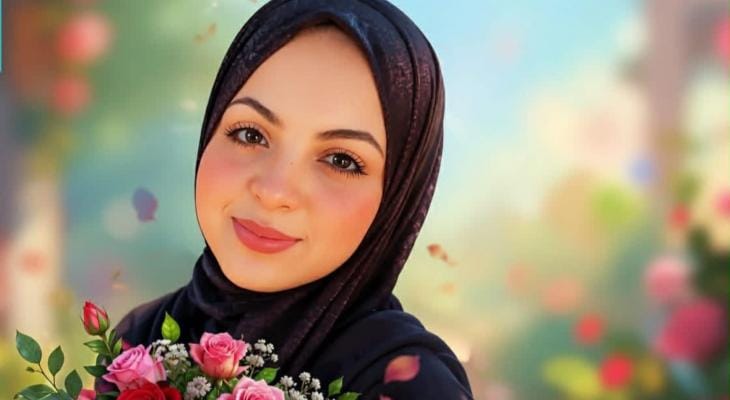
17-year-old Raghad Hussein Ashour left her home, Monday morning, carrying her books and dreams, heading to an educational center in the Rimal neighborhood of Gaza City. She was preparing for her secondary school exams and clinging to her right to education despite the war, displacement, and destruction that has affected schools and all aspects of life in the Gaza Strip.
But her path to knowledge was cut short. Raghad was killed in an Israeli airstrike that targeted a vehicle in the Rimal neighborhood as she was passing near the site of the attack on her way to the educational center. Her academic dreams turned into a new tragedy reflecting the reality for thousands of students in Gaza.
According to her mother, Raghad was an outstanding student and one of the top performers in her studies. She refused to let the war sever her connection to education.
After the destruction of schools and the disruption of the educational process, she had become accustomed to moving between the streets of Gaza and cafes in search of electricity and internet access to continue her studies and complete her assignments.
From Beit Hanoun to Displacement
Raghad comes from the town of Beit Hanoun in the northern Gaza Strip, but she and her mother were forced to flee to Gaza City to escape the relentless bombardment there. They settled in a displacement camp near the Saraya area in the Rimal neighborhood, where the young woman continued her studies amidst extremely difficult humanitarian conditions.
Raghad’s suffering wasn’t solely due to the war; she had been orphaned since childhood, losing her father when she was just two years old. She was raised by her mother, who dedicated her life to her upbringing and care.
As the years passed, the only daughter became her mother’s support and companion in facing life’s burdens and losses.
“Who will replace her?”
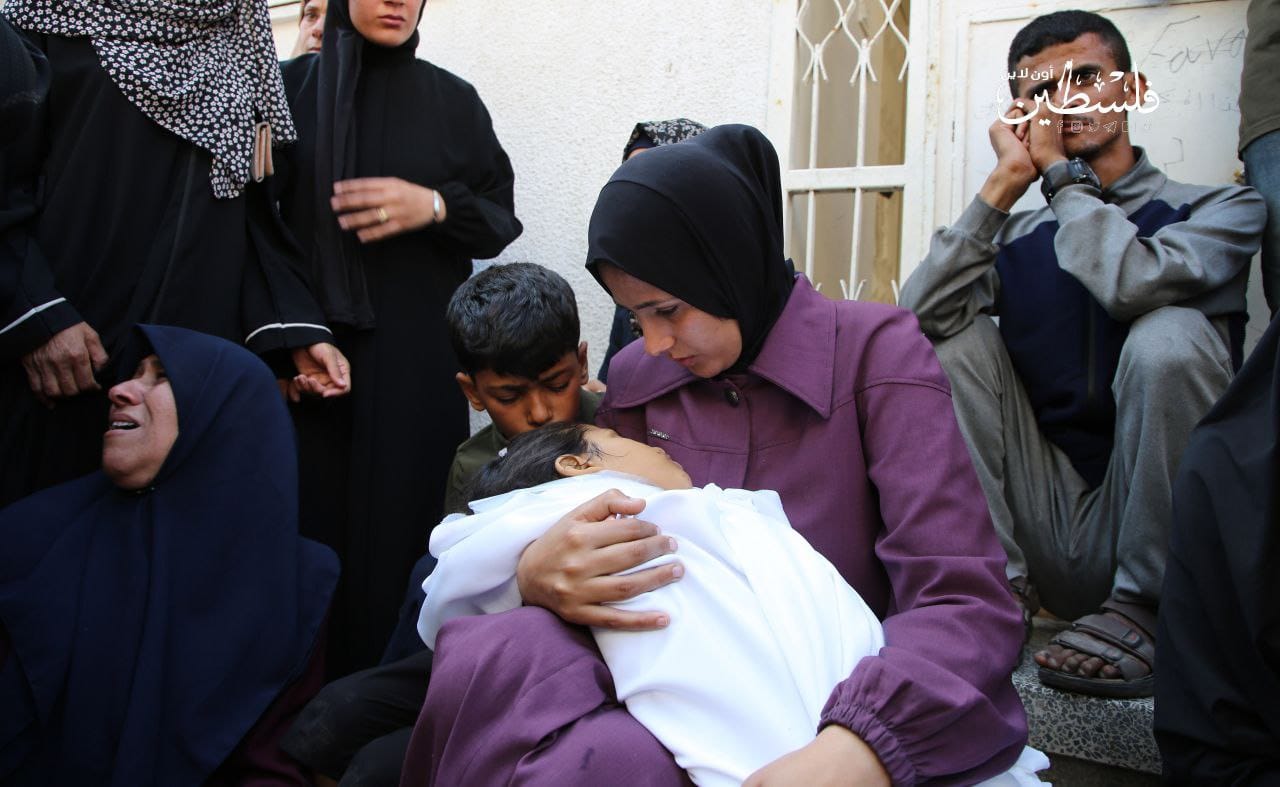
Standing before her daughter’s body, the grieving mother was unable to comprehend the magnitude of the tragedy. Her words, heavy with anguish, uttered, “My daughter was my only child… my rose was taken from me in an instant. Who will ever replace her?”
She added bitterly, “I used to move her from place to place during the war so she wouldn’t be taken from me. We slept together on the same pillow.”
The mother recounted years of fear for her only daughter, how she tried to protect her from death during repeated displacements and the harsh days of war, before losing her on her way to school.
In poignant scenes captured in widely circulated videos, the mother embraced her daughter’s body, weeping for dreams unfulfilled. She spoke of the joy of success that awaited her, and the future she had envisioned for her despite all the hardships, before those dreams were extinguished by the bombing.
Her death sparked widespread grief and reactions on social media, where many saw in her story a poignant illustration of the suffering of Gaza’s students who cling to education despite displacement, destruction, and the lack of basic necessities. For some, their books have become the final testament to dreams that were never meant to be fulfilled.
The Israeli occupation forces continue to violate the ceasefire agreement and the end of the war of aggression on the Gaza Strip for the 256th consecutive day. This agreement was signed on October 10, 2015, in Sharm El Sheikh, Egypt, under Arab and American mediation. Sanad news agency
Late Israeli prime minister Golda Meir once unashamedly said the Palestinians don’t exist and Israel was established on empty lands.
It was a view repeated time and again to justify the Israeli occupation of Palestinian lands and their subsequent grab of more Arab territories.
The photographs of Karimeh Abbud (1893-1940), the first Palestinian woman photographer, debunks that view and makes Israelis like Meir eat their words.
Google honoured her legacy by celebrating Abbud’s 123rd birthday with a Google doodle in 2016 two years before this article was first published.
“Abbud captured vast landscapes, many of which don’t exist today. Through her art, we’re able to experience the beauty of these regions as she saw them nearly 100 years ago,” said Google on November 18, 2016. “Thank you, Karimeh, for making art that endures.”
Only upon closer inspection it is clear that the tree is in fact painted on the negative, curving around her head and through her hands
Google also dwelled on her “photographs of family, friends and the surrounding landscape of Bethlehem, Palestine.”
Darat Al Funun of the Khaled Shoman Foundation in Amman presented the first comprehensive exhibition of photographs by Karimeh Abbud in late 2018 to continue January 11, 2019.
Documentary
The exhibition also included a short documentary on Karimeh’s life and work by Mahasen Nasser-Eldin.
Many art critics have commented on the impressive nature of her photography. In a tribute to Abbud Palestinian art critic Tammam Al Akhal said “she is friend of the light and sun… there is an artistic sense of the equilibrium inside her pictures. She was a true artist when taking a photograph.”
Al Akhal was giving a short presentation on the artistic poise in Abbud’s photographs as the Karimeh Abbud Photography Competition Prize was being launched by Dar Al Kalima University College of Arts and Culture in Bethlehem, Palestine, in 2016. The competition has since become an annual event designed to encourage young talent in art, culture and photography.
The Lady Photographer of Palestine
In her time, she established herself amongst the great photographers of the time with Al Akhal referring to her as standing as “tall as the skyscraper.”
Abbud was born in Bethlehem on November 18, 1893, in a Christian family which had settled in Palestine in the latter half of the 19th century. Her father was Said Abbud, an Anglican-Lutheran priest, who used to travel all over Palestine and take Abbud with him wherever he went.
Ivana Peric wrote that when Abbud was little she would accompany her father on his travels to distant places to serve his congregations in Jerusalem, Bethlehem, Haifa and Nazareth “and this constant travel to Palestinian cities and villages allowed [Abbud] to see the diverse landscape of her homeland first-hand. She wanted to see more and capture the beauty she encountered.”
Reverend Mitri Al Raheb — who became a sort of unofficial biographer of Karimeh Abbud and her family — said when he came to Palestine, her father travelled to many places from Gaza in the south to Shaffa Amer in the north and then finally settled in Bethlehem in 1890. However, the family finally put down roots in Nazareth and this is where Abbud grew up, going to primary school there, then to Jerusalem and later to the American University in Beirut where she studied Arabic literature.
However her true passion was photography. She was merely 17 when her father gave her a camera and she started clicking there and then and didn’t stop until her death. She was buried in the Bethlehem Church where her father preached from the early 1900s until 1947 when he retired and left Palestine in January 1948 because of the troubles in Palestine and returned to Marj Ayoun in southern Lebanon where he originally came from.
During this period, however, the second of his six children quickly established herself by becoming a highly competent photographer, competing in a man’s world alongside such old hacks as Khalil Raad, Hanna Safieh and Fadil Saba and a handful of Armenian photographers who dominated the profession.
Ahmad Mrowat, the director of the Nazareth Archive Project devoted to collecting the works of the “Lady Photographer”, said Saba, the local photographer, moved to Haifa in the early 1930s and this made the emerging photographer a household name. He was invited to cover events all over Palestine, including one celebration in Hebron.
Social revolution
Abbud created a social revolution in photography. Unlike the male photographers who worked out of their own studios, Abbud did much more. She had two studios, one in Nazareth where she also had a laboratory for processing the photos and keeping the negatives in a safe place and adding colour to some of them, and a studio in Haifa. However, she visited homes to take photographs of women and children which male photographers could not do.
Abbud went into the homes of well-to-do and middle class families as Al Raheb points out. Increasingly, these people wanted her to come to their homes because of prevailing social constraints that made it inappropriate for them to venture outside their houses, especially to be photographed in studios.
So Abbud photographed women and children at different social occasions, during parties and marriage ceremonies. Her reputation was quickly cemented in the 1920s and 1930s when she took up the profession full time. In Al Carmel, a local newspaper, she advertised herself as “the only national photographer in Palestine [who] learned this beautiful art by well-known photographic personalities and is specialist in the service of women at reasonable prices…”
There are two points here to consider that could actually be inter-related. Jinan Abdo stresses the national element in this advertisement. She states in a 2012 documentary on Abbud made by Mahasen Nasser-Eldin: “when she calls herself a national photographer that feeds into the national context that was present at the time. In the 1920s, after the British Mandate began, Muslim and Christian associations started to counter the idea that we are sectarian groups and not a nation and to support the idea of the unification of our nation, so the rational element was essential and I think we can look at Karimeh through this national context,” Abdo says.
Dr Issam Nassar, an academic at Illinois State University who teaches Middle East history, focuses on the “micro” element in her photography. “Taking portraits in studios at that time required preparations” whilst “in the clients’ homes… it was more relaxing because people felt at ease in their natural sorroundings.”
Hani Hourani, a social science researcher who studied art and photography, says: “If we look at the family and group photos [taken by Karimeh Abbud] the viewer doesn’t see the traditional style of the setting, the background décor and the fixed distribution of light but the onlooker sees such marked diversity in all these elements.
“The home was an opportunity for more improvisation and diversity in the styles captured by the photo leading many to suggest Karimeh Abbud was a non-traditional photographer calling for change in the way she clicked photos.”
Abbud’s photographs on show at Darat Al Funun were recently acquired accidentally after much cajoling.
Mrowat answered an advertisement placed in an Arab newspaper by an antiquarian Jewish collector named Boki Boazz calling for more information about Karimeh Abbud. That was in 2006.
Mrowat says at first the collector was not willing to divulge any information but after being pressed, it turned out that he had 4,000 photographs which he got hold of in one of the houses in the Qatamon district in Jerusalem after their owners fled in 1948; the photographs, he adds were of Karimeh Abbud because her name was initialled on each of the photographs — the first signed picture postcard belonging to her was dated October 1919.
Mrowat says his heart was set on obtaining the collection which he felt were a very important part of Palestinian heritage, finally persuading Boazz to give up his collection by offering him an old edition of the Torah printed in the Palestinian city of Safad in 1860.
The photos on show form only a part of the collection at Darat Al Funun and are only a fraction of the huge number of photographs said to number 9,000 still believed to be in the possession of the Israeli army as an article in the Haaretz newspaper stated.
The photos present a narrative of the Palestinian society and travel before 1948. Abbud took photos of cities and villages that flourished in the early part of the 20th century.
It was easy for Abbud to get around, Mrowat says, as she was probably the first woman to have an automobile and a driving licence in Palestine and the Arab world. She used to travel frequently to photograph Bethlehem, Jerusalem, Tiberias and Haifa. Many photos were taken of beaches, markets, mosques and churches, providing a unique glimpse of Palestinian life.
Mrowat, Dr Nassar and others suggest she would act, at times, as a tour guide, accompanying visitors to many tourist locations including the Jordan River and Yarmouk River as well as many other places. In between these, she was interested also in photographing the daily lives of Palestinian women, the different stitches they would make as they embroidered their garments which represented different villages, farming, women carrying water and wood as well as other scenes in both the countryside and in towns and cities.
Nassar puts it in another way when he says that Abbud was able to bring out the human aspects of the personalities she was photographing and this added value to her work and individuality because she succeeded in preserving the modesty and humanity of the Palestinian existence “through what professional photographers call the “aura” of the photograph and its phantasmical imagination.”
Al Akhal agrees, saying this is why Abbud’s photographs surpassed time. It was the “professionalism”, “creativity” and “high quality” that produced good negatives and in turn excellent photographs that “allowed her work to continue to be seen long after,” she says. “Through these pictures she [Karimeh Abbud] talks to us in silence, we build a dialogue with her, become friendly with her and construct strong relations with her.”
Through her images, Abbud provided a pictorial documentation of Palestinian life.
Nasser-Eldin, also coordinator of the the Karimeh Abbud Photograph Competition Prize, says “Abbud started what we can call ‘documentary photography’ documenting the lives of people through her studios and through her movement in the country carrying her bulky tripod and her camera wherever she went.
“Through her lens we got to know the forms of Palestinians living in Palestine before 1948. Her photos give us a change concept, a new picture of windows and images of Palestine and Palestinians, totally different from the pictures of orientalists who showed our country [Palestine] was empty of people and/or showed images of people spread out and not as an integrated community with civilisation and culture living in towns and cities and in modernity at that time,” Nasser Eldin added.
Her photos were well-taken and are a vital part of history, so at various times Israel has sought to adopt her as one of its own. This is what one book, published in 2011, titled Karimeh Abbud: Israeli Portrait and Wedding Photography by Monica Millian tried to do. Many have questioned its credibility as it is primarily sourced from Wikipedia and other online resources.
It can easily be understood why Israel would want to “cash in” on such an historic cultural figure, but Abbud is a Palestinian through and through as judged by historical evidence.
Marwan Asmar is a commentator based in Amman. He has long worked in journalism and has a Phd in Political Science from Leeds University in the UK. This article originally written for and appeared in Gulf News and is now reprinted in crossfirearabia.com.
Iman al-Rifai did not choose to seek refuge in Burj al-Shamali in south Lebanon for the camp is far away from Lubya, her hometown in the Tiberias district. Nor did she choose to to move to al-Badawi camp in the north of the country.
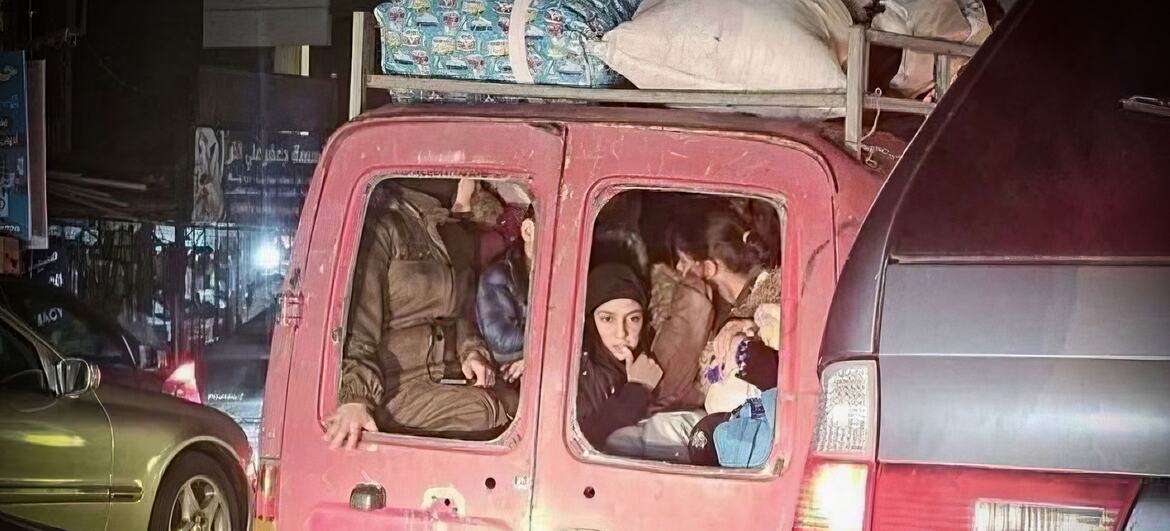
The forced displacement of Iman and her family was not their first in the latest Israeli war on Lebanon. It is their third. On the two previous occasions, they moved to Ain al-Hilweh camp in Sidon to remain close to their original camp.
In the 2024 war, Iman and her family were forced to flee to Syria and from there to Nahr al-Bared camp before returning to Burj al-Shamali after the ceasefire was declared. Each time, she preferred forced displacement to protect her children whilst leaving her husband behind. He like many of the other men, refused to leave, choosing to stay put despite the Israeli bombing.
“I’m now displaced with my children. But I am also scared. Honestly, both options are difficult. Staying under bombardment is hard, and being displaced is also difficult, but you try as much as possible to protect your life and the lives of your children,” said Iman, pointing out the feeling of being lost about the decision to flee or not never leaves her.
“Every time I’m forced to leave, I feel like I won’t come back. This feeling never leaves me, and it keeps me in a state of anxiety and fear. I’m even afraid to buy certain things. I feel that if I buy these things, it means I’m going to stay longer, I see it as a bad omen.”
Iman sums up displacement in one word: “Oppression.” It destroys a person from inside, the life of the family members is turned upside down, and this tremendously effects their psychological stability. “The anguish resulting from the past displacement of our families endured, and which we have experienced and has extended to our children. My children, who are not yet 17, already lived through two wars and five displacements, as if this is our fate in this country, as if this is what was written for us,” she ends with a sigh.
Iman’s situation is similar to that of many others, except for some of the details. Displacement, as everyone agrees is harsh in every aspect of life, regardless of whether one is in a shelter, with relatives, or in rented apartments.
Psychological Costs of Displacement
Bassam Jamil, who originally came from Tiberias, fled from Syria to Lebanon in 2013 during the Syrian war and eventually settled in Baalbek in the Bekaa Valley. But Lebanon has not been kind to Palestinian refugees especially from Syria like Jamil. It has placed more restrictions on them, even greater than those placed Palestinian refugees already living in Lebanon. This included the denial of legal residency and any other civil rights and leaving most of them fearful of being imprisoned, deported, or separated from the rest of the family.
“Refuge is like a stone in our throats and chests, preventing us from talking or breathing,” said Jamil, who fled from the al-A’edeen camp in Syria to a rural area for several days before crossing the border into Lebanon.
His displacement journey did not end there. In the 2024 Israeli war on Lebanon, he was forced to flee to Zahle and seek refuge in a shelter in one of the city schools, with his Alzheimer’s-afflicted father, his mother, and sister. Unlike other Palestinians in Lebanon who are embraced by the local community in the different camps, Jamil has never felt he “belonged or even a warm welcome”.
“Instead,” he says, “there is a strange competitiveness from the local community, as if our presence among them will deprive them of privileges and livelihoods.” Jamil believes “displacement to another camp is more difficult than displacement outside of it, given this strange competitiveness among the downtrodden.” He and his family have chosen to remain in Baalbek in this current war because of the great difficulties they faced during their previous displacements, economically and psychologically.
“The act of being displaced is one that follows a state of emergency and this means we are not prepared for its psychological, financial, and even physical costs. For us, it is the implementation of a harsh judicial ruling against our will,” Jamil says with a sigh.
Displacement Steals Human Lives
The United Nations Relief and Works Agency for Palestine Refugees (UNRWA), in its latest report on the emergency response in Lebanon—from May 20 till June 2—shows a 59 percent increase in the number of displaced refugees at the agency’s emergency shelters in the Siblin Institute in the south and the Battir School in the Nahr al-Bared camp in northern Lebanon. The increase from 1,264 to 2,148 displaced persons followed evacuation warnings and the ongoing Israeli aggression against camps and communities in Tyre, particularly the Rashidieh, Boss, and Burj al-Shamali camps.
The UN agency indicates there are 728 displaced Lebanese, 724 displaced Palestinians from Lebanon, 436 displaced Syrians, 241 displaced Palestinians from Syria, 15 displaced persons of other nationalities, and four unregistered Palestinian refugees.
Rania Saadallah was forced to flee from the Rashidieh camp in Tyre to a relative’s home in Sidon. Her displacement was multiple; between the first and second displacement, she lost her ailing mother. “The hardest part about this displacement is leaving my mother alone, it’s as if I’m leaving a part of me in the south,” she explained. Saadallah hasn’t let the Israeli attacks and constant eviction notices stop her from sneaking out from time to time to visit her mother’s grave. However she said that displacement steals a person’s life, “it’s as if you move from one world to another, a world that is alien to you, doesn’t belong to you, where the most basic elements of privacy are absent.”
Like other displaced refugees, Saadallah won’t even consider the possibility of not returning to return to her camp. “Its a slow death,” she said emphatically. For Saadallah and many like her, the camp has become “a small homeland” that cannot be severed from the refugee’s life. Just returning to the camp would revive our souls,” she pointed out.
The reality of forced displacement for Palestinian refugees is not limited to the 2024 and 2026 wars. Palestinian refugees have a long history of displacement during the past successive wars and internal conflicts in Lebanon. Studies indicate that there have been multiple waves of forced Palestinian displacement within Lebanon, beginning in the 1960s and continuing till this day. Some of these waves have led to the destruction of several Palestinian camps, such as Tal al-Zaatar, Jisr al-Basha, Nabatieh, and Nahr al-Bared, resulting in the displacement of many if its residents to other camps.
Historically, there has been a “demographic movement” within the camps, said Jaber Suleiman, a researcher in refugee and forced migration studies while attributing this movement to the destruction of the camps and/or other factors. Suleiman believes that under the current political conditions and the ongoing Israeli threat in the south and should it extend north of the Litani River, many residents of the camps and communities around Tyre who sought refuge in other camps may be forced to remain there, with some family members, with young people, staying in the original camp.
“The return of those who are displaced is linked to the return of the situation in the south to normalcy. If they cannot return quickly, they will remain in the camps they fled to and build new lives, as has happened before.”
Suleiman attributes the permenant displacement to economic factors and cost. “Those displaced to camps can stay with relatives or friends, and there is greater availability of aid from various organizations. Furthermore, many believe that displacement to a camp guarantees them a greater commitment from UNRWA,” he emphasized, adding that it is the “economic factors are the driving force and not location.”
Ali Hweidi, Director-General of the 302 Foundation for the Defense of Refugee Rights, agrees with this assessment, stressing the primary factor controlling the refugee displacement—whether to other camps, outside the camps, or reluctance to leave—is economic.
Hweidi pointed to available statistics indicating that “a smaller number of displaced people went to UNRWA shelters in southern and northern Lebanon, while the majority moved to camps, communities, and cities north of the Zahrani River, such as Mieh Mieh and Ain al-Hilweh camps, the city of Sidon, Wadi al-Zina, and others.”
He added most of these refugees are staying with acquaintances or relatives because renting is virtually impossible, “which places an additional burden on relatives and acquaintances,” especially since the unemployment rate among Palestinian refugees, according to UNRWA, has reached 45 percent, while the poverty rate exceeded 80 percent before the latest Israeli aggression. But Huweidi attributed the reluctance of some to flee to two reasons: Financial constraints and a lack of privacy.
A study by the Palestinian Human Rights Organization “Shahed,” published last March, indicated that the Israeli war contributed to deepening the economic crisis for Palestinian refugees in Lebanon, the majority of whom live below the poverty line and rely primarily on humanitarian aid. The study also showed the disruption of economic activity and the closure of many facilities and services as a result of the Israeli bombing and led to increased unemployment and food insecurity in the camps.
According to the study, many refugees lost their jobs outside the camps, specifically in cities like Beirut and Tyre, due to security risks and movement restrictions imposed in the war, leaving many families without any source of income. The “Shahed” study indicated concerns about deteriorating living conditions and food insecurity have become a real preoccupation for Palestinian refugees, hiking up psychological stress and social tension among camp residents.
Who is meeting the needs of the displaced?
The majority of Palestinian refugees displaced by this last war believe the shortcomings in providing assistance extend to all parties, from UNRWA to the various Palestinian factions and Lebanese state. The role of UNRWA has been limited to providing two shelters and some in-kind and cash assistance.
“The biggest pitfall for UNRWA was its lack of an emergency plan and pre-prepared scenarios for dealing with the displacement, despite many indicators which point to a security breakdown in Lebanon and the direct and indirect impact on the camps,” explained Hweidi. He noted UNRWA launched its emergency plan after the start of the Israeli aggression against Lebanon and allocated a budget exceeding $12 million to meet the needs. “However, it is striking that the agency relies primarily on its partners to provide everything within the shelters—food, water, and other necessities—and then distributes it.”
Suleiman pointed out to the historical failure to meet the needs of displaced persons, whether during the Lebanese Civil War or subsequent Israeli wars on Lebanon, by either UNRWA or other Palestinian factions. “The scale of the needs is always far greater than the services provided, given the ongoing deficit in UNRWA’s budget, which only allows it to offer the bare minimum, such as opening shelters,” he continued.
Suleiman and Hweidi agree the Palestinian factions offer virtually nothing. “The role of the different factions is limited to counting the displaced persons in the camps.” Suleiman sarcastically remarks: “The factions’ role has become limited to criticizing UNRWA rather than providing services,” placing the greatest burden on the UN agency and civil society.
Walid al-Ahmad, secretary of the Popular Committee in the Mar Elias camp in Beirut, says the displaced people seek the help of the Popular Committee upon their arrival at the camp. The committee role is usually collecting data of the families sheltering in the camp, and these are mostly Lebanese. He did however, say some Palestinian families who were displaced came to Burj al-Barajneh when Beirut’s southern suburb was threatened and faced eviction notices by the Israelis.
Al-Ahmad said as well that the main reason why displaced people contact Popular Committees is because of the services they provide. “As the Popular Committee in the Mar Elias camp, we have provided mattresses, blankets, personal hygiene items, and some food supplies since the beginning of the displacement, in addition to providing hot meals.”
He added that some organizations have also provided parcels, food, psychological support, and supplies for the elderly, as well as organizing recreational activities for the displaced.
In this context, social activist Dalal Shahrour, in the Beddawi camp, confirms the number of displaced families in the camp, according to the latest statistics from the Popular Committee, reached 400. “What usually happens is that the displaced persons stay with relatives until they can rent their own home. Those who cannot afford to rent are transferred by the Popular Committee to the shelter in the Batir school in the Nahr al-Bared camp,” Shahrour explained, emphasizing that the majority of displaced people go to the Popular Committee to register because various organizations rely on the data provided by the Popular Committees to distribute aid. She confirmed that only a small number of those who are well-off do not wish to receive aid register with the Popular Committee.
Shahrour considers the fluctuating number of displaced people, especially during this war, to be one of the most significant challenges facing the committee. “The numbers change with every ceasefire announcement and every evacuation notice,” she said, adding the scarcity of aid is another challenge to meet the need of the displaced.
With each wave of displacement, displaced persons lose a part of themselves and their human dignity. With each wave of displacement, the chances of survival in an environment fraught with daily challenges diminish.
“We face, as much as possible, the choice between waiting or pursuing the dream of return—two oppressive paths, each with its own heavy price,” says Bassam Jamil. Have the dreams of displaced refugees, once focused on returning to their villages and cities in occupied Palestine, now narrowed down to return to the camps, homes, and lives they were forced to leave behind?
The recent intensive Israeli air strikes in southern Lebanon and Western Beqaa, which resulted in the killing of at least 83 people and the injury of 141 others, including children and women, highlight a repeated pattern of targeting civilians and civilian objects. These attacks also demonstrate a blatant disregard for multiple ceasefire agreements, violating essential principles of international humanitarian law such as distinction and proportionality, amidst a lack of effective international accountability.
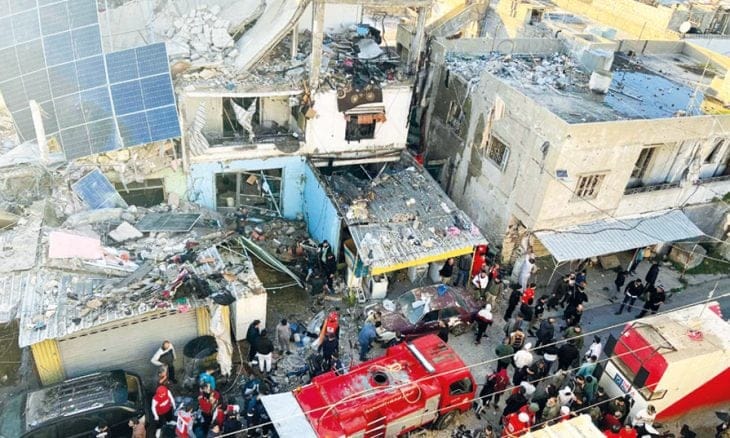
According to Lebanon’s Ministry of Public Health, an airstrike in Qennarit, Sidon District, killed seven people and injured 13, including five children and five women. In Sohmar, Western Beqaa, a house was hit, killing four family members and injuring another, with a child trapped under the rubble and waiting for rescue.
These casualties happened during numerous airstrikes on towns and densely populated areas across southern Lebanon and the Western Beqaa from Friday evening to Saturday morning. This highlights the wide geographical reach of the strikes and the danger they pose to civilians. The attacks also raise serious concerns about whether Israeli forces are fulfilling their legal obligation to take all possible precautions to safeguard civilians and minimise harm during military operations.
Euro-Med Human Rights Monitor documented extensive evacuation efforts by Lebanese Civil Defence teams, who evacuated 47 people to safety and transported 16 bodies along with 12 injured individuals to hospitals under extremely challenging conditions. This intense escalation occurred simultaneously with a new ceasefire that took effect on Friday at 4:00 p.m., overseen by the United States.
The timing of the airstrikes, many of which were carried out shortly before the ceasefire took effect, while others continued after it took effect, raises serious questions about Israel’s commitment to its obligations under ceasefire agreements. Such conduct undermines the core purpose of these arrangements, namely the protection of civilians and the prevention of further military escalation. It also demonstrates a consistent pattern of escalating military attacks right before ceasefires are implemented or extended, resulting in higher civilian casualties and diminishing trust in agreements meant to safeguard civilians.
These events are not isolated incidents but part of an ongoing pattern of violations since the first ceasefire agreement was implemented on 27 November 2024. This was followed by a temporary 10-day truce announced on 16 April 2026, which was extended by an additional 45 days in mid-May. The persistent military actions and attacks on civilians and civilian objects despite these agreements raise serious concerns about compliance with their legal obligations. They also highlight the critical need for independent and effective investigations to ensure accountability for any grave violations of international humanitarian law and international human rights law.
Since the ceasefire, Euro-Med Monitor’s field teams have recorded numerous Israeli violations, including airstrikes, artillery shelling, killings, and injuries in populated areas. Although Israel defends these actions with vague security threat claims, international law does not permit such assertions to override the obligation to respect the principles of distinction, proportionality, military necessity, and the obligation to take all feasible precautions to safeguard civilians.
Israeli officials’ repeated statements about ongoing attacks, regardless of ceasefire agreements, undermine the agreements’ purpose and protection, leaving civilians perpetually vulnerable. The ongoing military actions and violations despite publicly declared understandings raise concerns about Israel’s adherence to its international duties. This situation highlights the critical need for robust monitoring and accountability to ensure compliance and safeguard civilians from the impacts of continued hostilities.
Israel’s ongoing ground incursions and forced evacuation orders, coupled with a widespread and systematic campaign of destruction targeting Lebanese border villages and towns, including residential areas, civilian infrastructure, and essential facilities, exceed legitimate military needs. This behaviour raises serious concerns about violations of core international humanitarian law rules that prohibit the forced displacement of civilians and the destruction of civilian property, unless absolutely required by imperative military necessity.
Furthermore, levelling entire residential neighbourhoods and damaging civilian infrastructure deeply changes the geographic and demographic makeup of these areas. This renders them uninhabitable and denies residents the right to return safely and with dignity, recover their homes, property, and livelihoods. Due to their scale, intensity, and persistent nature, these acts also serve as punitive and retaliatory measures, which are unjustifiable under the special protections granted to civilians during armed conflicts.
The widening scope of military actions and forced displacements is significantly worsening Lebanon’s already severe humanitarian crisis. Hundreds of thousands of internally displaced people face harsh living conditions that are far below basic human dignity standards. This crisis is exacerbated by extensive damage to vital infrastructure and the declining capacity of public institutions and humanitarian groups to meet growing needs. These violations have far-reaching effects, threatening essential rights such as housing, healthcare, food, education, and work. Children, women, older people, and persons with disabilities are especially affected, bearing the heaviest burden.
The repeated pattern of attacks on civilians in their homes, including children and women, causing extensive casualties, particularly on the eve of or alongside each ceasefire announcement, requires urgent and concrete measures that go beyond routine condemnations. Effective action is needed to protect civilians, halt hostilities, and activate accountability mechanisms for grave violations of international humanitarian law.
The international community, particularly the states sponsoring the ceasefire process, should apply real and effective pressure on Israel to stop its military activities in Lebanon. Euro-Med Monitor cautions that frequently accepting ceasefire agreements while ongoing bombings persist weakens their original intent, diminishes their legal and humanitarian value, obstructs lasting stability in southern Lebanon, and puts tens of thousands of civilians at risk.
The international community’s frequent use of statements of concern and condemnations, without implementing concrete deterrent measures or engaging international accountability mechanisms, leads to ongoing impunity and diminishes the international legal system’s ability to protect civilians and prevent serious violations.
The international community must activate universal jurisdiction as an essential legal mechanism for prosecuting perpetrators of serious international crimes, ensuring that those responsible are brought before competent national courts in accordance with states’ obligations under the Geneva Conventions and customary international law.
The Office of the Prosecutor of the International Criminal Court must, under the Rome Statute, exercise its jurisdiction without delay by opening comprehensive and independent investigations into international crimes committed in Lebanon, including war crimes and crimes against humanity, particularly forced displacement of civilians, indiscriminate or disproportionate attacks, attacks on protected civilian objects, and the extensive and unjustified destruction of civilian property and infrastructure.
Euro-Med Monitor calls for the activation of relevant independent United Nations mechanisms, such as commissions of inquiry and fact-finding missions, to systematically and accurately document grave violations and preserve evidence in accordance with recognised legal standards. This approach ensures the evidence can be used in both international and domestic criminal proceedings.
If legally confirmed, these violations could constitute serious breaches of international humanitarian law, including failure to distinguish between civilians and military targets, disproportionate use of force, and neglect of the duty to take all possible precautions during military operations. They may also violate bans on collective punishment and forced displacement.
Individual criminal accountability is a core element of the international legal framework. The ongoing presence of impunity threatens global peace and security, weakens protections for civilians, and perpetuates a cycle of violations. Therefore, urgent global efforts are needed to activate international justice mechanisms, ensure redress for victims, and prevent future crimes.

 CrossFireArabia