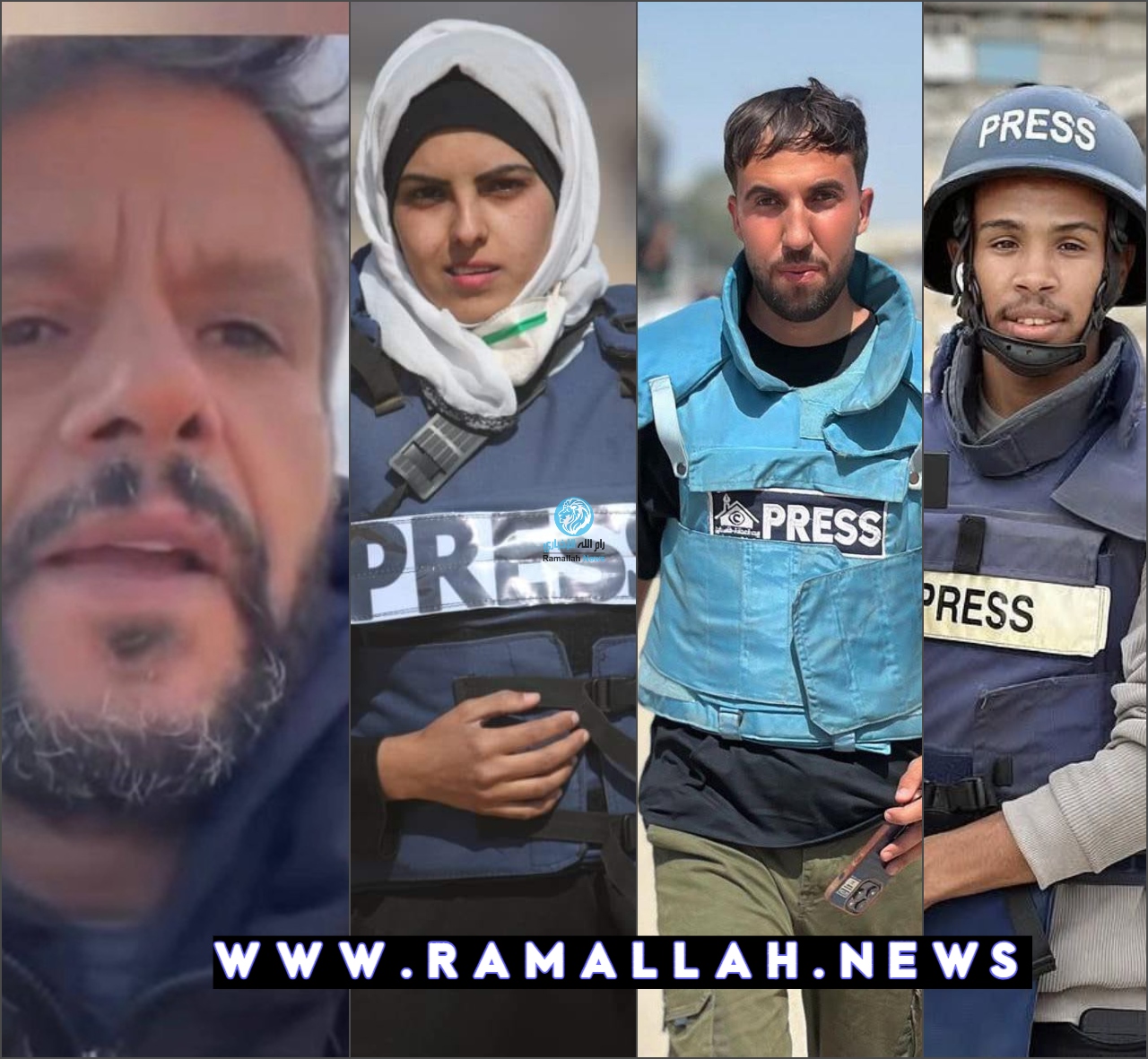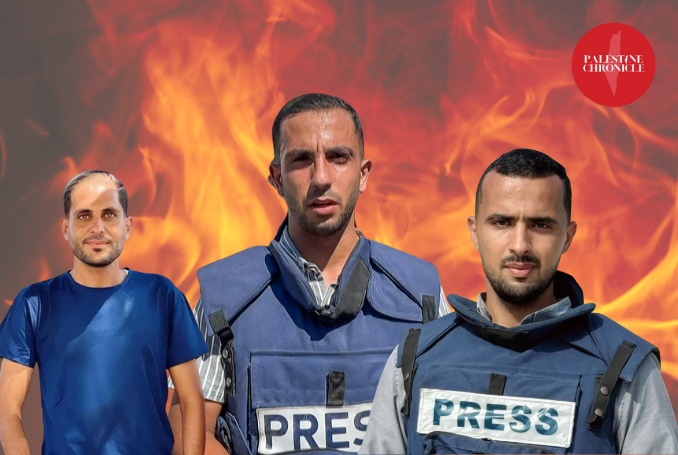
Israel Cannot Silence Palestinian Words

By Benay Blend

Palestinian journalists seek to document the truth about the Zionists’ brutal siege, while their detractors are working to erase all evidence of the crime scene.

Shortly after the news broke about the Israeli assassination of Palestinian journalist Anas al-Sharif and his five colleagues in Gaza City, a video appeared on my Facebook feed of chef Yotam Ottolenghi making baked haloumi cheese with fennel syrup.

In real time, the two events have nothing to do with each other. However, delving deeper into the realm of the imagination, both represent long-held Israeli efforts to erase the Palestinian presence on the land.

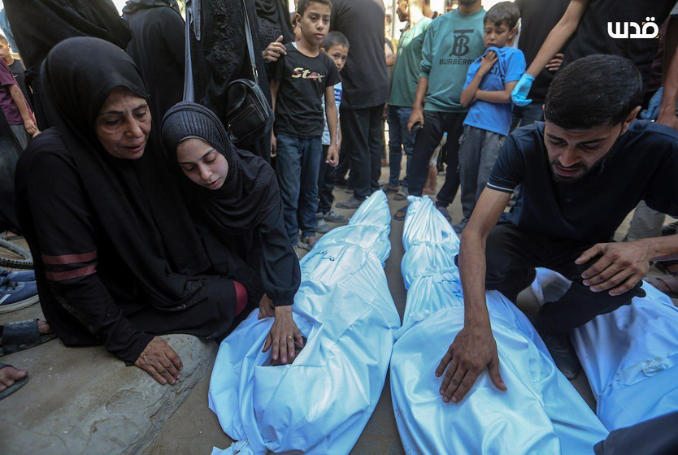
In a statement on the social media platform X, journalist Ramzy Baroud explained Israel’s motives for the murder of  at least 200 journalists in Gaza since October 7, 2023: “silence the truth by murdering those who report it.”

Afterward, they justify these deaths by claiming that the journalists were members of the resistance movement, a claim that is problematic for several reasons.

In a timely excerpt from Perfect Victims: And the Politics of Appeal (2025), Mohammed El-Kurd contends that allies often unwittingly refute the claim that victims, such as these journalists, were affiliated with Hamas. In this way, the characterization of the civilian as a “neutral figure” has depoliticized the Palestinian cause, rendering it a “humanitarian crisis” where “revolutionaries are not part and parcel of your nation.”

In the U.S., too, police shootings of Black, Brown and poor people are often justified by slandering the victim’s reputation post-mortem. This should come as no surprise, since the institution of policing harks back to its origin as slave catchers, along with its more present-day exchange of training with the Zionist state.

“It is not enough for a Palestinian to be a journalist to be deemed human,” concludes El-Kurd,  “they must be ‘unaffiliated.’”

For “Israelis,” this effort must prove difficult as they are taught to see Hamas everywhere, much like Americans were told to look for communists during the Second Red Scare in the 1950s. The latter were in our bathrooms, under our beds, and if we were not watchful, we might mistakenly marry one.

In “The Hamas are Coming: A View of the Violence from Inside Israel” (2021), Miko Peled writes of this phenomenon that has informed Israeli hasbara (propaganda) for years.

“There are never Palestinians, never people, only ‘The Hamas’ — and ‘The Hamas’ is, by the way, male and singular (in Hebrew),” Peled writes.  “’The Hamas thinks;’ ‘The Hamas believes;’ ‘The Hamas should know;’ ‘When the Hamas understands, he will stop;’ and finally, ‘When The Hamas is hit hard he will never dare to attack Israel again.’”

Not much has changed in Israeli hasbara since Peled wrote that piece nearly four years ago. Indeed, the New York Times, taking its cue, as usual, from Israeli sources, repeated that “Mr. al-Sharif,” whom the Israeli military accused of being a Hamas fighter posing as a reporter, but was really “the head of a terrorist cell,” thus the IDF “had taken steps to mitigate civilian harm,” though which civilians, Palestinians or “Israelis,” it does not say.

Barbs were then thrown back and forth. Al-Jazeera called the killing  “a desperate attempt to silence the voices exposing the impending seizure and occupation of Gaza” while the “Israeli Government” accused “Al Jazeera reporters of serving the interests of Hamas by presenting an exaggerated and distorted picture of conditions in Gaza.”

“The instinct of many defenders of Palestinians is to dispel the connection between the slain Palestinian media workers and their supposed political leanings, as if anywhere in the world these exist in isolation,” El-Kurd explains.

Just as El-Kurd implicates himself in this process, so do I. There have been times when I’ve distanced martyrs from supporting the armed resistance as if this gives us a more legitimate cause to mourn.

When we sanitize the dead in this way, however, “we are inadvertently reifying the colonial rationale that killed them and rendered them killable in the first place,” El-Kurd concludes, so perhaps it is better to just reply “So what?” Indeed, if Zionist soldiers and PR workers can find a place for themselves in global media, why do supporters of Palestine find the need to detach their heroes from armed resistance that occupies a legitimate role in the struggle?

There are many documented reasons as to why Israel targets journalists in the Gaza Strip. Significantly, Palestinian journalists seek to document the truth about the Zionists’ brutal siege, while their detractors are working to erase all evidence of the crime scene.

Moreover, for Western journalists, even those sympathetic to the cause, the only picture they can paint is that of victims who are barely surviving in the rubble.

In an interview with Beacon Press, historian Roxanne Dunbar-Ortiz describes a similar settler colonial narrative that pertains to Indigenous people in the Americas. Asked to explain the most enduring myth pertaining to Native Americans, Dunbar-Ortiz mentions the idea of “eliminationism,” a notion that does away with Native people.

Indeed, at the turn of the 20th century, the myth of the Vanishing Indian was at its zenith, thus allowing the mainstream population to view Native people as noble relics who exist only in the glory days of their past. These same people who at one time they had license to kill Native people are seen now as no longer a threat, subdued as they were in the last Indian massacre at Wounded Knee.

In reality, Native people have survived over 500 years of continual genocide, survival being an “active word,” Dunbar-Ortiz makes clear, involving  “an enormous amount of resistance and cultural continuity.”

On the other hand, “victimry” is a more common version, she concludes, because people can feel sorry about the state of Indian Country but without the requirement that they must do anything about it. “So they’re not really then dealing with the reality that Native people are here,” and like the Palestinians, “they’ve resisted, they’ve survived, they haven’t changed their mind about who they want to be and how they want the future to be.”

In “Sumoud: The Unyielding Heart of the Palestinian Cause in Palestine,” Ramzy Baroud describes a similar trajectory for Palestinians. “The profound and unrelenting struggles endured by Palestinians should, by any rational expectation, have irrevocably concluded the Palestinian cause. Yet, the struggle for freedom in Palestine is at its zenith.”

Like the experience of Native Americans, Zionist attempts to erase the presence of Palestinians goes back many decades. Nevertheless, the Palestinian resistance has endured, Baroud continues, due to the “concept of sumoud,” resilience that is akin to Dunbar-Ortiz’s explanation of “survival,” an active process that involves resistance and cultural endurance.

“Palestinian journalists in Gaza are themselves the story and the storytellers,” writes Ramzy Baroud. “Their success or failure to convey the story with all its factual and emotional details could make the difference between the continuation or the end of the Israeli genocide.”

From Refaat Alareer, the poet/teacher/ journalist who asked before his death that his life become a story to ensure that life goes on, to Anas Al-Sharif’s final testament written shortly before his death, Palestinian journalists have been responsible for conveying the truths of Gaza to the world, but they also leave a legacy that inspires future generations to carry on their work.

“Do not let chains silence you or borders restrain you. Be bridges toward the liberation of the land and its people, until the sun of dignity and freedom rises over our stolen homeland,” Al-Sharif wrote, shortly before his death.

With that last statement, Al-Sharif foretells his own assassination. His message is not one of victimhood, though, but rather a plea that others carry on his work.

On August 11, Dareen Tatour, the Palestinian poet who knew from experience the danger of rebellious words, posted a new poem written to honor the Al-Jazeera team murdered the day before.

Imprisoned for her verse “Resist, My People, Resist Them,” the poet is not so optimistic now that words can stop a bullet. Under the banner Martyrs of the Word and Image—They Left But the Word Remained, Tatour charged that their deaths were the consequence of a world gone silent to their pain.

“They are gone / but the truth remains,” she says, dependent on her to carry it, or “leave it to be bombed again” in the wake of her silence.

Unlike the person that she was ten years ago, Tatour knows now that “the road is longer and harsher,” yet still she is undeterred, for she continues “to write for them [the slain journalists], to be the echo of their voices,” because in this way, the Palestinian narrative will be triumphant.

– Benay Blend earned her doctorate in American Studies from the University of New Mexico. Her scholarly works include Douglas Vakoch and Sam Mickey, Eds. (2017), “’Neither Homeland Nor Exile are Words’: ‘Situated Knowledge’ in the Works of Palestinian and Native American Writers”. She contributed this article to The Palestine Chronicle.

Continue reading
UNESCO Condemns Killing of Journalists

The UN organization which champions culture and education, UNESCO, has strongly condemned the targeted killing of six journalists in Palestine by an Israeli drone on 10 August.

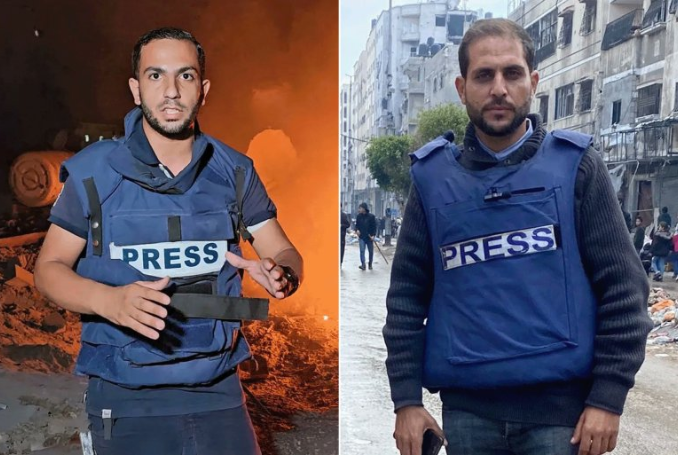
“I condemn the killing of journalists Anas Al-Sharif, Mohammed Qreiqeh, Ibrahim Zaher, Mohammed Noufal, Moamen Aliwa, and Mohammed Al-Khaldi and call for a thorough and transparent investigation,” UNESCO’s Director-General, Audrey Azoulay, said in a statement on Tuesday.

Five of the six worked for the influential Qatari-based media organization, Al Jazeera: Anas Al-Sharif and Mohammed Qreiqeh were on air correspondents, while Ibrahim Zaher, Mohammed Noufal and Moamen Aliwa worked as camera operators. Mohammed Al-Khaldi was a freelance photojournalist.  

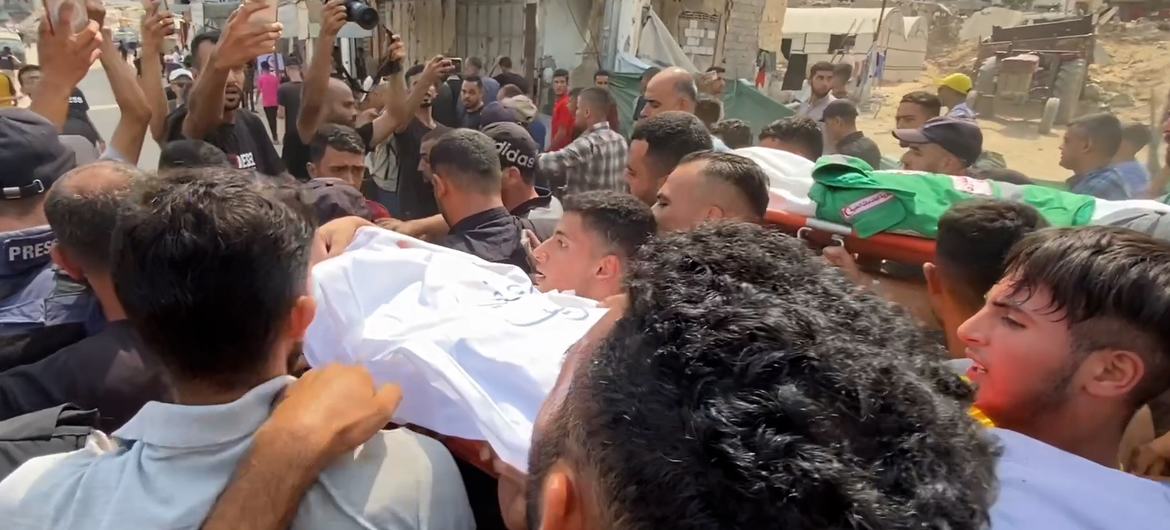
They were reportedly killed by an Israeli attack on a tent used by media personnel at the entrance of Al-Shifa Hospital in Gaza City.

Blatant, premeditated attack

The Israeli Defense Forces (IDF) alleged that 28-year-old correspondent Anas al-Sharif was a serving Hamas operative. Al Jazeera strongly denies this, describing the attack as an “assassination” and “yet another blatant and premeditated attack on press freedom.”

The UN Human Rights Council-appointed independent expert on freedom of expression issued a statement on 31 July denouncing an Israeli military spokesperson’s “repeated threats” and “unfounded accusations” against Mr. Anas Al-Sharif, flagging it as “a blatant attempt to endanger his life and silence his reporting” in Gaza.  

Condemning the attack in the strongest possible terms on Tuesday, two special rapporteurs described the killings as “an attempt to silence reporting on the ongoing genocide and starvation campaign” in Gaza.

“It is outrageous that the Israeli army dares to first launch a campaign to smear Anas Al-Sharif as Hamas in order to discredit his reporting and then kill him and his colleagues for speaking the truth to the world,” the experts said, demanding an immediate investigation into the killings and full access to international media, which Israel currently bars from entering Gaza.

Special Rapporteurs and other independent experts are appointed by and report regularly to the Human Rights Council. They work in their individual capacity, are not UN staff and receive no payment for their work.

Violation of international law

UNESCO chief Ms. Azoulay stressed that targeting journalists reporting on conflicts is unacceptable and violates international law.  

She also reiterated her call to respect UN Security Council Resolution 2222, which was unanimously adopted in 2015 to protect journalists, media professionals and associated personnel in conflict situations.

Since October 2023, UNESCO has reported at least 62 journalists and media workers killed in the line of duty in Palestine, excluding deaths in circumstances unrelated to their work, while OHCHR reports that at least 242 Palestinian journalists have been killed in the same time frame. 

UN News

Continue reading
Silencing Messengers: Israel Kills Five Journalists

Al Jazeera correspondents Anas al-Sharif and Mohamed Qraiqea were killed Sunday, along with three other Al Jazeera journalists, in an Israeli strike targeting a journalists’ tent near the Al-Shifa Hospital in western Gaza City, according to the Gaza Media Office.

The Qatar-based channel quoted the director of the Al-Shifa Medical Complex in Gaza who said, “Al Jazeera correspondents Anas al-Sharif and Mohamed Qraiqea were martyred in an Israeli strike on their tent,” without providing details.

The channel later confirmed that al-Sharif and Qraiqea were killed in an Israeli strike.

Al Jazeera Media Network early Monday condemned the “planned” assassination of its correspondents and cameramen in the Gaza Strip, calling it “a desperate attempt to silence voices ahead of the occupation of Gaza.”

“The order to kill Anas al-Sharif, one of Gaza’s bravest journalists, and his colleagues is a desperate attempt to silence voices ahead of the occupation of Gaza,” it said.

Al Jazeera’s statement noted that “many Israeli army officials repeatedly incited and called for targeting Anas al-Sharif and his colleagues,” as it held “the occupation army and its government responsible for targeting and assassinating its team.”

The statement added that “the assassination of our correspondents by the Israeli occupation forces is another blatant and deliberate attack on press freedom.”

The Gaza Media Office announced in a statement that the number of journalists killed since the start of Israel’s genocide in Gaza on Oct. 7, 2023, has risen to 237, following the killing of al-Sharif and Qraiqea, along with three other journalists.

It identified the other journalists killed as photojournalists Ibrahim Dahir and Moumin Alaywa and an assistant photojournalist Mohammed Noufal.

“The assassination was carried out with premeditation and deliberation, through a deliberate, intentional, and direct targeting of the journalists’ tent in the vicinity of Al-Shifa Hospital in Gaza City. This heinous crime also resulted in the injury of several other fellow journalists,” it added

The Director of the Al-Shifa Medical Complex in Gaza City, Dr. Mohammed Abu Salmiya, told Anadolu that the deaths from the strike on the tent in front of the complex’s gate have risen to seven, including five journalists.

Meanwhile, the Israeli army admitted in a statement to killing al-Sharif in Gaza City, while ignoring the killing of Qraiqea and the three other journalists in the same strike.

In his will that was written Aug. 6, which he requested be published after his death, al-Sharif wrote: “This is my will, and my final message. If these words reach you, know that Israel has succeeded in killing me and silencing my voice. Peace be upon you and Allah’s mercy and blessings.”

“Allah knows that I gave all the effort and strength I had to be a support and a voice for my people, ever since I opened my eyes to life in the alleys and streets of Jabalia refugee camp. My hope was that God would prolong my life so I could return with my family and loved ones to our original hometown of occupied Asqalan (al-Majdal), but God’s will came first, and His decree is carried out,” he said.

“I have lived pain in all its forms, and tasted grief and loss many times. Yet I never hesitated to convey the truth as it is, without distortion or falsification, hoping that Allah would bear witness against those who remained silent, those who accepted our killing, those who suffocated our breath, and whose hearts were unmoved by the scattered bodies of our children and women, and who did not stop the massacre our people have been subjected to for more than a year and a half.

“I urge you to hold fast to Palestine, the jewel in the crown of Muslims, and the heartbeat of every free person in this world.

“I urge you to care for its people, for its wronged little children who were not given enough time in life to dream or to live in safety and peace, whose pure bodies were crushed beneath thousands of tons of Israeli bombs and missiles, torn apart and scattered across the walls.

“I urge you not to let chains silence you, nor borders hold you back. Be bridges toward the liberation of the land and its people, until the sun of dignity and freedom rises over our usurped homeland.

“I urge you to care for my family. Take care of the apple of my eye, my beloved daughter Sham, whom the days did not allow me to watch grow up as I had dreamed as reported by Anadolu.

“And care for my dear son Salah, whom I had hoped to support and walk beside until he grew strong enough to carry my burdens and continue the mission.

“I urge you to care for my beloved mother, whose blessed prayers carried me to where I am, whose supplications were my fortress and whose light guided my path. I pray that Allah will comfort her heart and reward her abundantly on my behalf.

“Also take care for my life partner, my beloved wife, Umm Salah, Bayan, from whom the war separated me for long days and months, yet she remained true to our bond, steadfast like the trunk of an olive tree that does not bend, patient and trusting in Allah, carrying the responsibility in my absence with all strength and faith.

“I urge you to stand by them and be their support after Allah Almighty. If I die, then I die steadfast in my principles, and I bear witness before Allah that I am content with His decree, faithful in meeting Him, and certain that what is with Allah is better and everlasting.

“O Allah, accept me among the martyrs, forgive me my past and future sins, and make my blood a light that illuminates the path of freedom for my people and my family. Forgive me if I have fallen short, and pray for me to receive mercy, for I have remained true to the covenant, never changing or wavering.

“Do not forget Gaza … And do not forget me in your sincere prayers for forgiveness and acceptance,” he wrote..

Israel is facing mounting condemnation for its genocidal war on Gaza, where it has killed more than 61,000 victims since October 2023. The military campaign has devastated the enclave and brought it to the verge of famine.

Last November, the International Criminal Court issued arrest warrants for Israeli Prime Minister Benjamin Netanyahu and his former Defense Minister Yoav Gallant for war crimes and crimes against humanity in Gaza.​​​​​​​​​​​​​

Israel also faces a genocide case at the International Court of Justice for its war on the enclave.

Continue reading
Al Jazeera: Price For Press Freedom

Israeli occupation forces raided Al Jazeera’s office in Ramallah, in the occupied West Bank, shortly after midnight.

They extended the office’s closure for an additional 60 days and posted a military order at the entrance.

Last September, the army also stormed Al Jazeera’s office under a military order, handed the staff a closure notice, confiscated all equipment and documents, and barred the employees from using their vehicles.

Continue reading
Haaretz: US Finally Independent From Israel

An article in Haaretz reports that Israel has suffered several blows in recent days in its historical relations with the United States. And that US President Donald Trump no longer requires Saudi Arabia to normalize relations with Tel Aviv for Washington’s nuclear cooperation with Riyadh.

Adding insult to injury to the Israel occupying state, Trump has reached an agreement with the Houthis Ansar Allah group to end US military strikes on Yemen. This is plus the fact the US has began negotiations with Iran without the blessing of Israeli Prime Minister Benjamin Netanyahu. Further to that a US official in the Trump administration also held direct contact with the Hamas.

However, Odeh Basharat in his Haaretz article argues that the most painful blow Israel has ever suffered was Trump’s dismissal of his National Security Advisor, Mike Waltz, due to a discussion he had with Netanyahu, behind Trump’s back, about launching a military attack on Iran.

Basharat said the United States has finally begun to wake up and free itself from the shackles of Israel, and act as an independent state, not a “banana republic.” Basharat, a journalist from the Arab world, expressed his astonishment at these developments and wondered whether what was happening before his eyes was real or merely an illusion.

The writer believes that a seismic clash is taking place between the two countries and the two men, and that all the reasons are now converging. “America is gaining its independence 250 years after the beginning of its First Revolutionary War,” referring to the war that took place between 1765 and 1783, when 13 British colonies in North America rejected British colonial rule and gained their independence.

Basharat describes this emancipation as the Great American Rebellion, and attributes its causes to the fact that the world—and the United States as part of it—felt deeply concerned by what the writer, with biting sarcasm, called “Israel’s diplomatic acrobatics,” its “enlightened occupation” of the Palestinian territories, and its “closure (of the Gaza Strip) that allows only air in.”

According to the article, as soon as Israel reaches an agreement on a particular issue, it adds new conditions the next day. Although the Arab states that signed peace agreements with Israel were not required to recognize it as a Jewish and democratic state, only the Palestinians are required to do so, which, as Basharat argues, permanently relegates Israeli Arabs to second-class citizens.

According to the article, it has become clear that Netanyahu is deceiving everyone: Arabs, Jews, and Americans, not just Hamas and the Lebanese Hezbollah movement, as he previously boasted to Israeli police investigators that he misled and deceived them, then bombed them.

Since the time of David Ben-Gurion, Israel’s first prime minister, the state’s policy has been based on force. In contrast, Trump seems to believe in a policy of carrots and sticks—meaning diplomacy and force combined—according to the article.

The author claims that the US president thinks differently, as demonstrated by his actions toward the Houthis, Iran, and the tariffs. Once he realized he had failed, he took a step back.

As for Israel, its problem does not lie solely with Netanyahu, as Basharat argues, but rather with the fact that it has not offered an alternative to force. Only three of its former prime ministers, according to the article, have taken a different path: Moshe Sharett, whom Ben-Gurion was keen to overthrow; Yitzhak Rabin, who paid for it with his life; and Ehud Olmert, who was ousted before even presenting his plan.

Furthermore, Israel has long treated the White House as a branch of its prime minister’s office, intervening in the wording of every sentence in documents issued by Washington regarding Israel, according to the Haaretz article as reported in Al Jazeera.

Continue reading