Hamas Derails ‘Generals’ Plan’ in North Gaza

Military expert Dr. Nidal Abu Zeid has confirmed that despite separating the northern Gaza Strip from Gaza City, the Israeli army has not succeeded in implementing the so-called “generals’ plan” so far.

He added that what is happening on the ground can only be classified as “tactical success but strategic failure in light of the heavy losses suffered by the Israeli army in northern Gaza.

Abu Zeid added to Jordan24 that the resistance is still operating in pockets close to the separation line established by the occupation, while it seems that the Netzarim axis model is being repeated in northern Gaza, which puts the occupation in a fragile position and vulnerable to the strikes of the resistance, which has exchanged geography for losses, meaning that it has given land to the occupation but inflicts losses in wide areas of deployment.

Failure with Hezbollah

Regarding what is happening in southern Lebanon, Abu Zeid said the equation of proportionality and gradualism is still prevailing in military with Haifa has become opposite equation to the southern suburb and Tel Aviv to Beirut in targetting and bombing.

He added that this is while the occupation forces have yet failed after 13 days of ground fighting to achieve any significant progress, and everything the Israeli army is doing falls within the framework of reconnaissance operations by force in an attempt to determine the weak points of Hezbollah, which is defending in an unconventional manner on the front edge of the battle zone.

Iran Stop!

Abu Zeid pointed out that events are accelerating, as indicators of the Israeli response to the Iranian response have begun to increase and its features have begun to become clear, which will change the equation of the conflict in light of an American desire not to expand the circle of conflict as much as it is a desire to clip Iran’s nails in the region.

Continue reading
Israel Uses ‘Killer Robots’ to Murder, Flatten Gaza

The Euro-Mediterranean Human Rights Monitor  stated that the Israeli occupation army is using booby-trapped robots loaded with tons of explosives in the widespread destruction and killing operations carried out in northern Gaza.

It explained, in a statement Sunday, it “received numerous testimonies from inside Gaza, about the Israeli army’s use of booby-trapped robots and their detonation remotely, causing widespread damage to surrounding homes and buildings and great loss of life, at a time when the work of ambulance and civil defense crews is almost completely disrupted, except for a narrow range in some neighborhoods,” according to Quds Press.

“Israel’s use of booby-trapped robots is prohibited under international law, as these robots are considered random weapons that cannot be directed or their effects limited to military targets only,” the Euromed Monitor added.

It explained that “due to their nature, they directly hit civilians, or hit military targets, civilians or civilian objects indiscriminately. Therefore, they are prohibited weapons under international law, and their use in residential areas constitutes an international crime in and of itself.”

The statement quoted a Palestinian besieged in the “Al-Qassabi” neighborhood south of the “Jabalia” camp in the northern Gaza Strip, who said, “last Wednesday evening – 9 October – a huge explosion occurred in the Al-Qassabi neighborhood near where we were located.”

He added, “the sound of the explosion was very loud, I had never heard it so loud before, we have become able to distinguish between the sounds of explosions, so we know whether this sound is from bombing by aircraft, artillery or something else.”

He pointed out that “the sound of the explosion was many times louder than the sound of the airstrike, to the point that white dust covered the entire area. We later found out that this explosion was the result of a robot loaded with tons of explosives detonating, and that this robot destroyed about 6 or 7 houses at once. The occupation army detonates the robot in the houses without knowing whether there are civilians inside them or not.”

The Euro-Mediterranean Human Rights Monitor said that it documented the occupation army detonating two other robots in the “Tawam” area and in the “Zahraa” neighborhood adjacent to the Civil Defense west of the “Jabalia” camp, and another robot in the vicinity of the “Abu Ali Mustafa” intersection in “Bir al-Naja” in the western areas of the Jabalia camp.

Using “robots” to relieve pressure on the air force

military expert, engineer Muhammad Magharbeh, indicates that the “Israeli” air force “is going through its weakest stage,” considering that the occupation army’s resort to alternative destructive means to aerial bombardment is an important indicator of the challenges currently facing this weapon.

In an interview with Quds Press, he pointed out that the hundreds of thousands of tons dropped on Gaza during the year “are explosives resulting from bombs received from American ammunition stores, which are no longer able to meet the Israeli Air Force’s demands at the required speed.”

He also pointed out that Israeli Air Force air bases were damaged by the recent Iranian missile attack, in addition to “the great waste in using bombs on the Gaza and southern Lebanon fronts.”

He stressed that the Israeli Air Force faces “difficulty in carrying out full and effective air missions in its war with Hezbollah, difficulty in destroying tunnels at the expense of the scarcity of ammunition that it is forced to economize on, and the choice between using them for Iranian targets or destroying the Lebanese tunnels, or destroying the northern Gaza Strip to force the residents there to move to the south.”

Reports indicate that the Israeli occupation army consumed a large amount of ammunition in the early stages of its war on the Gaza Strip, specifically those used in aerial bombardment. During the first four months of the military operation, the Israeli Air Force bombed approximately 31,000 targets, 29,000 of which were in the Gaza Strip and the rest in other areas, most notably Lebanon.

According to a statement by the Israeli occupation army, the majority of these raids were carried out using fighter jets. The Israeli occupation forces, supported by the United States and Europe, continue to commit the crime of genocide in the Gaza Strip, for the 372nd consecutive day, by launching dozens of airstrikes and artillery shelling, while committing massacres against civilians, amid a catastrophic humanitarian situation resulting from the siege and the displacement of more than 95 percent of the population.

Continue reading
Sick Palestinian Prisoner Dies in Israeli Hospital

Despite suffering from multiple diseases, Israeli occupation forces detained 37-year-old Palestinian Mohammed Munir Musa from Bethlehem in April 2023.

On the morning of 13 October, 2024 Mohammed passed away at Soroka Hospital due to health negligence in Israeli prisons.

He is the 41st known prisoner to die in Israeli captivity since October 7.

Continue reading
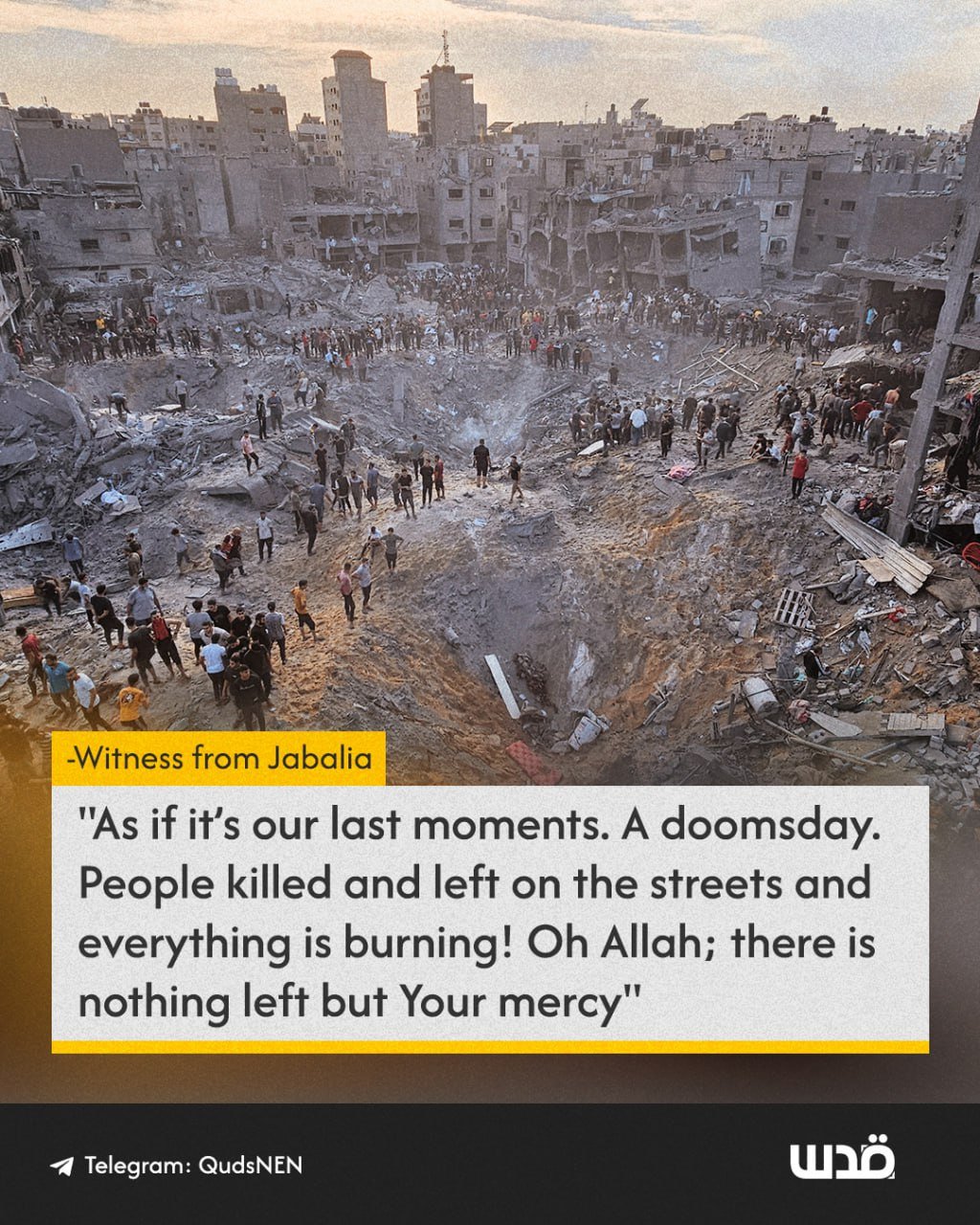
Jabalia Distress Calls: ‘Homes Burned, Detainees Shot, Corpses on Streets’

Secretary-General of the Palestinian National Initiative Movement Dr. Mustafa Barghouti warned of the seriousness of the crimes and massacres committed by the occupation army in the Jabalia Camp and various areas in the northern Gaza Strip.

He noted that the occupation army is committing brutal ethnic cleansing massacres against the civilian population in the northern Gaza Strip.

Barghouti added to Jordan24 that the occupation is trying to take revenge on the legendary steadfastness of the residents of northern Gaza and Gaza City who foiled the ethnic cleansing conspiracy against the Strip, as Israeli soldiers are carrying out campaign of massacres and starvation, siege and destruction of hospitals and medical facilities.

“We received distress calls from the residents of Jabalia camp who are being subjected to continuous brutal bombardment and lack of water, food and medical services. They pleaded that their homes are being burned, detainees are being executed in the field, and that corpses and wounded people are scattered in the destroyed streets and no one can reach them, Dr Al Barghouti said.

The residents told him the Israeli army is also using unarmed civilians in the camp after arresting them as human shields to walk in front of its armored vehicles as they advance inside the camp.

Al-Barghouthi called for an immediate campaign to repel the new ethnic cleansing attack that the Israeli army is trying to carry out, to stop the brutal massacre it is carrying out in the camp, and to break the media blackout on what is happening in northern Gaza.

Continue reading
Maariv: Cabinet Must “Think” Before Israel Falls in Regional Mud

A year after the Israeli aggression in the Gaza Strip and the war’s spread to Lebanon, Israeli politicians must now be involved in a real soul-searching process and study the course of this war on all fronts so may may see whether Israel succeeds in changing the strategic reality in the region or is begining the process of drowning in the mud on all fronts.

According to the Maariv newspaper, Israel is not built for  long wars and/or wars of attrition. The Israeli economy relies on human capital and therefore long wars could lead to the collapse of the economy.

To this day, the newspaper says, “three army divisions are conducting maneuvers in the Strip. But so far no combat goal has been achieved in Gaza.

“The Southern Command has not presented an exit plan, the Israeli army has not yet achieved most of the war’s goals: It has not released the 101 remaining hostages, it has not eliminated Yahya Sinwar, and has not been able to dissolve Hamas. It seems that day-after-day we will drown in the Gaza mud,” it said.

The Israeli army is relying on evacuating border villages. In general, the army has taken control of most of the line north of the border fence, but plans for the future are unclear.

For its part, Hezbollah has announced that it intends to operate in a guerrilla style to: Take advantage of the fact that Israel is not interested in a war of attrition.

In the West Bank, the newspaper says, the army is operating in Nablus, Jenin and Tulkarm. It is trying, in cooperation with the Shin Bet, to maintain a level of attack and operations in a way that does not turn the West Bank into another strong front.

In Iran, the Israeli government has not decided what it wants to do. Israel is obligated to attack forcefully after the Iranian attack two weeks ago, but the Iranian issue is complicated.

This is also due to the international community led by the United States, and countries in the Middle East warning of the repercussions of any Israeli response on the economy and oil and gas prices, the expected damage from Iran to the assets of the United States or moderate countries, and its impact on the elections in the USA.

All of these are part of the considerations that the Israeli government must make in order to evaluate what is happening on all fronts, because the future has become unanswerable.

Continue reading