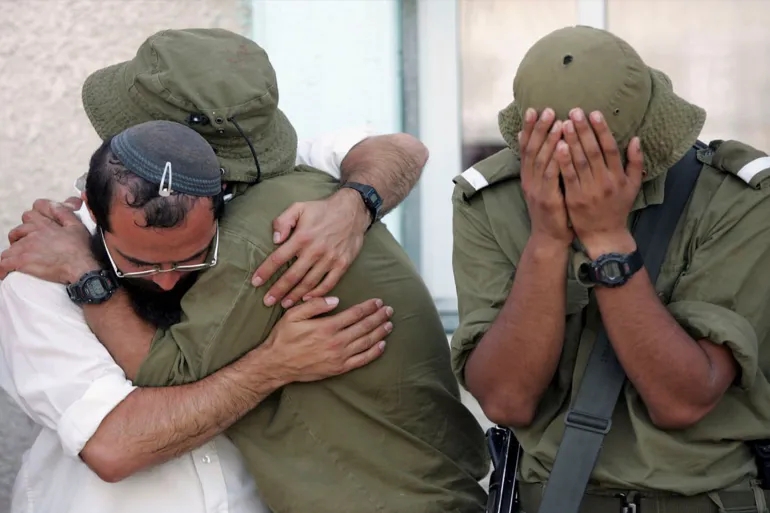
The Israeli army acknowledged, Monday, the death of a captain and medical doctor in the Givati Brigade and the wounding of seven other soldiers, including four officers and a battalion commander, in an attack carried out by Hezbollah using explosive-laden drones.
In a statement, the army said the deceased was a medic from the Shaked Battalion (424) of the Givati Brigade and was killed during fighting in southern Lebanon.
Israeli Army Radio reported that Hezbollah launched six explosive-laden drones around noon, Monday, toward a group of soldiers and a Nimer armored vehicle belonging to the Givati Brigade, which was stationed on the outskirts of the town of Zawtar al-Sharqiya, near the Shaqif site.
The radio added that among those seriously wounded were the operations officer of the Shaked Battalion and a platoon commander in the same battalion, while the battalion commander, a lieutenant colonel, was also wounded.
This attack comes a day after the Israeli army radio also announced the death of a soldier from the Givati Brigade’s reconnaissance unit and the wounding of four other soldiers in an explosion caused by an explosive-laden drone that targeted them, Saturday, evening in the Zawtar al-Sharqiya area of southern Lebanon.
The southern Lebanese front is witnessing a continuous escalation, amid ongoing clashes between Hezbollah and Israeli occupation forces according to Qudspress.
Matches organised by a former professional player are providing a brief respite from the harsh reality of life for the thousands living in overcrowded tents, schools or damaged buildings in the shattered Occupied Palestinian Territory of Gaza.
In the Al-Mawasi area west of Khan Younis, where tents stretch across the sand and snaking queues form for water and food, Asaad Al-Azzabi prepares for a match a world away from what he once knew.
Before the war, Mr. Al-Azzabi played for Al-Tajammu Club in Rafah, where he and his teammates had access to pitches, training halls, coaches and equipment.
UN News Asaad Al-Azzabi’s torn boots.
Borrowed boots
Now, he’s lucky if he can find boots to play in. “Sometimes I borrow a pair from a friend or patch them up with tape,” he says.
His home is now a tent in Al-Rahma Camp, a shelter for people displaced from Rafah, where access to clean water and sanitation services is scarce. He lives alone, after his wife left for Jordan with their son, who has cancer, to seek treatment.
According to UN data, around 1.7 million people are living in around 1,600 displacement sites across the Gaza Strip, most of them in temporary or informal locations. Most residents rely on water brought in by truck and are forced to cope with restrictions on the entry of equipment, fuel and repair materials.
Amid the struggle to meet basic needs, Mr. Al-Azzabi is preparing for the match with nearby Sheikh Al-Eid Camp. He explains the game plan to his players by drawing on the sand, before the team sets off on foot toward a pitch located among the tents of displaced people.
The match appears to be more than a sporting activity – it is a respite from the daily hardships of life in the camps.
Children and young men gather around the sandy pitch, applauding players, some of whom arrived after spending hours standing in queues for food, water or battery charging.
UN News Displaced people from Rafah watching the match between Al-Rahma Camp and Sheikh Al-Eid Camp.
Something out of nothing
Referee Alaa Abu Taha, a referee with the Palestinian Football Association and a displaced resident of Rafah, says football has become the “only outlet” for many people in Gaza.
“With the most limited resources, we try to play. Now there is no sports infrastructure. The pitch we are standing on now was originally prepared for basketball and volleyball, but our people create everything out of nothing,” he says.
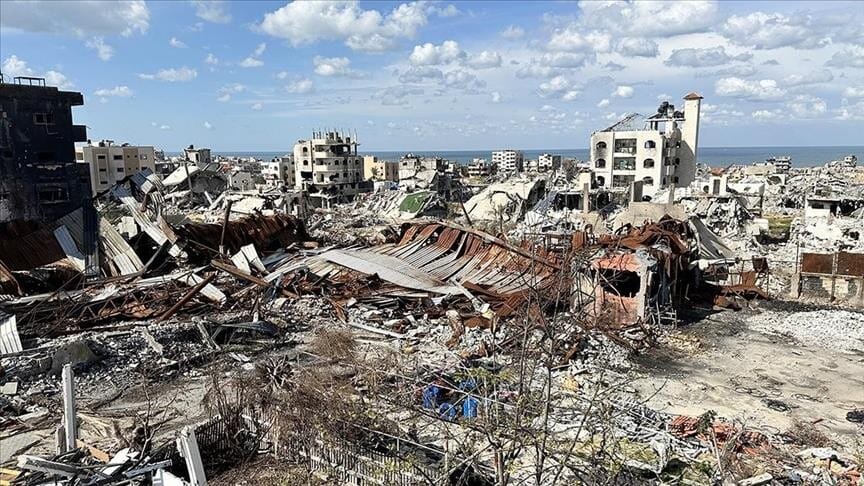
Gaza’s sports sector has suffered widespread destruction since the outbreak of the war. According to the Palestinian Football Association, hundreds of athletes have been killed, including many footballers, while hundreds of sports facilities have been damaged or destroyed, including pitches, club headquarters and training halls.
In Al-Mawasi these losses have not prevented players from organising a championship between displacement camps.
The big match
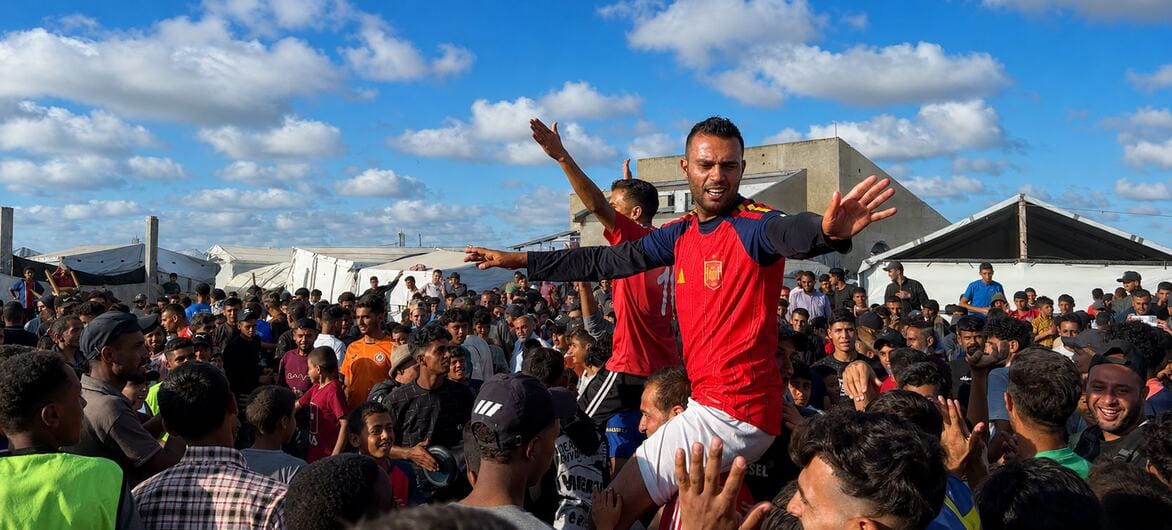
The match kicks off in front of a small crowd of displaced spectators, with Mr. Al-Azzabi taking part in boots held together by plastic tape. At the end of the match, Al-Rahma Camp defeats Sheikh Al-Eid Camp 2–1.
UN News Asaad Al-Azzabi celebrating with the crowd of young men and children.
After the final whistle, young men from the camp lift him and his teammates onto their shoulders, while children and young people celebrate among the tents. For a few brief moments, the sound of displacement recedes from the scene, and football emerges as a rare space for joy.
“Under these difficult circumstances, to be able to come out and play a match like this is a very good thing,” says Mr. Al-Azzabi. “Congratulations to our camp. I dedicate this championship to my wife and son in Jordan, and I wish my son a speedy recovery.”
For him, the game is more than a sporting victory. It is a message to his distant family and an attempt to preserve what remains of his life as a former player, chasing the ball as if it were the last thing connecting him to who he was before the war. UN News
Israeli Prime Minister Benjamin Netanyahu acknowledged Thursday that Israel currently controls 60% of the Gaza Strip and signaled plans to expand it further to 70%.
According to Israel’s Channel 12, Netanyahu said during a seminar in the Jordan Valley: “We currently control 60% of the Gaza Strip, and my directives are to move toward controlling 70%.”
He did not elaborate on how such plans would be implemented.
The Israeli army announced in October last year that it controlled 53% of the Gaza Strip after redeploying to the so-called “yellow line” under the first phase of US President Donald Trump’s plan to end the war in Gaza.
The arrangement envisioned further Israeli withdrawals under the second phase, launched in January. The “yellow line” refers to a temporary separation zone in eastern Gaza dividing areas under Israeli military control from areas where Palestinians are allowed to remain.
But Palestinian sources say that the boundary has been steadily pushed westward in recent months.
Bassem Naim, a senior Hamas official, told Anadolu that Israel has shifted the line by an additional 8% to 9% into Gaza’s territory, raising the area under Israeli control to more than 60% according to Anadolu.
The change has reduced the space available to Palestinians to roughly 38% of the enclave, intensifying an already severe humanitarian crisis.
Israel launched a genocidal war in Gaza in October 2023, killing more than 72,000 Palestinians and injuring over 172,000 others, most of them women and children, according to Palestinian figures.
[In translation]: The entire society is corrupt… the scum of the earth rule the land… their great arrogance will ultimately lead to a humiliating fall, God willing.
Dozens of Palestinian women at a displacement camp in central Gaza marked the 78th anniversary of the Nakba (Catastrophe) on Thursday, reliving scenes of displacement and loss they said continue to define Palestinian life decades after 1948.
Held at the Refaat Alareer camp in the Al-Zawaida area, the event linked memories of the historic Palestinian displacement with the reality of the ongoing Israeli war on Gaza, as participants said the suffering of exile and forced displacement had never truly ended.
The event was organized by the Sameer Project, a relief initiative led by Palestinians in the diaspora, and featured heritage performances, traditional dabke dancing and symbolic scenes highlighting Palestinian identity and the right of return.
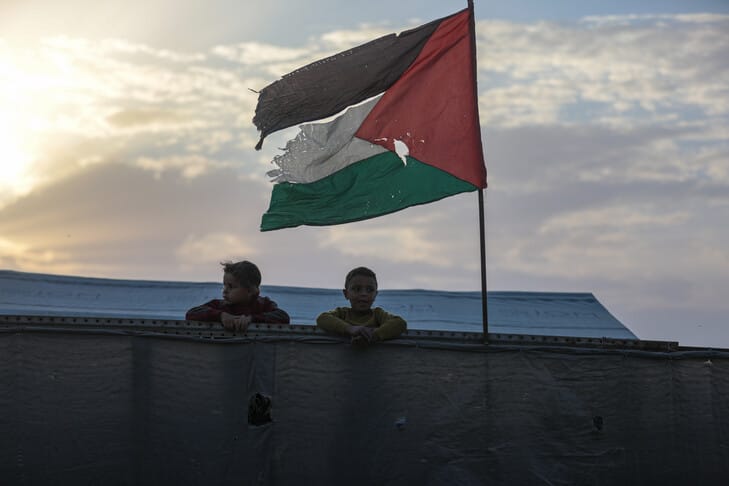
Women and children raised Palestinian flags, symbolic keys, and images reflecting displacement and attachment to the land. Several participants wore traditional Palestinian dresses and chanted songs and national hymns invoking Palestinian memory and what they described as an ongoing Nakba.
Palestinians commemorate the Nakba every year on May 15 through marches, exhibitions and public events in the Palestinian territories and around the world, calling for rights, including the return of millions of refugees.
The Nakba refers to the mass displacement of Palestinians in 1948 during the events surrounding the creation of Israel, when hundreds of Palestinian towns and villages were emptied and their residents forced to flee.
Reliving displacement
Ibtisam Abu Muailiq, a displaced Palestinian now living in Al-Zawaida, said Palestinians are still living through the Nakba today.
The current war, she told Anadolu, had brought back scenes of displacement and tent life that previous generations described after the events of 1948.
“Our home was destroyed, and we lost loved ones, some killed and others still missing, but we remain steadfast on the land of Palestine,” she said.
She called on people around the world to show compassion toward Palestinians and support them amid their suffering.
For Umm Mohammed Abdullah, the Nakba never ended.
Palestinians, she said, have endured repeated cycles of hunger, thirst, displacement and loss but continue to hold on to their land.
“No matter how severe the suffering becomes, we will not leave our homeland,” she added.
Steadfast despite war
Event coordinator Iman Al-Khatib said holding the event inside a displacement camp carried a message that Palestinians remain steadfast despite wars and catastrophes.
“We wanted to tell the world that Palestinians remain resilient and that the right of return will continue to live in the conscience of future generations,” she told Anadolu.
The Israeli army has killed more than 72,000 people, mostly women and children, and injured over 172,000 in a two-year war on the Gaza Strip since October 2023.
Despite a ceasefire that took effect on Oct. 10, 2025, the Israeli army has continued its attacks, killing at least 856 people and injuring 2,463 others, according to Gaza’s Health Ministry.

 CrossFireArabia