To Evelyn: The Baramki Home in Jerusalem
  • HebaHeba
  • August 13, 2026

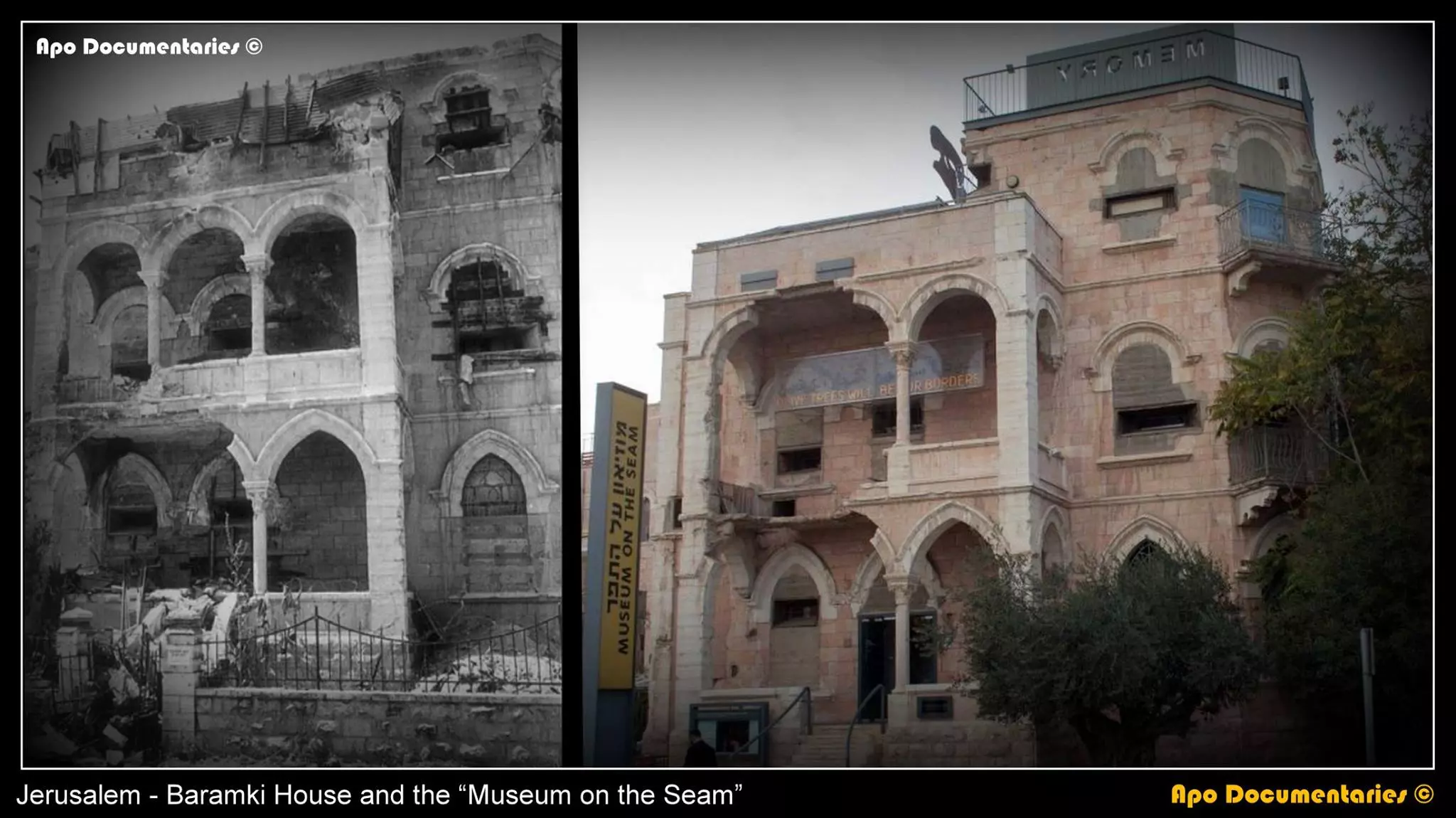
CROSSFIREARABIA – This house belongs to Andoni Baramki whom he built in dedication to his beautiful wife Evelyn. Andoni was a prominent Jerusalemite architect and built the home in 1932. The couple lived in this beautiful house until the War of 1948. Its location became a border area between the eastern part of Jerusalem under Jordanian rule and the western part of the city which Israel occupied. The house was located next to the Mandelbaum Gate, so the building was confiscated by Israel under its so-called Absentee Law which it introduced in 1950 and became an Israeli military outpost. After the Six Days War of 1967, the owner of the house demanded his property be returned by the Israeli authorities but his request was denied. In 1999, an Israeli foundation transformed the house into a museum, calling it as the Museum on the Seam. From Palestine Remembered

Continue reading
The Gaza Inferno

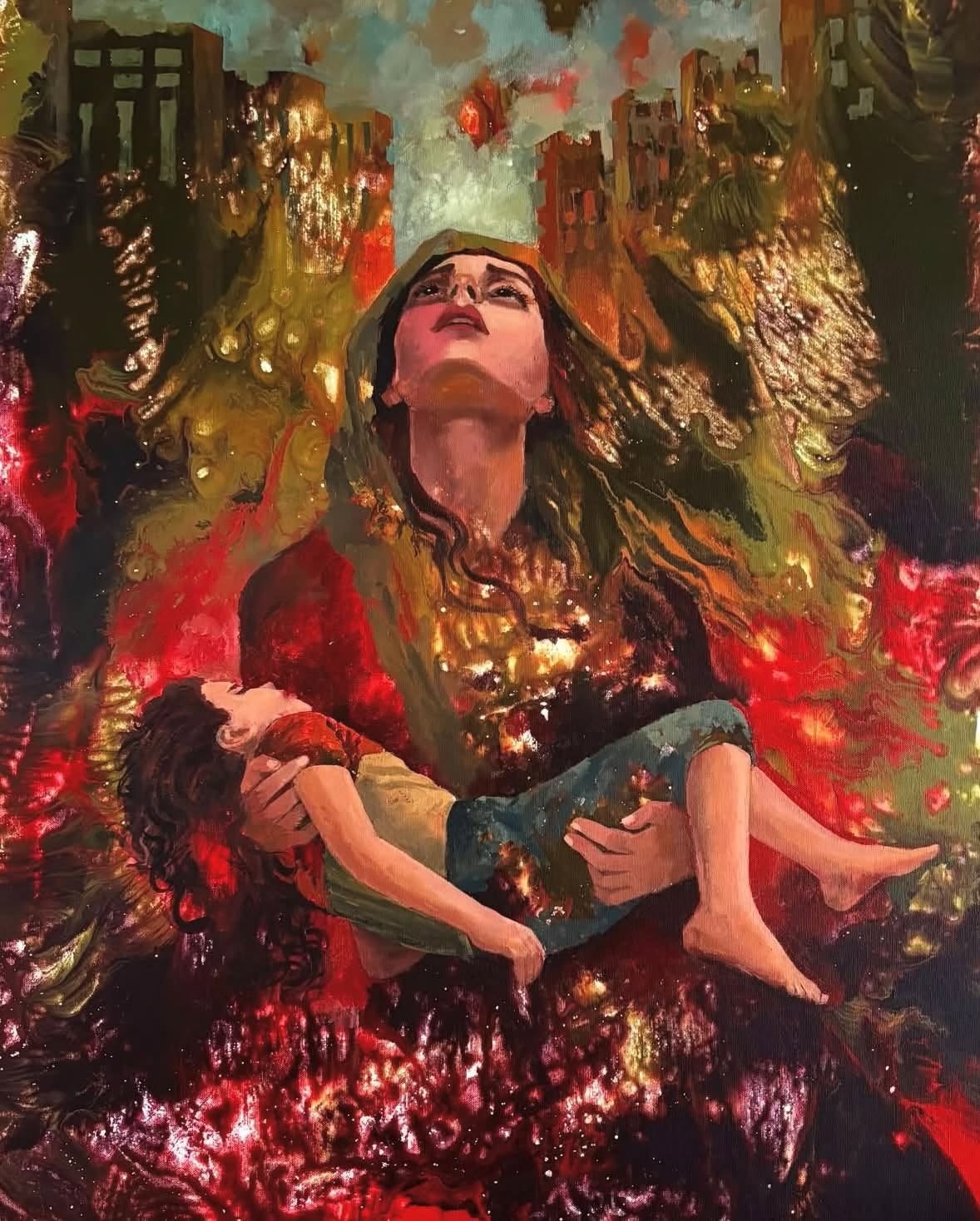
CROSSFIREARABIA: Maher Naji is an artist from Gaza. He was was born in the Jabalia refugee camp in 1963. He has an MA in Fine Arts and a Phd in architecture. His painting of a woman carrying her child looking up into the skies amidst the Israeli inferno all in red splotches is titled in Arabic “Kai La Nansa” (So We Don’t Forget).

Continue reading
Thinking of Hind Taher

Hind al-Husseini Remembered

From AbdelKader Muhtadi

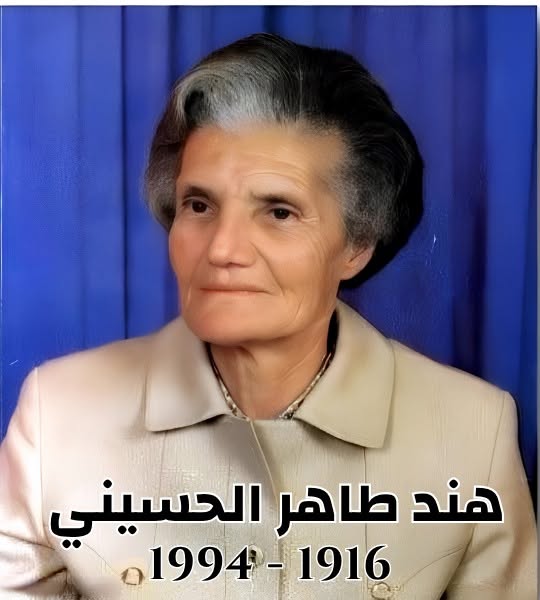
In one of the darkest moments Jerusalem experienced in 1948, Hind Taher al-Husseini transformed her noble humanitarian stance and compassion into an enduring educational and social legacy.

Born in Jerusalem on 25 April, 1916, Hind al-Husseini was a virtuous educator, a humanitarian activist, a staunch advocate for women’s education, and a pioneer of volunteer social work. In April 1948, she met 55 Palestinian children, most under the age of nine, who had survived the Deir Yassin massacre and were left homeless and without a guardian. She initially took them in at a temporary shelter before moving them to her family home in the Sheikh Jarrah neighborhood.

On her 32nd birthday, she officially founded the Arab Child Home. What began as an orphanage evolved into a comprehensive educational institution offering schooling, vocational training, literacy programs, kindergarten, and boarding facilities. Her vision extended beyond childcare to include advancing women’s education and social development. She founded a museum of Palestinian folklore in 1960 and contributed to the establishment of the Nashashibi Center for Culture and Literature to preserve Arab and Islamic cultural heritage. During the 1967 war, the Dar al-Tifl al-Arabi (Arab Child Home) was transformed into a clinic for treating the wounded, and was later rebuilt after sustaining damage.

Her community service garnered widespread international recognition. She received Jordanian medals for her social work and education, as well as the German Order of Merit, First Class, and served as a member of the Palestinian National Council.

Hind al-Husseini passed away in Jerusalem on September 13, 1994, leaving behind a legacy that stands as a testament to how compassion, education, and institution-building can transform humanitarian work into a lasting and impactful social force.

#PalestinianPersonalities #HindAlHusseini #Jerusalem #HistoryOfPalestine #DarAlTiflAlArabi #Education #SheikhJarrah

Continue reading
‘They Can’t Take The Sea From US’
  • HebaHeba
  • August 12, 2026

A Vast Sea, and a Narrow Water

By Ibrahim Isam

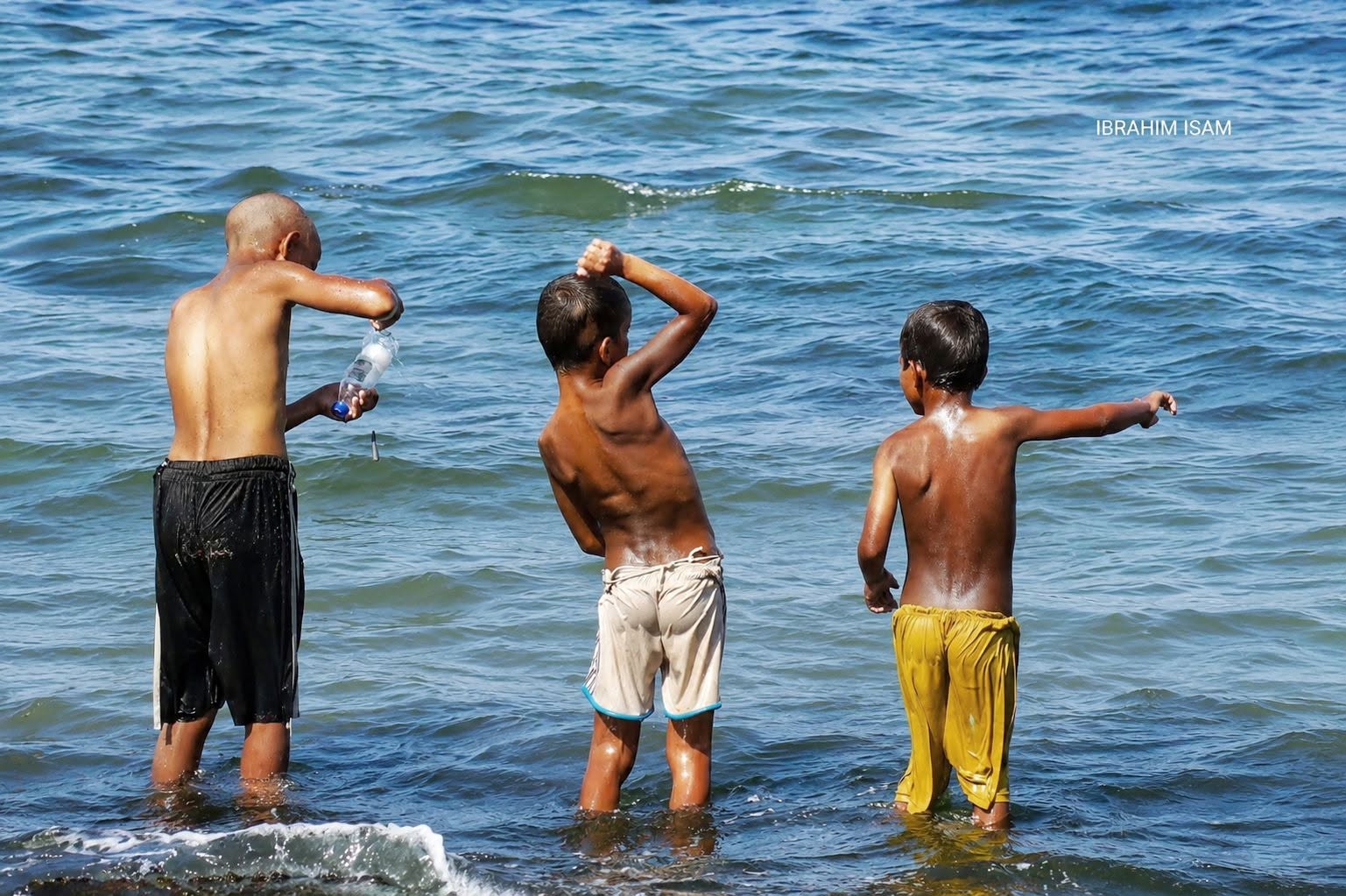
The sea was wide enough to carry the dreams of an entire city, yet in Gaza, it seemed narrower than a child’s dream.

Three children stood in the water, close together, as though sharing a secret they did not want the wind to overhear. No net. No boat. No fishing rod. Only scraps of fishing line they had gathered from abandoned nets along the shore, trying to turn what was left behind into a path toward a fish.

Perhaps they were fishing for fish.

Or perhaps they were fishing for something else.

Something that looked like tomorrow.

The sea stretched open to the horizon, yet they could not go far. A cruel contradiction: To see the road before you and still be unable to take it; to stand before endless water while life itself grows narrower for those who belong to it.

In the old stories, the sea was a passage into the unknown. Ships crossed it in search of a homeland, salvation, or a new beginning.

But these children had only a few meters of water, a broken thread, and a very small wish:

to return with something they could eat.

And still, they laughed.

Perhaps because children do not know surrender in the way adults do.

They see the water.

They see the fish.

They see the hand of a friend.

And they see, beyond the horizon, a place they cannot understand why they are forbidden to reach.

Perhaps innocence begins with this simple question:

Why can’t I go farther?

Perhaps peace begins there, too.

Peace is not a word written on walls, nor a promise postponed until tomorrow. Peace is a child being able to enter the sea without fear; carrying a real fishing net instead of a broken thread; returning home with a fish in his hands—not because that fish will change the world, but because it will tell him that life is still possible.

They walk through the water, step by step, as if teaching the sea itself the meaning of patience.

They do not ask for much.

Only a small piece of the sea,

and a larger space in which to live.

For freedom, in its simplest form, may be nothing more than reaching your hand toward the horizon without anyone telling you where you must stop.

And still, the sea remains vast…

So vast that it makes injustice seem narrower, harsher, and more absurd.

And the children remain in the water:

three small bodies,

three soaked dreams,

three little hands searching for a fish…

or for a tomorrow in which they can finally say:

The sea belonged to all of us.

Continue reading