During over two years of ongoing genocide in Gaza, the Israeli army has pursued a systematic policy of burying Palestinian bodies in unmarked graves, including near aid distribution centres in central and southern Gaza, under conditions that obstruct identification, conceal burial sites, and prevent families from learning the fate of their loved ones.
The investigation published by CNN, “Bulldozed corpses and unmarked graves,” reinforces the data obtained by Euro-Med Monitor through documented testimonies and underscores the need for an independent international investigation to identify the victims, locate burial sites, and ensure accountability for these practices.
These practices were documented by Euro-Med Monitor through a systematic programme that included extensive field investigations across northern and southern Gaza, interviews with survivors, eyewitnesses, and families of the missing, the collection of data from medical teams and local authorities, and the analysis and cross-checking of available visual material. This documentation reveals a systematic and widespread pattern of burial operations reflecting an Israeli army policy that cannot be treated as isolated incidents.
The worst thing I have ever experienced, after the shooting of civilians who were trying to get aid, was the order to clean up the area. The shooting was very intense, body parts everywhere, and the smell was awful
A contractor who worked with a humanitarian organisation in Gaza
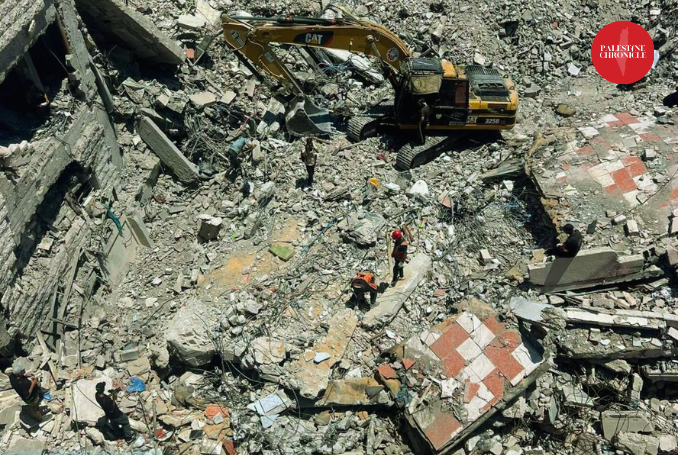
Euro-Med Monitor’s field documentation shows that Israeli forces repeatedly buried Palestinian bodies in public squares, open land, and areas near vital facilities, including aid distribution centres, hospitals, and schools, after sealing these locations militarily and blocking access by medical teams, families, and residents. This practice destroys potential evidence of unlawful killings, obstructs effective investigation, and deprives families of the right to know the fate and burial place of their relatives, in further violation of human dignity and international law.
Many Palestinian families discovered the bodies of their relatives buried in shallow pits left behind by Israeli forces after their withdrawal. This pattern was particularly evident near aid distribution centres and along forced displacement corridors, amid military operations marked by siege, starvation, and mass displacement of the civilian population.
Findings revealed by CNN on the Israeli army’s burial of Palestinians near aid distribution points are consistent with what Euro-Med Monitor has documented in recent months. Field testimonies show that Israeli forces prevented civilians and medical teams from accessing bodies for hours or days, then carried out rapid burials that concealed victims’ identities and destroyed potential evidence of unlawful killings.
Euro-Med Monitor verified the testimony of a contractor who worked with a humanitarian organisation in Gaza by reviewing available data and cross-checking it with independent sources. The witness stated that he saw Israeli forces fire on Palestinian civilians seeking humanitarian aid, killing several of them, after which he was instructed to clear the area, including bulldozing bodies and human remains.
The contractor stated, “The worst thing I have ever experienced, after the shooting of civilians who were trying to get aid, was the order to clean up the area. There were body parts. The shooting was very intense, body parts everywhere, and the smell was awful.”
“I complained to the Israeli army officer, but he replied, ‘That’s none of your business.’ I had to load body parts onto the back of the truck to dump them,” he added. “When I was ordered to carry out the task, I was not warned about the true situation. I find it difficult to talk about it. I feel my heart pounding and like I am going to collapse.”
At least 45 people have gone missing in the vicinity of aid distribution centres in the Gaza Strip, and their fate remains unknown, whether they were detained and subjected to enforced disappearance in Israeli prisons or killed and buried in unmarked sandy locations near those centres.
In March 2024, Euro-Med Monitor verified a widely circulated video showing, from a distance, two men walking separately along the Gaza beach, waving white flags in apparent surrender as they cautiously approached a group of Israeli soldiers on Al Rashid Street, near the barrier separating northern Gaza from the central and southern areas.
One of the men advanced towards the soldiers with his hands raised before disappearing behind a pile of sand and concrete, while the other attempted to flee but was pursued by an Israeli military vehicle and then suddenly fell to the sand, apparently after being shot. An Israeli military bulldozer subsequently appeared and buried both bodies beneath sand and debris.
The incident reflects a recurring pattern of deliberate dehumanisation and the use of terror to break the Palestinian population and force submission and displacement. It constitutes further evidence of the specific intent required for genocide under international law, while also being liable to classification as crimes against humanity and full-fledged war crimes.
An independent and comprehensive international investigation must be launched into the Israeli army’s burial practices near densely populated areas, aid distribution centres, and forced displacement corridors, including incidents involving the shooting of civilians seeking aid. The investigation must have full authority to collect and analyse evidence and to determine individual criminal responsibility for potential war crimes, crimes against humanity, and genocide.
The Israeli army must immediately disclose the locations of all mass and individual grave sites established during its military operations in Gaza. Urgent measures are required to protect these sites as potential scenes of international crimes, prevent the transfer or destruction of bodies and any tampering with evidence, allow independent forensic teams to enter Gaza, and lift restrictions on the entry of DNA testing equipment, or establish a secure mechanism for transferring samples to specialised laboratories abroad to enable victim identification and proper documentation of crimes.
Pressure must be exerted on Israel to disclose the identities of those killed, detained, or missing under its control during military operations, and to reveal burial or detention locations, to end families’ uncertainty and enable serious efforts to uncover the truth and secure redress. Israel must immediately disclose the fate of all persons it has arrested and continues to subject to enforced disappearance, cease this unlawful practice, allow detainees to communicate with their families and lawyers, and release all those held without a clear and specific legal basis, in accordance with international law.
Families and relevant Palestinian authorities must be enabled to retrieve the victims’ bodies and bury them in accordance with religious, humanitarian, and legal standards, ensure relatives’ participation in identification procedures, provide full disclosure regarding their fate, and deliver the necessary support.
States Parties to the Geneva Conventions and all other concerned states must ensure accountability for these crimes by opening national and international investigations, applying universal jurisdiction where necessary, and taking effective measures to prevent their recurrence. Euro-Med Monitor


 CrossFireArabia