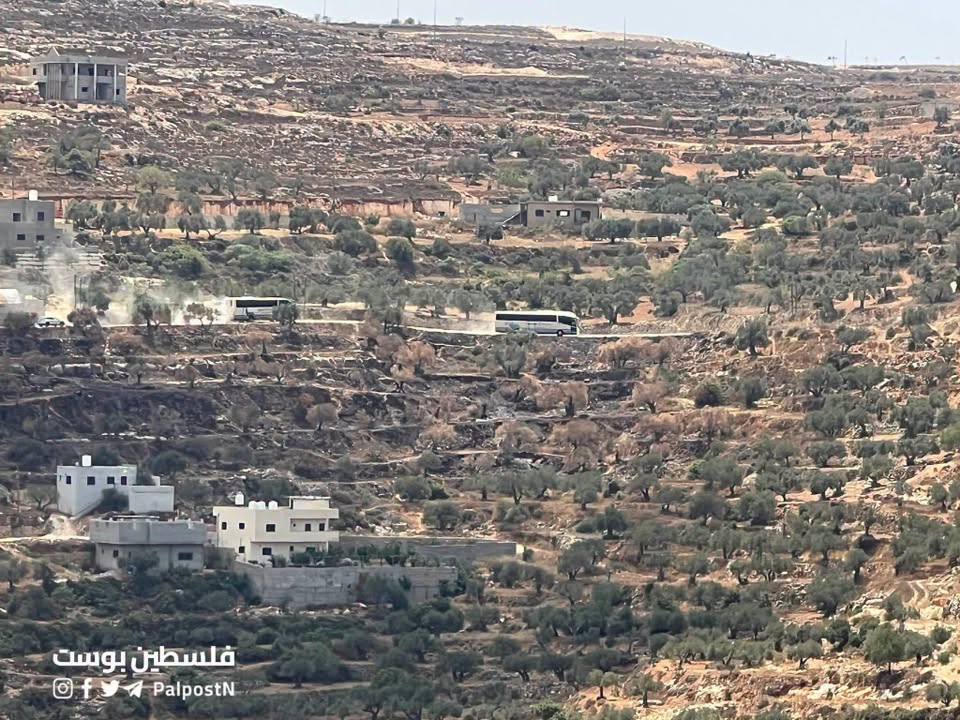
Farouq Ramadan: The Palestinian Who Snatched The Weapon From The Israeli Settler

On Friday morning, 24 July, the town of Tell, southwest of Nablus, witnessed not just a passing raid, but a legendary tale embodied by the heroism of an unarmed young Palestinian man.

Amidst the smoke and gunfire targeting Palestinians, the young man, Farouq Adnan Ali Ramadan, bravely stepped forward, creating an extraordinary scene in the history of popular resistance in the West Bank.

Clash at point-blank range:

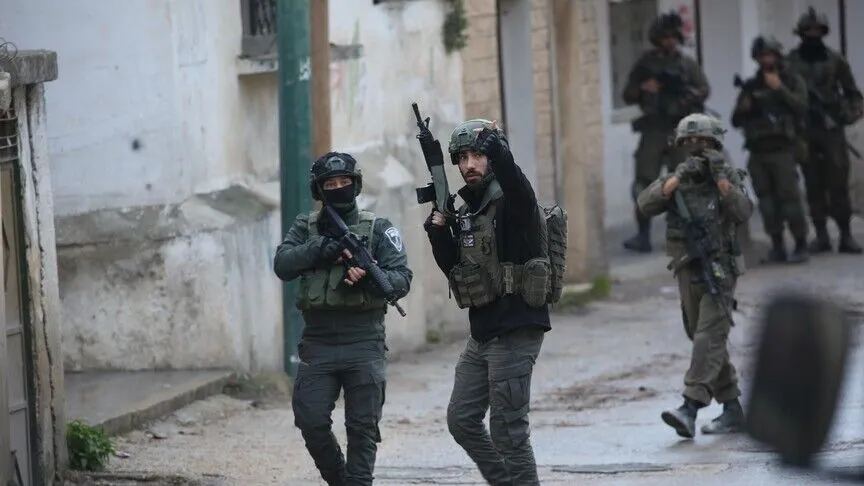
The events began when groups of settlers attacked the eastern part of Tell. Residents confronted them and forced them to retreat. Just half an hour later, the settlers returned, supported by Israeli military vehicles, and stormed the western area near the Havat Gilad settlement outpost. Clashes and hand-to-hand combat erupted between unarmed residents and armed settlers.

At that critical moment, amidst the indiscriminate gunfire directed at the residents, Farouq Ramadan advanced steadily and without hesitation, breaking through the wall of fire to directly confront one of the settlers’ security personnel and guards at the outpost. In a swift and direct physical confrontation, Farouq managed to forcibly seize the automatic weapon from the guard’s hand.

Not content with disarming the assailant, Farouq immediately shifted from a defensive position to confront the source of the fire, directly firing at the settlers and occupation officers in defense of the town of Tell and its inhabitants. This confrontation resulted in the death of an Israeli officer with the rank of major and a soldier from the Jerusalem Brigade, and the wounding of others, completely disorienting the attacking force.

Four Martyrs from One Family

In response to this operation, which shook the occupation’s security apparatus and led to the closure of Nablus and the imposition of a curfew, the occupation forces brought in massive reinforcements and opened fire indiscriminately, resulting in the martyrdom of Farouq Ramadan.

Farouk Ramadan’s heroism was not an individual act, but rather one etched in the blood of four members of the same family who stood firm against the massacre. Alongside Farouk, three of his relatives and cousins—Imran Ahmed Ali Ramadan, Ibrahim Hussein Ali Ramadan, and Jawad Hussein Ali Ramadan—were martyred defending their home.

Impact of the Operation and the Occupation’s Panic

Farouk Ramadan’s bravery sparked panic within the Israeli political and security establishment. Prime Minister Benjamin Netanyahu and several ministers in his government convened emergency meetings, while the Israeli army announced the deployment of additional battalions, imposing a complete security cordon around Nablus and Tell, and storming the Nablus Specialized Hospital.

The Israeli army announced that its forces were preparing to carry out a large-scale operational activity in the West Bank, adding that soldiers’ leave had been canceled and troop deployments throughout the West Bank had been reinforced.

Farouk Adnan Ramadan and his cousins ​​departed, leaving behind an extraordinary scene that will remain in the memory of Tell and the West Bank, and one that the occupation will also long remember. Aljazeera

Continue reading
UNESCO Places Sebastia on World Heritage ‘Danger List’

Palestine has successfully secured the inscription of the archaeological site of Sebastia on UNESCO’s List of World Heritage in Danger, Palestinian Minister of Tourism and Antiquities Hani al-Hayek announced on Friday.

The decision was made during the 48th session of the World Heritage Committee of the United Nations Educational, Scientific and Cultural Organization (UNESCO), held in Busan, South Korea.

The committee approved the listing of Sebastia under the emergency procedure and based on criterion (iii) of the World Heritage Convention, following the adoption of Palestine’s nomination file, which highlighted the site’s outstanding universal value as a unique testimony to the succession of civilizations and cultures that inhabited the area from the Iron Age through the Hellenistic, Roman, Byzantine, Crusader, and Ottoman periods.

In its decision, the committee said Sebastia is distinguished by its multiple archaeological layers and clear historical sequence, reflecting the continuous development of an urban, political, and religious center over more than two millennia, giving the site exceptional universal value deserving protection under the World Heritage Convention.

The committee also decided to place the site on the List of World Heritage in Danger due to what it described as serious threats, including Israeli occupation-related measures, land seizure plans, projects aimed at altering the historical and archaeological character of the site, and restrictions affecting protection, management, and preservation efforts.

The Ministry of Tourism and Antiquities welcomed the decision, describing the inscription of Sebastia as a historic national achievement that reflects Palestine’s cultural significance and demonstrates its commitment to protecting its cultural heritage in accordance with international standards despite challenges posed by Israeli occupation practices. WAFA

Continue reading
Remember The Massacre of Deir Yassin

Posted on Aslam Dar:

When you hear people say that history didn’t start on October 7th, this is exactly what they mean.


​The date was 9 April, 1948. Just weeks before Israel declared independence, the peaceful Palestinian village of Deir Yassin had signed a peace pact with their neighboring Israeli settlers, and the Palestinian villagers took that agreement seriously and actively refused to allow Arab militias into their village, choosing instead to remain completely neutral in hopes of maintaining peaceful relations.


​Now, the Israeli settlers knew the village had no armed protection, and rather than honoring that peace pact like the Palestinians did, they saw this as an opportunity. Zionist militias launched a savage attack on the village. They slaughtered hundreds of civilians, mostly women, children, and the elderly, and they did it in their own homes.


​Reports from the time document acts of sexual violence and mutilation. After the killings, survivors were loaded onto trucks and paraded through the streets of Jerusalem. They were publicly humiliated and mocked for the crime of trusting the Israeli settlers.
​Word of the massacre spread rapidly. The horror of what happened caused widespread panic throughout Palestine. Villages began to flee en masse, terrified they would suffer the same fate. The Israeli settlers had discovered that terror was an extremely effective weapon, and they used that fear to dramatically accelerate the Nakba.


​There are many stories just like this. But why didn’t we hear about them in school?

Continue reading
Israeli Kills 6-Member Family As They Slept

Story by Abdel Qader Sabbah, Mohamed Ahmed, Sharif Abdel Kouddous, and Jawa Ahmad

GAZA CITY—The charred shell of the Al-Masri family home in the Sabra neighborhood of Gaza City was still smoldering on Tuesday afternoon, hours after the Israel military bombed it, killing Firas and Salsabeel al-Masri and their four children—Faryal, Salma, Amira and Naim—as they slept.

The airstrike came without warning in the middle of the night, destroying the upper floor of the simple two-story structure and setting it ablaze. “We were asleep in the middle of the night, at around 2 a.m. or so, when we heard a huge explosion,” Abu Youssef Al-Masri, the children’s grandfather, told Drop Site as he stood in front of the partially collapsed home. “We realized the house had been struck. The house collapsed and caught fire.”

The fire spared nothing inside, family belongings burnt to ash lay among broken cinder blocks, the walls that remained standing blackened with soot.

“The house burned completely. It was my brother’s home—he, his wife, and their four children. Burned until it was charred. My brother’s entire family has been erased,” Mohammed Al-Masri, the brother of Firas, said. “They burned before our eyes and we couldn’t do anything.” He spoke standing at the graveyard where the family of six were buried on Tuesday afternoon.

The bodies were carried by relatives wrapped in white shrouds through the rubble-strewn cemetery to be laid to rest. Abu Youssef stood in the middle of the shallow graves and placed the small body of his granddaughter, Amira, next to her mother as Israeli drones buzzed incessantly overhead. “The whole world is watching us,” Mohammed said. “There is no ceasefire in effect, the war hasn’t stopped, and no one cares about us.”

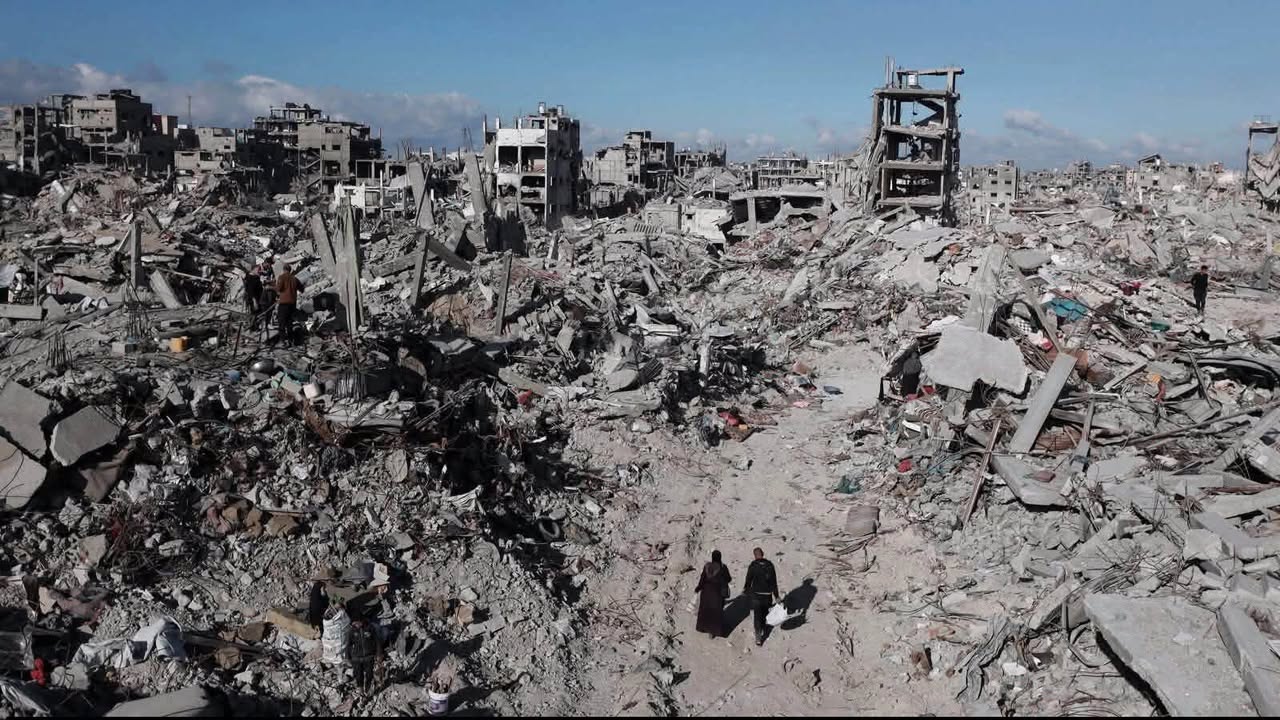
The attack on Tuesday came amid a particularly brutal and escalated Israeli assault across Gaza over the past several days as the world’s attention has been distracted by the renewed U.S. war with Iran. Daily airstrikes, shelling, quadcopter attacks, and shootings have targeted residential buildings, tent encampments, civilian vehicles, a funeral procession, a police station, and a hospital-turned-shelter, killing dozens of Palestinians across the enclave over the past week alone. At the same time, Israeli ground troops have been pushing further into Gaza, steadily extending the “yellow line” westward, taking more land, and driving the Palestinian population onto an ever-shrinking territory.

“It’s not simply that the resumption of the war in Iran provides cover, it’s also the fact that the war has largely been a failure from an Israeli perspective, and the Israeli state will look to compensate for this failure elsewhere before a new regional balance takes shape,” Nasser Abourahme, a professor of Middle Eastern and North African Studies at Bowdoin College, told Drop Site. “It’s most important to remember that the genocide itself has both stalled and never stopped. For all the horrific and unprecedented destruction and death, Israel hasn’t yet achieved any of its core aims: the ethnic cleansing of the Strip, the disarming of the resistance factions, or the resettlement of the Strip.”

The latest killing spree has brought the Palestinian death toll in Gaza since a so-called ceasefire went into effect in October 2025 to 1,180—including over 250 children—with 127 being killed in the first three weeks of July. Over 3,800 have been injured. The total recorded death toll since Israel launched its genocidal assault in October 2023 is now over 73,300 killed, with nearly 174,000 injured, according to Gaza’s health ministry.

On Monday, an Israeli airstrike slammed into the Al-Yemen Al-Saeed Hospital building in the Jabaliya refugee camp, killing at least four people and wounding several more. Like many hospitals in Gaza, the facility entirely ceased functioning during the war and is instead being used primarily as a shelter for displaced Palestinians.

“I went out to visit my friend near Al-Yemen Al-Saeed and suddenly there was a very large explosion, two consecutive explosions,” Youssef Akasha, an eyewitness who was just meters away from the attack, told Drop Site as he stood outside Shifa Hospital in Gaza City where the dead and wounded were being brought. Bloodied children were carried out of ambulances while bodies wrapped in blankets were put on gurneys. “The children were having fun, playing football, and suddenly they started screaming. We went directly to Al-Yemen Al-Saeed…we found the place destroyed and children were lying on the ground, women screaming, and men running to rescue the wounded.”

One of the worst attacks came on Friday, when Israel bombed a funeral procession outside the Ahmed Yassin Mosque in the Nuseirat refugee camp in central Gaza, killing at least eight mourners as they gathered to bury a man killed just hours earlier. Bodies lay strewn on the blood-soaked ground. One man was blown in half, his legs torn off his body as crowds of people screaming on the street tried to rescue the wounded. At Al-Awda hospital, injured children lay wide-eyed and silent on hospital beds as doctors rushed to treat them. One man knelt and embraced a bloodied corpse lying on a gurney, unable to let go.

“It was a very big attack and there was a large number of martyrs,” Medhat Saleh, an eyewitness who was wounded in his right arm, told Drop Site. “We couldn’t have imagined they would bomb a funeral of this size. Many children, women, and men…A massacre in every sense of the word. The people were piled on top of each other, torn apart.” He continued, “It’s gotten much, much worse. In recent days, this has become a daily occurrence.”

The UN High Commissioner for Human Rights, Thameen Al-Kheetan, made note of the escalated Israel assault in a statement on Tuesday. “The Israeli military has intensified its attacks in Gaza in recent days, killing and injuring dozens of Palestinians—children, women and men…Nine months after the announcement of a ceasefire, still, nowhere is safe for Palestinians in Gaza,” Kheetan said, noting that the UN had documented 57 Palestinians killed between July 13 and July 20 alone. “Meanwhile, the Palestinian population in Gaza remains trapped in an ever-shrinking area, with the ‘yellow line’ constantly being moved westwards by the Israeli occupying power, presenting a continuous threat to life as the Israeli military appears to routinely fire on Palestinians for mere presence in the vicinity of that line…The violations, the suffering and the misery that continue to be imposed on the Palestinians in Gaza cannot be ignored.”

As part of the October 2025 agreement, Israeli troops withdrew to the “yellow line,” a boundary running roughly parallel to the coastline and cutting off large swathes of north and south Gaza, that gave Israel control of 53% of the enclave. The move was supposed to mark the beginning of an eventual phased withdrawal back to a “buffer zone” at the border with Israel. Yet over the past nine months, the Israeli military has instead steadily pushed further westward in areas along the yellow line, taking more Palestinian land and placing yellow concrete blocks in some places to indicate their new line of control, which is now estimated to encompass closer to 70% of Gaza, according to Israeli military officials.

“The escalation of the killing, the expansion of the so-called yellow line in new land grabs, and the agitation of politicians and the settler movement for renewed Jewish settlement in Gaza all point to the fact that Israel’s endgame remains the ethnic cleansing of Gaza and its full conquest one way or another,” Abourahme said. “At the end of the day, the so-called ceasefire didn’t stop the genocide, it only modulated its tempo and intensity.”

For the past several days, Israeli ground troops have launched a sustained attack on areas near the Zeitoun neighborhood in Gaza City, including aerial bombing, shooting, and shelling attacks, razing land with bulldozers, and issuing displacement orders to force residents to flee their homes and shelters and drive them eastward.

“Today, they moved the yellow line here. The day before, they bombed the area, so we left. We spent one more night at home, then we had to leave,” Umm Salem Dawla, a resident displaced from the area, told Drop Site. “We gathered our belongings and left them at the camp. I keep saying I’ll go and sit by the cemetery. What can I tell you? What kind of life is this?”

On Wednesday, the troops pulled back and residents in the area found yellow concrete blocks placed at the Dawlah junction on Salah al-Din street—the main north-south thoroughfare running the length of the enclave.

“The Israelis started shelling the area, tanks started firing at us and at our home so we fled because the situation was extremely difficult…the tanks are always visible in the street, firing at our homes, and the quadcopters are constantly overhead. They don’t leave us alone. Twenty four hours a day there is shelling and gunfire,” Assem Dawla, another displaced resident of Zeitoun, said. “As you can see, we’re now taking out our belongings and leaving because the occupation has advanced the yellow line to Salah al-Din street. There is no longer any possibility of life here. Life in Zeitoun has been wiped out. There is no hope left and no way to live here anymore.”

The Israeli military’s encroachment to the Dawlah junction in effect prevents Palestinians in this area of Gaza City from accessing Salah al-Din road and the rest of the enclave further south.

“My fear is that all of Gaza will end up inside the occupation’s new boundaries. Netanyahu is now talking about taking 67% to 70% of the Gaza Strip, but I believe he wants to control all of it. There won’t be anywhere left for us. We’ll all be living under the control and domination of the Israeli army,” Dawla said. “The war is not over. We’re still living in a state of fear, greater even than when the war was ongoing.”

Sami Vanderlip edited the videos for this report.

Continue reading
Israel Continues to Ban Al Jazeera

Israeli authorities on Thursday extended the closure of the office of the Qatar television Al Jazeera in occupied East Jerusalem and banned its operations for an additional 90 days.

The daily Maariv said the extension marks the 14th time since Israel banned the channel in May 2024.

Israel barred Al Jazeera from operating inside Israel and the occupied Palestinian territories in May 2024 over its extensive coverage of Israel’s genocidal war on Gaza. The ban has been periodically extended since then.

Last January, Israeli Communications Minister Shlomo Karhi ordered the blocking of Al Jazeera and Lebanon-based Al-Mayadeen televisions across digital platforms, TV screens and YouTube.

The ban prohibits broadcasting and internet companies, and YouTube from providing services to Al Jazeera and Al-Mayadeen inside Israel.

In May 2024, at the height of Israel’s genocidal war on Gaza, Tel Aviv barred Al Jazeera from operating, a decision that has been repeatedly extended over the network’s coverage of the deadly assault.

More than 73,000 Palestinians have been killed and nearly 174,000 others injured in the brutal Israeli war since October 2023, which has also left the enclave in ruins. The UN estimates the cost of Gaza reconstruction at about $70 billion. Anadolu

Continue reading