Israel’s Mideast Message

By Dr Maisa Al Masri

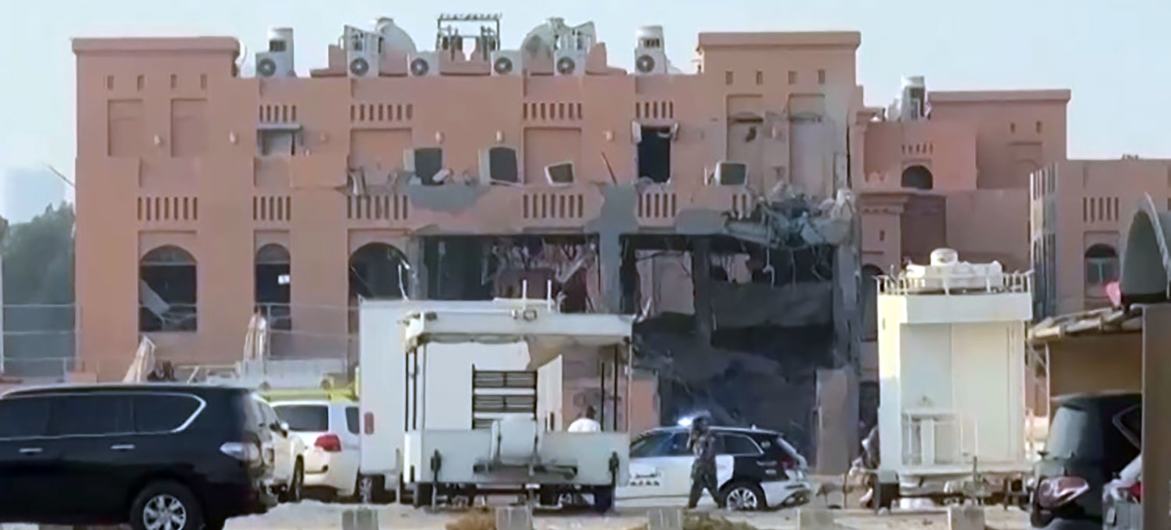
“This is a message to the entire Middle East,” Israeli Knesset Speaker Amir Ohana said in response to the Israeli airstrike that targeted Hamas leaders in the heart of the Qatari capital, Doha.

However, this statement is not merely a comment on the military operation strike into a declared strategic message, telling the entire region, and primarily the Gulf, that Israel, in partnership with Washington, has become the master of the decision-making process in the region.

Ohana’s statement is an explicit and direct threat that leaves no room for interpretation,  reflecting the new deterrence doctrine adopted by Tel Aviv: No red lines, no geographical immunities, and no Western allies outside the confines of Israeli dictates. Simply put, anyone who disagrees with us becomes a legitimate target, even if they are in the heart of a friendly capital that hosts the largest American military base.

This makes for a dangerous conclusion: Israel no longer views the Gulf states as partners in stability, but rather as “open arenas for fiery messages.” Washington is blessing the silence, participating in complicity, and mocking the Arabs.

Naked dominance

And don’t forget the Israeli crime in the heart of the Gulf marks the beginning of a new era of naked dominance. It’s not a traditional security operation, but a pivotal turning point in the rules of regional engagement, in which Qatar has been embarrassed both on the Arab level and internationally.

Israel has now publicly placed itself in a circle (no longer concealing its intentions) – through bombing and military strikes – that it no longer sees a distinction between political geography and the theater of operations. More dangerously, the heart of the Gulf today has become openly subject to Tel Aviv’s fire. And who can challenge it?

The strike wasn’t an intelligence leak or a silent targeting, but a direct airstrike in an area teeming with embassies, schools, and residential buildings, in a country that is a major ally of Washington and a pillar of American security in the Middle East.

Thus the message has become clear to everyone: No one is above attack… no state, no sovereignty, no partnership.

The US administration, led by Donald Trump, evaded with a series of conflicting statements about its prior knowledge of the operation. But whether it knew and blessed it, knew and remained silent, knew too late, or did not know at all, the outcome is the same: The American cover was removed, Gulf confidence eroded, and billions perished. The statements of the US embassy in Doha did not go beyond expressions of caution to American citizens, while White House statements swayed between “regret over the location” to “understanding the goal of eliminating terrorism.”

I believe the opposite message was conveyed to the Gulf capitals: Your security is not a priority, and your sovereignty does not equate to a clear position from Washington. The question that now arises however is: Why Qatar? Why now? Why was the strike carried out in Qatar and not in Turkey, or Iran for example? This is despite the fact that the Hamas leaders that were targeted had just returned from Istanbul, suggesting Tel Aviv chose the location not arbitrarily but with deep political awareness. Tel Aviv did not pull the trigger in Istanbul, even though the targeted leaders passed through it only hours earlier.

Turkey, with all its military, political, and international complexity, is not a testing ground for Israeli madness. There are red lines that even Tel Aviv dares not cross… and Turkey is one of them. The potential Turkish military response, the internal Turkish explosion during a highly sensitive election season, and the delicate balance of power within NATO rendered Turkish territory “operationally closed” even to the most violent wings of Israeli decision-making. But when the targeted figures left Istanbul for Doha, everything changed.

Qatar, like other threatened Arab states, in the Israeli security and intelligence mindset, is merely an intermediate gray area, neither neutral nor classified as an “enemy,” potentially a shocking target at a low cost. This is something all Arab decision-makers should be aware of.

From Tel Aviv’s perspective, Qatar is balancing contradictory roles, managing mediation, funding aid, and hosting parties that anger Israel without possessing a genuine deterrent umbrella. There are no international calculations that could prevent a surgical strike carried out within hours. Merely hosting an American base does not make Doha “immune,” but may even further tempt Tel Aviv, proving that decision-making in the region is no longer solely in Washington’s hands but in Tel Aviv as well.

In short, Israel needed a platform to send the biggest message since the Gaza war… so it chose the weakest link, amid the silence of its strongest ally.

Here, we can pause a moment at the Knesset member’s statement that the operation was “a message to the Middle East.” This is not a slip of the tongue, but a strategic doctrine upon which future decisions are based. Israel is telling all countries in the region that whoever harbors Hamas, or even engages in dialogue with it, will be next.

If the Arab states fail to take a firm political stand, the Doha precedent will be repeated elsewhere. It may not be Hamas’s mediation that stands accuse but rather the concepts of neutrality, balance, and even dialogue with parties Tel Aviv disapproves of and which then could become sufficient justification for a strike. It’s a policy of punishment.

This scene is posing existential questions for Arab capitals. If Qatar, Washington’s most important ally, is being bombed over the heads of its own people, after Syria, Lebanon, and Gaza… should we wait for Iraq’s turn? Riyadh? Abu Dhabi? Kuwait? And others? Does the American umbrella truly protect us, or is it used only when our interests intersect with Israel’s?

And what is the point of hosting American bases if they do not prevent airspace violations? Or provide protection?

What happened in Doha is pushing the region to crossroads: Either continuing its position of dependency and timid mediation, or repositioning strategically and developing independent air defenses, which is logistically difficult, or seeking alternative alliances (Ankara, Beijing, Moscow, Tehran?), and establishing red lines that Tel Aviv will not cross.

Qatar now faces difficult choices: Will it withdraw from the Hamas mediation? Will it demand real security guarantees? Will it go further, toward symbolic deterrence or unconventional partnerships? Or will it pay the price of protection once again?

Beware: A war of wills is beginning now. The Israeli airstrike in Doha was not just a blow to Hamas, but also a slap in the face to the sovereignty of the Gulf and the region, an undermining of the prestige of international law and its signed, ratified, and binding agreements, and an insult to the concept of the alleged strategic partnership with America.

This is the beginning of a new era, one in which Israel and Washington declare that the security of the region is no longer an Arab decision. The question now is: Will the Arabs as a whole wake up before “Ohana’s message” reaches other capitals? Perhaps.

The author is a political writer based in Amman Jordan and contributed this article to the Al Rai Alyoum Arabic website

Continue reading
Haaretz: US Finally Independent From Israel

An article in Haaretz reports that Israel has suffered several blows in recent days in its historical relations with the United States. And that US President Donald Trump no longer requires Saudi Arabia to normalize relations with Tel Aviv for Washington’s nuclear cooperation with Riyadh.

Adding insult to injury to the Israel occupying state, Trump has reached an agreement with the Houthis Ansar Allah group to end US military strikes on Yemen. This is plus the fact the US has began negotiations with Iran without the blessing of Israeli Prime Minister Benjamin Netanyahu. Further to that a US official in the Trump administration also held direct contact with the Hamas.

However, Odeh Basharat in his Haaretz article argues that the most painful blow Israel has ever suffered was Trump’s dismissal of his National Security Advisor, Mike Waltz, due to a discussion he had with Netanyahu, behind Trump’s back, about launching a military attack on Iran.

Basharat said the United States has finally begun to wake up and free itself from the shackles of Israel, and act as an independent state, not a “banana republic.” Basharat, a journalist from the Arab world, expressed his astonishment at these developments and wondered whether what was happening before his eyes was real or merely an illusion.

The writer believes that a seismic clash is taking place between the two countries and the two men, and that all the reasons are now converging. “America is gaining its independence 250 years after the beginning of its First Revolutionary War,” referring to the war that took place between 1765 and 1783, when 13 British colonies in North America rejected British colonial rule and gained their independence.

Basharat describes this emancipation as the Great American Rebellion, and attributes its causes to the fact that the world—and the United States as part of it—felt deeply concerned by what the writer, with biting sarcasm, called “Israel’s diplomatic acrobatics,” its “enlightened occupation” of the Palestinian territories, and its “closure (of the Gaza Strip) that allows only air in.”

According to the article, as soon as Israel reaches an agreement on a particular issue, it adds new conditions the next day. Although the Arab states that signed peace agreements with Israel were not required to recognize it as a Jewish and democratic state, only the Palestinians are required to do so, which, as Basharat argues, permanently relegates Israeli Arabs to second-class citizens.

According to the article, it has become clear that Netanyahu is deceiving everyone: Arabs, Jews, and Americans, not just Hamas and the Lebanese Hezbollah movement, as he previously boasted to Israeli police investigators that he misled and deceived them, then bombed them.

Since the time of David Ben-Gurion, Israel’s first prime minister, the state’s policy has been based on force. In contrast, Trump seems to believe in a policy of carrots and sticks—meaning diplomacy and force combined—according to the article.

The author claims that the US president thinks differently, as demonstrated by his actions toward the Houthis, Iran, and the tariffs. Once he realized he had failed, he took a step back.

As for Israel, its problem does not lie solely with Netanyahu, as Basharat argues, but rather with the fact that it has not offered an alternative to force. Only three of its former prime ministers, according to the article, have taken a different path: Moshe Sharett, whom Ben-Gurion was keen to overthrow; Yitzhak Rabin, who paid for it with his life; and Ehud Olmert, who was ousted before even presenting his plan.

Furthermore, Israel has long treated the White House as a branch of its prime minister’s office, intervening in the wording of every sentence in documents issued by Washington regarding Israel, according to the Haaretz article as reported in Al Jazeera.

Continue reading
Can Arab States Stop The Israeli Genocide?

Neither the Israeli war nor the ethnic cleansing of Gaza will ever stop if there is no forceful, determined intervention from the outside. 

And primarily this intervention has to come from the Arab countries and the pan-Arab nation as a whole: If these states – so-called Arab brethren and Islamic affiliates bound by common language and culture – don’t stand up and say ‘no’ to Netanyahu’s bloody war on Gaza, now in its 15th month, the ethnic cleansing, devastation, destruction and possibly the near and future displacement of the Palestinian people will continue to be hummed.

No bland utterances

Arab countries, from the far-west to the center and all the way to the east must move beyond bland utterances and condemnations of the mindless bloody Israeli military actions on Gaza that has so far resulted in the killing of more than 50,000 people, internally displaced more than 2 million of the population with 14,000 dead yet to be recovered from under the millions-of-tons of rubble that needs years to clear out.

As well, and further stated by Palestinian activist Dr Mustafa Al Barghouti, Arab states have to now develop at least a two-pronged strategy to drive the message across that they will not stand ideally by and watch the Palestinian people of Gaza being massacred and driven to smithereens.

Arab countries, and incidentally this should have been done a long time ago, which have normalized with Israel must freeze their diplomatic relations with the Zionist entity. Their leaders must say to Prime Minister Benjamin Netanyahu that relations will remain cut and frozen and that no further relations will take place, until he ends the Israeli war on Gaza and from now on, its back to the “bad old days” of a black Cold War between the Arab countries and Israel. 

The message needs to be loud and made crystal clear by Arab leaders for Netanyahu and his extremist government and military men to stop the carnage, killing and mayhem that is being created in Gaza and its people.

Determined Arabs

It is only through such a determined approach that will force the Israeli government, its leaders and ministers to sit, think and possibly review their slaughter of the Gaza enclave. At the very least, they would be forced to put the “brakes on” to their “happy attitude” of committing their atrocious massacres carried out almost daily since 7 October, 2023.

What is needed is a credible deterrence with those in power moving beyond their pedestals and high chairs and plush stages and put words and action together for the Arab world is nowhere as helpless on this issue as it is being projected.

All of the 22 Arab countries have now a real opportunity to stop the Gaza massacres through the new American president at the White House Donald Trump. He forced Netanyahu’s hand for a temporary ceasefire starting 19th January, 2025 which continued for almost two months and he can do it again if he wanted to and/or forced to. At the moment there is no political will.

Effective tool

Despite the present-relaunching of the war on 19 March, basically through an American green-light, Arab countries can have an effective and meaningful role if they choose to. After all, Trump soon backed down when he first suggested that the USA take over Gaza and turn it a Middle East Riviera whilst displacing its people to neighboring countries such as Jordan and Egypt.

He soon retreated from pursuing such an idea especially when Arab capitals such as Cairo, Amman, Riyadh, Algiers, Beirut, Kuwait, Doha, Muscat and Abu Dhabi condemned such a move with Netanyahu even having the audacity to say  Palestinians can have their state in Saudi Arabia. Trump’s Riviera idea soon became bogged down but Israel shortly after, restarted its war on Gaza, again with the blessing of the US administration.

But here again, and today the Arab countries, can make their move. The USA has vital, strategic, economic and political interests in the world and these can be used in different ways to persuade Washington to pressure Tel Aviv to back down on Gaza, other than promising to continue its bloody onslaught on ordinary Palestinians in Gaza with the hope of getting rid of Hamas and which according to their calculations they can’t beat until 2027 and/or whenever.

Netanyahu must be made to stop! He is not doing so because of the ongoing military supplies and backing from the United States and from the muted Arab response which have to go beyond condemnation and denunciations. Arab states have the tools at their disposal, it is time for these to be uses effectively otherwise the Israeli genocide will continue and expand.

This comment is written by Dr Marwan Asmar, chief editor of the crossfirearabia.com website.

Continue reading