The US General Who Swallowed His Own Truth
 CrossFireArabia
- March 6, 2026
By Jassem Al-Azzawi
General Dan Kaine, Chairman of the Joint Chiefs of Staff, delivered a confidential warning to President Trump with the utmost candor—the kind of candor that democracies rely on and empires routinely ignore. He said: “We don’t have enough ammunition to win this war. It’s not going to be pretty.” This warning wasn’t born of cowardice; it was the last vestige of institutional integrity that still flickers within the halls of American military power.
Trump’s response was that of a circus clown, not a commander-in-chief. Through his “Truth Social” platform—that distorted mirror of American political life—he dismissed the warning with the arrogance of a street vendor, saying: “Oh, no, no, no. If we do it, we’ll win easily.” Thus, a sober assessment became mere publicity, and caution a lie.
But the biggest lie came later. When Kaine’s warning leaked, Trump not only rejected it but completely reversed it. With the confidence of a man who has never been held accountable for anything, he told the American public the general had said the exact opposite—that the United States had plenty of missiles, munitions, and everything else. “That’s not what he said at all,” Trump declared, putting words of false victory in the mouth of a man who had offered only warnings.
And General Cain remained silent
This silence is not just a footnote in this story; it is the story itself. By remaining silent, Cain allowed the American public to absorb the falsehood as truth. He did not say: “No, Mr. President, that’s not what I said.” He did not invoke his oath, nor the soldiers who would pay with their lives for the gap between political rhetoric and logistical reality. He chose the safety of silence over the danger of truth, and in doing so, he betrayed not only himself but the Republic. This is the rot at the heart of American militarism.
As historian Andrew Bacevich has long warned, the professional military has become more of an instrument of imperial ambition than a defender of democratic values, with senior officers more concerned with their next post than with the Constitution they swore to uphold. Kaine’s silence was not a mere slip of the tongue; it was a symptom of a deeper malaise.
The logistical picture Kaine described in private was not theoretical; the calculations were unforgiving.
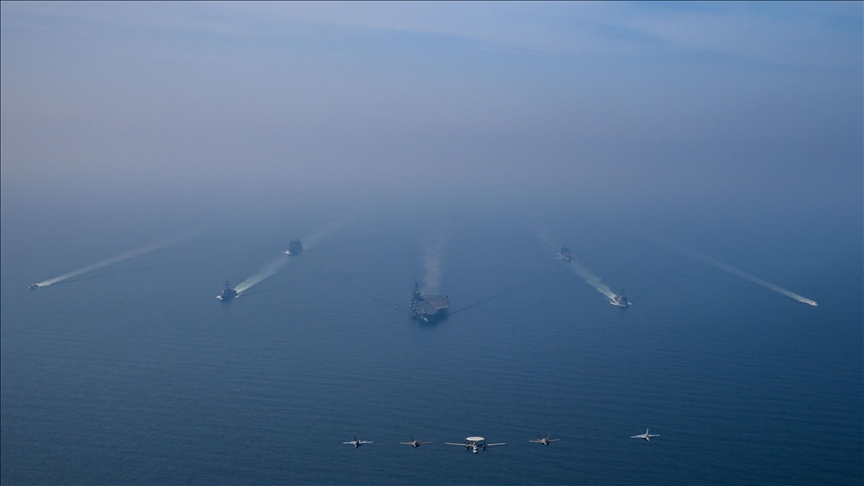
Current stockpiles of interceptor missiles and precision munitions could not sustain a prolonged air campaign against a country three times the size of Iraq. The Wall Street Journal documented a “worrying gap” in U.S. missile stockpiles, noting that reserves were “far below” the requirements of intensive and sustained operations. Pentagon contractors were instructed to “double or even quadruple” production of Patriot, SM-6, and precision-strike missiles—a tacit admission that the arsenal built for Cold War scenarios is inadequate for the war being fought today.
Consider Gaza: Israel, the most heavily armed military power in the Middle East, with complete air and naval dominance, has turned a tiny coastal strip into a moon-like landscape of devastation over two and a half years, yet it has not broken Hamas. Gaza is only 37 kilometers long. Iran, on the other hand, is a nation of 90 million people, with mountainous terrain, strategic depth, fortified infrastructure, and a combat-hardened Revolutionary Guard. The idea that it will collapse under a few weeks of American airstrikes is not strategy; it is wishful thinking. “God help us if this continues, if it gets to four weeks,” Colonel Daniel Davis warned on the Deep Dive podcast. He was speaking in military terms, and the same prayer applies. Politically.
When Trump now raises the prospect of sending ground troops, he is not escalating from a position of strength, but rather improvising from a position of denial. Admitting that air power and missiles alone cannot achieve the political objective is an admission that the original objective was never honestly assessed. This is the pattern of American wars at the end of an empire: Glittering promises, disastrous calculations, and then a grim and horrific reckoning paid in blood by those who had no seat at the table where the lies were told.
The costs are already piling up—not just in the currency of munitions and riches, but in the currency that empires always ultimately spend and regret most: credibility. America’s word, already devalued by two decades of contrived justifications for war, is getting cheaper by the day.
Democracies can tolerate miscalculations, and they can tolerate bad presidents, but what they cannot long tolerate is the institutionalization of a culture where the truth is whispered behind closed doors and swallowed whole in front of cameras. When the chairman of the Joint Chiefs of Staff allows his words to be weaponized for propaganda — when the man in charge of counting missiles refuses to correct a president who pretends they are plentiful — something far greater than military credibility collapses.
What is crumbling is the social contract between the governed and those who send them to their deaths.
Caine’s silence was not cautious; it was complicity. And in an imperial machine suffering from a shortage of ammunition and a shortage of truth, complicity is the only resource that seems inexhaustible, because when the missiles finally run out, slogans won’t replace them.
Reality will.
Al-Azzawi is an Iraqi writer who contributed this piece to Al Rai Al Youm which was translated and appeared in crossfire.com