The Israeli and US plans aiming to transform the Gaza Strip into an economy lacking financial sovereignty are extremely concerning. The plans suggest abolishing cash currency and enforcing a transition to a digital economy managed by external entities aligned with Israel.
This would change access to money and basic transactions from a fundamental right into a revocable privilege, making food, medicine, and shelter dependent on security decisions and military assessments. It reflects a coercive restructuring of daily life aimed at pushing the population toward poverty and displacement, managed through technology.
After over two years of financial blockade, Liran Tancman, an Israeli businessman and former officer in Israeli Intelligence Unit 8200, who has been involved with the Gaza Humanitarian Foundation (GHF), said at an event in Washington that rebuilding Gaza depends on restoring its digital and economic connectivity. He outlined a vision for creating a “secure digital backbone” to support electronic payments, education, and financial services, alongside an “Amazon-like logistics system”. This approach aims to transition the economy from a rights-based framework to one focused on operational and security control.
Introducing digital wallets as a technical solution for reconstruction functions as a cover for a new phase of engineering control over the population and increasing economic reliance on Israel. This strategy transforms financial technology into a programmable instrument for collective regulation, enabling real-time monitoring, arbitrary restrictions, and selective freezing of funds amidst ongoing blockade and occupation, all while lacking Palestinian sovereignty over data, financial systems, operational conditions, or options to object.
Subjecting the right of access to financial resources to a security authority, whether directly or indirectly, undermines the core of economic and social rights. It damages the right to food and human dignity and breaches international humanitarian law, which prohibits collective punishment and criminalising the population. Additionally, it violates the prohibition on the use of starvation as a warfare tactic and conflicts with the fundamental obligation to protect civilians and guarantee their access to essential survival needs.
Any digital infrastructure established under occupation or international tutelage without full Palestinian sovereignty over data and financial systems risks becoming a tool for collective control and subjugation. Israel has frequently enforced arbitrary movement restrictions based on vague and non-appealable security reasons, raising fears that similar restrictions could extend to access to financial resources.
Euro-Med Monitor warns that creating a digital financial system under Israeli control could serve as a comprehensive coercion tool against Palestinians, especially journalists, activists, and human rights defenders. Digital wallets might be frozen based on a single decision, or individuals could be assigned broad security labels, resulting in the loss of access to funds without proper oversight, due process, or remedies. This situation risks making essential rights to food, medicine, and shelter dependent on unchecked security judgments.
Israel’s extensive security classification system for Palestinians, which designates hundreds of thousands as having political or national affiliations, could potentially be used as a financial weapon under such a framework to block access to their wallets and enable coercion. This situation is similar to the current restrictions on travel for medical care or movement freedom, often justified by “lack of security approval,” despite the lack of clear standards or real chances to contest these decisions.
The threat goes beyond simply denying funds; it involves turning the economy into a network of conditions and restrictions. Basic services would become dependent on political and security compliance, while aid, salaries, and trade could be used as tools for classification. People would be tracked through digital records that decide their access to essential needs. This method risks reinforcing arbitrary discrimination and could lead to collective punishment that affects both individuals and groups.
Restricting the development of advanced internet services to areas like the so-called “New Rafah,” combined with partial reconstruction efforts, raises concerns about using technology as a pressure tool to alter demographics and enforce coercive changes. Digital services risk becoming a privilege tied to geographic location rather than a universal public right, thereby weakening the principles of non-discrimination and equitable access to services.
Euro-Med Monitor emphasises Tancman’s crucial role in the GHF, which is associated with contentious aid distribution methods amid the Gaza genocide. Field data indicate that the foundation’s policies helped engineer starvation in the enclave, resulting in about 1,200 civilian deaths and injuries to thousands more during food access efforts. He is also among those who suggested tying aid distribution to “biometric” checks, effectively turning relief efforts into mechanisms for data gathering, coercion, and security control.
Any digital or economic initiative that overlooks the occupation’s realities and provides the occupying power with more control tools over the population’s lives does not contribute to rebuilding Gaza or facilitating recovery. Instead, it solidifies an illegal system of domination and risks turning technology into a means to prolong violations and maintain the blockade in a “smart” manner. In this form, the blockade becomes programmable, with punishment that is swift and direct, serving as leverage to drive the population into poverty, displacement, and uprooting by limiting livelihoods and linking survival to security policies.
The reconstruction efforts and any transitional phase must be grounded in respect for international humanitarian law and human rights law, guarantee full Palestinian sovereignty over resources, systems, and data, and ensure the separation of humanitarian arrangements from security and intelligence functions.
Euro-Med Monitor underscores the prohibition on linking any financial services, humanitarian aid, or access to basic necessities to “biometric” verification, security classifications, or political conditions. It advocates adopting the principle of data minimisation and preventing the transfer or sharing of data with any third party, particularly security bodies or companies contracted with them.
Since October 2023, Israel has barred all cash entries into Gaza and enforced a strict financial blockade, resulting in the closure of all bank branches during the genocide. Although some branches later reopened partially, they were still not allowed to bring in cash, thereby preventing cash withdrawals.
Euro-Med Monitor urges rejection of any financial or digital arrangements imposed on Palestinians under occupation or made in their name without real Palestinian sovereignty, independent civil representation, and enforceable oversight and appeal processes. The idea of “consent” in the context of occupation lacks legitimacy as long as Palestinians do not control money and data.
Any system that does not guarantee full Palestinian sovereignty over data, infrastructure, standards, and governance, and that grants the occupying power or its agents the ability to access, disable, or freeze operations, remains an unlawful instrument of control, regardless of any humanitarian or developmental framing.
All digital systems should undergo regular independent audits focusing on privacy, cybersecurity, and human rights impacts, with the results openly published. Full transparency is required regarding funders, owners, operators, contractors, and contractual conditions. Euro-Med Monitor calls for safe non-digital alternatives and opposes making survival or access to services dependent on digital wallets, which could exclude vulnerable groups or those without connectivity or technical means.
The establishment of independent and effective appeal mechanisms with well-defined jurisdiction, competent judicial authority, and quick decision-making regarding asset freezes or transaction restrictions is crucial. These mechanisms should ensure transparency in operational standards and objection procedures and require that decisions be reasoned.
Euro-Med Monitor urges the establishment of an independent Palestinian civil authority to govern the financial and technological systems without interference from the occupation. It emphasises that genuine economic progress depends on lifting unlawful restrictions on crossings, cash flow, goods, and communications, rather than replacing a physical blockade with a “smart” digital one that increases dependency and perpetuates violations.
“Gaza is on the verge of economic and humanitarian collapse. People live day to day, always at risk from hunger and disease,” notes a UN report. Yet these words were written not in 2025, but by the Independent UN Commission of Inquiry on Gaza in 2019.
Israel has enforced a blockade on the Gaza Strip since 2007. No one and nothing enters or leaves without Israeli permission, including at the crossing to Egypt. Every import and every exit requires an application to Israeli authorities. Human Rights Watch has repeatedly called Gaza the world’s largest open-air prison. Between 2017 and 2021, Israel blocked materials needed to maintain the water system. In 2017, the UN stated that 97% of Gaza’s water was undrinkable. Oxfam concluded the same year that Gaza was the most water-scarce place on earth.
From 2023 onward, Gaza became the target of genocide. From the first days, the blockade on essentials was radically expanded. On Oct. 8, 2023, then-Israeli Defense Minister Yoav Gallant announced there would be “no electricity, no food, no fuel,” because Israel was fighting “human animals.” The total blockade, combined with unprecedented bombardment, turned Gaza into the greatest humanitarian crisis of the 21st century.
During this genocide, international agencies, especially the UN, struggled to keep civilians alive. More than 400 distribution points tried to provide the bare minimum. Political pressure was needed again and again. There were 11 UN resolutions in all, 4 by the Security Council, 5 by the General Assembly and 2 by the Human Rights Council, calling on Israel to enable sufficient humanitarian aid. Israel dismantled every channel through which aid could be delivered. More than 900 humanitarian workers have been killed in Gaza since the genocide began. Never before in any war has the toll on aid workers been so high.
Netanyahu’s starvation strategy
By March 2025, the total blockade hardened into an open starvation strategy. “We have decided to stop all deliveries into Gaza, including food, water and aid,” Prime Minister Benjamin Netanyahu declared on March 2, 2025.
Barely two months later, in May, Israel and the US rolled out the so-called Gaza Humanitarian Foundation (GHF). This, Israeli officials said, would be the new and only route for humanitarian aid. Rumors of a new distribution mechanism had circulated since February, a design Israel was planning with US partners. Coverage of those plans was overshadowed by Donald Trump’s “Gaza Plan.” In a joint press conference with Prime Minister Netanyahu in Washington on Feb. 4, 2025, Trump publicly declared the intention of the US to “take over” the Gaza Strip. That the GHF sits inside this vision follows from statements by GHF officials. In June 2025, Executive Chairman Johnnie Moore Jr. said: “The United States will take full responsibility for the future of Gaza.”
It is not a purely American venture. Logistical coordination at the GHF is led by Israeli Brigadier General Yaakov Baruch. Despite its name, the GHF is not a foundation; it is a political-military organization. Alongside the Israeli military, mercenaries from the US are involved. According to The Times of Israel, Jared Kushner, son-in-law of Trump, is the chief architect of the idea. The US initially put €30 million ($35 million) into the project, with further pledges. In July 2025, Trump complained that no one had expressed gratitude. But what exactly should anyone thank the GHF, Israel, or the US for? GHF spokesperson Shahar Segal offers an answer. “It is frustrating to see people constantly blaming Israel, when in reality it is Israeli logistics that ensure humanitarian food reaches those who desperately need it. The GHF model is saving lives.”
Is that true? No. Among the familiar set of claims used to relativize the genocide is the allegation that allowing international aid only helps Hamas. Again and again, the line is that aid never reaches civilians. Another claim is that Hamas steals humanitarian supplies. The conclusion is clear: this is propaganda. Videos of armed guards on trucks or of lootings by armed gangs have been presented by Israel, in a misleading fashion, as Hamas seizures.
A review by the United States Agency for International Development examined 156 incidents of loss or theft of US-funded aid between October 2023 and May 2025. It found not a single piece of evidence that any of those incidents could be attributed to Hamas. In 44 cases, there were links to Israeli military activity. Reuters reported that Israeli military offices had produced no evidence of systematic theft by Hamas. The New York Times cited sources inside Israel’s government who acknowledged they had none either.
From 400 aid points to 4 militarized sites
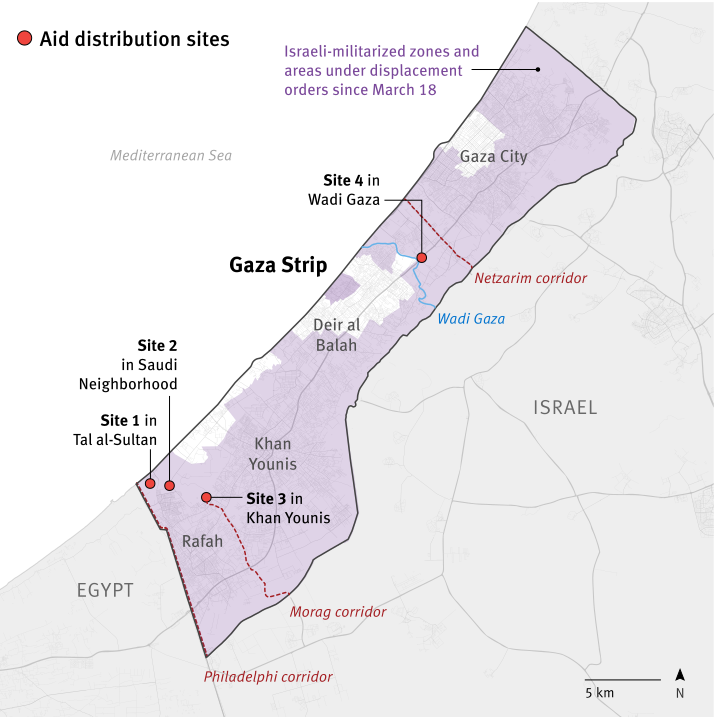
Is the GHF more effective at distributing aid? Not at all. Instead of the 400 international distribution points that once existed, Israel’s blockade and the imposition of the GHF have left only 4 highly militarized sites, with just 1 in the densely populated north. The UN calculates that Gaza’s basic humanitarian need amounts to around 600 truckloads a day. By its own account, the GHF moves at most 26 truckloads daily, roughly 4% of what is required. In a territory facing acute hunger, such an amount is not small—it is nothing.
According to the IPC Famine Review Committee, the whole of Gaza has been in IPC Phase 5 since July, the highest alert, a catastrophic food emergency. People in this phase are at immediate risk of starvation. More than 700,000 people have gone days without any food. The UN special rapporteur on the right to food, Michael Fakhri, was blunt: “Israel has made clear its intention to starve everyone in Gaza.”
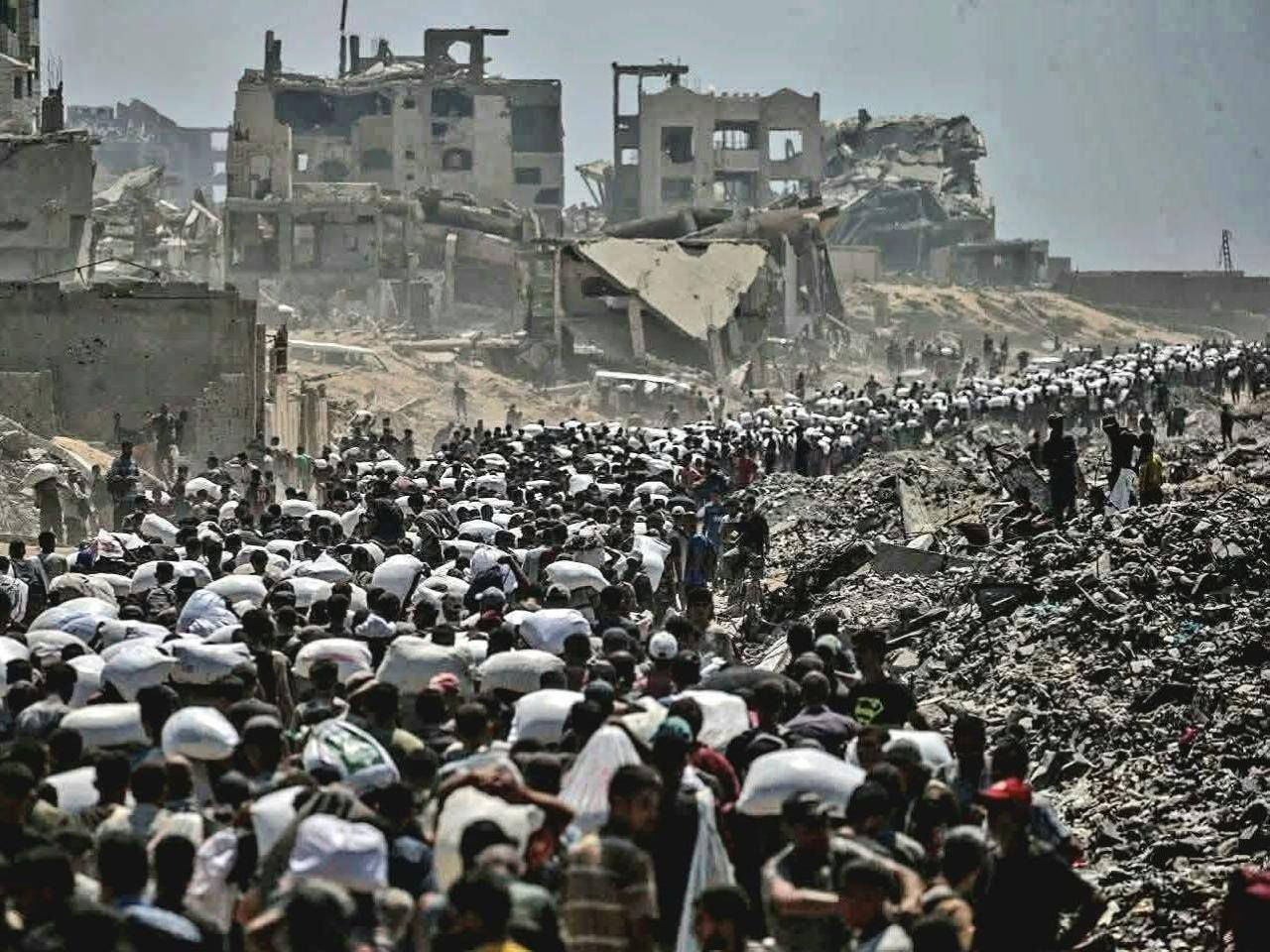
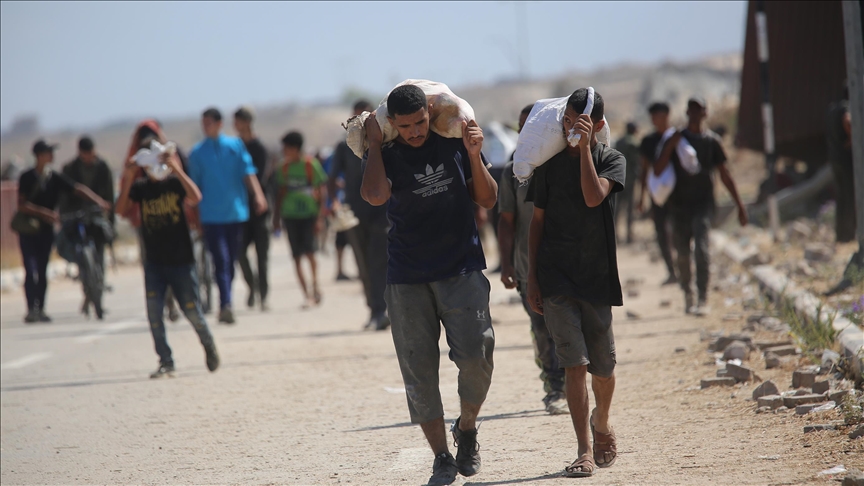
What Israel and the US call a distribution mechanism and a foundation is, in the words of Doctors Without Borders, “slaughter dressed up as humanitarian aid.” Starving civilians are forced to walk up to 40 kilometers (25 miles) under the burning sun to reach GHF sites. Arrival does not guarantee help. More than 1,881 starving civilians have been killed at or near GHF distribution sites. The Israeli army regularly fires indiscriminately into the waiting crowd.
Philippe Lazzarini, Commissioner-General of UNRWA, calls the GHF “an alibi for the systematic starvation of Gaza.” For him, the logic is clear. Israel destroyed the humanitarian infrastructure in order to replace it with a facade organization under military control. OCHA spokesperson Jens Laerke sees in the GHF a “distraction.”
What does it distract from? Netanyahu has said the plan out loud. On May 11, according to the Israeli outlet Maariv, he tied aid to permanent expulsion. Those who receive aid at a given place should never see that place again and must evacuate. “The residents of Gaza whom we are expelling will not return. They will no longer be there. We will control the place. There is no other war aim. All other goals are mere eyewash.”
By the Israeli government’s own account, the GHF is a means to drive Palestinians out of Gaza or to let them die, by deliberately starving them, denying supplies, and cutting off humanitarian aid.
*The author is the editor-in-chief of the German journal itidal.de.The opinions expressed in this article are the author’s own and do not necessarily reflect Anadolu.
More than 100 aid organizations have accused Israel of weaponizing starvation by blocking life-saving aid from entering Gaza, leaving vast quantities of relief supplies stranded in warehouses while more Palestinians starve.
In a joint statement on Thursday, the groups, including Doctors Without Borders and Oxfam, said that aid trucks have massed on Gaza’s borders amid Israel’s blockade of the famine-stricken territory, and new rules are being used by Israel to deny the entry of food, medicine, water and temporary shelters.
“Despite claims by Israeli authorities that there is no limit on humanitarian aid entering Gaza, most major international NGOs [nongovernmental organisations] have been unable to deliver a single truck of life-saving supplies since 2 March,” the groups said.
“Instead of clearing the growing backlog of goods, Israeli authorities have rejected requests from dozens of NGOs to bring in life-saving goods, citing that these organisations are ‘not authorised to deliver aid’,” the groups added.
Relief organisations that have worked in Gaza for decades are now told by Israel that they are not “authorised” to deliver aid due to new “registration rules”, which include so-called “security” vetting.
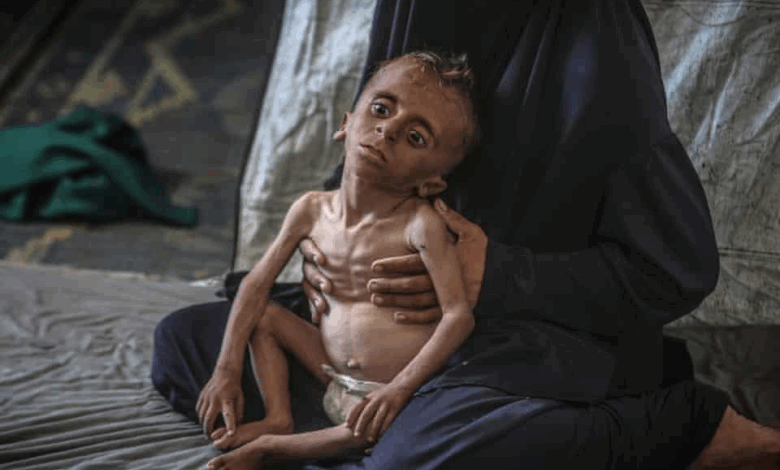
Hospitals in Gaza are now without basic supplies as a result, and children, the elderly and those with disabilities are “dying from hunger and preventable”, the statement noted.
The more than 100 relief organisations have called for pressure to be exerted on Israel to end its “weaponisation of aid”, for Israel to end its “bureaucratic obstruction” and for unconditional delivery of life-saving humanitarian aid to Gaza according to the Quds News Network.
Bushra Khalidi, Oxfam policy lead, said her organisation has more than $2.5m worth of humanitarian aid supplies that “have been rejected from entering Gaza by Israel”.
MSF’s emergency coordinator in Gaza, Aitor Zabalgogeazkoa, said the restrictions on aid are part of Israel’s militarised distribution of relief supplies, spearheaded by the controversial US- and Israeli-backed Gaza Humanitarian Foundation (GHF).
“The militarised food distribution scheme has weaponised starvation and curated suffering. Distributions at GHF sites have resulted in extreme levels of violence and killings, primarily of young Palestinian men, but also of women and children, who have gone to the sites in the hope of receiving food,” Zabalgogeazkoa said.
At least 859 starving Palestinians have been killed by Israeli forces and American mercenaries while seeking food near or at GHF distribution sites since May.
Israel’s Diaspora Minister Amichai Chikli, who had a role in the new rules imposed on aid groups, told the AFP news agency that registration of humanitarian groups could be rejected if Israel deems that its activities deny the democratic character of Israel or ” promote delegitimisation campaigns”, such as the movement to boycott Israel over its war on Gaza.
The joint outcry comes as two out of three famine thresholds for food consumption have been breached across most of Gaza, with acute malnutrition levels in Gaza City confirming aid agencies’ repeated warnings, according to the Integrated Food Security Phase Classification (IPC).
“Mounting evidence shows that widespread starvation, malnutrition, and disease are driving a rise in hunger-related deaths,” the IPC assessment maintained.
“The worst-case scenario of Famine is currently playing out in the Gaza Strip.”
UNICEF has warned that Gaza faces a grave risk of famine, with one in three people going days without food.
Over 100 humanitarian organizations, including Amnesty International, Doctors Without Borders (MSF), and Oxfam, warned that “mass starvation” is spreading across Gaza, with their colleagues in the enclave wasting away from hunger.
The World Health Organization (WHO) said Gaza City has been the area “worst-hit” by malnutrition in the Gaza Strip, with nearly one in five children under five there now acutely malnourished.
The World Food Programme (WFP) has warned that thousands of Palestinians in Gaza are “on the verge of catastrophic hunger,” with one in three people in the enclave going days without food.
UN experts, Tuesday, called for the immediate dismantling of the Gaza Humanitarian Foundation (GHF), warning that its operations are deepening the suffering of Palestinians and undermining international humanitarian law.
In a statement, the experts said Palestinians are “paying the ultimate price of the international community’s legal, political and moral failure” as the death toll in Gaza surpasses 60,000, with over 90% of the population forcibly displaced.
The GHF established by Israel in February 2025 with the backing of the US, was set up to distribute aid in the Gaza Strip. However, UN experts described it as “an utterly disturbing example of how humanitarian relief can be exploited for covert military and geopolitical agendas in serious breach of international law.”
“Under any circumstances, when war crimes are overlooked in exchange for temporary relief, impunity can become normalised. Yet, in this case, we are leaving a State accused of genocide, war crimes and crimes against humanity in charge of feeding the population affected by the genocide without oversight and with impunity. This overt hypocrisy is disturbing,” the experts said according to Anadolu.
Since the GHF began operating in late May, Israeli forces and foreign military contractors are said to have opened fire on people seeking aid at its distribution sites. Since then, nearly 1,400 people have been killed and over 4,000 injured while attempting to access food, including at least 859 fatalities around GHF facilities alone, according to the UN.
The experts condemned the use of “humanitarian camouflage” by Israel, calling the foundation’s name “an insult to the humanitarian enterprise and standards.”
“Seeing children dying of hunger in their parents’ arms should shake us out of our complacency,” they said. “Blocking or delaying aid is not just inhumane – it is a war crime where it is intended to starve civilians and in the context of a well-documented and globally denounced genocide.”
“The credibility and effectiveness of humanitarian assistance must be restored by dismantling the GHF, holding it and its executives accountable, and allowing experienced and humanitarian actors from the UN and civil society alike to take back the reins of managing and distributing lifesaving aid,” the statement said.
The experts urged member states to impose a full arms embargo on Israel, suspend trade and investment agreements that harm Palestinians, and ensure accountability for corporate entities complicit in violations.
Israeli forces at the sites of a new US-backed aid distribution system in Gaza have routinely opened fire on starving Palestinian civilians in acts that amount to serious violations of international law and war crimes, Human Rights Watch said Friday.
Mass casualty incidents have taken place on a near-daily basis at or near the four sites operated by the Gaza Humanitarian Foundation (GHF), which operates in coordination with the Israeli military. At least 859 Palestinians have been killed while attempting to obtain aid at GHF sites between May 27 and July 31, 2025, most by the Israeli military, according to the United Nations. The dire humanitarian situation is a direct result of Israel’s use of starvation of civilians as a weapon of war—a war crime —as well as Israel’s continued intentional deprivation of aid and basic services, ongoing actions that amount to the crime against humanity of extermination, and acts of genocide.
“Israeli forces are not only deliberately starving Palestinian civilians, but they are now gunning them down almost every day as they desperately seek food for their families,” said Belkis Wille, associate crisis and conflict director at Human Rights Watch. “US-backed Israeli forces and private contractors have put in place a flawed, militarized aid distribution system that has turned aid distributions into regular bloodbaths.”
States should press Israeli authorities to immediately stop using lethal force as a method of crowd control against Palestinian civilians, lift unlawful sweeping restrictions on the entry of aid, and suspend this flawed distribution system, Human Rights Watch said. Instead, the UN and other humanitarian organizations should be permitted to resume aid distributions across Gaza at scale and without restrictions, as they have proven able to feed the population in line with humanitarian standards and as required by binding rulings by the International Court of Justice in South Africa’s genocide case against Israel.
In May, after more than 11 weeks of an Israeli-imposed total blockade on Gaza, the GHF distribution mechanism began operating. The aim of the Israeli authorities was reportedly to ultimately replace humanitarian aid delivery by the UN and other aid organizations.
Israeli authorities justified these moves by claiming Hamas diverted aid, but New York Times reporting, based on Israeli military sources, indicates that the Israeli military does not have evidence that Hamas systematically diverted aid from the UN. The UN-led system remains operational, but is subject to significant restrictions by Israeli authorities, including how much and what type of aid is allowed in and where it can go.
The GHF system is run by two US private subcontracted companies: Safe Reach Solutions (SRS) and UG Solutions, in coordination with the Israeli military. The companies have said they are “committed only to delivering food to suffering civilians” and are independent of any government, but all four distribution sites are within militarized areas. Three sites are in Rafah, which Israeli authorities have largely razed to the ground and where they have proposed to concentrate Gaza’s population. One is in the ethnically cleansed Israeli security zone known as the Netzarim Corridor, which cuts Gaza in half. None of the sites are accessible to people in northern Gaza, who are instead reliant on the UN-led distribution system.
In July, Human Rights Watch interviewed 10 people who were on the ground in Gaza in recent months and witnessed violence at or near aid sites, or who treated those injured and killed at the sites. Those interviewed included Anthony Bailey Aguilar, a retired US Army Special Forces lieutenant colonel, who worked in Gaza as a security contractor for UG Solutions, including in the control centers and at dozens of distributions at all four distribution sites between May and June; a foreign humanitarian worker who worked in Gaza in June; two foreign doctors who worked in Gaza in May, June, and July and treated civilians who were injured at or near GHF aid distribution sites; and six Palestinian witnesses to violent incidents related to the distributions. Researchers also analyzed satellite imagery at different spatial resolutions, verified videos and photographs including content taken by Aguilar, analyzed document metadata, and reviewed social media posts by GHF.
Human Rights Watch sent letters to GHF, SRS, UG Solutions, the Israeli military, and the US government on July 19 with a summary of findings and list of questions. The Israeli military, UG Solutions, counsel for UG Solutions, and counsel for GHF/SRS responded and their overall responses are reflected below.
The four GHF distribution sites were selected and constructed by the Israeli military, counsel for GHF said to Human Rights Watch. Through satellite imagery, researchers confirmed that the sites are in militarized zones, surrounded by military outposts. Counsel for GHF said it hired SRS to run the distribution sites, which in turn hired UG Solutions to provide security at the sites.
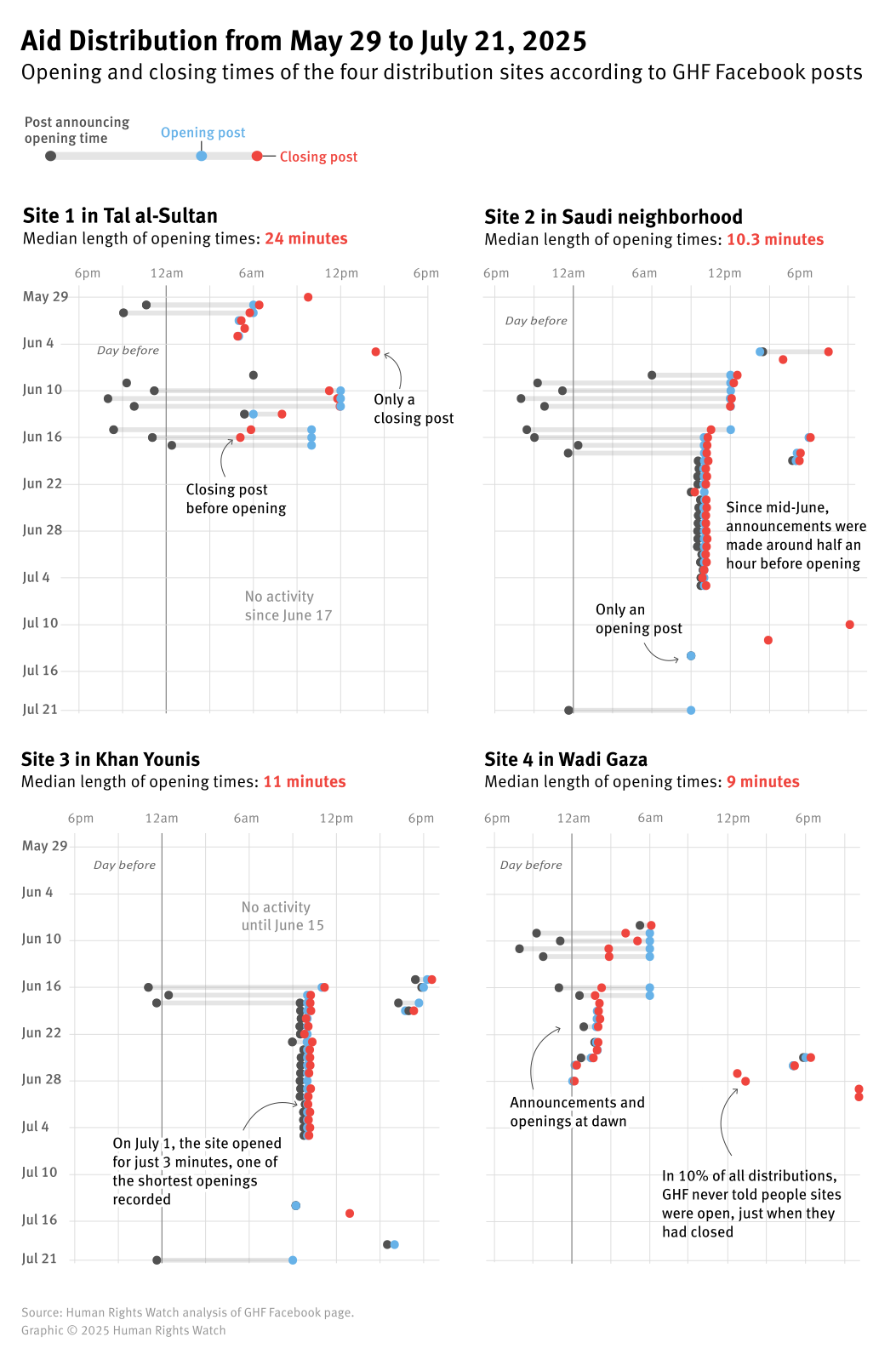
Rather than delivering food to people at hundreds of accessible sites throughout Gaza, the new mechanism requires Palestinians to trek across dangerous and destroyed terrain. According to five witnesses, Israeli forces control the movement of Palestinians to the sites through the use of live ammunition. Inside the sites, the distribution of aid itself is an uncontrolled “free-for-all,” as Aguilar described it, that often leaves the most vulnerable and weakest people with nothing. Human Rights Watch analyzed announcements made on GHF’s Facebook page of 105 distributions across the 4 sites and found that 54 distribution windows were under 20 minutes long and 20 distributions were announced as finished before their official opening time had begun.
One Palestinian man told Human Rights Watch that he left his home at about 9 p.m., trying to reach a site that was due to open at 9 a.m. the next day. On the way, he said, an Israeli tank opened fire on him and others as they were walking towards the site: “If you stopped walking, or did anything they didn’t want, they fired at you.” In a separate incident, Aguilar said he witnessed an Israeli tank fire on a civilian vehicle just outside Site 4, which he believed killed four people inside, on June 8. Another contractor who spoke to ITV News described the same attack on the car.
Another Palestinian man who went to one of the aid sites described the difficult and risky journey: “So many people who need aid are not getting it because they are not able to make it all the way there. Those who do go are taking their luck into their own hands, and it’s remarkable if they come back alive.”
According to seven witnesses interviewed by Human Rights Watch, Israeli forces regularly fired on civilians. Three Palestinian witnesses and Aguilar also claimed they witnessed armed guards within the GHF sites using live fire and other weapons against civilians during aid distributions. These armed guards would apparently be UG Solutions contractors, given that the letter from the counsel of GHF and SRS confirmed that the only contractors with weapons inside the distribution sites are from UG Solutions. GHF, SRS, and UG Solutions have denied the allegations that their contractors used force against civilians and stated that UG Solutions personnel only use deadly force as a last resort and have never harmed civilians or aid seekers.
The aid mechanism has failed to address mass starvation in Gaza, Human Rights Watch said. Counsel for GHF said they have delivered 95 million meals in Gaza, as of July 28. However, even at full capacity at the four sites, the GHF scheme is only capable of providing about 60 trucks of food per day, according to Aguilar, as compared to the 600 trucks per day that entered Gaza under the UN-led aid scheme during the ceasefire in early 2025.
On July 29, the world’s foremost experts on food insecurity, the Integrated Phase Classification (IPC), said that the “worst-case scenario of famine is currently playing out in the Gaza Strip.” Gaza’s Ministry of Health reported that, as of July 30, 154 people, including 89 children, have died due to malnutrition since October 7, 2023, the majority of whom since July 19. On July 27, the Israeli military announced it would resume airdrops, designate secure routes for the entry of aid, and implement “humanitarian pauses” in populated areas to facilitate aid.
International humanitarian law, or the laws of war, applicable to the hostilities between Israeli forces and Palestinian armed groups, require parties at all times to distinguish between civilians and combatants. Attacks may only be directed against military objectives, and attacks that target civilians and civilian objects, or are indiscriminate, are prohibited. International human rights law, which also applies in Gaza, prohibits the intentional lethal use of firearms by law enforcement officials except when “strictly unavoidable to protect life.” These standards also apply to private security personnel exercising police powers.
Under both bodies of law, authorities may take measures to ensure aid delivery, but the use of lethal force against civilians is strictly limited. For example, if civilians had moved off a route designated by the Israeli armed forces, that would not, in itself, make them targets who could be lawfully attacked. Nor would such a situation justify the intentional use of lethal force by policing authorities as “strictly unavoidable in order to protect life.” The willful unlawful killing of civilian members of the occupied population is a war crime.
The repeated use of lethal force against Palestinian civilians by Israeli forces, without justification, violates both international humanitarian and human rights law. Human Rights Watch is not aware of any evidence in the cases documented that those killed represented an imminent threat to life at the time they were killed. The intentional use of lethal force by those exercising policing powers without lawful justification also violates human rights law. Regular killings by Israeli forces near GHF sites also amount to war crimes, given all the evidence indicating that these are deliberate, targeted killings of persons the Israeli authorities would know would be Palestinian civilians.
On June 26, one month after SRS started distributing aid at the sites, the US government announced it was allocating US$30 million to GHF. The source of funding for GHF’s first month of distributions remains unknown; in its letter to Human Rights Watch, counsel for GHF said it “received $100 million from a government other than the United States or Israel,” without specifying the government.
The Trump administration sent the allocation by circumventing congressional approvals. The United States is complicit in Israeli violations of the laws of war in Gaza, given its provision of substantial military aid despite knowledge of the continuing grave violations.
The US Congress should also be requiring notifications on any additional funding destined for GHF and demand a report on how US funds are being used currently, including an assessment of the effectiveness of the aid for starving Palestinians.
Pursuant to their obligations under the Genocide Convention, states should use all forms of their leverage, including targeted sanctions, an arms embargo and suspension of preferential trade agreements, to stop Israeli authorities’ ongoing atrocity crimes.
“It is indefensible that, instead of using its significant leverage to press Israel to end its ongoing acts of genocide, the US is backing and even funding a deadly mechanism that is resulting in Israeli forces killing starving Palestinian civilians as a method of crowd control,” Wille said. “States should urgently act to stop the extermination of Palestinians.”
Israeli Killings of Palestinians Seeking Food Aid
According to the UN, at least 1,373 Palestinians were killed as they tried to access food between May 27 and July 31, 2025, most by the Israeli military, including 859 who were in the vicinity of GHF sites.
Dr. Victoria Rose, a British doctor who worked at a large hospital in Gaza in May and June, said that on June 1 staff were alerted that there had been mass casualties at Site 1 that morning. She said throughout May, she had not seen any patients with gunshot wounds, only blast injuries. However, on that day, she said over 100 people—mostly men but also some women and teenage boys—were brought into the hospital with gunshot injuries. Two of the men she treated had been shot in the back of their legs. “Already by the late morning there were over 10 bodies piled up against one side of the emergency room,” she said. According to the Gaza’s Ministry of Health, 31 died that day.
Dr. Nick Maynard, another British doctor working at the same hospital in Gaza in June and July, echoed that there has been an uptick in gunshot injuries with the increased distributions via the GHF mechanism. Individuals who sustained injuries at or near distribution sites were mostly teenage boys with gunshot injuries in the abdomen, neck, head, or groin area, he said.
Humanitarian organizations on the ground have documented similar trends. Doctors Without Borders noted “a stark increase in the number of patients with gunshot wounds” at the time of the expansion of GHF aid distributions. The International Committee of the Red Cross (ICRC) on July 8 highlighted a similar “sharp surge in mass casualty incidents linked to aid distribution sites,” saying the organization’s medical team treated “over 2,200 weapon-wounded patients” and logged more than 200 deaths, “a scale and frequency … without precedent.” After the mass casualty event on June 1, the ICRC noted that “all patients said they had been trying to reach an aid distribution site.”
The Israeli military has largely responded to questions about killings of Palestinians seeking aid by saying they fired on people they viewed as a “threat,” or when crowds moved in a way that “threatened the forces,” or that they were merely firing “warning shots.” Based on accounts from Israeli officers and soldiers, the Israeli newspaper Haaretz reported that soldiers were “ordered to fire at unarmed crowds near food distribution points in Gaza, even when no threat was present,” something Anthony Bailey Aguilar alleges he witnessed on numerous occasions. Aguilar told Human Rights Watch that he was monitoring a distribution at Site 4 in a control room along with a senior Israeli commander, who told Aguilar to give the order to contractors to shoot three unarmed children who an adult had lifted up onto a Hesco barrier (a large, collapsible wire mesh container lined with a heavy-duty fabric and filled with sand, dirt, or gravel to create a solid wall) to avoid being crushed or trampled by the crowd. When he refused to give the order, the commander replied, “Tell your men to shoot them now or we will shoot them,” Aguilar said. In the end, he said, no shooting occurred on that occasion because the children got down on their own.
In its letter to Human Rights Watch, the Israeli military said it conducted “in-depth examinations” of “reports of civilians casualties near distribution sites” and that “incidents are under review by the authorized bodies,” but it did not provide any further details. Israel’s internal law enforcement system has long been recognized by human rights monitors as a “whitewash mechanism.”
UG Solutions also said in its July 29 letter that Aguilar could not have witnessed Israeli military abuses, since “he did not leave the static distribution site during operations and would not have had a line of sight to IDF assets beyond the high berms protecting the sites.” Human Rights Watch, though, reviewed multiple videos in which UG Solutions’ contractors were positioned on top of high berms with a line of sight into areas where Israeli forces operated and verified a video taken by Aguilar on June 8 of an Israeli tank next to Site 4.
Accounts from Aid Seekers at Distribution Sites
An aid seeker who has a disability told Human Rights Watch he walked for 12 hours to a GHF distribution site in Rafah in early June for a distribution that began at 2 a.m. He said Israeli forces made him and tens of thousands of others who arrived at the site early wait outside for several hours. He and many others decided to lie down in a pit in the ground until the site opened to avoid being shot by Israeli forces. He said Israeli military tanks were posted in the area and at the site entrance. He said he saw a tank shell hit a young man in the head when the tanks opened fire on the crowd, apparently to keep people from approaching before the site officially opened. He believes the man died.
The aid seeker was able to go inside and pick up some food on that occasion, but the next time, he said:
The smarter and stronger ones got to the aid first. Some people were crushed by the crowd. Within an hour, all the aid was gone, and tanks came back with a quadcopter flying in the sky. I rushed away as fast as I could empty-handed. Someone like me with a disability couldn’t do much. We call this death aid.
Aguilar also highlighted how the GHF aid distribution method disadvantaged those who could not run quickly and push through crowds to get aid, noting that “others, particularly older people, women and children, were sifting through the dirt for scraps like individual beans.”
Another man who went to the distribution sites twice in June said the first time, when he was at the front of the line waiting for Israeli forces to let people into the site, he witnessed Israeli military tanks firing into the crowd, killing at least one man near him in the front. Once allowed into the site, he was able to get some aid. The second time, he waited further back, and as a result was unable to get any aid by the time he entered the site. He witnessed multiple quadcopter drones drop stun grenades onto the crowd on that occasion as well, he said.
Gaza Humanitarian Foundation Operations
The GHF aid mechanism was reportedly designed by about a dozen Israeli reservists and businessmen who began meeting as early as December 2023 in an effort to sideline the UN, according to the Wall Street Journal, citing people who said they took part in the discussions. Aguilar said he and the other contractors entered Israel on B2 tourist visas: “We were just tourists with guns. It was absurd.” Aguilar shared pictures of the visa and the tax invoice he received with Human Rights Watch.
Before the distributions, SRS staff put out boxes and then open the sites, after which Palestinians rush in and grab what they can and leave. According to Aguilar and other witnesses, this distribution system lacks registration, vetting, tracking, or equitable distribution mechanisms.
“There is no oversight of who gets the aid; it’s a free-for-all. People take multiple boxes, and many leave with nothing,” Aguilar said.
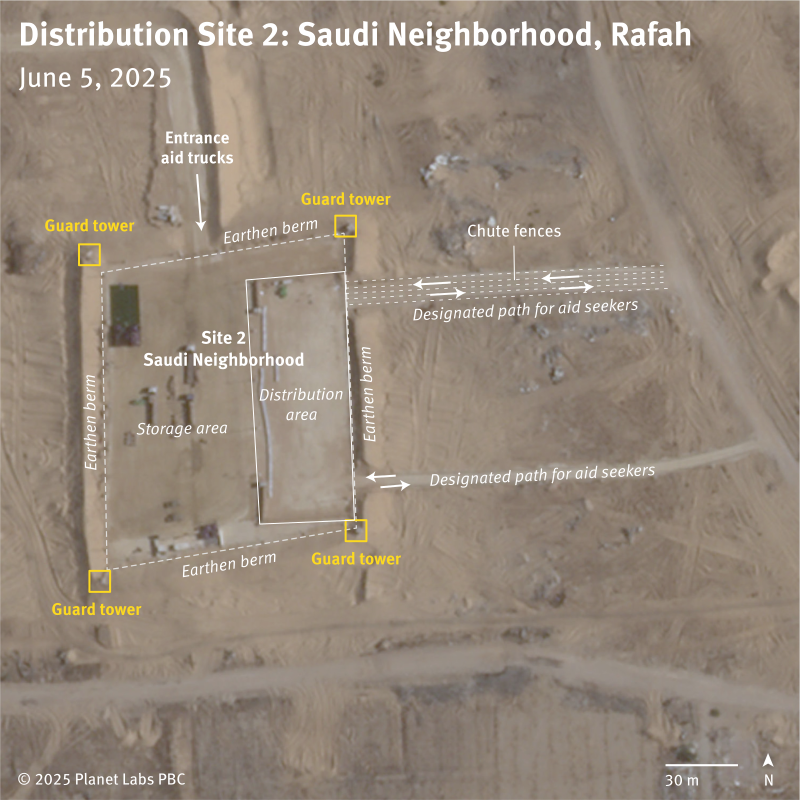
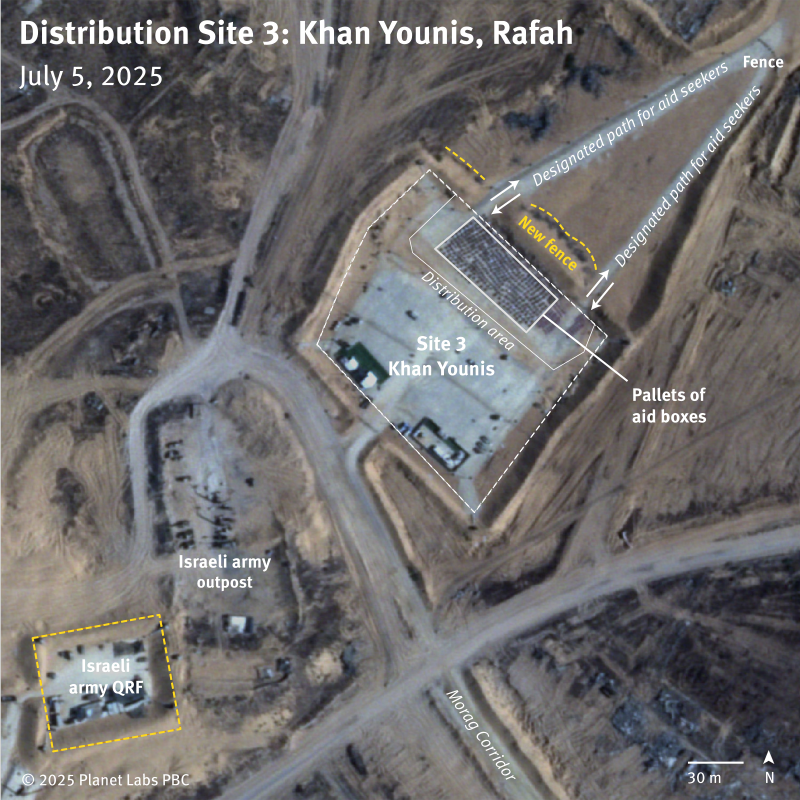
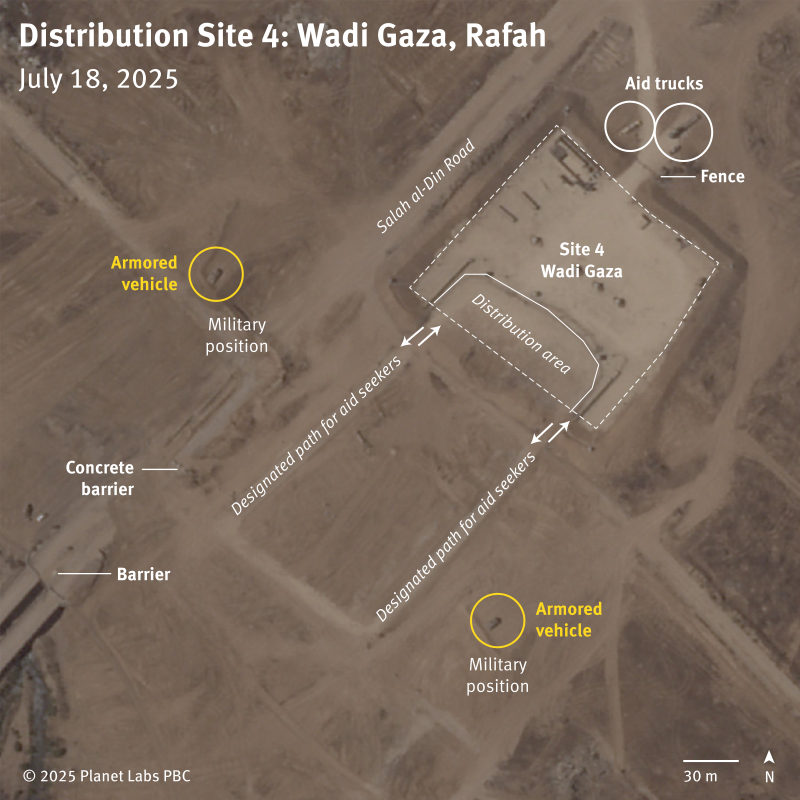
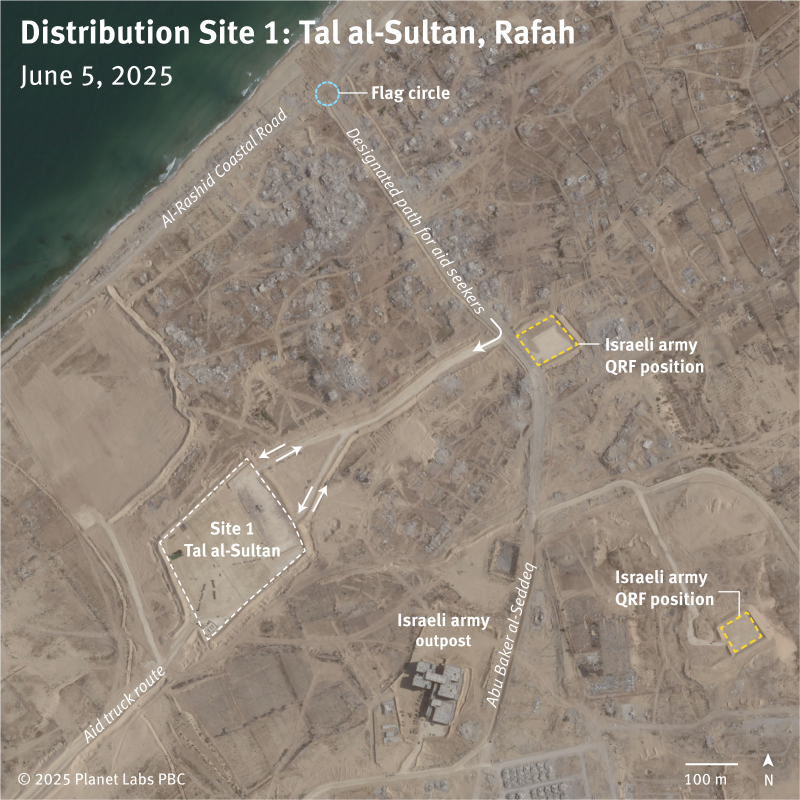
The four GHF distribution sites are all located within militarized areas designated by the Israeli military in security corridors and buffer zones in large parts of the Gaza Strip. Three of the distribution sites (Sites 1, 2, and 3) are in the Rafah Governorate within the buffer zones created along the “Philadelphi” and “Morag” Corridors, where Israeli military operations are ongoing. A fourth site (Site 4) is in the buffer zone created by Israeli forces in the “Netzarim Corridor,” located in central Gaza. These areas have been completely razed and emptied of Palestinians by Israeli forces, actions which amount to the crime against humanity of forced displacement and ethnic cleansing.
In contrast, when allowed to operate without restriction, the UN distributes aid to hundreds of sites across Gaza to improve people’s ability to reach aid safely in their area and mitigate issues of crowd control. Aid distribution takes into account identified needs at the community level, specific vulnerabilities, and family size.
According to satellite imagery, as of April 26, none of the four sites had been established. Soil preparation began in late April for Sites 1 and 4, and in early May for Sites 2 and 3. Construction appears to have been completed around May 17 for Site 4 and by May 23 for Sites 1, 2, and 3, less than three days before Site 1 became operational.
Each of the four open-air distribution sites has a rectangular layout enclosed by earthen berms, with four guard towers positioned at the corners. Civilian access to the distribution area is controlled through narrow entry and exit points, guided by chutes or jersey barriers, while a separate path allows aid trucks to access the storage area.
Before distribution operations started on May 26, Aguilar said he raised concerns with the design and construction of all four sites, including in particular Site 3. Human Rights Watch documented how additional “security” features added to some sites in early June could harm Palestinians seeking aid, that the sites were particularly dangerous when congested, and that the sites were in proximity to Israeli forces. Satellite imagery from July 5 shows an additional fence added to the north berm of Site 3. Aguilar said that this is a triple-strand razor wire added in early June to deter civilians from rushing over the berm and could prove dangerous if people were pushed up against it.
The exits and entrances often become congested due to the large crowds. Satellite imagery of Site 4 shows that Israeli armored vehicles usually sit at the entrance and exit of the civilian routes.
The sites are surrounded by military infrastructure including outposts, equipment, and vehicles, some of which are positioned along the civilian access routes. While some of the infrastructure was pre-established by the Israeli military during the creation of these corridors, additional outposts, defined by Aguilar as Israeli military Quick Reaction Force (QRF) staging areas, were constructed during the establishment of the distribution sites. Aguilar said that when the distribution is ongoing, the Israeli military positions tanks and soldiers in these nearby holding areas.
It is also difficult for Palestinians in need of aid to get basic and accurate information about GHF operations: from May 29 onward, GHF asked people to check its Facebook page where it posted information daily, though many in Gaza do not have an internet connection or sufficient battery charge for their phones. This is because Israel has cut off electricity, targeted and damaged telecommunications infrastructure, and restricted the entry of fuel. There was a near total communications blackout between June 11 and 13.
These posts detailed which sites were open and closed, allowing researchers to identify how long GHF said distributions lasted each day. GHF also posted important notices of changes to their system. Facebook is the main platform through which GHF has consistently communicated to Palestinians despite also having a WhatsApp and a Telegram group. On June 18, GHF posted that all official announcements regarding locations and times would be posted exclusively on their Facebook page.
Through the analysis of GHF Facebook posts from May 29 and July 21 of a total of 105 distributions, Site 2 had 39 distributions, followed by Site 3 with 29, Site 4 with 22, and lastly Site 1, with 15 distributions.
The raw data behind this graphic can be downloaded on the Human Rights Watch GitHub account here.
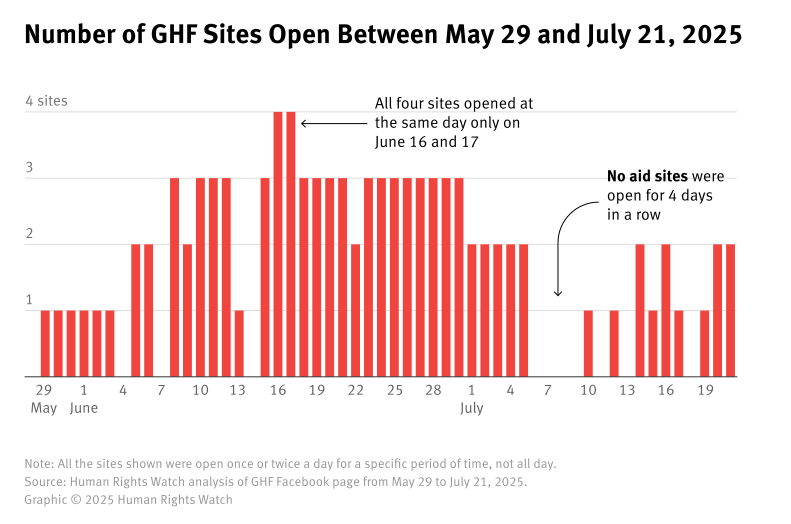
While the four sites were in operation after May 26, they only all began operating once a day on June 16. However, this only lasted for 2 days, on June 16 and 17. These were the only days on which all 4 sites operated. Either 2 or 3 sites were operational on the majority of days analyzed by Human Rights Watch. On June 18, GHF posted that staff would distribute aid twice a day at the distribution sites, “when they were able.” Staff were able to do this only on 9 occasions. Out of the 54 days between May 29 and July 21, no aid was distributed from any sites on 10 days in this period. The stated reason for this was, most often, due to maintenance and renovation works.
The raw data behind this graphic can be downloaded on the Human Rights Watch GitHub account here.
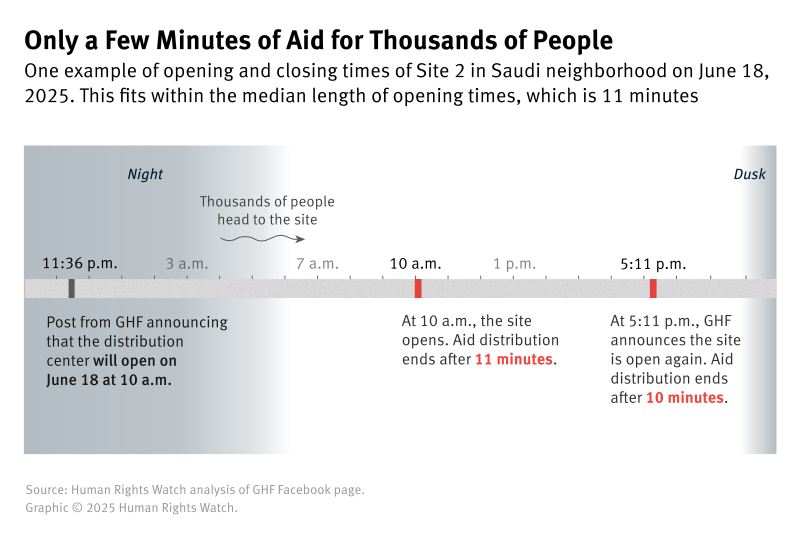
On 14 occasions, GHF announced that sites were closed at the end of distribution, but they had not announced when distribution had begun, making it impossible for Palestinians to know when aid was being distributed. On 54 occasions, the distribution windows were open for less than 20 minutes. On 20 occasions, the distribution windows were announced to be closed before they had been announced as open. For example, on June 15 and 16, GHF announced that Site 1 would open at 10 a.m. for distribution, but then posted, on June 15, that aid distribution had finished at 5:50 a.m. and, on June 16, at 5:06 a.m. Fifteen distributions took place at Site 1. While, of these, 10 distributions were scheduled with a specific opening time, they still were open at this time on only 3 occasions. Researchers analyzed 21 distribution events at Site 2 from June 15 to July 5, finding that the median duration of each distribution was 11 minutes.
Eleven distributions took place in the hours of darkness between 1 a.m. and 3 a.m. On July 15, GHF posted that people should not approach the sites during the hours of darkness due to safety concerns. This followed the introduction of a red or green flag system at Site 3 on July 14 and at Site 2 on July 17, according to GHF Facebook posts. Green indicated that the site is open and red that it is closed, according to a GHF post on July 14. Human Rights Watch has no further information about how this system supposedly worked, where the flags were placed and how often the sites were opened and closed. In its July 28 letter, GHF said: “SRS has added flag systems to identify open and closure times, loudspeaker systems to better communicate with the population, improved site defenses to prevent interactions that could lead to escalation, and has communicated site rules to the population using a variety of social media platforms.”
A day after introducing this flag system at Site 3, GHF posted on July 15 that they had to shut down the site due to overcrowding. On July 16, between 17 and 21 Palestinians were trampled to death at that site in a crowd crush, GHF counsel said in its letter, adding the incident was triggered by “agitators in the crowd.” The GHF Facebook account never posted that Site 3 and Site 2 were open on that day, and only posted at 1:05 p.m. that they would not reopen that day. Gaza’s Ministry of Health said that 15 Palestinians died in a crowd crush after tear gas was fired at a crowd of people awaiting aid, and that Israel forces shot dead another 6 people.
On July 18, the sites were seemingly all closed. Limited information was shared on July 19 and 20, only that the sites were open, but no time was given for the distribution.
It would be near impossible for Palestinians to follow the instructions issued by GHF, stay safe, and receive aid, particularly in the context of ongoing military operations, Israeli military sanctioned curfews, and frequent GHF messages saying that people should not travel to the sites before the distribution window opens.
The director of GHF stated in a live-streamed event on July 22 that GHF was planning to open up four new distribution sites in the coming weeks.
Alleged Use of Force by UG Contractors
Human Rights Watch separately interviewed four people, Aguilar and three Palestinians, who claimed they witnessed armed guards using live fire and other weapons against civilians during aid distribution inside the GHF sites. GHF and UG Solutions have both denied this. In letters from UG Solutions and the companies’ counsel, they state that UG Solutions personnel only use deadly force as a last resort and have never harmed civilians or aid seekers.
A 39-year-old Palestinian man, who said he had been to GHF aid distribution sites roughly 30 times, told Human Rights Watch that he was near his brother, a father of three, when he was fatally shot in the head near the entrance of Site 4 in Wadi Gazi at around 9:50 p.m. on June 29. The man said he saw the gunfire that killed his brother coming from armed men inside the site soon after an Israeli tank which had been in the area retreated, the signal the Israeli military has developed to indicate when a site is open for distribution. A second man at the same distribution said he saw two armed guards at the site open fire on the crowd after an Israeli tank retreated. As the crowd rushed into the site, he said a bullet to the head killed his friend, whose body he carried from the site, and bullets hit two other men next to him, one in the chest and one in the leg. He is not sure whether they survived. GHF’s Facebook page notes that a distribution at Site 4 concluded around 10 p.m. that night. A third Palestinian man, who went to the distribution sites twice in June, said, “I saw people being shot in the leg, arm, and head,” inside the distribution sites while he was there.
Aguilar has alleged that UG Solutions contractors fired in the direction of civilians, including women and children, who were not visibly armed, apparently as a method of crowd control. During the period while he worked with UG Solutions, he also said he was never given any written rules of engagement. Aguilar alleged that he saw contractors fire towards the crowds during distributions, including with stun grenades and pepper spray and, in some cases, live ammunition. “The crowd control mechanism was live gunfire, rendering these sites into death traps,” he said. “We were setting people up to die. I couldn’t be complicit in that.” Contractors fired toward people, particularly their feet, as they entered the site, to make the crowd stick to a particular path, Aguilar alleged. On occasion after all of the aid boxes were gone—often minutes after the distribution began—he alleged he saw contractors again fire towards the crowds, including with stun grenades, tear gas, and pepper spray, to force out those who remained, scouring the dirt for loose beans, or trying to take wood from the pallets on which the food had been transported, he added.
Aguilar alleged that, from what he saw, at no point were the lives of staff working at the distribution sites in any risk, nor did he see any of the Palestinians coming for aid carrying weapons. However, counsel for GHF said that several staff members were injured during aid distributions, and that Hamas “assassinated” 12 of its employees and “tortured others.” Human Rights Watch asked GHF for more information about the injuries and killings of their employees, but they did not provide further details regarding the 12 employees who were killed. News reports indicate that they were attacked on their way to an aid distribution. Hamas has denied responsibility for the alleged killings. Counsel for GHF added that two UG security personnel were injured by a grenade on July 5, citing a Reuters article, and that, “on July 16, one UG medic was stabbed with an icepick by an unknown person while successfully disarming an unknown individual who threatened UG and local workers with a pistol.”
Aguilar described two incidents he witnessed in which he alleges that private contractors fired live ammunition in the first incident and stun grenades in the second, into crowds of Palestinians at the aid distribution sites, killing one person on each occasion, he believes. Human Rights Watch could not independently verify the killings, which the companiesdeny. Aguilar provided videos and photographs he took capturing elements of both incidents, which Human Rights Watch analyzed, along with other sources of data where possible.
In one of the incidents, parts of which Aguilar caught on camera, at Site 4 on May 29, Aguilar said he saw a UG Solutions contractor firing into a crowd and then a man dropped to the ground, motionless, at a distance away from him. According to Aguilar, another contractor cheered and said, “Damn, man, I think you got one,” and the shooter yelled back, “Hell yeah, boy.”
Human Rights Watch analyzed seven videos filmed by Aguilar at Site 4 between 12:03 p.m. and 12:30 p.m. local time on May 29, according to the files’ metadata.
One of these videos, taken at 12:17 p.m. on May 29 and geolocated to the civilian access route at Site 4, shows over a dozen armed men inside the site. A man with an American accent says, “I’ve got an IDF tank posted in the northwest corner now. I brought them in and talked to them; they’ll do a show of force.” Aguilar said the distribution had finished for the day and people were leaving because there were no more aid boxes left.
Another voice says, “I told them [the Israeli military] to hold there, I don’t want this to be too aggressive because this is calming down.” A person off-camera, likely on the other side of an earthen berm, fires 29 shots. A voice with an American accent shouts in celebration, and then a second person with an American accent says, “Damn, man, I think you got one.” Someone answers back, “Hell yeah, boy.” Another voice with an American accent comes on a two-way radio nearby and says, “We are destroying trust now, let’s go.”
A second video taken approximately 30 seconds after the video of the alleged shooting finished shows a contractor firing his rifle in the direction of Palestinians. The video shows the individual wearing a gray uniform, wielding a rifle, and he is identified as one of “our guys” through a radio communication made by another contractor, with an American accent, to the Israeli forces. The contractors can be heard telling the Israeli forces that they are firing warning shots. No dead body or injured person can be seen in this six-minute video filmed from the top of a berm.
In a second incident that occurred on June 2 at Site 1, Aguilar alleged he saw a UG Solutions contractor fire a stun grenade into the crowd and hit a woman in the head while she was picking up scattered beans from the ground. He said she dropped, apparently lifeless, to the ground and was taken away by a donkey cart.
Human Rights Watch reviewed a photograph from Aguilar of the woman on the cart that was taken on June 2 at 5:31 a.m. local time, according to the metadata. Aguilar said he touched her body after the incident and found no signs of life, but her injuries are not visible in the photograph.
Aguilar also said that UG Solutions contractors used extensive amounts of less-lethal ammunition, including stun grenades, tear gas, and pepper spray. He said that on June 16 at Site 1, for example, contractors expended 18 stun-tear gas grenades, 19 stun grenades, 27 tear gas canisters, and 60 cans of OC spray, a chemical irritant much stronger than typical pepper spray and capable of incapacitating people rather than merely dispersing crowds, during an 8.5 minute distribution of 25,000 boxes of food for about 8,000 aid seekers in which no-one he believed posed “any risk.”
In its July 28 letter to Human Rights Watch, counsel for GHF said, “SRS Rules of Engagement allow use of deadly force ‘only under extreme necessity and only when lesser means have failed or cannot be reasonably employed.’” GHF’s counsel added, “With respect to crowd control devices, in limited instances, and only when strictly necessary to prevent civilian harm, we use non-lethal devices. At no point has any GHF employee or contractor fired a weapon at a civilian” or “killed or injured aid seekers.”
UG Solutions said contractors used pepper spray and other less-lethal munitions in order to “prevent trampling in the crowds of civilians seeking aid,” noting that this has saved lives. The company’s letter confirmed that the only contractors with weapons inside the distribution sites are from UG Solutions, adding that “no UG Solutions personnel have ever directed warning shots towards civilians,” and that they instead directed them “upwards, in the air and towards the coastline.” Despite Human Rights Watch’s requests for more information on the lethal and less-lethal weapons issued to UG Solutions contractors at the sites, counsel for GHF said it would “not disclose” details on this.


 CrossFireArabia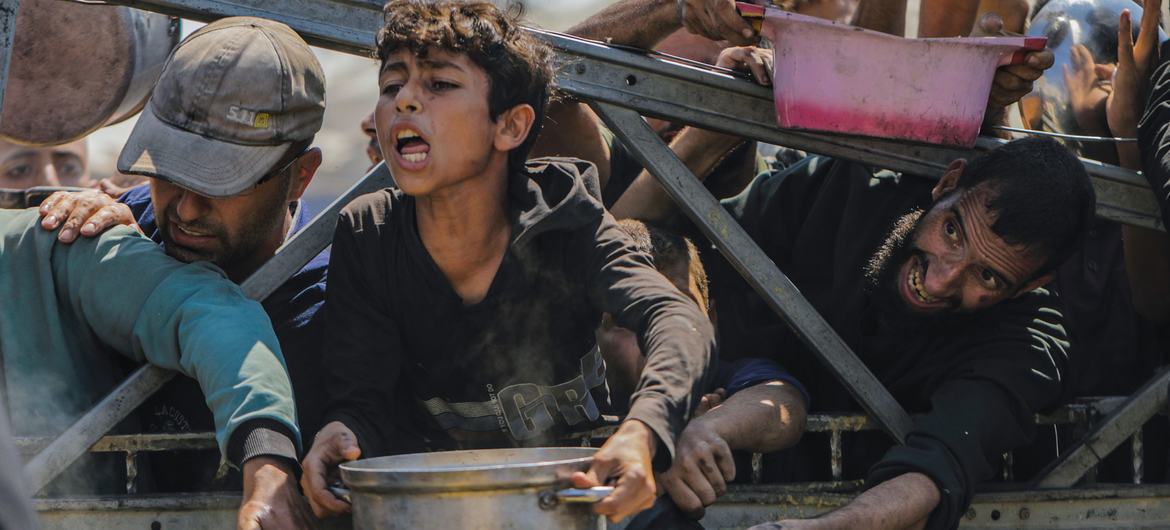
 File Photo