Trump: The Deal-Maker in Our Midst
 CrossFireArabia
- May 14, 2025
US President Donald Trump begun his Middle East tour on 12 May, starting in Saudi Arabia with the Gulf Cooperation Council (GCC) summit, then moving on to Qatar and concluding in the United Arab Emirates (UAE). Trump will be accompanied by a large delegation, including senior White House staff, several ministers, high-ranking officials, and an army of businesspeople. At the core of Trump’s tour to the influential and wealthy GCC states—Saudi Arabia, Qatar, and the UAE—will be investments, economic ties, business, and bilateral relationships. The Trump administration aims to attract hundreds of billions of dollars in investments from Gulf wealth funds into the United States.
Expected discussions include Israel’s military campaign in Gaza, Palestinian statehood, negotiations over Iran’s nuclear program, and the ceasefire deal with Yemen’s Houthi group. Additionally, Syria and Lebanon may also feature on the agenda. Syrian President Ahmad al-Sharaa is reportedly seeking a meeting with Trump during his visit to Saudi Arabia, aiming to persuade him to lift sanctions and increase US involvement in Syria’s reconstruction, economy, and oil sector.
Trump critically needs this tour to project an image of a successful leader who has secured hundreds of billions of dollars in pledged investments and deals, as well as closer political and security ties with GCC states. Hundreds of agreements are anticipated during the visit, covering areas such as AI, transportation, minerals, energy, infrastructure, aviation, defense, and potentially broader agreements on semiconductors and nuclear energy.
Matter of prestige
The significance of this tour is heightened by the fact that Trump is facing both internal and external challenges, having yet to achieve any substantial victories in his ongoing struggles. These include the tariff dispute, Israeli involvement in Gaza, the Iran nuclear deal, Russia’s war in Ukraine, tensions with Canada and Greenland, and his ongoing conflict with China. An image of victory during his Gulf tour would help compensate for these setbacks. Gulf leaders are well aware of this and will arrange exceptional welcome ceremonies and generous hospitality for him. In other words, they will arrange a wonderful show for him. This not only caters to his personal ego but also enhances his standing both domestically in the US and internationally, where he is in dire need of a win. The outcome could create a win-win situation. However, it is important to note that not all the promises made during this tour will materialize. While some initiatives may come to fruition, others may remain merely part of the spectacle.
Unlike his first visit to the region during his initial term in the White House, which included Israel, Tel Aviv is notably absent from his current itinerary. This exclusion is quite significant. Under Netanyahu, Israel has little to offer the US president, aside from more problems, a negative image in the region, and a tarnished reputation for the president himself. It serves as a reminder of his failure to achieve a ceasefire in Gaza, largely due to Netanyahu’s unwillingness to pursue it.
In a previous interview following Biden’s election at the end of 2020, Trump explicitly blamed Netanyahu for the failure of his peace initiative with the Palestinians, stating, “Netanyahu never wanted peace.” Amid the ongoing conflict, initiatives aimed at encouraging Saudi Arabia to recognize Israel—an objective pursued by Trump during his first term—are likely to remain on hold. Riyadh has indicated that it requires tangible progress toward a Palestinian state first, a condition that Israel has not been willing to meet. However, Reuters reported this week that the US has shifted its stance and is no longer insisting that Saudi Arabia normalize relations with Israel as a prerequisite for advancing discussions on civil nuclear cooperation.
Desire to appear as dealmaker
Regardless, Trump’s Middle East tour represents more than just a diplomatic engagement with key US allies; it is a calculated effort to reclaim geopolitical momentum and project strength amid mounting domestic and international challenges. The emphasis on economic deals, defense cooperation, and strategic investments highlights Washington’s strategy of leveraging the Gulf’s financial and political capital to enhance Trump’s image as a dealmaker-in-chief. However, beneath the pomp lies a web of unmet expectations and unresolved conflicts.
While Saudi Arabia, Qatar, and the UAE are acutely aware of Trump’s need for a symbolic win, they remain cautious about committing to politically costly moves without tangible concessions, particularly concerning Palestinian statehood. Ultimately, this trip may provide short-term optics that bolster Trump’s leadership narrative, but its long-term impact will depend on whether these engagements translate into sustained commitments or fade into the background noise of global challenges.
Dr Bakir is Assistant Professor at Qatar University, and non-resident senior fellow at the Atlantic Council.
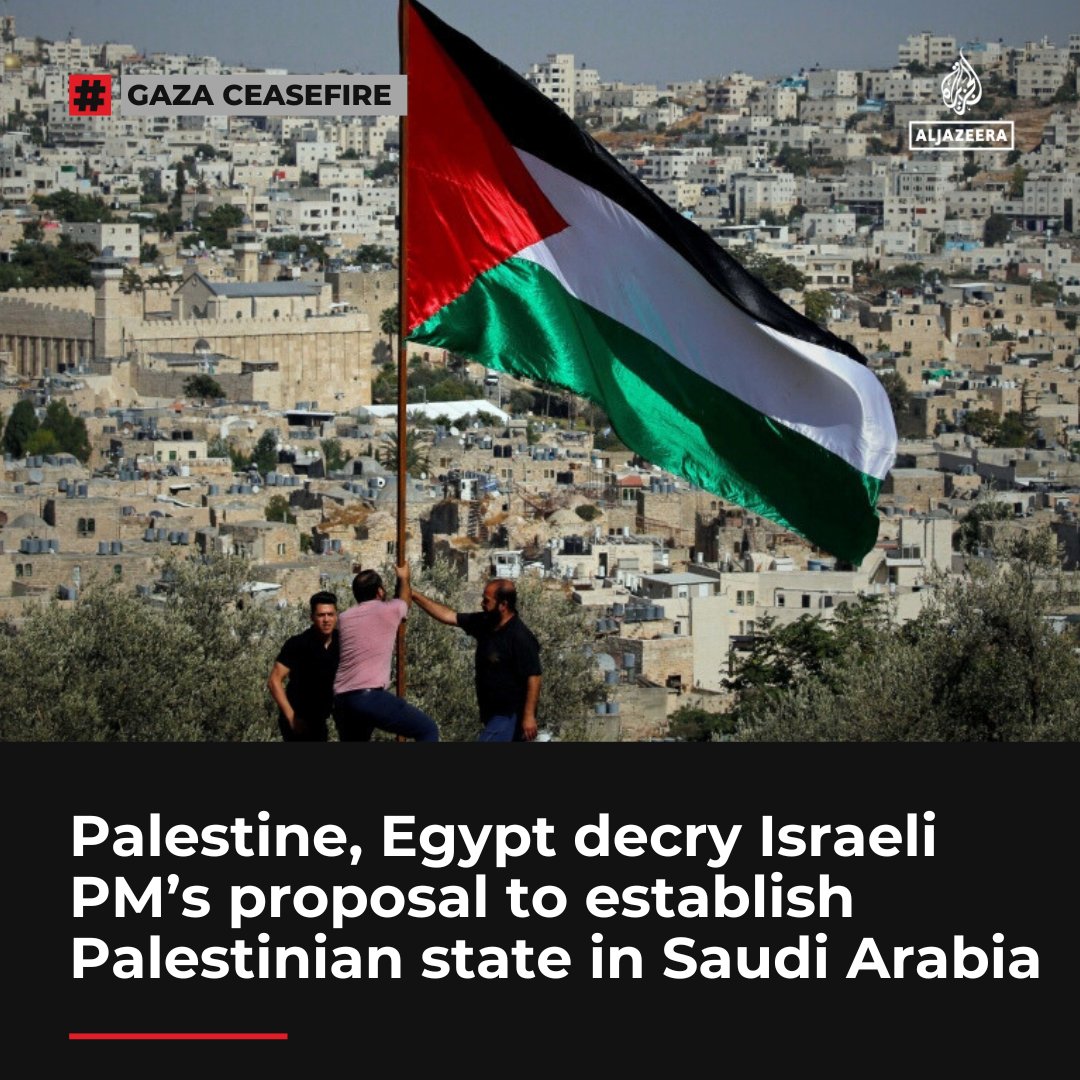
Arabs Condemn Netanyahu’s Call For Palestinian State in Saudi Arabia
- CrossFireArabia
- February 9, 2025
Arab countries strongly condemned Israeli Prime Minister Benjamin Netanyahu’s statements suggesting the establishment of a Palestinian state in Saudi Arabia.
In an official statement, the Saudi Foreign Ministry reaffirmed its “categorical rejection” of such rhetoric, emphasizing that “the Palestinian people have a right to their land, and they are not intruders or immigrants to it who can be expelled whenever the brutal Israeli occupation wishes.”
The statement said, “This extremist, occupying mentality does not understand what the Palestinian land means to the brotherly people of Palestine,” asserting that Israel “does not think that the Palestinian people deserve to live in the first place.”
The Qatari Foreign Ministry said in a statement that Netanyahu’s statements are “a flagrant violation of international law and a blatant infringement of the United Nations Charter.”
The ministry affirmed Qatar’s full solidarity with Saudi Arabia and reiterated its “categorical rejection of calls for the forced displacement of the brotherly Palestinian people.”
In a statement, Jordan’s Foreign Ministry spokesman Sufian al-Qudah said, “The Israeli government continues its provocative policies and statements that undermine the sovereignty of nations and the principles of international law.”
He stressed Jordan’s “absolute rejection of these provocative statements, which reflect an exclusionary and inciting ideology hostile to peace and contribute to further escalation in the region.”
The Foreign Ministry in Muscat, in a statement, reaffirmed “Oman’s firm stance in support of the establishment of an independent Palestinian state on its full sovereign territory in Palestine, with East Jerusalem as its capital, based on the 1967 borders.”
The Bahraini Foreign Ministry, in a statement, expressed the kingdom’s “strong condemnation and denunciation of the irresponsible Israeli statements regarding the establishment of a Palestinian state on Saudi territory,” considering them a “blatant violation of international law and the UN Charter.”
The ministry reaffirmed “Bahrain’s full solidarity with Saudi Arabia and its unwavering support for its security, stability, and sovereignty.”
The Iraqi Foreign Ministry issued a statement expressing its “firm rejection of these remarks, which constitute a blatant violation of Saudi Arabia’s sovereignty and an attack on the legitimate rights of the Palestinian people, in addition to contradicting international law and the UN Charter.”
The ministry emphasized “Iraq’s full solidarity with Saudi Arabia and its unwavering stance in supporting the security, stability, and sovereignty of nations.”
The Yemeni government, in a statement issued by the Foreign Ministry, condemned Israel’s arrogant and provocative remarks against Saudi Arabia, describing them as “a dangerous escalation that threatens the stability of the entire region.”
The ministry warned that “Israel’s arrogant statements not only target Saudi Arabia but also represent a serious escalation that endangers regional stability as a whole.”
The Mauritanian Foreign Ministry, in a statement, described the Israeli prime minister’s remarks as “irresponsible,” adding that they “constitute an unacceptable violation of international norms and laws and a provocation that threatens the security and stability of the region.”
Arab League Secretary-General Ahmed Aboul Gheit firmly denounced “in the strongest terms” the Israeli prime minister’s remarks about relocating Palestinians to Saudi Arabia. He emphasized that “the logic behind these statements is completely unacceptable and reflects a total disconnect from reality.”
Gulf Cooperation Council (GCC) Secretary-General Jassem Al-Budaiwi stated that “these dangerous and irresponsible statements confirm the approach of the Israeli occupation forces in their lack of respect for international laws and treaties, as well as the sovereignty of nations.”
Palestinian resistance movement Hamas strongly described Netanyahu’s remarks as “hostile toward Saudi Arabia and the Palestinian people, reflecting an arrogant approach and a colonial mindset that disregards the historical rights of the rightful owners of the land.”
On Thursday, Netanyahu suggested that Palestinians should establish their state in Saudi Arabia rather than in their own homeland, dismissing any notion of Palestinian sovereignty.
“The Saudis can create a Palestinian state in Saudi Arabia; they have a lot of land over there,” he said.
Earlier, on Feb. 4, US President Donald Trump said Washington would “take over” Gaza and resettle Palestinians elsewhere under an extraordinary redevelopment plan that he claimed could turn the enclave into “the Riviera of the Middle East.”
His proposal was met with wide condemnations from the Palestinians, Arab countries, and many other nations across the world, including Canada, France, Germany, and the UK as reported in Anadolu.
IRGC says Iran started its Operation True Promise 26 by launching missiles and drones against Israel