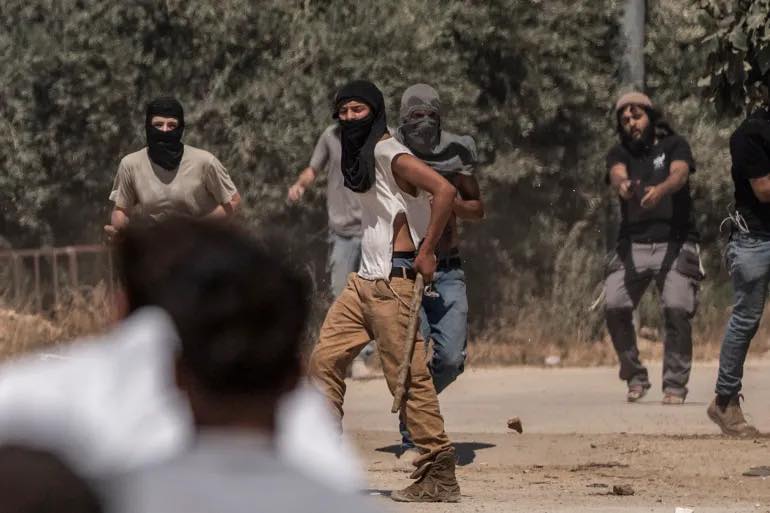
Israeli Army Fails in Ground Campaign in Lebanon

On 1 October, Israel announced the start of its ground military operation into Lebanon, which included air strikes, artillery shelling, and assassinations, but the Israeli occupation army has not yet been able to position itself in any village or town its soldiers have entered due to the resistance from Hezbollah fighters.

High Death Toll

According to Hezbollah the toll of Israeli army losses since the start of what it called the “ground maneuver in southern Lebanon” reached more than 100 dead and 1,000 wounded officers and soldiers, in addition to the destruction of 43 Merkava tanks, 8 military bulldozers, 2 Hummer vehicles, 2 armored vehicles, and 2 personnel carriers, and the downing of 4 Hermes 450 drones, and 2 Hermes 900 drones.

Despite talk of an imminent truce, Israel is still continuing its military escalation and announced the start of a second phase of the “ground incursion” targeting Lebanese villages outside the scope of its first operation in the south of the country.

Military experts told Al Jazeera Israel was surprised by the intensity of the resistance it faced during the ground incursion, despite its success in assassinating a large number of military leaders at the first and second levels.

This partial success prompted it to modify its strategy and shift to a new tactic based on entering areas, booby-trapping buildings, then detonating them, and quickly withdrawing to avoid further human losses, especially after the resistance succeeded in setting up ambushes.

Why has the Israeli army not been able to occupy any Lebanese village despite the military buildup on the northern border for more than a month?

Unable to occupy a single village

Military expert Brigadier-General Hassan Jouni confirmed to Al Jazeera the Israeli military buildup. Despite its five divisions with between 50,000 and 60,000 soldiers according to the Hebrew media, the Israeli army was unable to occupy a single village. He explained there is a fundamental difference in military science between the concepts of raid and occupation.

According to Jouni, a raid is defined as an advance towards a specific target with the aim of detonating or booby-trapping it or carrying out a security or military mission, such as arresting or liquidating someone, followed by a rapid withdrawal. Occupation means controlling a specific target and positioning oneself there, while establishing defensive centres to protect it.

Regarding the events in the south, he considered that what happened was advanced raids targeting specific villages with the aim of destroying them and withdrawing without the intention of remaining.

Jouni pointed out the Israeli decision not to station themselves in those locations came as a result of the fierce resistance their forces faced there, as they realized that any attempt to remain would make them vulnerable to continuous attacks by the resistance, which intensified its targeting of their movements towards the border villages and towns with artillery and missiles.

Does this situation reflect the strength of the Lebanese resistance and/or is it a military strategy followed by the occupation army?

According to Jouni the concentrated ground operation aimed to penetrate deep into Lebanese territory to reach the Litani River, especially after the harsh strikes against the Hezbollah leadership. However, Israel, after believing the resistance had been exhausted, was surprised by its intensity and steadfastness, which prompted it to modify its strategies. Therefore, the actual penetration was less than expected and was limited to a depth of no more than three kilometers.

What is the military significance of the strategy of the occupation army entering border villages and booby-trapping them without completely occupying them?

Blowing up cities

Military expert Brigadier-General Ali Abi Raad told Al Jazeera Net the Israelis seek to achieve two basic goals by blowing up cities. They are:

First, to facilitate the movement of their forces during military operations. In areas that contain buildings, progress becomes more difficult due to the risk of the presence of resistance fighters inside them, which forces them to destroy these buildings to open the way for their movements.

Second, to make these areas uninhabitable, especially those that are considered an “environment for resistance”, such as southern Lebanon. By destroying them, the Israelis isolate the environment that supports the resistance, and punish the residents who may be part of it. This strategy is known as “punitive deterrence”.

Abi Raad confirms that this strategy is not new, but part of the Israeli occupation’s approach in all areas it controls, whether in Gaza, West Bank and/or Lebanon. This approach has been witnessed in several wars, including the 2006 war on Lebanon.

Burned areas?

Is the Israeli occupation seeking to impose a new reality by turning the border areas into burned areas instead of being demilitarized?

Military expert Abi Raad points out the Israelis are seeking to impose a fait accompli by using internationally banned weapons, such as phosphorous and vacuum bombs, and stated that MK84 bombs were used in the assassination of Hassan Nasrallah, Secretary-General of Hezbollah, and are currently being used in the bombing of the southern suburbs and a number of Lebanese border villages.

He explained that the effects of these shells are clear, as buildings fall completely to the ground and turn into ash, and that the resulting craters reach a width of 3 meters and a length of 7 to 8 meters, or more in some cases, reflecting the extent of the great destruction.

In his opinion, this problem represents a major threat, as the goal of the destruction is to eliminate life in those areas in the long term. He explained that if the war stops now, the reconstruction process is expected to take at least two years, wondering what the situation will be like if the destruction continues and the war worsens?

Do these tactics form part of a strategy aimed at pushing Hezbollah away from the border areas?

Brigadier-General Abi Raad says Hezbollah is part of the population of the south who are closely connected to their land and this war is “defending their lands”, as the border strip is close to homes that were built at huge costs, making it difficult for people to leave them easily, and they will return to them no matter what. Therefore, the idea of ​​​​removing the party from the south or the area south of the Litani is “unrealistic”.

On the political level, he believes an agreement may be reached on stripping  Hezbollah of its weapons in those areas, but the issue is not limited to a range of only 10 or 20 kilometers.

He explained the issue goes beyond the type of weapons the party possesses and the areas in which it is present. When it possesses missiles with a range of up to 100 or even 250 kilometers, then removing it to the north of the Litani will have little effect.

Continue reading
Maduro: Netanyahu is a Monster Created by EU, US Empire

Israeli Prime Minister Benjamin Netanyahu is a “monster created by the European Union and the US Empire,” and he is committing genocide against Palestine and Lebanon, Venezuelan President Nicolas Maduro said on Monday.

Netanyahu “still has the audacity” to give orders to the United Nations to withdraw peacekeeping forces from southern Lebanon, Maduro said, referring to Israel’s call to UN chief Antonio Guterres to move the UN Interim Force In Lebanon (UNIFIL) from the Lebanese side of the border.

Five UN troops were injured in a series of incidents last week, the latest of which involved the UN force accusing Israeli troops of forcibly breaching a gate and entering one of their positions, as Israel continues its aggression across Lebanon, killing more than 1,300 people since September 23.

The Venezuelan president described Netanyahu as “the monster created by the European Union and the US Empire,” adding that even Nazi dictator Adolf Hitler did not dare to do what the Israeli Prime Minister is currently doing.

Maduro said what is happening in the Middle East today “is not a conflict, but a colonial project by the United States, the United Kingdom, and Europe aimed at controlling the region.”

“Netanyahu bombed hospitals, schools, mosques, and refugee camps in Gaza. Is this a war? This is genocide,” the Venezuelan President said.

In late September, Maduro strongly condemned the Israeli assassination of Hezbollah leader Hassan Nasrallah, denouncing Netanyahu as “Hitlerish” and criticizing world leaders for their silence.

He expressed Venezuela’s solidarity with the people of Lebanon and Gaza, also drawing comparisons between the Israeli Prime Minister and Hitler.

“We are witnessing the actions of a murderer who only reminds us of Hitler,” he said according to the Quds News Network.

Continue reading
Iran Strike on 15 Israeli Sites Topped $53 Million in Damages – Report

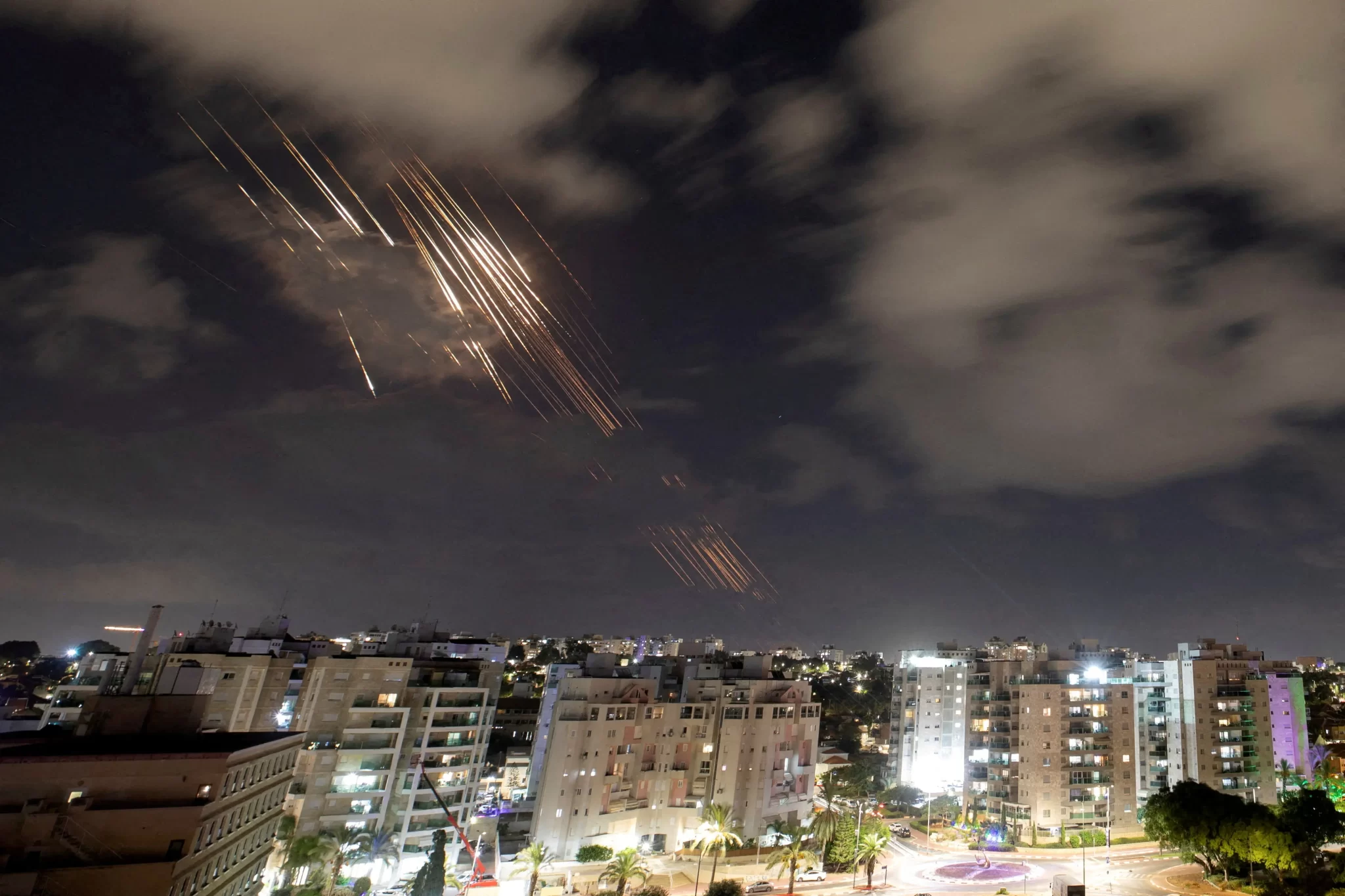
The Iranian missile attack on Israel earlier this month caused significant damage to property, amounting to an estimated $53 million, according to an Israeli report published on Sunday by Yedioth Ahronoth. The attack, which occurred on 1 October, is now regarded as one of the most destructive since the beginning of the war starting 7 October 2023.

Citing recent data from Israel’s property tax authority, Yedioth Ahronoth reported that the damages to civilian property are estimated between 150 and 200 million shekels (approximately $40 to $53 million). This makes it the most costly single missile strike on the occupation state since the war began.

The report detailed damage in at least 15 locations, including Israeli military bases. In Hod HaSharon, a settlement in central Israel, around 100 apartments were damaged, with losses estimated at more than 10 million shekels ($2.6 million) for one building alone.

Israel announced earlier this month that Iran had launched approximately 180 missiles in a retaliatory strike for the assassinations of Hezbollah leader Hassan Nasrallah, Hamas leader Ismail Haniyeh, and Iranian Revolutionary Guard commander Abbas Nilforoushan. The attack was described by Iran as revenge for these killings, which occurred in late September during Israeli airstrikes in Beirut and in July during an Israeli strike in Tehran.

Shortly after the incident, the Israeli military, as well as the Biden administration, denied that the strike had a significant influence according to the Quds News Network.

Continue reading
US Loses Trust in Israel Over Iran

The White House’s distrust of Israeli Prime Minister Benjamin Netanyahu’s government has grown increasingly in recent weeks as Tel Aviv carries out multiple wars across the region, according to a report published Tuesday.

Washington’s wear in trust comes as Israel prepares its response to Iran’s ballistic missile attack last week. Tehran said it carried out the strikes in retaliation for the July assassination of Hamas political leader Ismail Haniyeh in Tehran and the killing of Hezbollah Secretary-General Hassan Nasrallah in Beirut last month.

Four US officials told the Axios news website that Washington is not opposed to Israel carrying out its reprisal but wants it to measure its attack according to Anadolu.

“Our trust of the Israelis is very low right now, and for a good reason,” one of the officials said.

Jake Sullivan, US President Joe Biden’s national security advisor, told his Israeli counterpart Ron Dermer last week that the US expects “clarity and transparency” from Israel as it plans its response, in part because any Israeli attack has implications for the security of US forces and interests in the region.

Skeptical

Sullivan signaled during the call that if the Biden administration is not informed beforehand, it would not automatically step in to thwart another ballistic missile attack from Iran, Axios said. Dermer reportedly said Israel wants to keep the US in the loop, but the officials are skeptical that is the case.

The US had been left in the dark about Israel’s assassination of Haniyeh, which took place just days after Netanyahu assured Biden that he would work to advance a Gaza cease-fire and hostage deal, as well as the strike that killed the Hezbollah leader and a series of explosions that targeted the militia’s communication devices.

US Defense Secretary Lloyd Austin was reportedly livid when he was informed of the strike that killed Nasrallah within minutes of the time when the jets dropped dozens of bombs on Beirut’s southern suburbs. He was irked by the fact that the notification time was not sufficient to adequately increase the security of US forces in the region.

Officials said Israeli Defense Minister Yoav Gallant told Austin that he was instructed by Netanyahu not to give Washington an advance warning.

Gallant’s visit to the Pentagon, which was to take place Wednesday, was called off at the last minute, according to the Pentagon. It did not give a reason, but Israeli media reported that Netanyahu is barring his defense minister from flying to Washington until Biden calls him directly.

Netanyahu’s further decision to walk away from a US-backed 21-day cease-fire proposal in Lebanon further eroded US trust, as has Israel’s decision to order all civilians in northern Gaza to flee south as it prepares a new offensive on the region.

US officials have said they are concerned that the directive is setting the stage for a potential siege and that Palestinian civilians would not be allowed to return.

“They tell us what we want to hear — the problem is lack of trust,” a US official told Axios as reported by the Turkish news agency.

Continue reading
An Eye For an Eye

CROSSFIREARABIA – Israelis will not rest if the Palestinians don’t get their independent homeland and statehood to live free just as was the case before 1948 when Israel was forcibly created.

This present Israeli war on Gaza has shown that clearly.

While the Israeli war machine may have destroyed, nay, obliterated the whole of the enclave, the strip continues to be filled with resistance fighters who move above and below grounds with their weapons fighting their enemies.

Israel, its leaders, politicians and military, long propped up by American weapons have long known that but they continue to destroy rather than own up to Palestinian aspirations and the fact that the incessant conflict will not end otherwise.

In this war, slaughter, genocide – going into its second year now and shows no signs of stopping but on the contrary moving northwards to Lebanon – there developed a sense of equilibrium and proportionality although on a much smaller scale judging from the vast different of the protagonists.

Israel used massive bombs on civilians and sent them into a whirl of displacements, while Hamas continually fired rockets and missiles on the settlements and military bases surrounding Gaza and further beyond.

The immediate effect of that was the mass evacuation of the Israeli population from all these settlements, in effect as soon as the Israeli big guns started to ‘hammer’ the cities, town, villages and hamlets of northern Gaza soon after 7 October, 2023.

Displacement

Today, the Jewish settlements, more likely big towns and cities with high tech infrastructure stand empty; their populations have long been moved to hotels and guest houses by the extremist government of Benjamin Netanyahu, for their safety.

They still wait their return but there is no end in sight as to when will this happen. The late Hassan Nasrallah of Hezbollah, just before he was killed by Israel, said the occupation entity will not rest in peace, neither will the Jews return to their homes, until the bombs on Gaza stop.

Hezbollah had taken up the fight with Israel soon after 7 October as a support to Gaza through rocketing its northern parts with missiles. This process also set off a mass drove of Israelis to leave their homes, like their counterparts in the south, to be housed in a hotel accommodation away from the bombs and raging fires.

As the war genocide on Gaza continued in the following months, the return of these settler Israelis to their homes continued to be foggy, unknown. Many of these settlements and conurbations like Kiryat Shmona and Maalot today stand empty like ghost towns.

In Gaza around 2 million people out of a population of 2.2 million were forced into internal displacement, continually moving between areas from the north of Gaza to its southern border.

Likewise, the number of Israelis that were displaced was, initially estimated at 400,000 people with an extra 60,000 forced to leave when Hezbollah increased their missiles on the north after June 2024.

While they have been living in hotel accommodation many Israelis have been trying to get out of the country over the past months with the figures ranging from 500,000 up to a million.

Further to that about a quarter of Israelis polled by the Kan official channel, say they are truly thinking of leaving the country and 14 percent of them are supporters of Likud and the extremist rightwing parties. Indeed, soon after 7 October, the Ben Gurion Airport became filled with travelers as Hamas rockets started to land on Tel Aviv.

The airport is filled again today with travelers because of incoming missiles from Hezbollah from the north and the occasional ballistic missiles coming all the way from Yemen by the Houthis and/or the fright Israelis got from the recent incoming 200 missiles they saw in their skies from Iran.

There is no doubt that ordinary Israelis are under a lot of strain with sirens going off and on, all the time signaling for them, to go into the underground shelters. Video clips see them running asunder to the shelters, and who wouldn’t be scarred?

After all, the people of Gaza and now Lebanon are experiencing it all the time. For them however, there are no sirens, no warnings of 2000-pound bombs being dropped on their heads with no questions asked; their slaughter appear to be “manageable” foe western states who sell weapons to Israel.

The war can stop anytime. Hostages, around 110 from the original 250, can be returned anytime if there is a ceasefire but the Israeli prime minister is stuck on bringing them home by force, or so he says.

 Meanwhile Israelis are literally running. One videoclip in a Tel Aviv mall show people moving hastily to ahead, no doubt, to the underground shelters as the sirens blast all over.

Thus, there is a military equation that is being played out here: ‘You bomb us we will bomb you’. The Israeli army must realize that this is what is happening, and the stakes of the war game just keep getting higher and higher with Israel headed by Netanyahu, Yoav Gallant, Chief of Staff Herzi Halevi, Bezalel Smotrich and Itamar Ben Gvir, being lead to the abyss.  

Continue reading