Israel Cannot Annex West Bank Says VP Vance

US Vice President JD Vance rejected Israel’s proposed annexation of the West Bank as a “stupid political stunt,” reaffirming Washington’s opposition to unilateral actions and commitment to the Gaza ceasefire.

US Vice President JD Vance delivered a sharp rebuke to Israeli lawmakers on Thursday, explicitly rejecting any annexation of the West Bank and characterizing the recent Knesset vote on the matter as “a stupid political stunt.” 

Speaking to reporters in Tel Aviv, Vance left no ambiguity about the Trump administration’s position regarding the occupied Palestinian territory.

Clear US Policy Statement

“If it was a political stunt, it was a very stupid political stunt, and I personally take some insult to it,” Vance said regarding the Knesset’s preliminary approval of a bill to impose Israeli sovereignty over the occupied West Bank.

https://www.palestinechronicle.com/israeli-knesset-approves-preliminary-reading-of-bill-to-annex-west-bank/embed/#?secret=OBbWh2L4xb#?secret=TLEUEm5JV2

He then delivered the administration’s definitive position: “The West Bank is not going to be annexed by Israel. The policy of the Trump administration is that the West Bank will not be annexed by Israel. That will continue to be our policy.”

Vance’s remarks came a day after the Knesset approved, by a vote of 25 to 24, a bill to impose Israeli sovereignty over the occupied West Bank.

Israeli National Security Minister Itamar Ben-Gvir welcomed the vote, saying: “The time to impose sovereignty over the West Bank has come now.” 

Meanwhile, the Likud party, which leads the ruling coalition, described the bill as “showy” and damaging to relations with Washington.

The US Vice President said that such unilateral steps “contradict Israel’s commitments to the peace process and international agreements,” and reiterated that Washington’s message to Israel was clear: The need to maintain the Gaza ceasefire and avoid any action that could reignite tensions.

‘Despite Exceptions’

Vance also addressed the situation in Gaza, affirming that both Hamas and Israel are respecting the ceasefire “despite some exceptions.”

He made clear that “the United States would not deploy American soldiers in the Gaza Strip,” reaffirming Washington’s commitment to maintaining the ceasefire and advancing reconstruction.

According to Vance, reconstruction efforts would begin in areas “free of Hamas,” but he cautioned that it was still too early to launch large-scale rebuilding. He added that the United States hoped to see the reconstruction of Rafah “within two or three years.”

On October 9, Hamas and Israel agreed to a ceasefire and prisoner exchange following indirect negotiations in Sharm El-Sheikh under US sponsorship and mediation by Qatar, Egypt, and Turkiye according to The Palestine Chronicle.

Continue reading
America ‘Force Arms’ Netanyahu on Gaza

The Americans, both the Biden and Trump administrations, gave the Israelis two years to destroy Hamas in Gaza.  This is what the leader of the Palestinian National Initiative Dr Mustapha Al Barghouti started by saying. So for them the time was up came 7 October, 2025.

He maintained that it was because they couldn’t finish the job, the White House acted swiftly, stating enough is enough, the war on Gaza must end. What he said its true because today, the quest to end the war on the enclave and let the aid trucks in is an American initiative, who are almost dragging Israeli Prime Minister Benjamin Netanyahu forward who doesn’t want to end the war.

In a sharp analysis, the Palestinian politician said the Americans, especially President Donald Trump came to realize that the Israelis were not going to destroy Hamas despite the mass destruction of the Gaza Strip through mass weapons supplied by the United States. And that this is when the Trump administration decided to act and enforce the present, albeit fragile ceasefire between Tel Aviv and Hamas and according to him, ending the bloody, destructive, heinous war on Gaza.

But it was not for the lack of trying. When Trump entered the White House in January 2025, he then tried to sell the Rivieria Gaza idea to the region but he finally realized the Palestinian people of Gaza couldn’t be driven out of their homeland, even if it was just temporarily as he claimed and that there was going to be no way of parcelling them out to other countries.

Dr Barghouti pointed out Trump tried very hard talking to states like Indonesia, in the Arab world and those in Africa, seeking all sorts of pressure to persuade them to take the Gazans. But after much diplomatic chitchat, he realized the Palestinians weren’t for moving despite the fact that 250,000 of them were killed and/or injured at the hands of the Israeli army and the horrific mass destruction of their homeland.

This proves that the idea the Palestinian population can be ethnically cleansed – much talk about that in the past two years of the genocide – was a non-starter and that 1948 when hundreds of thousands of Palestinians were driven off their land by Israeli militias and terror gangs was not going to be repeated. Dr Barghouti added the last onslaught on Gaza has proved that ethnic cleansing has become a “closed chapter”. 

And he added Trump and his team led by Steve Witkoff and Gerard Kushner became aware of that, and that is when it was decided to push for a ceasefire to save Israel from itself. Barghouti putted this way: Trump realized many countries of the world were turning against Israel because of its murderous actions on Gaza and its mass displacement and starvation of the people of the enclave and to let Netanyahu have his own way by refusing to stop the war would be detrimental to US interests in the region.

Thus when Israel tried to re-start the war on Gaza last Monday – and a week into the ceasefire – when two of its soldiers were killed in Rafah through lone fighters and which Hamas immediately disavowed, the Trump administration played down the incident in the interest of maintaining the ceasefire accord reached at the beginning of October, 2025.

Trump first dispatched Witkoff and Kushner to Israel with Vice-president JD Vance who followed on a two-day visit in an effort to keep tempers low. Their visit to Israel today is sending a message that the US administration wants the ceasefire to be followed through in the interest of Trump’s 20-point peace plan for the Middle East.

Continue reading
US Vice-President Cancels Visit to Israel

US Vice President JD Vance was expected to travel to Israel on Tuesday, but decided against it due to Israel’s expansion of its military operation in the Gaza Strip, according to an Axios report.

The report cited a senior US official as saying that Vance made the decision “because he didn’t want his trip to suggest the Trump administration endorsed the Israeli decision to launch a massive operation at a time when the U.S. is pushing for a ceasefire and hostage deal.”

Vance officially cited “logical” reasons for his decision, the report added.

According to Israeli officials, Axios said, the Trump administration had informed the Israeli government on Saturday that Vance was “considering stopping in Israel” after attending the pope’s inauguration.

Discussions had also taken place on Sunday between US and Israeli officials regarding preparations for his visit. Soon thereafter, Axios said, Israeli media reported on Vance’s expected arrival on Tuesday.

Reports Denied

Several hours later, the report added, a White House official denied the reports.

In a statement to reporters traveling with the VP, the official reportedly said. “While the Secret Service has engaged in contingency planning for the addition of several potential countries, no additional visits were at any point decided upon, and logistical constraints have precluded an extension of his travel beyond Rome.”

“He will return to Washington on Monday,” the statement added.

https://www.palestinechronicle.com/israel-greenlights-gaza-aid-amid-american-pressure-cabinet-dissent/embed/#?secret=4bl8Jhe4Zw#?secret=UxS9CRr0Ds

A US official, however, told Axios that logistics were not the issue and that “concerns were raised that a trip to Israel at this time would be perceived by Israel and countries in the region as validation for Israel’s expanded operation.”

“At that point, Vance decided not to go,” Axios said.

Vance’s decision, the report noted, sheds light on how the US administration’s views on the current Israeli policy in Gaza amid the administration’s attempts to cut a deal to halt Tel Aviv’s ongoing operation in the enclave.

Mass Displacement

Since March 2, Israel has shut Gaza’s border crossings, preventing all humanitarian aid, including water, food, and medical supplies, into the enclave, exacerbating an already severe humanitarian crisis in the enclave.

On Sunday, the Israeli army began a broad ground offensive dubbed ‘Gideon’s Chariot’ in the besieged territory aimed at displacing two million Palestinians in Gaza to the south and destroying most of the territory.

Under pressure from the US administration and European allies, the Israeli security cabinet decided late on Sunday to allow some aid into the enclave.

Axios said that US envoy Steve Witkoff had given both Hamas and Israel “an updated proposal” for a ceasefire last week “and is pressing the parties to accept it.”

Over 53,000 Killed

Since Israel’s reneging on the ceasefire on March 18, it has killed and wounded thousands of Palestinians throughout the Gaza Strip through a bloody and ongoing aerial bombardment.

On October 7, 2023, following a Palestinian Resistance operation in southern Israel, the Israeli military launched a genocidal war against the Palestinians, killing over 53,000, wounding more than 118,000, with over 14,000 still missing.

Despite habitual condemnation by many countries around the world of the Israeli genocide, little has been done to hold Israel accountable.

Israel is currently under investigation for the crime of genocide by the International Court of Justice, while accused war criminals — including Prime Minister Benjamin Netanyahu — are now officially wanted by the International Criminal Court.

The Israeli genocide has been largely defended, supported, and financed by Washington and a few other Western powers according to The Palestine Chronicle.

Continue reading
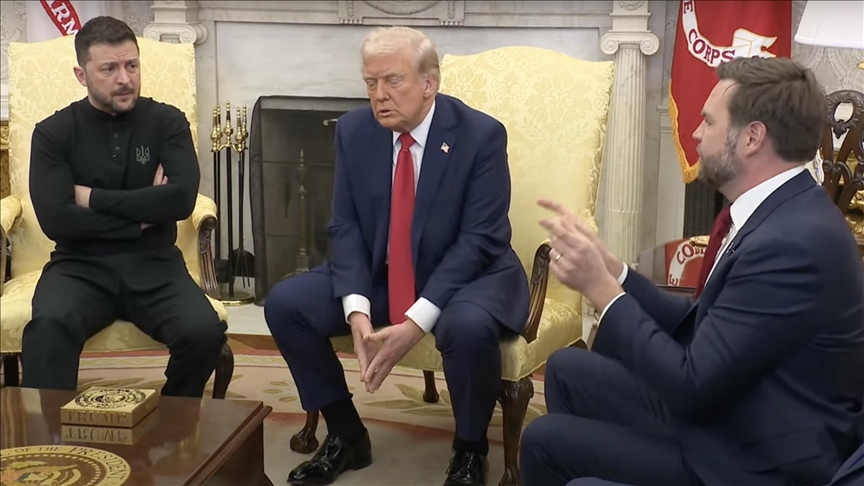
In Washington: Trump, Zelenskyy, Vance Locked in Verbal Fight

READ the Full transcript of heated exchange at the Oval Office in the White House.

Ukrainian President Volodymyr Zelenskyy on Friday got in a heated war of words with US President Donald Trump and Vice President JD Vance Friday during a critical meeting at the White House.

The public spat was over Zelenksyy’s doubts that Trump’s efforts to broker a deal to end the three-year-long war with Russia may not yield lasting peace.

Zelenskyy departed the White House following the argument, and a planned signing ceremony for a deal on critical minerals and press conference were canceled. ​​​​​​  

Here is the full transcript of the heated exchange at the White House:

Reporter: Poland was under Russian control for decades after the Second World War. When I was a kid, I looked at the United States not only as a most powerful country, richest country in the world, the country that has great music, great movies, great muscle cars, but also as a force for good. And now I’m talking with my friends in Poland, and they are worried that you align yourself too much with Putin. What’s your message for them?

Trump: Well, if I didn’t align myself with both of them, you’d never have a deal. You want me to say really terrible things about Putin and then say, hi, Vladimir. How are we doing on the deal? It doesn’t work that way. I’m not aligned with anybody. I’m aligned with the United States of America, and for the good of the world, I’m aligned with the world, and I want to get this thing over with. You see, the hatred he’s got for Putin that’s very tough for me to make a deal with that kind of hate. He’s got tremendous hatred, and I understand that, but I can’t tell you the other side is exactly in love with you know him, either. So it’s not a question of alignment. I have to I’m in line with the world. I want to get the thing said. I’m aligned with Europe. I want to see if we can get this thing done. You want me to be tough? I could be tougher than any human being you’ve ever seen. I’d be so tough, but you’re never going to get it done that way. So that’s the way it goes. One more question.

Vance: I will respond to this. So look, for four years, the United States of America, we had a president who stood up the press conferences and talked tough about Vladimir Putin, and then Putin invaded Ukraine and destroyed a significant chunk of the country. The path to peace and the path to prosperity is maybe engaging in diplomacy. We tried the pathway of Joe Biden of thumbing our chest and pretending that the President of the United States’ words mattered more than the President of the United States’ actions. What makes America a good country is America engaging in diplomacy. That’s what President Trump’s doing.

Zelenskyy: Can I ask you?

Vance: Sure? Yeah.

Zelenskyy: He (Putin) occupied our parts, big parts of Ukraine, part of East and Crimea. So he occupied in 2014. so during a lot of years. So I not speaking about just President Obama, then President Trump, then President Obama, now President Trump, God bless now President Trump will stop him. But during 2015 nobody stopped him. He just occupied and took. He killed people.

Trump: I was not here.

Zelenskyy: Yes. But during 2014 till 2022. The situation the same that people are been dying on the contact line. Nobody stopped him. You know that we have conversations with him, a lot of conversation, many bilateral conversation, and we signed with him.. In 2019 I signed with him, the deal, I signed with him, Macron and Merkel, we signed ceasefire. Ceasefire. All of them told me that he will never go. We signed him, gas contract. Gas contract, yes, but after that, he broke the ceasefire. He killed our people and he didn’t exchange prisoners. We signed the exchange of prisoners, but he didn’t do it. What kind of diplomacy JD you are speaking about? What do you mean?

Vance: I’m talking about the kind of diplomacy that’s going to end the destruction of your country, Mr. President, Mr. President, with respect. I think it’s disrespectful for you to come to the Oval Office to try to litigate this in front of the American media. Right now, you guys are going around and forcing conscripts to the front lines because you have manpower problems, you should be thanking the president for trying to bring it into this.

Zelenskyy: Have you ever been to Ukraine that you see what problems we have?

Vance: I have been to.

Zelenskyy: Come once.

Vance: I’ve actually, I’ve actually watched and seen the stories, and I know what happens is you bring people. You bring them on a propaganda tour, Mr. President. Do you disagree that you’ve had problems bringing people in your military? and do you think that it’s respectful to come to the Oval Office of the United States of America and attack the administration is trying to prevent the destruction of your country?

Zelenskyy: A lot of questions. Let’s start from the beginning. First of all, during the war, everybody has problems, even you, but you have a nice ocean and but don’t feel now, but you will feel it in the future.

Trump: You don’t know that.

Zelenskyy: God bless, you will not have a war…

Trump: Don’t tell us what we’re going to feel. We’re trying to solve a problem. Don’t tell us what we’re going to feel, because you’re in no position to dictate that exactly.

Zelenskyy: I am not telling you.. (inaudible) I am answering… question…

Trump: You’re in no position to dictate what we’re going to feel. We’re going to feel very good.

Zelenskyy: You will feel influence…

Trump: You’re right now not in a very good position. You’ve allowed to be in a very bad position, and it happens to be….

Zelenskyy: From the very beginning of the war.. (inaudible)…

Trump: You’re not in a good position. You don’t have the cards right now. with us, you start having problems right now.

Zelenskyy: I’m not playing cards…

Trump: You are playing cards. You’re gambling with the lives of millions of people.

Zelenskyy: I am the president of.. (inaudible)

Trump: You’re gambling with World War II. You’re gambling with World War III, and what you’re doing is very disrespectful to the country, this country, that’s back to you far more than a lot of people say they should..

Vance: Have you said thank you?

Zelenskyy: A lot of times…

Vance: No, in this entire meeting?

Zelenskyy: Even today…

Vance: You went to Pennsylvania and campaigned for the opposition in October, offer some words of appreciation for the United States of America and the president who’s trying to save your country.

Zelenskyy: Please, you think that, if you will speak very loudly about the war…

Trump: He is not speaking loudly, your country is in big trouble.

Zelenskyy: Can I answer?

Trump: No, no, you’ve done a lot of talking. Your country is in big trouble.

Zelenskyy: I know…

Trump: You’re not winning. You’re not winning this. You have a damn good chance of coming out okay, because of us.

Zelenskyy: We are staying in our country, staying strong, from the very beginning of the war, we’ve been alone, and we are thankful. I said, thanks…

Trump: You haven’t been alone…

Zelenskyy: I said thank you…

Trump: We gave you, through this stupid president, $350 billion we gave you military equipment…. if you didn’t have our military equipment, if you didn’t have our military equipment, this war would have been over in two weeks…

Zelenskyy: In three days. I heard it from Putin in three days. This is something…

Trump: Maybe less…

Zelenskyy: in two weeks.. of course.

Trump: It’s going to be a very hard thing to do business like this.

Vance: You said thank you.

Zelenskyy: I said… (inaudible)…

Vance: Except that there are disagreements, and let’s go litigate those disagreements, rather than trying to fight it out of the American media, when you’re wrong, we know that you’re wrong.

Trump: You see, I think it’s good for the American people to see what’s going on. I think it’s very important. That’s why I kept this going so long. You have to be thankful you don’t have the cards. You don’t have the cards..

Zelenskyy: I am thankful…

Trump: You’re buried there.

Zelenskyy: I can tell you again…

Trump: People are dying. You’re running low on soldiers.

Zelenskyy: Listen…

Trump: You’re running low on soldiers. It would be a damn good thing. Then you tell us, I don’t want to ceasefire. I don’t want to ceasefire. I want to go and I want this… Look, if you could get a ceasefire right now, I tell you, you take it so the bullets stop flying and your men stop being killed…

Zelenskyy: Of course, we want to start the war, but I …

Trump: You are saying you don’t want to ceasefire. I want a ceasefire because you get a ceasefire faster than…

Zelenskyy: Ask our people about ceasefire. What they think… (inaudible)…

Trump: That wasn’t with me, that was with a guy named Biden who was not a smart person.

Zelenskyy: It was your president…

Trump: That was with Obama who gave you sheets and I gave you javelins. Yes, I gave you the javelins to take out all those tanks. Obama gave you sheets. In fact, the statement is Obama gave sheets and Trump gave javelins, you got to be more thankful, because, let me tell you, you don’t have the cards. With us, you have the cards, but without us, you don’t have any cards.

Anadolu

Continue reading
Is America Abandoning Europe?

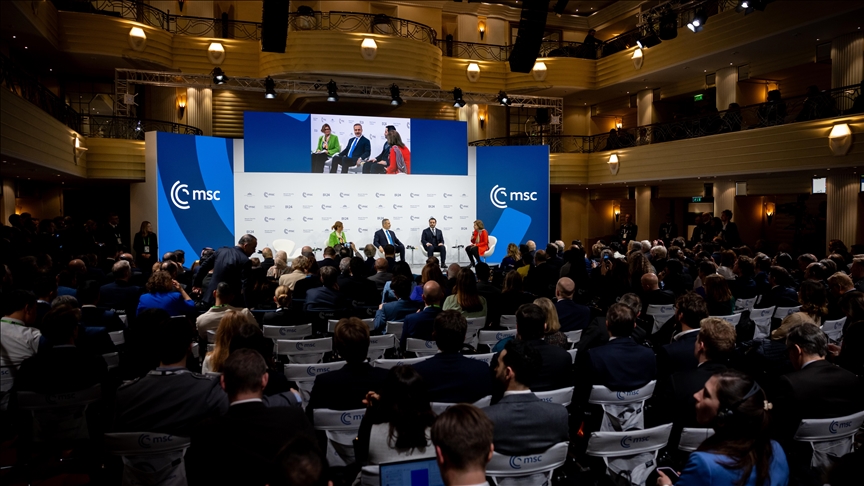
In 2007, Russia’s President Putin gave a now-infamous speech at the Munich Security Conference (MSC), announcing Russia’s new posture of hostility towards the US and Europe. In 2022, when Russia invaded Ukraine, many looked back at Putin’s 2007 Munich speech as a revealing moment of his intentions.

This year’s MSC could be a similar watershed. This time, the warning bells ring from across the Atlantic. US Vice President JD Vance delivered one of the most hostile speeches by a US official to Europe in decades. Rather than addressing the Russian or Chinese threats, Vance argued that Europe faced a “threat from within,” accusing the EU and national governments of censorship and ignoring popular demands on issues like illegal migration.

Meanwhile, away from Munich, US President Donald Trump held a phone call with Putin, setting the stage for negotiations between the US and Russia for a peace agreement in Ukraine – without involving European counterparts in the discussions. The day before, Defence Secretary Pete Hegseth announced some of the US expectations from this deal: Ukraine should drop its NATO membership bid, European countries would need to provide the forces to enforce the agreement, and these forces would not be covered by NATO’s Article 5 guarantees.

The transatlantic picture in which the MSC took place was even bleaker. Since Trump’s inauguration one month ago, the new president had promised (and now imposed) tariffs against countries across the world, including Europe. He has threatened to annex the territory of allies like Canada and Denmark.

Normally, the MSC is an opportunity for the United States to reaffirm its commitment to Europe and the Atlantic alliance. This year, it could be remembered as the time when the US started the process of abandoning Europe – or even going aggressively after it.   

An attack on Europe

Vance’s speech and the reactions to it have dominated the discussions at the MSC. Although the conference theme was “multilateralization”, the real topic on everyone’s mind was: how would Trump’s second administration approach Europe?

As the pre-conference report argued: “Donald Trump’s presidential victory has buried the US post–Cold War foreign policy consensus that a grand strategy of liberal internationalism would best serve US interests.” That this consensus was gone was clearly visible in the conference. Despite perfunctory references to shared values, Vance’s speech did not talk about the alliance between Europe and North America, nor about the common threats and how to face them.

And he has voiced support for anti-EU parties. Vance pronounced his speech in Germany, just weeks before federal elections, and argued that there should not be “firewalls” in government – a clear reference to the far-right Alternative für Deutschland (AfD) which has so far been kept out of governing coalitions. After the speech, Vance met with the AfD leader.

Additionally, Vance criticized Romania for canceling its 2024 elections and accused the EU of censoring free speech. But Vance failed to acknowledge that the very election that brought Trump and him to power in November was the subject of major foreign interference by Russia, China, and Iran. Rather than sitting idly by, US agencies took active measures to counter these malign actions and prevent disruptions – like raising awareness, coordinating with the media, and keeping politics out of the fight. With his speech, Vance seems to be arguing for the exact opposite approach.

All these issues did not touch on security and defense, the core of the MSC’s discussions. But they did lure in the background of Vance’s speech. A few months ago, Vance argued that the EU should not regulate tech companies owned by Elon Musk. If the Europeans did so, he argued, the US should reduce its security commitments to NATO. Hence, American assurances could become bargaining chips to resolve other issues.   

How will the EU respond?

Vance’s Munich speech marks a new era in US relations with Europe. While the themes are not new – Trump has never been a fan of NATO, and enjoys courting Europe’s far-right – the extent of the rhetorical change cannot be understated. Ukraine’s President Zelensky, speaking in Munich the day after Vance, spelled out the challenge in clear terms: “We can’t rule out the possibility that America might say ‘no’ to Europe on issues that threaten it.”

The reaction from European leaders has been strong so far. EU Commission President Von der Leyen called for an emergency clause in the EU treaties to allow member states to boost defense spending [8]. French President Macron called for a summit of European leaders in Paris on Monday, February 17 – to sketch out a common position on the upcoming negotiations over Ukraine, and on making up for US security guarantees from Europe.

The greatest challenge, however, will be transforming outrage into meaningful action. Europeans have long ignored calls to take charge of their own security. Domestic constraints over spending, divisions and the continued belief that Uncle Sam will have their back have stood in the way of ambitious choices. Will this time be different?  

This opinion was written by Giuseppe Spatafora for the Anadolu news website.

Continue reading