Sudan: Cabinet Returns to Khartoum

Sudan’s government officially returned to the capital Khartoum on Sunday for the first time since the outbreak of war with the paramilitary Rapid Support Forces (RSF) in April 2023, Prime Minister Kamel Idris said.

Speaking to a crowd upon his arrival from Port Sudan, where the government had been operating as a temporary capital since the conflict began, Idris described the move as a turning point for the country.

“Today we return, and with us returns a government of hope to the national capital,” he said. “We promise improved services and a better life for our people.”

Idris pledged to enhance health and education services, rebuild hospitals and rehabilitate schools and universities, placing particular emphasis on the University of Khartoum. He also vowed to improve security and living conditions for citizens.

The prime minister said the government has submitted the 2026 state budget without imposing additional financial burdens on the public, adding that it aims to reduce inflation to 70%.

According to the latest official figures released in November, inflation stood at 74.2%.

Idris said the budget also seeks to raise gross domestic product growth to 10% and curb parallel market exchange rates as part of efforts to stabilize the economy.

He described the current year as “a year of peace,” calling it “the peace of the brave and the victorious.”

On May 21, the Sudanese army announced it had regained full control of Khartoum, declaring the capital free of the RSF following battles in the Salha area south of the city.

Last July, the chairman of the Transitional Sovereignty Council, Abdel Fattah al-Burhan, issued a decree forming a national committee to prepare Khartoum for the urgent return of federal institutions and residents according to Anadolu.

Of Sudan’s 18 states, the RSF controls all five states of the Darfur region in the west, except for some northern parts of North Darfur that remain under army control. The army, meanwhile, holds most areas of the remaining 13 states in the south, north, east, and center, including the capital Khartoum.

Sudan’s humanitarian crisis has worsened since the war between the army and the RSF erupted in April 2023 over a dispute on unifying the military establishment, killing tens of thousands and displacing millions.
Continue reading
Devastation in Gaza is Staggering – WFP Official

Describing the level of devastation across the Gaza Strip as “absolutely staggering”, the Head of Emergency Communications for the World Food Programme (WFP) has told UN News in an interview that civilians are desperate for lifesaving aid and there’s a growing risk of widespread famine.

Speaking from Gaza, Jonathan Dumont said many people have been displaced multiple times, and that families are living either in tents or in the rubble of collapsed buildings, with no access to electricity or running water.

The text has been edited for length and clarity.

UN News: How do you describe the situation on the ground in Gaza, after more than a year since the war erupted there?

Jonathan Dumont: The devastation is absolutely staggering. This year, I’ve been to Goma, Port au Prince, Khartoum, a lot of different places where people have issues getting food or have been displaced. But in Gaza, I haven’t met anyone who hasn’t been displaced at least two or three times, due to military activity.

Almost everyone has lost their home. In the south, a lot of people are living in tents, and with the winter coming, you have rain and wind blowing them over, flooding them. Most kids don’t have shoes.

A lot of people feel they have no choice but to go back to their homes, which are quite frequently, literally rubble. I met a few families who are living in basically the cement blocks that have collapsed over them, and there’s no electricity, running water or sewage. This is the second winter for many of them that they’re homeless.

People walk on destroyed buildings in Gaza.

© WFP/Jonathan Dumont

People walk on destroyed buildings in Gaza.

UN News: What is the most striking story you’ve heard from people in Gaza?

Jonathan Dumont: When we were moving to Gaza City, we had to pass a checkpoint, and there were some bodies on a bridge in this sort of no man’s land area, and there were dogs eating the bodies. It was an horrific scene.

Some of our colleagues were tasked to pick up the bodies, and we couldn’t stop, but a bit later we came across two women and some children who were walking south, due to the intense military activity in the north. What struck me the most in that moment was that those children were going to come across the same scene of the dogs eating corpses, and I kept thinking about the impact that it might have on them.

UN News: You’ve been to the northern part of Gaza. Can you tell us more about what you saw there?

Jonathan Dumont: I’ve been to Gaza City, although I didn’t go to the areas in the far north. Gaza City is a huge city but many of the buildings have been destroyed. Before you had villas, beach cabanas and a fishing port, and now it is just a ghost town.

Much of Gaza has been destroyed in the ongoing conflict.

© WFP/Jonathan Dumont

Much of Gaza has been destroyed in the ongoing conflict.

WFP is able to reach that area, so there’s some food there, but the food prices of what’s not coming from the international community, or from WFP, are through the roof. There was someone selling peppers for 195 dollars…five dollars for one pepper. People can’t afford that.

Bakeries are being treated as banks – with metal slots and a metal corridor to channel people through because people are desperate, and they don’t want people to get injured or crushed trying to get food. 

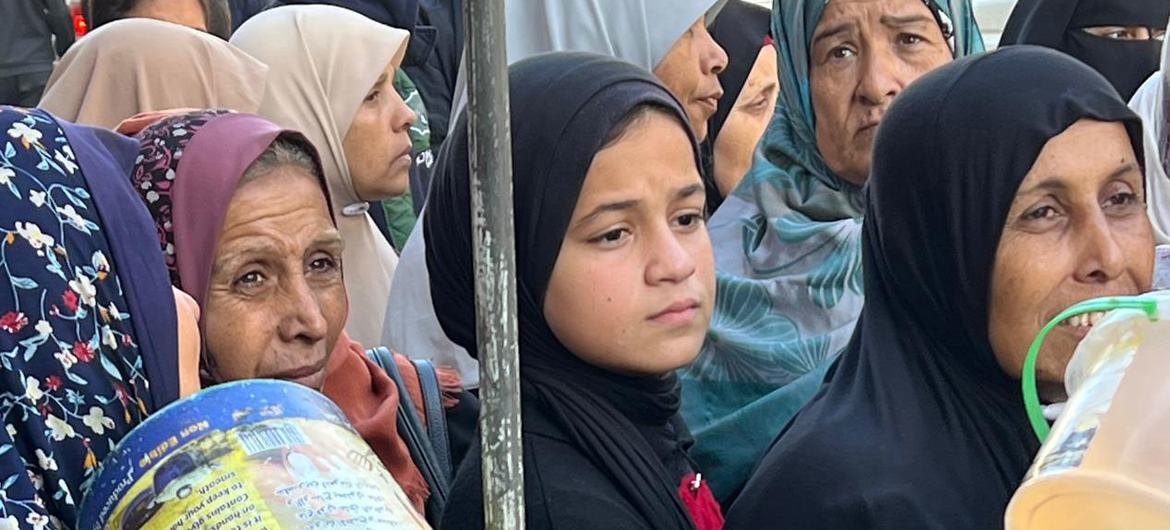
In Khan Yunis, where we are distributing hot meals, people get really desperate – you can see it in their faces, in their eyes.

UN News: The IPC report warned of the acute hunger and maybe some of people are on the verge of famine. Do you think the food insecurity is getting worse in Gaza?

Jonathan Dumont: The problem is that there’s been a total breakdown of society here, there’s no police, no infrastructure or any of the structures of society. As a result, what we’ve had in the southern part of Gaza is that gangs are emerging. We’ve had our trucks coming in from the south looted, and our drivers beaten.

We are trying to find solutions to have a consistent flow of food in. Obviously, the easiest way to do that would be if there was a ceasefire, which we are always hopeful will happen. In the absence of that, we need to find a way of getting all the food that we have outside Gaza into the country so that people can access it. We need to make sure people have access to food.

UN News: Many of the bakeries are not functioning. How many of them are working at full capacity?

Jonathan Dumont: In the south there is none of the WFP’s bakeries which are big volume bakeries. In the north there are some, but in the south, there are just small bakeries, so people are improvising when they have some flour.

Bread is the staple here, bread is life. 

UN News

Continue reading