Hassan Al Karmi: The Dictionary-Maker

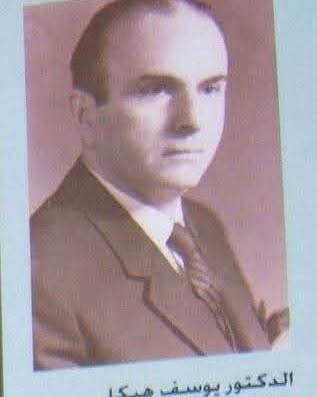
EDITOR’S NOTE: This is a tribute article I wrote originally about the Palestinian dictionary-maker who died on 5 May, 2007. It is befitting to reprint now from the hackwriters website because of the enormous contributions this man made to Arabic-English, English-Arabic dictionaries.

I first met Hassan Al Karmi when he was in his 90s. He was still as sharp as a tack. He was living another of his golden ages. He had already 14 Arabic-English, English-Arabic dictionaries under his belt and he was now writing treatises on Islam and the West. After our first meeting to do an article on him that appeared in a local newspaper–not written by me–we became friends and I started to visit him regularly though not as much as I would have liked. He would tell me Marwan keep coming to see me, I want to discuss what is happening in this world that has gone mad!

He first lived alone with only a Sri Lankian maid to look after him although he had numerous old guard friends, part of them his relatives, and part admirers, just happy to be in the company of a man who started to make dictionaries in the 1960s.

Hassan Al Karami made Amman his home in 1990 saying this is where he wanted to spend his retirement and the rest of his life. He came here quite by chance en route to Damascus where his wife wanted to see her original birthplace. Whilst in Amman, she passed away and so Hassan Al Karmi, nom de guerre Abu Zeyad, decided to make his home permanently here. He says he was 87 or there about by then and felt that it was time to come home.

Hassan Al Karmi had lived most of his life in London, and therefore could legitimately be called Anglo-Palestinian as he migrated to Britain in 1948 when Palestine fell to the Zionist occupiers. However, he never forgot his roots.

He was a Jerusalemite, born and bred, a teacher and an educational inspector by profession who traveled all over Palestine in the inter-war years from 1918 till 1948. He wasn’t too sure of the exact date of his birth, although he would tell me it was either in 1904 or 1907 but all he would say is he and his family would move at that time freely between Palestine, Syria and Jordan where his father served as chief judge in the 1920s to then Prince Abdallah of Trans-Jordan.

In an unpublished autobiography, Al Karmi vividly describes these years. The information he provides about his life in the various cities of Palestine during the 1920s and 1930s in places like Al Ramleh and Jerusalem are particularly illuminating. The reader receives a sketchy but a clear picture of the educational system in Palestine under the British Mandate with the young Al Karmi moving from one school to another.
From 1948 to 1990 London was to be his home, finding a job at the British Broadcasting Corporation–BBC Arabic–as a language supervisor, checking and correcting the Arabic that was spoken and broadcast to the Arab world. He remained at the BBC till his retirement in 1968, but by then he was known all over the Arab World through his program Qawl al Qawl, “Saying Upon Saying” that started in 1954 and lasted till the 1970s.

This program made him famous, almost a star, heard by many across the Arab world, commoners and kings, intellectuals and princes. He would tell me his presence at the BBC allowed him to meet and interview people like the late Sir Anthony Eden who was British Foreign Secretary at the time of the Suez Crisis in 1956 when Britain, France and Israel attacked Egypt, and he frequently interviewed Glubb Pasha who headed the Arab Legion in Jordan in the early 1950s.

The late King Faisal of Saudi Arabia who was murdered in the early 1970s wouldn’t miss an episode of the program, Karmi told me when they used to meet in the 1960s the king would tell him he was a judicious listener to the program. The late Egyptian President Gamal Abdel Nasser was another admirer, and ordered his own media to emulate the program.

Abu Zeyad was very proud of his BBC series not only because of the many friends he made across the Arab world including the late King Hassan II of Morocco but it helped him to maintain his roots and culture for he would frequently travel to the region to buy books and dissect the knowledge which he would use as quizzes for his program.

And in his London home he built an impressive collection of books, numbering at least 1000, which he left to one of his two daughters, Ghada Karmi, a medical doctor-turned academic, an author, commentator, and now a researcher at Exeter University’s Institute of Middle East Studies. Although the 48-volume collection of “Saying Upon Saying” was brought from London to stay as a cherished prize in his Amman flat.
He only bought a fraction of his books to Amman and some of his dictionaries, a number of which are out of print, but many others still on the market. He used to say to me proudly in actual fact he wrote 14 dictionaries but only eight are published, a great achievement in itself.

His first, Al Manar dictionary, was started in the early 1960s at the height of his career at the BBC, but was published in 1970, it is today long out of print although I managed to see a copy of it in one of the bookshops in downtown Amman.

On occasions I tried to ask him how he actually went about making his dictionaries but at many times his thoughts would seem intellectually scattered and his mind thinking of too many ideas. He was much too concerned with the malaise of the Arab world, arguing there was now another Christian crusade led by the United States against every Arab man and women, young and old.

Words seems to him superfluous if they are not connected to the culture, politics, religion and economics of the region. He looked for social habits and idiosyncrasies, seeing the Arab man as riddled with contradictions that are as much as his own fault as the fault of the globalist culture and the dictation of the outside world, of Bush’s America.

He was an inter-disciplinarian in the way he approached his work. He would always say that making dictionaries was the hardest projects he ever embarked on, but it was one of his priceless projects because it put the course of the Arabic language on a fixed linage and protected it. That’s why an endless amount of reading was required to look at the normative values of Arabic words and phrases, how the Arabic word was used and understood by the ordinary man-in-the street rather than how the intellectual and the pedagogues understood them and handed them down to the plebs.

What made making dictionaries in Arabic harder still he would say is, because unlike English, there is no ready-made references in Arabic and involved looking at words and going back to their origins, dissecting their consonants, or when they were said and come up with modern equivalents but one that ensure consistency and not deviate from the tone, intonation and syntacs.

Of course he had to look at other dictionaries which he brought back to London from his frequent trips to Arabia. Sometimes he would expressly travel to Egypt, Lebanon and Syria to gather what he termed as a book culture which he would ship to his house in London and sift through patiently to understand how one would differ from another and the context in which it is being used.

He thought there was no time to lose, for him time was of the essence, his dictionaries, books and world news was of paramount importance. When he wasn’t preparing one book, he would be seen scribbling in his shaky writing and would at times amusingly say ‘I can’t make head or tail of what I wrote’. On seeing him sign a book for me, his son Zeyad once comment amusingly, ‘take care of the signature, one day it will be very valuable.’

I remember his late 90s, where he would be sitting at his desk or at his favorite armchair with a magnifying glass in one hand and a pen in the other saying I just completed the adding of 10,000 extra words to one of my dictionaries that was to be printed in Beirut, then switching his mind to George W. Bush and his neo-conservatism, curse their politics in Iraq and on Palestine and say ‘why don’t they leave us in peace, we are a peaceful people.

The sum total of all of his printed dictionaries was eight over the span of the 1970s, 1980s and 1990s. They included Al Mughni Al Akbar, (English-Arabic), Al Mughni Al Kbir (English-Arabic), Al Mughni (English-Arabic), Al Mughni Al Waseet (Arabic-English), Al Mughni Al Waseet (American English-Arabic, Al Mughni Al Wajeez (English-Arabic), Al Hadi for Arabic language, Al Hadi Al Waseet, Al Hadi for students).

It was very strange to be in the company of such a man, I never thought of him per se as a dictionary-maker. I suppose I was very privileged to have known a man whose mind was to say the least multi-dexterous, leaping from one idea to another, it simply kept buzzing and enthused with intellectual thought. There was no end to his surprises.

One day I went to see him and out of the blue handed me a book he just published on a cat he had in his inter-war years in Palestine. Would you believe somebody would write a book on his cat, he would tell me, and yet why not, cats are very clever things you know and we should appreciate them more, one day I was trying to get rid of my cat, so I took it 20 kilometers from where I lived and left it there, and when I went back home there it was on my door step, what other animals would have the sense to do that.

He would tell me the story time and again and I would just nod my head and think of his many talents. It was his almost devoutness to knowledge, almost a humbling trait, that would probably stick out as his most basic of his character.

Hassan Al Karmi was not the kind of person who would be sidelined. While many people start becoming peripheral as they enter their octogenarian years, the intellectual caliber of Al Karmi left no room for peripheralism or the sense of being left out on any topic of conversation.

His mind never surrendered to his enfeebled body, and which radiated with sparkles of intellectualism about the moderation and enlightened forces of Islam and the godlessness of the West led by America and George Bush’s version of global domination. Towards his latter years, and through a penetrating historical analysis he came to speak of an embedded alliance between Judaism and Christianity and even supported the coining of the phrase of “Judeo-Christianity” to express an intrinsic relationship between the USA and Israel.

Towards the latter part of his life, his daughter Siham, herself a lady in her 70s and a biology teacher, came all the way from London to be with her father, while the others would try and come as much as possible. He and they shall be remembered as living in two cultures and trying to reconcile themselves with both.

Continue reading
Albanese: Israel, West Must Pay For Gaza Rebuild

The UN special rapporteur on the occupied Palestinian territories said Friday that Israel should pay for the reconstruction of Gaza together with the US and other main arms provider countries.

Speaking at an event in London on the situation of human rights in the occupied Palestinian territories, Francesca Albanese noted that there should be a full assessment of complicity over the genocide in Gaza, stressing that not just Israel but all the states aiding genocide should face sanctions.

“States must cut ties with Israel, must stop aiding and assisting a state that maintains an unlawful occupation,” said Albanese.

Touching on the accountability, the special rapporteur said that Israel should pay for the reconstruction of Gaza, together with the US, Germany, and Italy, who are the main weapons providers according to Anadolu.

She went on to say that there should be a robust investigation into the UK’s complicity with this genocide through its services that have been provided from Cyprus bases.

“If Israel do not want to be accused of colonial practices, it should not behave as a colonial power, as a colonial entity, taking land, displacing the people,” she added.

Saying that the two years of genocide in Gaza is “the combination of 60 years of impunity,” she noted that it is not going to stop “unless things change in London or in Rome, or in Berlin, or in Paris.”

‘No robust response against sanctions’

Touching on US sanctions against her, Albanese said that with the sanctions, Albanese herself, International Criminal Court (ICC) judges, or Palestinian human rights groups are “considered like criminals.”

“There has not been robust enough for response, or a robust enough response to this to have the sanctions lifted,” she said.

Saying that since she is banned from traveling to the US, she cannot present her reports to the UN General Assembly, while also adding that she also cannot open a bank account.

UN experts in August warned that US sanctions on Albanese threaten the human rights system, a month after the US announced it imposed sanctions on the special rapporteur for her “efforts to prompt” ICC action against US and Israeli officials.

In August, the US also sanctioned four ICC officials for authorizing the arrest warrants for Israeli Prime Minister Benjamin Netanyahu and former Defense Minister Yoav Gallant, accusing both officials of war crimes and crimes against humanity in the Gaza Strip.

About 250,000 families are currently living in displacement camps across the Gaza Strip, many facing cold weather and flooding inside fragile tents, according to the Civil Defense.

Although a ceasefire took effect on Oct. 10, living conditions in Gaza have not improved, as Israel continues to impose strict restrictions on the entry of aid trucks, violating the humanitarian protocol of the agreement.

Israel has killed more than 70,000 people, mostly women and children, and injured over 171,000 others in attacks in Gaza since October 2023, which have continued despite the truce.

Continue reading
London, Censorship and Banksy!

A new artwork by Banksy appeared on the walls of London’s Royal Courts of Justice on Monday. It showed a judge using a gavel to beat a defenseless protester. Within hours, guards covered it up, proving Banksy’s point.

Banksy confirmed the piece was his by posting a photo on Instagram. The image quickly went viral. But at the court itself, workers and guards rushed to block the public from seeing it.

Security guards stood in front of the wall as soon as the painting appeared. Witnesses said they tried to stop people from taking photos. Later, staff arrived with materials to cover it.

The image was believed to reference the state’s response to pro-Palestine demonstrations. Police detained nearly 900 people during Saturday’s protest against the banning of the peaceful activist group Palestine Action.

Defend Our Juries, a group opposing the crackdown, linked the artwork to growing anger over censorship and arrests. A spokesperson said:

“When the law is used as a tool to crush civil liberties, it does not extinguish dissent – it strengthens it. As Banksy’s artwork shows, the state can try to strip away our civil liberties, but we are too many in number and our resolve to stand against injustice cannot be beaten.”

The protester in Banksy’s work is shown lying on the ground, holding a white placard. A red smear on the placard looks like blood. In Banksy’s Instagram post, a lawyer and a cyclist pass by the scene without noticing.

The HM Courts and Tribunals Service justified the cover-up. They said the court is a listed building. Officials are “obliged to maintain its original character.”

But critics argue that the decision was not about heritage. They say it was a political act meant to silence a powerful message.

Banksy is no stranger to political art. The anonymous artist has painted on the Israeli apartheid wall in the occupied West Bank. His works often target injustice, war, and state violence.

In May, he posted an image from Marseille of a stenciled lighthouse alongside the words: “I want to be what you saw in me.” The work was immediately vandalized.

Continue reading
Palestinian State Out of Gaza Horrors?

It is hoped that the appeals for more recognitions of the Palestine state in the UN General Assembly in New York will increase pressure on Israeli Prime Minister Benjamin Netanyahu and his coalition partners to drastically change course and make the Palestinian state a reality.

Notwithstanding the US neutrality recognition, at least as things stand now, coupled with the increased efforts from the European Union, Israel stands to be ostracized in the international community.

One point remains rather curious however, is UK’s Premier Keir Starmer’s condition being that Britain will recognize a Palestinian state if Israel refuses to accept a ceasefire on Gaza.

For all intents and purposes, it seems what Starmer is interested in, is basically a ceasefire and then Palestinian state, but then again this is for the British government to ponder on in the face of the rolling train of recognitions.

But what does this recognition entails in practical terms? It basically means the stalled Oslo negotiations since 1993 are to be revived again, and if need be on different terms than what was envisioned before. Here one says different terms because the Oslo agreements were guaranteed by the world powers and nothing came out of them.

Indeed much more must be done by the world community, especially that now, we have a more difficult and intransigent Israeli government which needs above all else to accept, at least in principle, the two-state solution.

But also and at the same time time, the recognition of a Palestinian state entails the recognition of a Palestinian leadership with the ability and responsibility to represent the Palestinian people.

One supposes there is a general consensus on that now since the current PNA has become defunct and its current leadership obsolete in front of the immense responsibilities and tasks ahead.

In brief, it would be a mere rhetorical smokescreen to call on recognizing a Palestinian state without actually paving the way for the creation of such a state by totally changing the current PNA leadership via honest elections supervised by the international community and which represent the will of the Palestinian people.

Of course one cannot but insist, that the Arab role in the newly envisaged peace process is crucial. One also cannot help but think that the role of Saudi Arabia will be crucial for the next phase. For  start, the precondition of Saudi for any form of dealings with Israel, is for the latter to accept the principle of two-state solution, and in fairness it must be clarified that the French-Saudi initiative which led Emmanuel Macron to recognize a Palestinian state was supposed to be declared in in Paris.

But now due to this effort, it has become an international case at the UN. Israel has failed with all of its endeavors to normalize relations with Saudi Arabia without giving any concessions, mainly the acceptance of the precondition of the recognition of the two-state solution, and now it is facing both the pressure of the international community and the condition of the Saudis, especially they shift their strategy from the UAE to India, and without the Saudis they will have nothing in the Gulf.

But still there is the bleeding wound of Gaza, the wound which can never start to heal without a collective Arab effort led by the Saudis which takes back to the conundrum of Israel’s acceptance of the principle of Palestinian state. Only then can Saudi Arabia lead the Arab effort, to first of all disarm Hamas, give an amnesty to Hamas members, and exile its leadership out of Gaza, in the hope of rehabilitating the strip and start in earnest the reconstruction efforts.

Continue reading
Britain to Recognize Palestine, Israel Cries Wolf

Israel rejected a British government decision on Tuesday to recognize a Palestinian state in September unless Tel Aviv takes “substantive steps to end the appalling situation” in Gaza, calling the move a “reward for Hamas.”

“The shift in the British government’s position at this time, following the French move and internal political pressures, constitutes a reward for Hamas and harms efforts to achieve a ceasefire in Gaza and a framework for the release of hostages,” the Israeli Foreign Ministry claimed in a statement as reported by Anadolu.

British Prime Minister Keir Starmer said his government would move to recognize a Palestinian state at the UN General Assembly in September if Israel fails to take “substantive steps to end the appalling situation in Gaza, agree to a ceasefire and commit to a long-term sustainable peace, and revive the prospect of a two-state solution.”

Last week, French President Emmanuel Macron confirmed that Paris would officially recognize a Palestinian state during the UN General Assembly in September.

So far, 149 of the UN’s 193 member states have recognized Palestine – a number that has steadily risen since Israel began its war on Gaza in October 2023.

The British decision comes amid mounting domestic and international pressure on Israel to end its genocidal war in Gaza and allow humanitarian aid into the besieged enclave.

The Israeli army has pursued a brutal offensive on Gaza since Oct. 7, 2023, killing over 60,000 Palestinians. The relentless bombardment has devastated the enclave and led to food shortages.

On Monday, Israeli rights groups B’Tselem and Physicians for Human Rights-Israel accused Israel of committing genocide in Gaza, citing the systematic destruction of Palestinian society and the deliberate dismantling of the territory’s healthcare system.

Last November, the International Criminal Court issued arrest warrants for Israeli Prime Minister Benjamin Netanyahu and his former Defense Minister Yoav Gallant for war crimes and crimes against humanity in Gaza.

Israel also faces a genocide case at the International Court of Justice for its war on the enclave.

Continue reading