Macron: Persona Non Grata in Israel

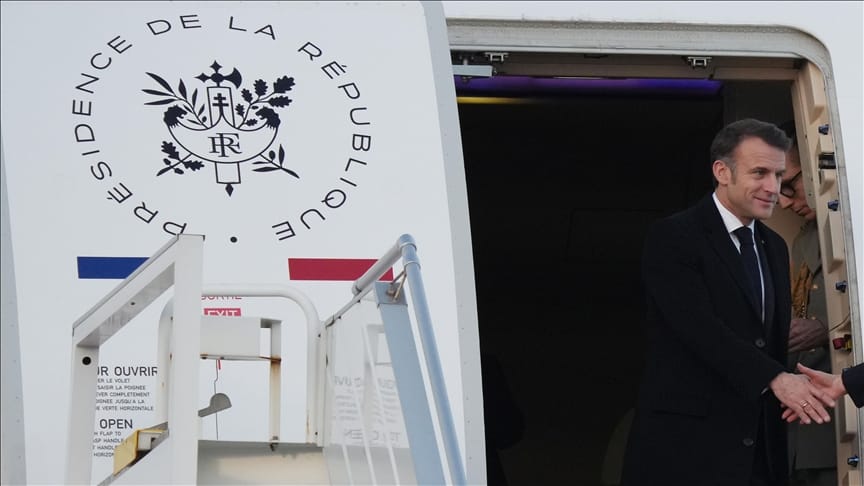
Israel signaled Thursday it will rebuff any visit by French President Emmanuel Macron over his country’s plan to recognize a Palestinian state.

Israeli Foreign Minister Gideon Saar said in a phone call with his French counterpart, Jean-Noel Barrot, that France’s move to recognize Palestinian statehood would “undermine stability in the Middle East and harm Israel’s national and security interests.”

“Israel seeks good relations with France, but France must respect Israel’s position when it comes to matters essential to its security and future,” Saar said during the call as cited by his office’s statement according to Anadolu.

He stressed that any visit by Macron “has no place” as long as France pursues the recognition move.

According to The Times of Israel news outlet, Prime Minister Benjamin Netanyahu has conditioned any visit by Macron on scrapping his move to recognize a Palestinian state.

There was no immediate French comment on Saar’s statement.

France and several European countries, including Belgium, the UK, Canada, and Australia, plan to recognize Palestinian statehood during the upcoming meetings of the UN General Assembly on September 8-23, joining 147 nations that already do.

Continue reading
France Condemns Israel’s Plan to Occupy Gaza

France, Friday, condemned in the “strongest terms” the Israeli government’s plan to occupy Gaza, reiterating its “firm opposition” to the scheme.

“France strongly condemns the plan adopted overnight by the Israeli government to once again extend its military operations to take control of Gaza City, with the aim of militarily controlling the entire Gaza Strip,” the Foreign Ministry wrote in a statement.

It reiterated France’s “firm opposition” to any plan to occupy the Gaza Strip and forcibly displace its population, underlining that such actions would lead to “serious violations of international law” and an “absolute deadlock.”

“They would undermine the legitimate aspirations of the Palestinians to live in peace within a viable, sovereign, and contiguous state, and would pose a threat to regional stability,” the ministry said.

It further reaffirmed that France will continue to work for implementation of a two-state solution, stressing that the future of the Gaza Strip “must be part of a future Palestinian state led by the Palestinian Authority.”

“France will continue the work initiated in New York, together with its partners and the United Nations, to deploy a temporary international stabilization mission to ensure the security of both Israelis and Palestinians. It calls on its partners and all other states to join this collective effort,” it added, referring to a recent conference on a two-state solution.

On X, Foreign Minister Jean-Noel Barrot also denounced the Israeli plan.

“France strongly condemns the Israeli government’s plan aimed at preparing for the complete occupation of Gaza. Such an operation would worsen an already catastrophic situation without enabling the release of Hamas hostages, its disarmament, or its surrender,” he wrote.

Continue reading
France to Airdrop Mass Aid Into Gaza

France announced Tuesday that it will airdrop a total of 40 tons of humanitarian aid into the Gaza Strip starting Friday.

“We will organize, starting Friday and in close coordination with Jordanian authorities, four flights carrying 10 tons of food each into the Gaza Strip,” Foreign Minister Jean-Noel Barrot told French broadcaster BFM TV, as he is co-chairing a high-level conference on a two-state solution to the Palestinian-Israeli conflict at UN headquarters in New York according to Anadolu.

Stressing that the air route is “useful” but “not sufficient,” he noted that 52 metric tons of French humanitarian cargo are currently blocked just a few kilometers from the Gaza Strip.

“It is therefore essential that Israeli authorities finally agree to reopen land access to Gaza in a sufficiently meaningful way to ease the horrific suffering of the civilian population there,” Barrot said.

He further reaffirmed that they had achieved and “even exceeded” the goals that they had set by creating momentum with Britain’s announcement that it is considering recognizing the state of Palestine.

“Other countries are following suit,” Barrot said. “In short, we have revived a political horizon: the two-state solution, which was on the verge of collapse.”

Continue reading
Seismic Shift Across The Atlantic

By Dr Khairi Janbek

Even before Trump’s coming of age, which is a long way away, or  more accurately so, coming to power, one often wondered about the status of the European Union (EU) in the world of changing circumstances and the existential meaning of its presence on the world power map among the increasing differences among its member states.

Although and frankly, differences always existed within the Union, the Russian invasion of Ukraine made those differences more acute, sharper and penchant materializing between those Europeans fearing being next on the Russian menu, those who want an assertive position against Moscow, those reluctant either way, and those who are out rightly pro-Russia.

Evidently, having unity among the 27 European countries which are not necessarily different in their political structures, yet having necessarily different strategic interests end up with infighting, recriminations and threats.

As well what makes things near-impossible, is that the EU does not have a mechanism to expel a fellow-member from the Union, so one is always beleiving that there is hope that an obtrusive member of the Union would walk out voluntarily in the manner made by the British Brexit.

Now it is more complicated. Not only the EU is having to deal with a possible Russian threat, but also a looming trade war with the US that is compounded with the distinct possibility that America may be withdrawing its protection umbrella from Europe.

Of course, this legitimately raises the question about the future of NATO; a question which was raised before especially after the demise of the Soviet Union in the early 1990s. This ultimately means a new form of a military alliance will be required for the EU.

Ideally, one would have thought a smaller EU entity, leaner and meaner, with incorporation of Britain in it, would the best option, while the rest of Europe, from its center to its eastern side, hitched by accords with Russia and the USA.

This would be far better instead of the current large European crippled Levathian with Britain running like a headless chicken proposing to be the bridge between the USA and EU, a link both sides of the Atlantic believe it’s too far a gap for any meaningful effect.

Having said all that, there is a window of opportunity now with the new government in Germany, showing more courageous initiatives in wanting to see a reset of the Atlantic relationship, which falls well with President Macron of France, the other core member of the EU which has the idea of creating a single European army to protect the EU and its interests.

When it comes to transnational trade, the absurdity of the war of tariffs will hurt all including the American economy, though European companies whose main market is in the USA will go and invest in America, but those US companies whose main market is Europe, will invest in the EU.

Essentially, the seismic shift in relations across the Atlantic is set to commence with most probably less profits but more fairness.

Dr Khairi Janbek is a Jordanian writer based in ParisFrance

Continue reading