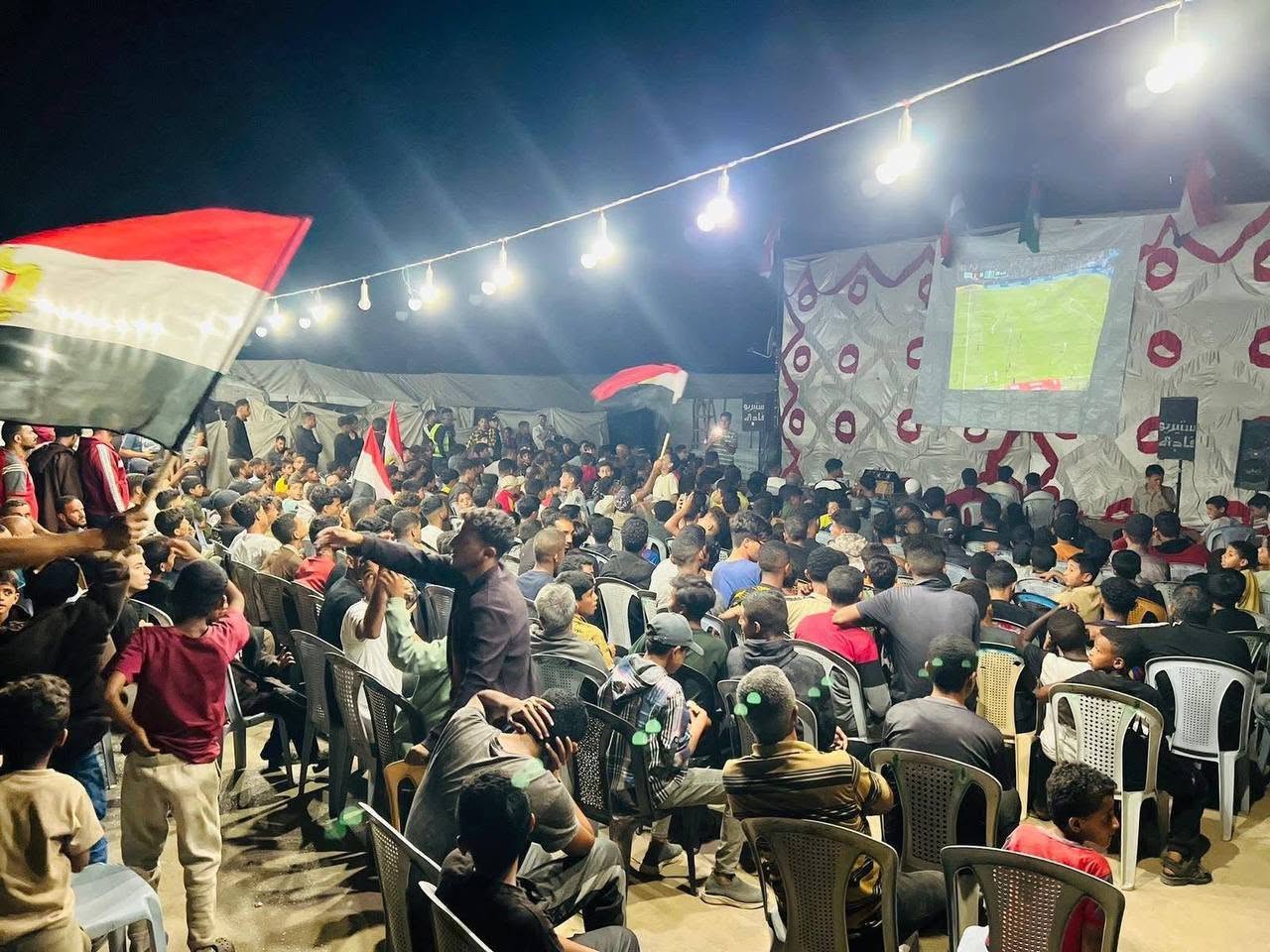
World Cup Through Gazan Eyes

Despite the heavy burden of war, displacement, loss, and deprivation they have endured for nearly three years, many Gazans, especially the youth, have not relinquished their passion for football and following the World Cup matches. They have become a temporary escape from the harsh reality of war.

With the start of the Arab teams’ matches in the world’s most important football tournament, displacement camps in the Gaza Strip have been transformed into something resembling “popular caravans” or open-air cafes, where hundreds of displaced people gather in front of large screens or televisions to watch the matches and cheer on their favorite teams.

In the Nuseirat camp in the central Gaza Strip, hundreds of Gazans gathered in the main square of the Nuseirat market in front of a giant screen to watch the match between the Egyptian national team and their Belgian counterparts, which ended in a 1-1 draw. Cheers and popular songs filled the air during the match, a scene that brought a measure of vitality back to faces worn down by war.

In the Khan Younis area of ​​southern Gaza, some of the tents housing displaced people have been transformed into makeshift cafes. Young men sit on wooden benches in front of televisions to watch matches of the Arab teams participating in the tournament. Some tents are decorated with Egyptian flags, and several young men drape the flags over their shoulders while watching the games.

During major sporting events, Gazans typically make a point of showing their support for the Arab teams, expressing the cultural and social ties that bind them to the Arab world and emphasizing their shared sense of solidarity and belonging.

For many residents of the Gaza Strip, these gatherings represent a rare opportunity for recreation and a break from the pressures of daily life. They also offer a temporary space for joy and engagement with a global event, away from the constant bombardment, displacement, and suffering.

However, watching the World Cup in Gaza is not as easy as it is in other parts of the world. In addition to the dire humanitarian situation and economic collapse, residents face financial, technological, and security challenges that make watching the matches a difficult task.

High Subscription Costs

The high subscription cost of beIN SPORTS channels, the exclusive broadcaster of the tournament, stands out as one of the most significant obstacles, in addition to the large time difference, as most matches are held in the early morning hours due to the United States, Canada, and Mexico co-hosting the tournament.

In an attempt to alleviate this crisis, the sports channels’ agent in Gaza managed to obtain a special exemption from the network’s headquarters in Qatar, allowing the reactivation of older equipment within the Gaza Strip, taking into account the exceptional circumstances faced by the residents. This exemption was granted for monthly subscriptions ranging between 350 and 420 shekels (US$120-150), providing some cafes and fans with a limited opportunity to watch the matches.

Alternatives, but Not Enough

Other alternatives are no more readily available. Free Turkish or Iranian channels may broadcast some matches, but they lack the Arabic commentary that has become a cherished part of the Arab public’s experience with major tournaments.

On the other hand, IPTV services rely on a stable internet connection, which has become virtually impossible given the extensive damage inflicted on the telecommunications infrastructure during the war.

Security Concerns Over Renewed Israeli Bombing

The suffering of Gazans is not limited to material and technical aspects; it also extends to security concerns. Gathering in cafes or public squares to watch matches has become fraught with danger due to the ongoing Israeli bombardment, prompting many to avoid going out at night. Despite this, some cafes continue to broadcast matches at night, even with the possibility of renewed Israeli attacks.

Despite all these challenges, football remains a rare outlet for many Gazans and a way to cling to life, a temporary attempt to postpone the pain of war and engage, even for a few hours, in a collective joy that restores some semblance of normalcy.

Since October 8, 2013, Israel, with American and European support, has committed genocide in the Gaza Strip, including killing, starvation, destruction, displacement, and arrests, ignoring international appeals and orders from the International Court of Justice to cease its actions.

The genocide has left more than 246,000 Palestinians dead and/or wounded, most of them children and women, and more than 11,000 missing, in addition to hundreds of thousands of displaced people and with a famine that claimed the lives of many, most of them children, as well as widespread destruction and the erasure of most of the cities and areas of the Gaza Strip from the map. Quds Press

Continue reading
Targeting Journalists Israeli Style

“After losing my leg in the war, I returned to photojournalism not just for work, but because I have loved photography since childhood,” said Palestinian reporter Sami Shahada.

Mr. Shahada lost his leg due to a severe injury he suffered in Nuseirat in central Gaza in April 2024, but he picked up his camera and returned to document the tragic events that have been unfolding in Gaza.

He will not let his disability stop him from working. “It is impossible for me to leave photojournalism, even if I face all these obstacles,” he said.

Ahead of World Press Freedom Day marked annually on 3 May which focuses on the role of media to highlight accountability, justice, equality, and human rights, our UN News correspondent in Gaza spoke with Palestinian journalists, documenting the risks and personal traumas they face reporting from the war-torn enclave.

War has devastated Gaza.

© UNICEF/Mohammed Nateel

War has devastated Gaza.

Since the war began following the 7 October 2023 attack by Hamas on Israel an increasing number of journalists have been killed or injured in Gaza as a humanitarian crisis has engulfed the enclave.

Bearing witness

On one leg, leaning on crutches, Sami Shahada stands behind his camera, wearing his blue press jacket, working amongst the rubble of destruction with colleagues.

“I witnessed all the crimes that happened, and then the moment came when I was a witness to a crime that was perpetrated against me,” he told UN News.

Sami Shehadeh looks at a video of the moment he was injured in Gaza in April 2024.

UN News

Sami Shehadeh looks at a video of the moment he was injured in Gaza in April 2024.

“I was a field journalist, carrying a camera in an open area and wearing a helmet and a jacket which identified me as a journalist, yet I was directly targeted.”

That incident marked a turning point in his life. “I did not need help from anyone before, now I need help,” adding that “I have the determination and persistence to overcome this new reality. This is how we journalists must work in Gaza.”

Working the streets

Journalist Mohammed Abu Namous is another of these journalists.

Filming with one of his colleagues in the rubble of a destroyed building in Gaza City he said: “While the world celebrates World Press Freedom Day, Palestinian journalists remember their workplaces which were destroyed in the war.”

“The minimum we need to carry out our journalistic work is electricity and the internet, but many do not have this, so we resort to commercial shops that provide the internet. The streets are now our offices.”

Palestinian journalist Mohammed Abu Namous and his colleague cover the impact of the war in Gaza.

UN News

Palestinian journalist Mohammed Abu Namous and his colleague cover the impact of the war in Gaza.

He believes that Palestinian journalists have been targeted during the Israeli occupation of Gaza and said that media workers must be protected “whether they work in Palestine or elsewhere in the world.”

Voices not silenced by death of loved ones

Journalist Moamen Sharafi said he lost members of his family in an Israeli bombing in northern Gaza, but despite “the many negative impacts on a personal, social, and humanitarian level, professionally nothing has changed.”

He was determined to carry on working, he explained, as he was due to live broadcast from the streets of Gaza City.

Palestinian journalist, Moamen Sharafi (right,) lost several family members during the current war that started in October 2023.

UN News

Palestinian journalist, Moamen Sharafi (right,) lost several family members during the current war that started in October 2023.

“We have become more determined to continue our work and uphold our professional values and perform our mission with humanity to the world,” he continued, “in order to convey the reality of what is happening on the ground inside Gaza, specifically the humanitarian situation, and the impact on children, women and the elderly who suffer greatly.”

UN News

Continue reading
Israel, Trump and the Latest Bombing of Gaza

Israel relaunched its bloody war on Gaza, with vehemence and callousness and with the blessing of the Donald Trump administration in the White House.

Its back to the “good old bloody days” of murder, mayhem and slaughter of mostly innocent women and children who have no part in the current war waged between Israel and Hamas.

Unwilling to quench its thirst for blood, Israel relaunched its war on the 364-kilometer Gaza Strip by killing over 322 people in the first five hours of early morning Tuesday while everyone was fast asleep.

Up until then it has been a “slight” rest bite reached through a ceasefire on 19 January between Hamas and Israel through US, Qatari and Egyptian mediators bringing an end to the daily killing of Gazans that today stands at 48,500 people.

Everyone is asking if the ceasefire is wrecked and stands in ruin on day 525, the total length of the carnage started on the people of Gaza soon after 7 October 2023, when about 1200 Israelis were killed.

Whatever the politics of the recent war, it has become amply clear the Israel slaughter has not been aimed at Hamas fighters, which it couldn’t eradicate even after 15 months of war on the Islamic organization but resulted in the mass killing of the women and children of Gaza.

The latest spate of dropping bombs on the people of Gaza, facilitated by the United States which stands as complicit in this genocide, sees no end light, but is seen as just the beginning although Gaza and its infrastructure is already annihilated with its people displaced and living in the wild and under the skies.

The world stands and waits to see, if the genocide will continue from this day onwards, or is it just a pressure tool to get Hamas to release the 59 or so Israeli prisoners it currently holds. If the latter is the case however, Hamas has long shown, it has a long breath and will not release the prisoners that originally were around 250 and now stands at the current number through exchange deals with the fact that the Israeli army has killed around 23 of them in failed rescue operations.

The latest bombings, carried from the air starting from the south of the strip on the southern city of Rafah, Nuseirat, Al Shati and Maghazi camps, and Deir Al Balah in the center of the enclave, including Gaza city and the destroyed northern areas, speaks of dark days are expected ahead.

Hamas are yet to respond militarily. There are couple of issues to consider here. Hamas officials have been talking to the Trump administration officials in the last couple of weeks about different paths.

Will that continue, particularly after this bloody debacle. Prime Minister Benjamin Netanyahu, who long wanted to destroy Hamas, and thus the war to continue, said this time around, the latest military operation in Gaza is being carried out “in consultation” with Trump and his associates.

If this is the case, the latest Israeli deadly spate, may not last long, particularly because Trump is on record of stating that he doesn’t want the war to continue but wants to end it which means he will not continue to supply Israel with weapons indefinitely and there will come a time when he will stop.

But that might be a while before that and he may continue to tolerate the mass bombing of Gaza. However, since he is talking to different parties through his envoy Steve Witkoff, he will likely “manage” what Israel continues to militarily do in the Gaza Strip and be involved in a “stop-go” war process.

The problem with Trump is that also he is looking for different objectives in Gaza. He first wanted to displace its 2.2 million people to neighboring countries like Jordan and Egypt. Now, he appears to be retracting from this position because of Arab and world pressure.  

Will he backdown and order Israel for a quick “fix” and or let the war on Gaza continue by which time Hamas, will once again, start fighting Israel again, both in the Strip and through endlessly targeting its major cities, towns, settlements for the past 15 months.

Despite the fact that Trump said that “all hell will break lose” on Gaza if the war doesn’t stop and Hamas is not brought to heed, the US president is choosing to forget the Houthis, despite mass bombing them in the last couple of days. They promised they will continue to strike Israel if it continues to stand as an obstacle to humanitarian and food delivery to Israel and will not be deterred by US and British bombing of Yemen. And to prove their point, a ballistic missile was fired on the same day, Tuesday, after the Israeli bombing of the Strip.

Hence what Trump wants and what he will get on the ground are two different things. His wish to end the Israel-Hamas war and establish a “new Gaza” will not be achieved through parochial thinking.

The Palestinians are on the ground, they have no wish to go anywhere while Hamas continues to have a formidable fighting capability and have no qualms to going back to war. The fact they are talking to the mediating parties, including the US doesn’t mean they are ready to put their guns down and leave the grounds of Gaza.

Netanyahu must realize that unless he wants the whole Middle East region to be engaged in a perpetual long-term war. The question is Trump and the United States military establishment prepared for that?

The above-analysis is written by Dr Marwan Asmar, chief editor of the crossfirearabia.com website.

Continue reading
Israel Kills Anadolu Cameraman in Gaza

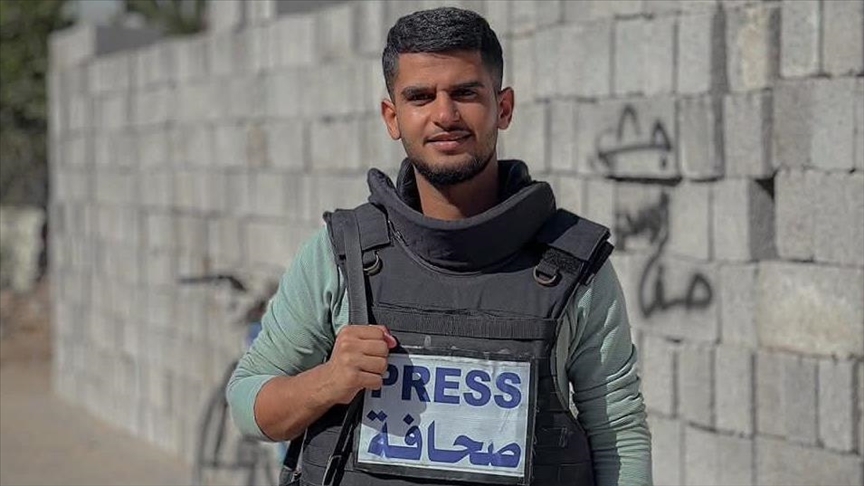
Saed Abu Nabhan, a freelance Anadolu cameraman in Gaza, was killed on Friday by a long-range rifle attack by the Israeli army. Abu Nabhan, 25, had a wife and one child.

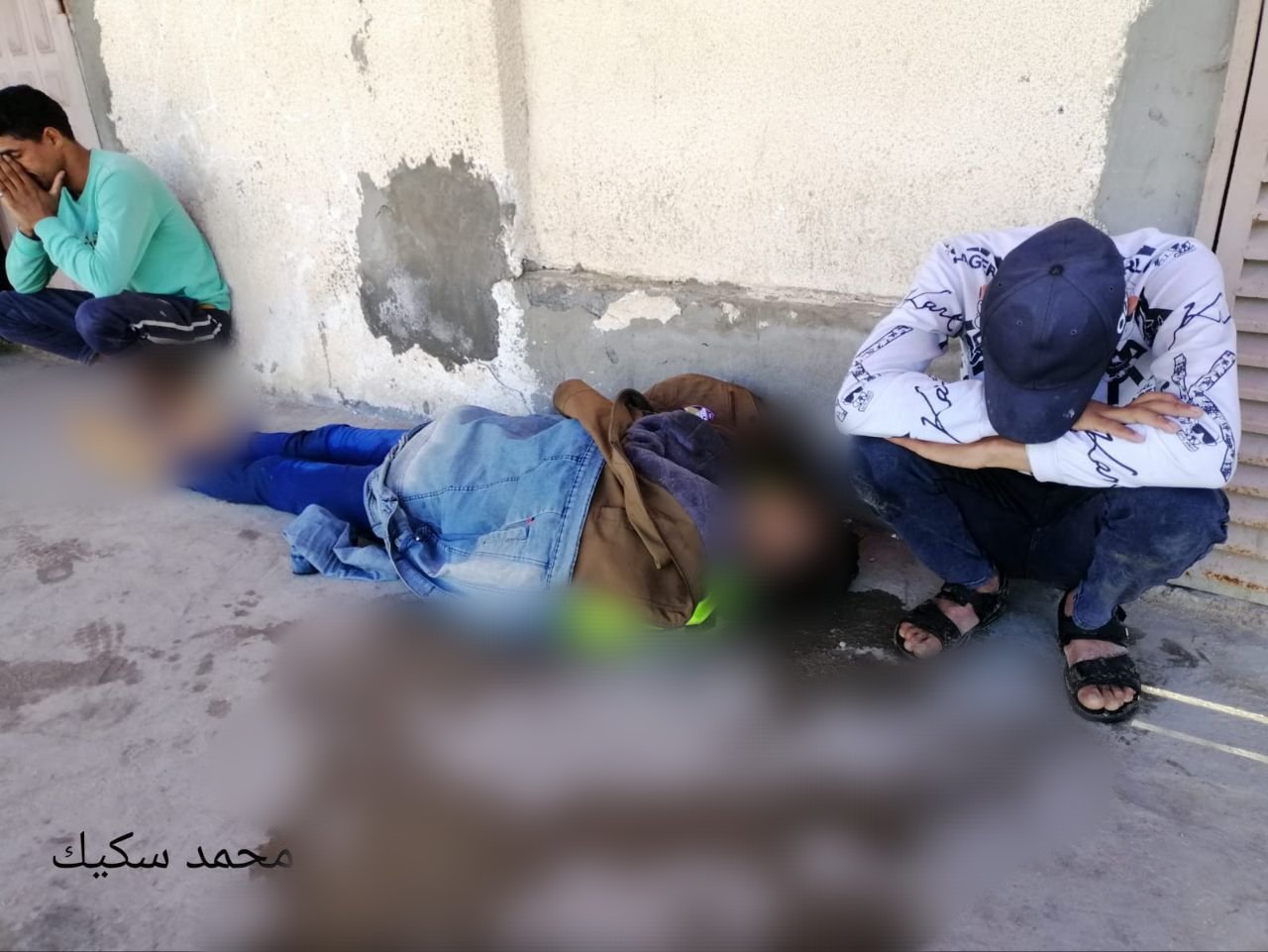
In the fatal incident, the Israeli military first surrounded an area in the Al-Jadeed Refugee Camp, located in the central Gaza Strip’s Nuseirat region, where many journalists were, before targeting those in the area.

Footage from the scene shows a wounded individual being rushed out of a house on a stretcher with the help of aid workers.

Nearby, Abu Nabhan is seen trying to run while covering the incident with his equipment. At that moment, he is targeted by what appears to be a shot fired from a long-range rifle.

Abu Nabhan then falls to the ground and lies motionless. People nearby struggle fearfully to approach him due to the threat of being targeted by Israeli bullets.

Official Palestinian news agency Wafa reported on the attack, confirming that Abu Nabhan was killed.

Separately, at least one person was reported dead, with the deceased and injured taken to Al-Ahli Baptist Hospital, following an Israeli airstrike on a house in Gaza’s Shuja’iyya neighborhood.

The death of Abu Nabhan brought the total number of Palestinian journalists killed in Israeli attacks on the Gaza Strip since Oct. 7, 2023 to 203. Reports also indicate that 399 journalists have been injured, and 43 others captured.

The Israeli army has continued a genocidal war on Gaza that has killed more than 46,000 people, most of them women and children, since a Hamas attack on Oct. 7, 2023, despite a UN Security Council resolution calling for an immediate cease-fire.

In November, the International Criminal Court issued arrest warrants for Israeli Prime Minister Benjamin Netanyahu and former Defense Minister Yoav Gallant for war crimes and crimes against humanity in Gaza.

Israel also faces a genocide case at the International Court of Justice for its deadly war on Gaza.

Continue reading