Trump, Gaza and The New Political Ploy


Dr Sami Al-Arian

The infamous 19th-century imperialist and racial supremacist, Cecil Rhodes, once remarked: “It is our duty to seize every opportunity to acquire more territory and we should keep this one idea steadily before our eyes that more territory simply means more of the Anglo-Saxon race.” He then added: “Just fancy those parts that are at present inhabited by the most despicable specimens of human beings, what an alteration there would be if they were brought under Anglo-Saxon influence.”

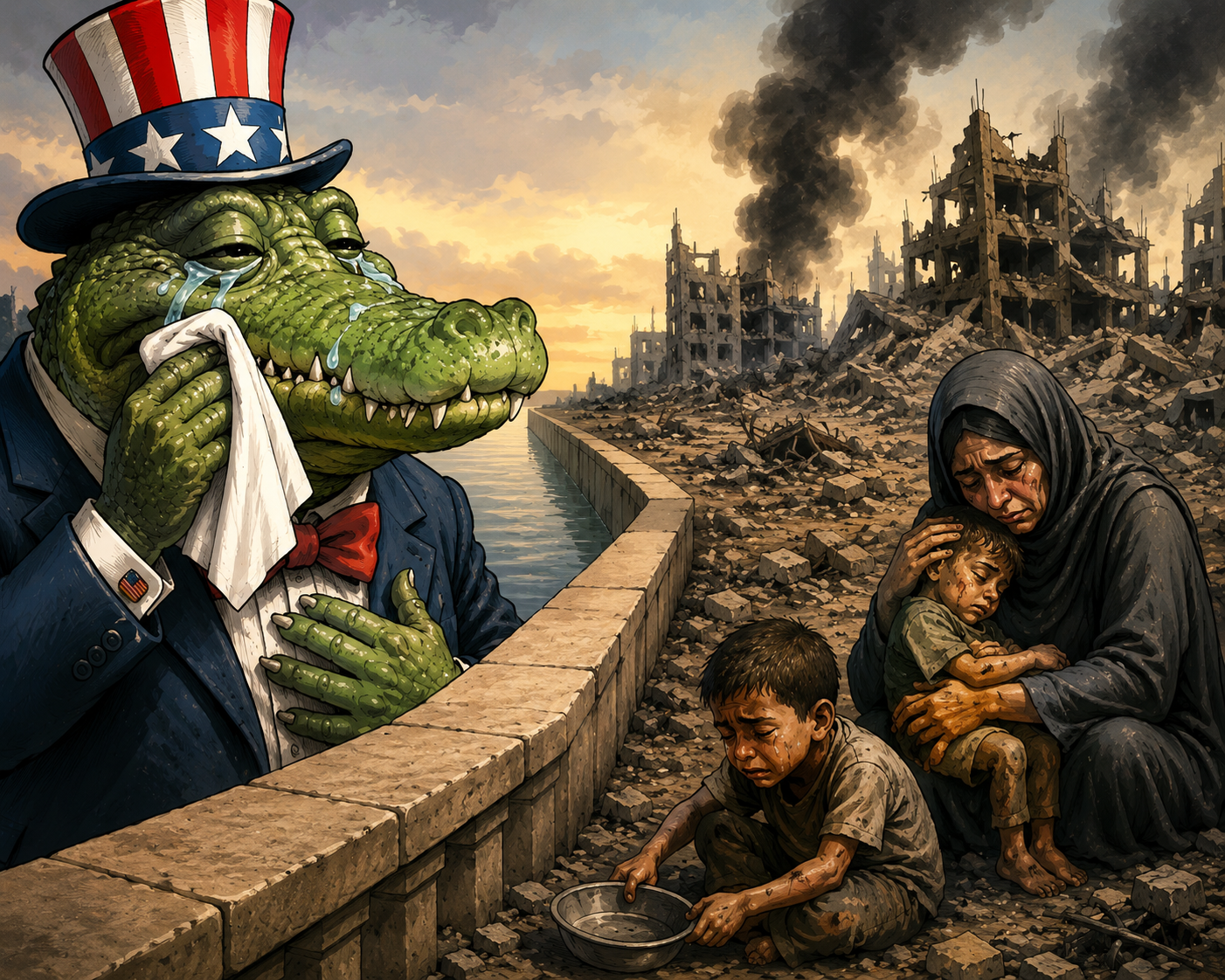
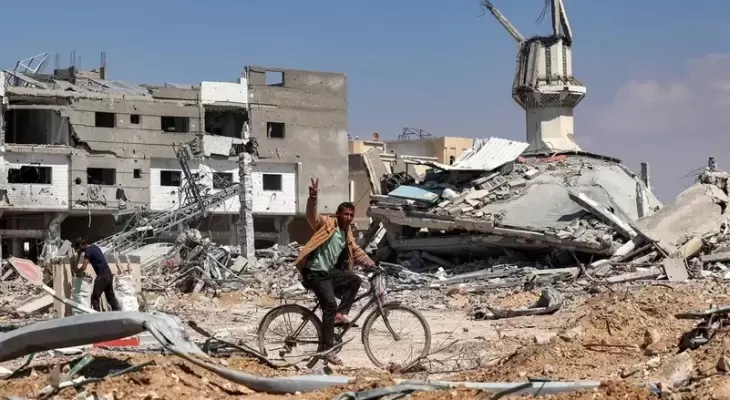
More than a century later, US President Donald Trump expressed similar attitudes during his meeting on Feb. 4, with the Israeli prime minister and indicted war criminal Benjamin Netanyahu, when he said: “We will take over the Gaza Strip, will own it long-term and will redevelop it … I do see a long-term ownership position.” In a settler-colonialist spirit, Trump callously continued, “I don’t think people should be going back to Gaza. I think that Gaza is not a place for people to be living.” He neglected to mention, of course, the exception for Jewish settlers in prime real estate along the Gaza beach. He then added, “They’re living in hell,” without any hint of irony, considering the 15-month US-sponsored genocide, supported by funds, bombs, and diplomatic protection.

Strategic agenda and regional dynamics

There were many items on the agenda between Trump and Netanyahu, including Iran’s nuclear program, the future of Gaza and the West Bank, and normalization with Saudi Arabia.

To be sure, Trump was not an unknown quantity. In his first term, he demonstrated total hostility towards the Palestinians and embraced the most radical positions espoused by extremist Zionists. These included recognizing Jerusalem as Israel’s capital and relocating the US Embassy there, the annexation of the Syrian Golan Heights (occupied by Israel since 1967), the closure of the Palestine Liberation Organization (PLO) office in Washington, DC, ending all humanitarian aid to the Palestinians through the UN refugee agency (UNRWA) or US agencies, and integrating Israel within US Central Command (CENTCOM), the US military command responsible for a region stretching from Egypt to Afghanistan.

Furthermore, throughout his presidency Trump completely disregarded the so-called two-state solution — a long-touted US goal — in favor of Netanyahu’s approach of normalizing relations with Washington’s Arab client regimes while pursuing an aggressive settlement expansion policy intended to establish a de facto Greater Israel. In effect, it appears that “Trump 2.0” is trying, in his own way, to fulfill his promises of securing a greater Israel for his right-wing Zionist donors [1], benefactors [2] and appointees [3]. The proposal to forcefully remove over 2 million Palestinians from Gaza does not appear serious or achievable, since the Palestinians will never cooperate in their own displacement, nor would neighboring countries be willing to support a dangerous plan that would destabilize the region. In the past, Trump proposed similar hyperbolic ideas that failed to materialize, including his calls [4] for constructing a Riviera on the beaches of North Korea.

Netanyahu came to the White House with several objectives in mind. He sought Trump’s support to continue his war of extermination in Gaza after freeing many Israeli captives at the end of the first stage of the ceasefire deal. His political allies pressured him to resume the war in order to achieve his elusive objective of dislodging Hamas and eradicating the resistance — an aim he has not accomplished during the 15-month onslaught. It would appear that Trump wants to achieve this goal using political means through his outrageous proposal rather than through military pressure. If that is the case, this would be Trump’s way of handing Netanyahu the fig leaf he needs to silence his hard right critics and conclude the second stage of the ceasefire deal.

On Iran, Trump has doubled down on his policy of applying extreme pressure through economic sanctions in order to get the Iranians to negotiate a deal on their nuclear program. In return, the Iranian Foreign Minister Abbas Araghchi has called [5] for “maximum wisdom” to be applied to relations between Washington and Tehran, instead of the “maximum pressure” policy Trump has espoused. Since these are the early stages of diplomatic maneuverings, it’s very doubtful that Netanyahu received a green light from Trump to use military strikes against Iran in the near term.

On the West Bank, the Zionist regime has been escalating its aggressive settlement policy as well as its unprecedented attacks on several Palestinian cities, particularly against refugee camps in Jenin, Nablus, Tobas and Tulkarem.

Towards a Saudi-Israeli accord and its fallout

In the past, Trump and many of his administration officials, such as the new US ambassador to the Zionist regime, Mike Huckabee, have endorsed the expansion of Israeli settlements and the calls for annexing large parts of the West Bank. But backing such a policy now will certainly impede the central piece of Trump’s main objective in the region, which is to conclude a normalization deal with Saudi Arabia. To negotiate a deal with the Saudis, Trump must rein in Netanyahu and his extremist allies by promising them what they desire most: a Gaza free not only of Hamas’ rule but also of Palestinians, as well as the annexation of a large part of the West Bank, in exchange for a normalization deal with the Saudis and possibly beyond.

The Israelis certainly know that they will not get the Palestinians to leave voluntarily when they could not compel them to do that through their genocidal war. They recognize that they cannot unilaterally annex parts of the West Bank before the normalization deal with the Saudis is concluded. They also know that Trump has a very long agenda, both domestically and internationally, particularly with regard to the Ukraine war and China, and will not allow a devastating war with Iran to disrupt his agenda. Once the fog of the visit clears, it will become apparent that Trump’s primary policy in the Middle East is to cement a Saudi-Israeli agreement, one that cannot be finalized without putting a hold on other contentious issues such as a military escalation with Iran, West Bank annexation, or the resumption of the Gaza genocide. But that does not mean that the Zionist regime and its supporters within the Trump administration will not push hard to achieve all their objectives in Gaza, the West Bank and against Iran. Regardless, the Palestinians and their supporters worldwide must be vigilant to resist and defeat all their nefarious plans, particularly in Gaza, the West Bank, as well as any plans to integrate a genocidal regime in the region.

People across the Middle East have witnessed the true colors of the Zionist regime. Achieving a normalization deal with the Saudis or any other party would require nothing less than the total erasure of their collective memory. It would appear that the main lesson of the Oct. 7 attacks has not been learned. They took place at a time when regional and international actors had all but buried the Palestinian cause and ignored the plight of the Palestinians in pursuit of their own interests. Not only will none of the policies advanced by Trump address these issues, but they will exacerbate them. And thus, like his forgotten deal of the century, these policies are doomed to fail.

[1] https://www.nytimes.com/2024/06/25/us/politics/miriam-adelson-trump-israel.html

[2] https://www.thejc.com/news/usa/from-jared-kushner-to-miriam-adelson-meet-the-jewish-figures-in-trumps-inner-circle-sllz2ky1

[3] https://www.palestinechronicle.com/from-stefanik-to-hucabee-donald-trumps-cabinet-is-a-pro-israel-swamp/

[4] https://www.youtube.com/watch?v=P-iTikGb-CY

[5] https://www.thenationalnews.com/news/mena/2025/02/06/irans-foreign-minister-calls-for-maximum-wisdom-in-response-to-trumps-maximum-pressure-tehran-policy/

Dr Sami Al Arian is public affairs professor and the director of the Center for Islam and Global Affairs at Sabahattin Zaim University in Istanbul.

CrossFireArabia

CrossFireArabia
Dr. Marwan Asmar holds a PhD from Leeds University and is a freelance writer specializing on the Middle East. He has worked as a journalist since the early 1990s in Jordan and the Gulf countries, and been widely published, including at Albawaba, Gulf News, Al Ghad, World Press Review and others.

Related Posts

The US General Who Swallowed His Own Truth

By Jassem Al-Azzawi

General Dan Kaine, Chairman of the Joint Chiefs of Staff, delivered a confidential warning to President Trump with the utmost candor—the kind of candor that democracies rely on and empires routinely ignore. He said: “We don’t have enough ammunition to win this war. It’s not going to be pretty.” This warning wasn’t born of cowardice; it was the last vestige of institutional integrity that still flickers within the halls of American military power.

Trump’s response was that of a circus clown, not a commander-in-chief. Through his “Truth Social” platform—that distorted mirror of American political life—he dismissed the warning with the arrogance of a street vendor, saying: “Oh, no, no, no. If we do it, we’ll win easily.” Thus, a sober assessment became mere publicity, and caution a lie.

But the biggest lie came later. When Kaine’s warning leaked, Trump not only rejected it but completely reversed it. With the confidence of a man who has never been held accountable for anything, he told the American public the general had said the exact opposite—that the United States had plenty of missiles, munitions, and everything else. “That’s not what he said at all,” Trump declared, putting words of false victory in the mouth of a man who had offered only warnings.

And General Cain remained silent

This silence is not just a footnote in this story; it is the story itself. By remaining silent, Cain allowed the American public to absorb the falsehood as truth. He did not say: “No, Mr. President, that’s not what I said.” He did not invoke his oath, nor the soldiers who would pay with their lives for the gap between political rhetoric and logistical reality. He chose the safety of silence over the danger of truth, and in doing so, he betrayed not only himself but the Republic. This is the rot at the heart of American militarism.

As historian Andrew Bacevich has long warned, the professional military has become more of an instrument of imperial ambition than a defender of democratic values, with senior officers more concerned with their next post than with the Constitution they swore to uphold. Kaine’s silence was not a mere slip of the tongue; it was a symptom of a deeper malaise.

The logistical picture Kaine described in private was not theoretical; the calculations were unforgiving.

Current stockpiles of interceptor missiles and precision munitions could not sustain a prolonged air campaign against a country three times the size of Iraq. The Wall Street Journal documented a “worrying gap” in U.S. missile stockpiles, noting that reserves were “far below” the requirements of intensive and sustained operations. Pentagon contractors were instructed to “double or even quadruple” production of Patriot, SM-6, and precision-strike missiles—a tacit admission that the arsenal built for Cold War scenarios is inadequate for the war being fought today.

Consider Gaza: Israel, the most heavily armed military power in the Middle East, with complete air and naval dominance, has turned a tiny coastal strip into a moon-like landscape of devastation over two and a half years, yet it has not broken Hamas. Gaza is only 37 kilometers long. Iran, on the other hand, is a nation of 90 million people, with mountainous terrain, strategic depth, fortified infrastructure, and a combat-hardened Revolutionary Guard. The idea that it will collapse under a few weeks of American airstrikes is not strategy; it is wishful thinking. “God help us if this continues, if it gets to four weeks,” Colonel Daniel Davis warned on the Deep Dive podcast. He was speaking in military terms, and the same prayer applies. Politically.

When Trump now raises the prospect of sending ground troops, he is not escalating from a position of strength, but rather improvising from a position of denial. Admitting that air power and missiles alone cannot achieve the political objective is an admission that the original objective was never honestly assessed. This is the pattern of American wars at the end of an empire: Glittering promises, disastrous calculations, and then a grim and horrific reckoning paid in blood by those who had no seat at the table where the lies were told.


The costs are already piling up—not just in the currency of munitions and riches, but in the currency that empires always ultimately spend and regret most: credibility. America’s word, already devalued by two decades of contrived justifications for war, is getting cheaper by the day.

Democracies can tolerate miscalculations, and they can tolerate bad presidents, but what they cannot long tolerate is the institutionalization of a culture where the truth is whispered behind closed doors and swallowed whole in front of cameras. When the chairman of the Joint Chiefs of Staff allows his words to be weaponized for propaganda — when the man in charge of counting missiles refuses to correct a president who pretends they are plentiful — something far greater than military credibility collapses.

What is crumbling is the social contract between the governed and those who send them to their deaths.

Caine’s silence was not cautious; it was complicity. And in an imperial machine suffering from a shortage of ammunition and a shortage of truth, complicity is the only resource that seems inexhaustible, because when the missiles finally run out, slogans won’t replace them.

Reality will.

Al-Azzawi is an Iraqi writer who contributed this piece to Al Rai Al Youm which was translated and appeared in crossfire.com

Continue reading
‘They Don’t Know Iran’s Military Lexicon’: First Six Days of The Aggression

By Abdul Bari Atwan


They truly don’t know Iran. By this, I mean the Israelis and the US, and even some Arab leaders, none of whom dared to condemn the aggression. But the aggression entered its sixth day without the regime falling, and/or the new interim leadership rushing to the nearest negotiating table to surrender. The following factors need to be considered.

The battlefields:

First: The downing of an advanced American fighter jet, the F-15, by Iranian missiles in the west of Iran, a firstever development. This suggests the Iranian military leadership may have developed new missiles capable of achieving this feat, or they acquired them from their Chinese and Russian allies, or both, particularly the Russian S-400 and S-500 missile systems.

Second: The entry of Hezbollah’s ballistic missiles into the arena, striking deep inside Israel, specifically Tel Aviv and Haifa, for the first time after 15 months of restraint and the rebuilding of its military arsenal, and/or what was destroyed during the Israeli aggression. This means that no area in the Zionist entity will be safe.

Third: The fiery speech delivered by Sheikh Naim Qassem, Secretary-General of Hezbollah, containing strong unprecedented tone statements most notably: “We will not surrender and we will defend our land, no matter the sacrifices and despite the disparity in capabilities. We will not surrender.”

Fourth: The introduction of the fastest “infiltrating” drone into the Iranian Air Force for the first time. Named “Hadid 110,” it has a speed of 517 km/h and, according to Western military experts, is considered more efficient than its sister drone, “Shahed,” which performed well deep inside Israel. Its production costs only $35,000, while shooting it down costs $4 million.

Fifth: Every day of resistance by the Iranian army and people costs the occupying state approximately $1 billion. As for America, the costs of the war has already nearly spiralled to $160 billion in the first six days. These preliminary estimates are likely to rise, especially after the bombing of aircraft carriers and the destruction of warships, the increasing number of dead and wounded, the largest military buildup since the Iraq War, and the rise in energy prices.

Sixth: The fulfillment of the promise to close the Strait of Hormuz, which means delivering two fatal blows. The first is to the Western economy because oil and gas prices would likely reach record-breaking figures, and the second, for the Arab states who host the US military bases. Closing the Strait means preventing their oil and gas exports from reaching global markets, and the losses will increase while oil and gas revenues decrease depending on the war’s duration and developments.

The Iranians wanted from the outset a regional war of attrition with no end in sight in direct opposite to the new American warefare military doctrine, which aims for short, swift, and clean wars (without American casualties). The Iranians resolved to bomb all those cooperating with the aggression in the region. This new Iranian theory was best and most clearly expressed by Sheikh Naim Qassem when he called on the Israeli army to prepare for many days of fighting with all available means.

Defeat, surrender, and raising the white flag, individually or collectively, have no place in the Iranian military and political lexicon. In the first six days, the Iranian army launched 500 hypersonic missiles with multiple cluster warheads and more than 2,000 drones, resulting in the displacement of more than 7 million settlers to shelters and tunnels, and the destruction of large parts of Tel Aviv and Haifa.

Neither the 47-year-long starvation siege, nor three Israeli-American aggressions within a few years, nor the incitement of popular protests and the planting of spies among the protesters, nor the deployment of aircraft carriers and warships, nor inflation and the collapse of the national currency, succeeded in defeating the mighty and unwavering Iranian will, and consequently, in toppling or changing the regime.

Our proof is they baffled the Americans in negotiations that lasted more than two years in Vienna and in several other Arab and European capitals, and they never conceded. They rejected all American conditions, starting with halting enrichment and handing over 460 kilograms of highly enriched uranium, and even refusing to allow the inclusion of the Iranian missile industry or severing ties with resistance factions on the negotiating table.

Yes, arrogance, conceit, and the unfortunate complicity of some Arabs blinded them to the true nature of Iran, and they will pay a very heavy price, the most prominent feature of which will be the destruction of all Israeli gas infrastructure. In the Mediterranean, water and electricity stations, and the lack of distinction between settler and soldier, many assumptions have changed after the massacre of the children’s school in southern Iran… and time will tell.

This opinion was written in Arabic by the chief editor of Alrai Al Youm Abdul Bari Atwan and translated for crossfirearabia.com

Continue reading

You Missed

IRGC says Iran started its Operation True Promise 26 by launching missiles and drones against Israel

IRGC says Iran started its Operation True Promise  26 by launching missiles and drones against Israel

Iran Halts Attacks on Neighboring States Unless…

Iran Halts Attacks on Neighboring States Unless…

Iranian govt spokesman: 30% of victims are children; 165 of them killed among 1300 civilians who died by US/Israeli bombing

Iranian govt spokesman: 30% of victims are children; 165 of them killed among 1300 civilians who died by US/Israeli bombing

White House: ‘We destroyed more than 30 Iranian ships and are moving to destroying the navy completely’

White House: ‘We destroyed more than 30 Iranian ships and are moving to destroying the navy completely’

White House: ‘We Have 4 to 6 Weeks to End The Military Operations in Iran’

White House: ‘We Have 4 to 6 Weeks to End The Military Operations in Iran’

IRGC: Iran Has Not Closed The Hormuz Strait Except to Ships Linked to Israel/USA

IRGC: Iran Has Not Closed The Hormuz Strait Except to Ships Linked to Israel/USA