Oslo: Strangling The Dove

By Dr Khairi Janbek

When we do a recap of the Oslo Agreements, they were a series of accords between Israel and the PLO signed in 1993. It was a process meant to lead to a permanent settlement of the Palestinian-Israeli conflict within five year, including decisions on borders, refugees, security, Jerusalem and settlements.

But right from the start, voices were divided over the process, while for others, the whole idea had a built-in mechanism for failure from the start. The Palestinians started seeing that the Oslo Agreements were neither ending the establishment of Israeli settlements nor the end to occupation, while for the Israelis it didn’t seem to end their security concerns.

Indeed, it is pointless to think which comes first, the chicken or the egg, because two different fears and logistics persisted from the start.  But also, it is important to think about the circumstances which brought about the idea of launching the process, and which did put the PLO in a tough position for being perceived as supporting the wrong side which lost; Iraq.

The room for manoeuvre for the late Yasser Arafat was very tight as he stood to lose the legitimacy of the PLO.

What one is trying to say is that, right from the start, outside official circles, many on the Palestinian side were against Oslo probably as many as was the case on the Israeli side.

The gradual erosion of Oslo mainly through the continued Israeli actions kept feeding extremism on both sides.  Nevertheless, the concept was not revoked by any Israeli government because of its effect on Arab public opinion, pressure which is likely to block any peace initiative. Moreover, the international atmosphere was not conducive for such an initiative.

Having said that, one cannot claim that the international atmosphere is currently more indifferent to the abrogation of the Oslo, rather Israel seems to have more leeway in undertaking unilateral actions with more impunity.

Of course, it is not international law that can be counted on in this respect but rather, at least for the time being Donald Trump’s disapproval of the idea of annexing the West Bank by Israel. This is despite the fact that all the Israeli actions of dividing the West Bank from north to south first and currently from west to east, goes unnoticed. But the important thing has been till now, and don’t say the magic word, end of Oslo.

However, the recent development is that Israeli political parties, the partners in Netanyahu’s government are all pushing openly, for the abrogation of the Oslo agreements and cancelling out all the Israeli obligations towards it.

One can only say such an open declaration is a matter of principle by the Israeli government, because the changes on the ground are there for all to see. One supposes all parties are playing for time to see the end of the Palestinian national aspirations.

The columnist is a Jordanian writer based in Paris, France

Continue reading
Middle East Psychosis

By Dr Khairi Janbek

As far as one is concerned, the Middle East has been for a long time a matter of balance of power overlapping with strategic reluctance to change its status quo. But the advent of US President Donald Trump is ushering a new era with all sorts of possibilities.

On the microcosm level for instance, Arafat’s Fateh movement in the PLO was checked in a formula of a balance of power by the leftists organizations as well as the Palestinian organizations sponsored by some Arab countries, the affiliation of all in the PLO created the sense of a balance of power.

However, with the emergance of the PNA and the affiliation of the Palestinian groups in it, albeit with variable influence, created a unit which under the balance of power notion, necessitated the creation of a check and balance on its power.

Consequently Hamas was created, and what seemingly appeared as contradiction between them, turned out to be a symbiotic relationship between them. Now, one cannot say with certainity what will happen next, however, if the objective is to maintain the balance of power by just weakening Hamas, this will require symbiotically weakening the PNA as well, but if the objective is to eleminate Hamas, the next step will be to eleminate the PNA.

As for the macro level, and as one often repeats, the Middle East, has at least for the last five decades was strategically governed by the famous triangle, Iran-Israel-Turkey, with the Arab world having little say in their own affairs , if at all.

However, since the fall of the Shah regime in Iran, the search started for a third angle to replace Iran in governing the Middle East, considering the open hostility of Iran towards West. Consequently some Arab countries jumped into the frey as possible candidates, like Egypt, then Qatar, UAE and Saudi Arabia. But as it seems, a preference for the old triangle was decided upon by the world powers, accepting the inconvenience of having to negotiate with Iran.

Now, we can see a new development that breaks the taboo of the old balance of power in the region.

Starting mid-way from the Biden administration, and with the start of the second Trump administration, the notion of balance of power by the usual triangle has turned into a balance of aggressiveness in the region, as Israel and Iran “bombard” each other, Turkey’s involvement in toppling Assad, and now the distinct possibility of confrontation with Israel in Syria, while being threatened itself by Iran if it cooperates in any possible American attack on Persia. Thus the stability which this triangle had sustained itself, is no more.

From appearances, at least how things look like: It seems Israel is being supported by Trump explicitly and by many other international parties implicitly, to be either the major power that has a say in Middle Eastern affairs. This means that Iran’s grip on the region will be curtailed through negotiations at least if not war; and here the symbiotic issue appears again, with Turkey’s role curtailed through pressures and/or and economic threats.

Here, as well, the aim is to designate Israel as only point of compass on the map of the Middle East, which Arabs are expected to flock to and normalise with.

In this case events will inevitably take a nasty symbiotic turn, meaning Iran will have to be attacked and taken out altogether with its surrogates from the power relations of the Middle East, and Turkey forced to take a more insular step from the affairs of the region, even with a regime change if required.

But we will have to wait and see what lies in store!

Dr Janbek is a Jordanian writer based in Paris, France.

Continue reading
In a Psychedelic Arab World

Dr Khairi Janbek

The Arab world has been for some time now like a theme park with all the trappings. There are zones of fun and entertainment, with bright lights, cafes and restaurants with people living in them whilst other zones stand like halls of mirrors with distort images, chambers of horror, and ghost trains with their own population.

The ones who run both zones tend to be standing outside them frequently greeting each other. But the people of the entertainment zone are always wary that the people of the other zone may envy them, so they give them enough to let them carry on with their lives as best as they can.

The obsession with the geographical and civilizational unity of the Arab world has always inflated expectations of Arab solidarity as a tool to solve the problems of Arab societies ranging from economic development and good governance, to conflict resolution.

As the expectations go unmet, popular frustration at the weakness of one nation, prompt further calls for solidarity accompanied with anger from the other Arab people, however, it seems, and for all intents and purposes, the pan-Arab hopes seem to be always unreasonable. In fact when the colonialists thought that the Arab peoples should be grateful to each have their own nation-states across the geographical span, the Arab peoples, as a whole, felt cheated for not having a single, one-state to represent them.

As for the current Palestinian tragedy, its roots in recent terms have been planted in 1974, when the late King Hussein was put under extreme pressure to accept the notion that, the PLO, being the sole representative of the Palestinian people, in other words transferring the Arab burden of the Palestinian problem to the shoulders of the late Yasser Arafat.

Of course, one is not going to repeat the horrors which came after that regarding this issue, but the idea that the Palestinian issue being an Arab cause, ended there and then. The Palestinian issue went from being a political issue, to a mere human rights concern, with the option for the Arab states to support according to the levels of anger expressed by their own populace regarding the Palestinian people’s plight.

It was Saddam Hussein’s invasion of Kuwait in 1990 that struck the final nail in the coffin of the illusion that there can be an Arab solution to Arab problems, but even this illusion did not apply to the Palestinian problem, because that concern was gone almost two decades earlier.

So today, it is natural for sympathy for the Palestinians to direct its call to the international community to react, because frankly this is the only quarter which can do something, whatever it may be, because the realization had set in from before that the Arabs will not do anything.

We live in times now, in which no Middle Eastern regime, in addition to those having a state within a state inside them, will be ever permitted to ever threaten Israel by the Trump administration, be that through the threats of dividing countries, or in throwing them to the jaws of poverty and destruction through economic extortion; in fact, we are in the era of enforced ugly peace.

Dr Janbek is a columnist based in Paris France.

Continue reading
Trump, Gaza and The New Political Ploy


Dr Sami Al-Arian

The infamous 19th-century imperialist and racial supremacist, Cecil Rhodes, once remarked: “It is our duty to seize every opportunity to acquire more territory and we should keep this one idea steadily before our eyes that more territory simply means more of the Anglo-Saxon race.” He then added: “Just fancy those parts that are at present inhabited by the most despicable specimens of human beings, what an alteration there would be if they were brought under Anglo-Saxon influence.”

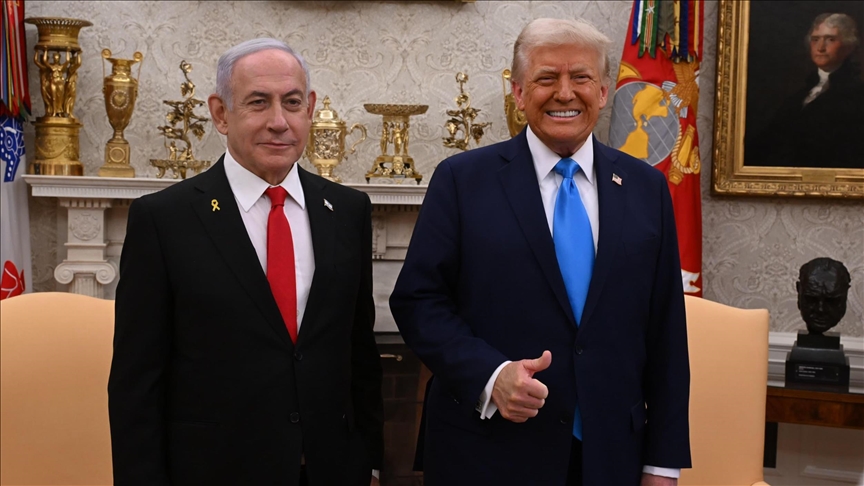
More than a century later, US President Donald Trump expressed similar attitudes during his meeting on Feb. 4, with the Israeli prime minister and indicted war criminal Benjamin Netanyahu, when he said: “We will take over the Gaza Strip, will own it long-term and will redevelop it … I do see a long-term ownership position.” In a settler-colonialist spirit, Trump callously continued, “I don’t think people should be going back to Gaza. I think that Gaza is not a place for people to be living.” He neglected to mention, of course, the exception for Jewish settlers in prime real estate along the Gaza beach. He then added, “They’re living in hell,” without any hint of irony, considering the 15-month US-sponsored genocide, supported by funds, bombs, and diplomatic protection.

Strategic agenda and regional dynamics

There were many items on the agenda between Trump and Netanyahu, including Iran’s nuclear program, the future of Gaza and the West Bank, and normalization with Saudi Arabia.

To be sure, Trump was not an unknown quantity. In his first term, he demonstrated total hostility towards the Palestinians and embraced the most radical positions espoused by extremist Zionists. These included recognizing Jerusalem as Israel’s capital and relocating the US Embassy there, the annexation of the Syrian Golan Heights (occupied by Israel since 1967), the closure of the Palestine Liberation Organization (PLO) office in Washington, DC, ending all humanitarian aid to the Palestinians through the UN refugee agency (UNRWA) or US agencies, and integrating Israel within US Central Command (CENTCOM), the US military command responsible for a region stretching from Egypt to Afghanistan.

Furthermore, throughout his presidency Trump completely disregarded the so-called two-state solution — a long-touted US goal — in favor of Netanyahu’s approach of normalizing relations with Washington’s Arab client regimes while pursuing an aggressive settlement expansion policy intended to establish a de facto Greater Israel. In effect, it appears that “Trump 2.0” is trying, in his own way, to fulfill his promises of securing a greater Israel for his right-wing Zionist donors [1], benefactors [2] and appointees [3]. The proposal to forcefully remove over 2 million Palestinians from Gaza does not appear serious or achievable, since the Palestinians will never cooperate in their own displacement, nor would neighboring countries be willing to support a dangerous plan that would destabilize the region. In the past, Trump proposed similar hyperbolic ideas that failed to materialize, including his calls [4] for constructing a Riviera on the beaches of North Korea.

Netanyahu came to the White House with several objectives in mind. He sought Trump’s support to continue his war of extermination in Gaza after freeing many Israeli captives at the end of the first stage of the ceasefire deal. His political allies pressured him to resume the war in order to achieve his elusive objective of dislodging Hamas and eradicating the resistance — an aim he has not accomplished during the 15-month onslaught. It would appear that Trump wants to achieve this goal using political means through his outrageous proposal rather than through military pressure. If that is the case, this would be Trump’s way of handing Netanyahu the fig leaf he needs to silence his hard right critics and conclude the second stage of the ceasefire deal.

On Iran, Trump has doubled down on his policy of applying extreme pressure through economic sanctions in order to get the Iranians to negotiate a deal on their nuclear program. In return, the Iranian Foreign Minister Abbas Araghchi has called [5] for “maximum wisdom” to be applied to relations between Washington and Tehran, instead of the “maximum pressure” policy Trump has espoused. Since these are the early stages of diplomatic maneuverings, it’s very doubtful that Netanyahu received a green light from Trump to use military strikes against Iran in the near term.

On the West Bank, the Zionist regime has been escalating its aggressive settlement policy as well as its unprecedented attacks on several Palestinian cities, particularly against refugee camps in Jenin, Nablus, Tobas and Tulkarem.

Towards a Saudi-Israeli accord and its fallout

In the past, Trump and many of his administration officials, such as the new US ambassador to the Zionist regime, Mike Huckabee, have endorsed the expansion of Israeli settlements and the calls for annexing large parts of the West Bank. But backing such a policy now will certainly impede the central piece of Trump’s main objective in the region, which is to conclude a normalization deal with Saudi Arabia. To negotiate a deal with the Saudis, Trump must rein in Netanyahu and his extremist allies by promising them what they desire most: a Gaza free not only of Hamas’ rule but also of Palestinians, as well as the annexation of a large part of the West Bank, in exchange for a normalization deal with the Saudis and possibly beyond.

The Israelis certainly know that they will not get the Palestinians to leave voluntarily when they could not compel them to do that through their genocidal war. They recognize that they cannot unilaterally annex parts of the West Bank before the normalization deal with the Saudis is concluded. They also know that Trump has a very long agenda, both domestically and internationally, particularly with regard to the Ukraine war and China, and will not allow a devastating war with Iran to disrupt his agenda. Once the fog of the visit clears, it will become apparent that Trump’s primary policy in the Middle East is to cement a Saudi-Israeli agreement, one that cannot be finalized without putting a hold on other contentious issues such as a military escalation with Iran, West Bank annexation, or the resumption of the Gaza genocide. But that does not mean that the Zionist regime and its supporters within the Trump administration will not push hard to achieve all their objectives in Gaza, the West Bank and against Iran. Regardless, the Palestinians and their supporters worldwide must be vigilant to resist and defeat all their nefarious plans, particularly in Gaza, the West Bank, as well as any plans to integrate a genocidal regime in the region.

People across the Middle East have witnessed the true colors of the Zionist regime. Achieving a normalization deal with the Saudis or any other party would require nothing less than the total erasure of their collective memory. It would appear that the main lesson of the Oct. 7 attacks has not been learned. They took place at a time when regional and international actors had all but buried the Palestinian cause and ignored the plight of the Palestinians in pursuit of their own interests. Not only will none of the policies advanced by Trump address these issues, but they will exacerbate them. And thus, like his forgotten deal of the century, these policies are doomed to fail.

[1] https://www.nytimes.com/2024/06/25/us/politics/miriam-adelson-trump-israel.html

[2] https://www.thejc.com/news/usa/from-jared-kushner-to-miriam-adelson-meet-the-jewish-figures-in-trumps-inner-circle-sllz2ky1

[3] https://www.palestinechronicle.com/from-stefanik-to-hucabee-donald-trumps-cabinet-is-a-pro-israel-swamp/

[4] https://www.youtube.com/watch?v=P-iTikGb-CY

[5] https://www.thenationalnews.com/news/mena/2025/02/06/irans-foreign-minister-calls-for-maximum-wisdom-in-response-to-trumps-maximum-pressure-tehran-policy/

Dr Sami Al Arian is public affairs professor and the director of the Center for Islam and Global Affairs at Sabahattin Zaim University in Istanbul.

Continue reading
Oslo Accords, Old Memories

By Dr Khairi Janbek

When the Oslo Accords was signed, the greatest achievement was seen as being, the breakthrough in the impasse of mutual recognition between the PLO and Israel. They both recognized each other’s right to exist, and that was all about it.  Of course everyone knew then as much as now, that crucial issues were not addressed, but the whole picture was: Israelis and Palestinians will no longer kill each other.

As for how to proceed in order to establish a two-state solution from there on was left to the future to take its own course without any hint even at the end of the five-year transitional period when there was supposed to a be  sovereign Palestinian state. From then on it was a matter of illusions; Palestinian illusions as well as Israeli illusions.

For the PLO, the hope was that by accepting 22% of the Palestinian lands and relinquishing the right on the rest of the territories, a Palestinian state can be built with parts of East Jerusalem as its capital, while for the Israelis, a Palestinian “ bantustan” governed by the PLO, dependent on Israel with limited ‘petro-dolar’ support was the limit.

But who came out to make a name for himself right from the start as the fierce opponent of Oslo; it was of course Mr Benjamin Netanyahu.  Was his opposition taken seriously, indeed it was, but all hopes were pinned on US support to keep the situation stagnant in the format of a no Palestinian state but also no Israeli re-occupation.

However, this stagnation is brought in back today as Oslo came to end by the Palestinians and Israelis effectively killing each other and a situation of non-contextual relevance to the once seen as a historical agreement.  Indeed, when the guns spill death, words tend to be superfluous, but ultimately the guns will stop and the words will start flowing again with the Oslo Accords consigned to the shelves of history.

What would all this mean in a US election year it is hard to say, and even harder to predict. How would the future occupant of the White House call the shots in the Middle East, given the fact, and forgive the cliche, the region is indeed on the brink of a big war.

Will there be a new pressure from the US for a new wider peace accord between the Arabs and the Israelis that can guarantee within it at least, the minimum of Palestinian rights, or a semblance of an accord forced on the wreckage of a post big regional war, for which the winner gets the spoils? It is a hard to tell, but it won’t take too long to find out.

Dr Khairi Janbek is a Jordanian writer based in Paris and the above opinion is that of the author and doesn’t reflect crossfirearabia.com.

Continue reading