When The Knights Start Falling: A View From Amman

By Saleem Ayoub Quna

Five years after his controversial disappearance from his cell in a Miami prison, Jeffry Epstein’s infamous legacy, remerges in unexpected ways and places.

His ex-clients, associates and “victims” are, one after the other, involuntarily, coming back to center stage, in no less embarrassing circumstances, than the ones they were, voluntarily, involved in in the first, hush-hush, part of this unfolding drama.

The released three million pages, certainly, harbor much more details about Epstein’s clandestine part of his empire, which he started in the late 1980s, and lasted for nearly three decades, than anyone could have anticipated, when Epstein was announced dead in 2019.   

Potentially, it would take life-time assignment for brigades of investigators and researchers to turn every stone out of this huge pyramid of documents, i.e. more stunning information should be expected, more names of celebrities and heads of states could be queuing to be unmasked.

One of the most intriguing pieces of information revealed so far, yet not conclusively, is the one related to former Israeli Prime Minister, Ehud Barak’s connection with Epstein.

While it is widely believed that Epstein was originally recruited by Israeli intelligence services the ‘Mossad’, to build this international web of contacts for reasons that are familiar to all, it is not clear why among other present or ex-Israeli officials, Ehud Barak’s name would pop out in the way it did!  

When asked about it, Ehud Barak, admitted that he had good relations with Epstein that lasted for the period of 15 years, during which Epstein had hosted him in his Manhattan private residence on many occasions!  

The question here is who, among these two men, was using the other? Or who was working for the other and being paid by him? Or was it that kind of swapping stuff, whose value could not be translated into cash, considering that Barak was not a playboy!

Then, other big names came out such as Bill Gates, Bill Clinton, Donald Trump and many other VIPs, who all expressed their regret to have known or been associated with Epstein! Why any one of them did not do that, the “expression of regret”, five years ago when Epstein died? Or did they think or hope that their, behind the doors, relationships with Epstein would be buried, simultaneously, with the burial of Epstein’s body?  

But there are other big names that were associated with Epstein who, seemingly, did not have neither the time nor the will to express their regret to have known Epstein. A group of VIPs, whom I would like to nickname the “Knights” of a very special order; knights of hot nights who willingly fell into the well-orchestrated silk traps weaved by Epstein’s establishment. Instead they found themselves, practically, paying dear for their friendship with him. 

One of the most prominent knights is no other than ex-Prince of the British throne, Andrew Mountbatten who certainly was a big fish caught in Epstein’s net. He, the ex-prince, also knew how to keep his mouth shut for 5 years. But now and after his royal title and embarrassing pictures popped out, the local British police dared to book him, in broad day light, for preliminary interrogation. His elder brother, the actual King Charles III, had but to consent to the idea that his younger playboy brother should be put on trial for what he did! 

Other high status figures and “knights” who already fell off their, once immune little thrones; include: Jack Lang, the ex-French politician and Head of Arab World Institute in Paris, Peter Mandelson, from the British political establishment, the Labor Party, Mona Juul, a Norwegian ex- Ambassador, Alexander Acosta, the ex-US labor Secretary and lastly Sultan Ahmad bin Suleim, the UAE tycoon businessman.

From this angel the whole thing looks absurd and surreal: When you think how all those big names of movers and shakers of world affaires were united, by their free-will, to fall in the smallest trap hole ever known to mankind?

Saleem Ayoub Quna is a Jordanian author writing on local, regional and international affairs and has two books published. He has a BA in English Literature from Jordan University, a diploma from Paris and an MA from Johns Hopkins University in Washington.       

Continue reading
The Epstein Triangle: A View From Amman

By Saleem Ayoub Quna


Jeffrey Epstein, an Amercan citizen of the 21st century, Persian scholar Abu-Bakr Al-Karaji of the 10th century, Chinese mathematician Jia Xian of the 11th , Yang Hui of the 13th century and lastly, the French philosopher Blaise Pascal of the 17th century, all had something in common! They were all involved, for living, in the business of studying and drawing triangles, with one thematic exception in the case of Epstein! His contribution, in this field, was virtual, simply because the three sides, of his own triangle, were made of politics, money and sex, not lines drawn on paper!


Although, most probably, many entrepreneurs and adventurers preceded Epstein in this “creative” and venturous type of business, no one could have come even close to his status. A status for which he
could have easily won the title: “The epitome architect of the most treacherous triangle in history”!
As for the rest of us humans, and since we found ourselves dwelling on the only inhabitable planet called earth, we have been interacting and often exploiting, one another, on the basis of, precisely, those three sides of the triangle: Politics, money and sex!


But first let’s be elementary about it! Sex is the natural biological mechanism that safeguarded the reproduction of human species and other creatures on earth! Without it, our beautiful planet will be missing its ultimate key component!

Money is the most efficient tool, created by humans, to guarantee a descent life, devoid of hunger, disease and ignorance! Without it, all 8 billion people living on planet earth, would be equally poor and
suffering! While politics is the overall intellectual umbrella that is supposed to take care of the implementation of law and order between people and nations! Without it, we humans would be living like animals in a jungle!


But in Epstein’s smaller world, these three sides of the triangle were mysteriously and intricately intertwined. They may have looked rigid and static in theory, but in reality they were not. They switched roles and rotated position, depending on circumstances. Sometimes, acrobatically, they overlapped each other! That’s why, until this moment, it is impossible to definitely determine which of the three sides come first in life, or which of them is more or less important?


But here is another clue: If life can go on without money or politics as it has been the case for thousands of past-centuries, it could not have continued without sex! But this naturally-born physical urge known as “sex”, has two significant characteristics: Variation in intensity and in style. As for the first characteristic, for both genders, it goes into a peak period in life, then slowly fades away with age. As for style, humans kept being creative!


As time passed, sex again was classified into two categories: Legal and illegal. Both categories have flaws and faults. But the outside of the wedlock relationships are more complicated and controversial, because they come by, either as a “price” to be paid, or as a “prize” to be bestowed by one party to the other. In other words, sex can easily play the double role of a goal or an objective on its own, or that of a means or a vehicle, intermittingly!

Things can get really complicated if and when one of the two parties to the out of wedlock constitution relationships belonged to an underage feminist group! Epstein’s greatest talent was his ability to choose the right time and location when and how to use sex as a “prize” or as a “price” with his selected elite clients, depending on their different tastes, needs and status.


But the intriguing question is this: Was Epstein just another successful and smart businessman who managed to avail special sexual services, to a wealthy willing influential clientele, regardless of their faith, language or nationality, just to make his own fortune, or was he up to something bigger? In other words: Was Epstein an independent free-lancer working for himself to be become richer, or was he commissioned, to do so, by a third party, whose goals and objectives would entail blackmailing and
extortion, for ulterior sinister motivations?


What the millions of released pages have already told us, is more than shocking and have already caused damage and chaos where it broke. What if, what we have seen, so far, is just the tip of a monster iceberg
that is still sleeping in the dark bottom of the ocean?

This opinion was especially written for by Saleem Ayoub Quna who is a Jordanian author writing on local, regional and international affairs and has two books published. He has a BA in English Literature from Jordan University, a diploma from Paris and an MA from Johns Hopkins University in Washington.

Continue reading
Trump’s War Through Politics

By Dr Amani Al-Qarm

About 2,500 years ago, there was a Chinese general named Sun Tzu, renowned for his military genius and unique philosophy on achieving decisive victory. He compiled his vision in a famous book called “The Art of War.” Sun Tzu states in his book that subduing the enemy without fighting is better than winning a hundred battles, and that a skilled commander feeds on his enemies.

This means exploiting the enemy’s resources, weaknesses, and even strengths, striking at their strategy and alliances, and besieging them to achieve victory, rather than relying solely on one’s own resources. In other words, achieving victory at the lowest cost is preferable to destroying a country, and capturing the head of state is better than killing him.

The Trump administration’s slogan, “Peace Through Strength,” is not new to American administrations, but it was perhaps more blatant and explicit during Trump’s presidency, as was the case with everything else under his rule: no embellishment, no lofty phrases, no justifications to appease hypocritical Western arrogance, such as democracy and human rights. There are only declared and clear objectives: oil, minerals, money, and control without cost.

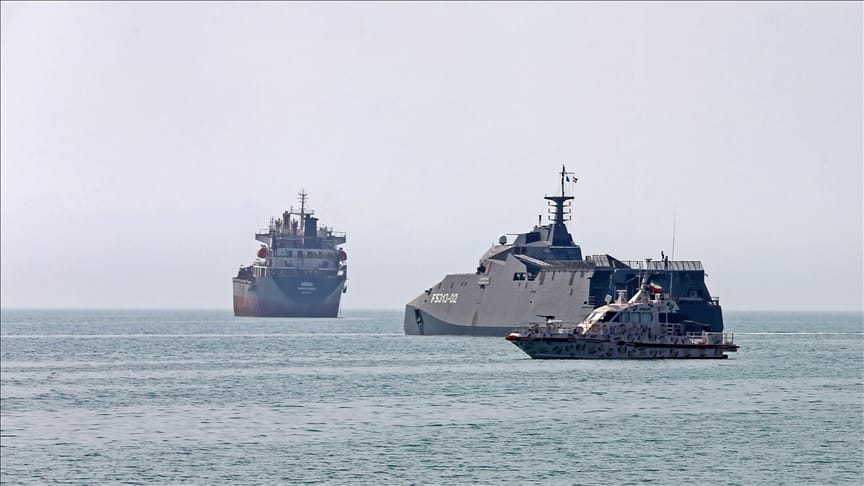
The entire world is watching the current unique American approach to dealing with the Islamic Republic of Iran. Just when the world expected an American strike on Iran, the door was opened for negotiations under the auspices of the massive aircraft carrier USS Lincoln and its destroyers and missiles stationed in the Arabian Sea.

This leaves allies and adversaries alike bewildered and unable to predict the outcome, while Trump maintains the element of surprise and the timing of the strike. It seems that Trump is not content with the slogan “Peace Through Strength” alone, but has added to it some of the principles of General Sun Tzu’s doctrine. Trump Feeds on His Enemies:

Iran is in a state of weakness unprecedented in decades. Internally, the country is seething with poverty and oppression, and the recent protests are unlike any before. Internal affairs are no longer purely domestic; they now carry external costs, given the threats the US president has made against the Iranian regime throughout the past month.

Furthermore, the country is strategically exposed. Its alliances have been shattered, and it and those who deal with it economically and militarily are besieged. The time is ripe to pounce on the prey. And because, as Tzu said, subduing the enemy without cost is better than winning a hundred battles, Trump has opened the door to negotiations to achieve his objectives.

What does Trump want from Iran? Is he negotiating to restore relations between the two countries? Or to liberate the Iranian people? Of course not. He seeks victory without a fight. The collapse of the country as a result of war would transform it into scattered chaos throughout the region, as has already been witnessed in Iraq, Libya, Yemen, and Syria.

Therefore, containing it to the greatest extent possible and completely changing its hostile behavior since 1979 is preferable to destroying it. And to strip it of everything it considers its sources of power: eradicating any nuclear ambitions, eliminating its missile program, and reducing its regional role to the bare minimum, while also constantly reminding it that America is serious and ready to confront it. From America’s perspective, qualitative and nuclear superiority should belong only to Israel in the region.

What happens next depends on Iranian behavior. Will it submit and be pragmatic, as it has been in the crises that have characterized its relationship with the United States since 1979, or will the Iranian regime feel that this crisis is existential, thus raising the voice of ideology where there is no turning back?

This article is republished from the Arabic Al Rai Al Youm website.

Continue reading
Netanyahu Leaves Washington Empty-Handed

By Mohammad Al-Kassim

Israeli Prime Minister Benjamin Netanyahu returned from Washington without the outcome he had clearly hoped for, or the outcome he had led his domestic audience to expect in the days before the trip.

The visit, hastily moved up by a week and framed by Netanyahu as urgent and decisive, ended with a brief, anodyne statement from his office. There was no joint appearance, no press conference, and no public declaration of alignment with President Donald Trump on Iran. 

When Netanyahu met with Trump at the White House on Wednesday, Iran was top of the Israeli PM’s agenda. And on his way back to Israel, Netanyahu said he had made his feelings clear – “not hide my general scepticism about the possibility of reaching any agreement with Iran”. 

For a leader who typically amplifies diplomatic achievements and personal rapport with American presidents — from his 2015 address to Congress opposing the Obama administration’s Iran deal to his close partnership with Trump during the Abraham Accords — the restraint was striking.

President Trump, for his part, said “nothing definitive” had been decided. 

The White House made clear that negotiations with Iran remain ongoing following the first exploratory round of US–Iran talks aimed at testing parameters for a possible new nuclear framework. 

That, in itself, was the headline Netanyahu had hoped to prevent.

Meeting defined by what didn’t happen

Netanyahu arrived in Washington, saying he would present Israel’s “guiding principles” for negotiations with Iran. 

But there was nothing fundamentally new in those principles — nor in the message he delivered.

For more than three decades, Netanyahu has framed Iran as an existential threat to Israel, warning of its nuclear ambitions in international forums, including at the United Nations General Assembly in 2012, where he famously drew a red line on a cartoon bomb.

His objectives have been consistent: weaken Iran by any means available; prefer regime change if possible; and, failing that, ensure Iran is permanently deprived of nuclear capabilities and long-range missiles.

After last year’s direct, unprovoked Israeli attack on Iran, missile capabilities have become even more central to Israel’s demands.

In Washington, Netanyahu pushed a maximalist position:

  • no uranium enrichment on Iranian soil, a demand that goes beyond previous US negotiating frameworks, including the 2015 Joint Comprehensive Plan of Action, which permitted limited enrichment under strict monitoring;
  • strict limits — ideally elimination — of Iran’s ballistic missile programme, a core pillar of Tehran’s deterrence strategy and long considered non-negotiable by Iranian leadership;
  • constraints on Iran’s regional allies and proxy networks, and
  • Israeli freedom of action to strike Iran, even under any future agreement.

He also opposes any ‘sunset clause’ seeking permanent restrictions that would entrench Israel’s strategic dominance in the region.

None of this aligns with the trajectory of US–Iran diplomacy. 

While the Trump administration has yet to spell out the precise parameters of a potential agreement, early signals from Washington point to a more limited objective than Israel has been demanding. 

The focus appears to be on extending Iran’s nuclear breakout timeline and preventing weaponisation — rather than eliminating uranium enrichment altogether or dismantling Iran’s ballistic missile programme.

In effect, the White House seems to be testing whether an imperfect but enforceable deal is achievable before turning to escalation. 

That approach reflects a calculation that containing Iran’s nuclear advances, even partially, may be preferable to the risks of confrontation or military action.

At the same time, President Trump has sharpened his rhetoric. 

He reiterated his commitment to negotiations but paired it with a stark warning: if Iran fails to reach a nuclear deal with Washington, the outcome would be, in his words, “very traumatic”. 

For the first time, Trump also attached a timeframe to that ultimatum, suggesting that diplomacy has a limited window — roughly the next month — before consequences follow.

The message from Washington is deliberate ambiguity: diplomacy remains the preferred path, but the clock is now publicly ticking.

The timing of Netanyahu’s trip is critical. Netanyahu advanced the visit shortly after the first round of US–Iran talks, signalling urgency — and concern. 

Israeli officials feared momentum: that negotiations might move ahead before Israel could shape their parameters.

That fear appears well-founded. While Trump continues to issue rhetorical threats toward Iran, his actions suggest a preference for testing diplomacy before escalating militarily. 

Domestic pressures and political stakes

Netanyahu’s urgency is also driven by domestic considerations. 

His governing coalition faces mounting pressures, including disputes over military conscription exemptions for ultra-Orthodox parties, budget constraints linked to prolonged wartime expenditures, and ongoing public dissatisfaction following the October 7 attacks and subsequent regional escalation. 

A dramatic confrontation with Iran — or even the perception that he is leading one — would be politically transformative.

Iran remains one of the few issues in Israel that still commands near-consensus across coalition and opposition lines. 

Netanyahu knows that. He has long positioned himself as the indispensable guardian against Tehran, and he needs to show Israeli voters that Washington remains closely aligned with him.

That explains the repeated emphasis, aimed at domestic audiences, on “coordination” with the US — even when public evidence of such coordination is thin.

According to Israeli assessments, Netanyahu brought intelligence to Washington intended to cast doubt on Iran’s intentions, including claims that Tehran is stalling negotiations, continuing executions, and refusing to engage seriously on missiles.

But if this intelligence was meant to derail diplomacy, it appears not to have succeeded.

Trump’s team — including Steve Witkoff, Jared Kushner, Marco Rubio, and others — listened. 

But the White House has not embraced Israel’s conclusion that negotiations are futile. 

Instead, it appears determined to test whether a deal is possible, even if imperfect. That leaves Israel preparing for an alternative outcome.

The prevailing assessment in Israel is that talks may ultimately fail — either because Iranian demands prove incompatible with US red lines, or because Israel’s demands make an agreement politically or technically impossible. 

That is precisely why Netanyahu insists on keeping the military option alive.

Behind closed doors, the three-hour meeting likely went beyond negotiating positions to contingency planning: what happens if talks collapse, how far Israel can act independently, and what level of US support or tolerance it might expect.

Israel’s core demand remains unchanged: freedom of action.

Despite public expressions of unity, Netanyahu and Trump are approaching Iran from different strategic premises. 

Trump appears to value flexibility and leverage, using the prospect of force to extract concessions while keeping diplomatic channels open. 

Netanyahu seeks permanence: structural constraints that prevent Iran from re-emerging as a threshold nuclear power under any future political configuration.

What binds them — at least for now — is political self-interest. Both prefer to avoid public confrontation. Both face domestic calculations. And both understand the risks of escalation.

For Netanyahu, however, the Washington visit underscored an uncomfortable reality: Israel can influence US policy, but it does not control it.

Diplomacy is moving forward — whether Israel likes it or not. – TRTWorld

Continue reading