Hamas, Trump and The Gaza Gamble

By Dr Khairi Janbek

One can only have a distant view of the current developments regarding the war on Gaza, and consequently in all honesty, a bird’s eye view of the situation. For all intense and purposes, one assumes the Hamas acceptance of plan presented by US president Donald Trump would represent extremely high-stakes gamble for them.

On the one hand it offers a pathway to end the bloodshed and set the road for reconstruction of the bludgeoned Gaza Strip. On the other hand, the plan demands existential concessions, loss of armaments, leverage, and an an end to the movement’s future. If Hamas accepts with sincerity, and the plan is implemented faithfully, it could mark a turning point towards stabilization, but also with risks of breakdown, backlash, internal splits, and which carry the warnings of a precarious road ahead.  

It is important in the meantime to advise against the search for victors and/or the vanquished, because in this time and age, wars do not seem to be launched in order to be decisive, and the view of the Gaza war is no different.  Essentially it is to be believed and cardinal to the Trump administration, the issue of arms pertaining to Hamas and Hezbullah are seen as obstacles to peace and to Israel’s normalization with the Arab world. Therefore, the objective, one imagines, is to eliminate those arms to the American administration which has wider objectives in this crucial region of the world.

Here, as well, one has to be careful with words. Is Hamas supposed to surrender all of its weapons, or will there be an accommodating plan for the Islamic movement to keep some of its weapons, so long as it is not seen to constitute any future threat?

On the other side of the equation, are we really at the juncture of seeing the total end of Hamas as an organisation? In other words, are we about to see an amnesty for the Hamas fighters, especially those who surrender their weapons and are willing to partake in the future plans for Gaza away from those who wish to leave and to be provided with a safe passage outside the Gaza enclave?

Or is there a plan within the plan. if indeed, the Trump plan is not in essence a diktat, will there be long and tedious negotiations that will accept a form of political participation for a future-transformed Hamas into less than a political organization and more than an NGO?

Then what about the role of the Arab and Islamic countries, whose leaders met with Trump during the last UN General Assembly and who subsequently welcomed Hamas acceptance of the Trump plan? After all, there is the supposition that Arab and Islamic countries will provide, if not brain, then money and brawn. Essentially, without Arab and to a lesser extent Islamic involvement, no plan will have a leg to stand on. But to what extent the Arabs are willing to get involved still remains to be seen.

Dr Janbek is a Jordanian writer based in Paris.

Continue reading
Netanyahu and The Crippled Horse

By Rashad Abu Dawood

Gideon’s chariots are sinking in the Gaza quagmire. Israel is increasingly isolated, becoming a pariah state in the world. Israeli Prime Minister Benjamin Netanyahu received a slap in the face, or rather spat at, as the Israeli media described it, in his speech at the United Nations, where he spoke to walls as most of the delegations left when they saw him take the podium.

He lied and lied and tried to distort the facts of his crimes in Gaza, but the world no longer believes him.

Where is Netanyahu taking the region, the world, and even Israel itself to? His path has no end but death and destruction. This man no longer cares about international law, United Nations, or humanity. Nor, of course, does he care about the truth he tries to conceal with lies that no longer convince most Israelis or the countries and peoples of the world.

He reads from the Torah and impersonates Prophet Moses, Joshua bin Nun, and the kings of Israel, whose kingdoms once reigned but all perished. This was not because of the lack of character of their leaders or their lack of faith, but because their people disobeyed them and angered God. Didn’t they say to Moses: “Go, you and your Lord, and fight. Here we are sitting!”

Netanyahu misrepresents biblical terms. “Blotting out the memory of Amalek” refers to the Canaanite inhabitants of Palestine, and is a call for the Israeli army to act in Gaza exactly as Joshua did in Jericho: Genocide in the name of divine promise. “Iron swords” refer to the conflict between the Israelites and the Philistines during the time of David and Saul, when the Hebrews were forbidden from manufacturing iron weapons as a symbol of sovereignty.

As for the term “Gideon’s Chariots,” which the Netanyahu government has acknowledged as a failure – first its first phase and now second – remains a goal however to wipe out Gaza City including its people and structure. Gideon is the biblical judge who led his people during a moment of moral decline and widespread idolatry, when his enemies, Midian and Amalek, joined forces to destroy the crops. Despite the apprehension, Gideon continued his work in secret, believing in salvation from the Amalekites, and ultimately their kingdom was destroyed and wiped out.

After using most of the biblical terms to cover up his recklessness, failure, and corruption before the Israelis, Netanyahu began searching in history for something to distract them from their reality. He found the experience of “Sparta,” demanding they rely on themselves, manufacture weapons, and isolate themselves from the international community as a solution to the isolation he and his ally US president Donald Trump admitted Israel was experiencing.

As Israeli writer Ben Caspit put it in his Maariv article: “This man has completely lost his inhibitions, his balance, and his connection to reality. That he continues to command our Titanic is a danger to lives. Israel must not become Sparta or North Korea. This is not fate. Israel could have been a leading, beloved, accepted, and renowned country, a beacon of technology, intelligence, leadership, and economics in the Middle East as well, had it not been led by the unruly group of savages that this man brought upon us. How do I know all this? From the fact that we were, not long ago.

But one problem:  Sparta has became extinct, lost, and disappeared. It no longer exists today (a small village bearing that name was rebuilt in modern times). What survived was Athens, the same Athens that Netanyahu is trying with all his might to destroy.

By the way, it was the Nazis who embraced Sparta, its culture, and its myths, orally, in writing, and in practice. And here, too, we know how things ended.

Netanyahu is the child who killed his parents, and then later asked for a reduced sentence because he was an orphan!

This column by Rashad Abu Dawood was originally written in Arabic for Addustour newspaper

Continue reading
Israel and The Banality of Evil

By Ismail Al Sharif

‘…As though you and your superiors had any right to determine who should and who should not inhabit this world – we find that no one, that is no member of the human race, can be expected to want to share the earth with you. This is the reason, and the only reason, for which you deserve to be hanged,” – Hannah Arendt, German-Jewish philosopher.

When you read the sentence: “We had to create conditions more painful than death,” you might think it’s taken from a horror novel or a dystopian narrative that depicts future or imaginary societies in which values ​​collapse, injustice prevails, and environmental and social devastation rages. It’s the “corrupt city,” the exact opposite of utopia, the ideal city.

You might think the sentence appeared in one of Ahmed Khaled Tawfik’s “Utopia,” George Orwell’s “1984,” or Albert Camus’s “The Plague.” You might think it was a line in the testimony of a serial killer who plagued the police for a full decade before dozens of bodies were discovered buried in his garden.

But would you believe that this statement was uttered by Minister of “Zionist Heritage,” Amichai Eliyahu? He wasn’t angry, he wasn’t agitated, and no spittle was flying from his mouth. He said it with calm, measured calm, wearing a smart suit and tie, his face sporting a trimmed beard that, at first glance, you might mistake for a dignified sheikh or a holy man.

His statement was devoid of any emotion, like a routine uttering from a government employee, explaining to people that the power outage was due to a heat wave, or that the road closures were due to temporary maintenance work.

Have you ever wondered how decisions to commit genocide are made? And how countries became complicit in these?

My direct answer: Decisions to commit genocide are made when they are put on the agenda, when they are announced from golf courses or discussed at dinner tables. When children and women are killed by bombs, and hospitals and shelters are destroyed, a dapper bureaucrat takes the stage.

He starts his day with a jog around his house, has breakfast with his children, kisses his wife goodbye, asks her what she needs from the market, and instructs his children to behave.

This same bureaucrat takes center-stage to defend genocide, beautifying it, whilst sanitizing it linguistically, using flowery terms such as: “Precision strikes,” “human shields,” “collateral damage.”

He like other bureaucrats are creative in manipulating the vocabulary: Torture is transformed into “interrogation,” starvation into “economic pressure,” and ethnic cleansing into “security buffer zones” or “humanitarian cities.” Even death traps are remarketed under glamorous names, such as the “Gaza Humanitarian Foundation.”

Let’s return to the Minister of “Zionist Heritage,” who concludes his statement by saying: “Death is no longer enough. It must be painful, prolonged, and free from any international accountability.”

Even the most brutal of tyrants in history were careful to conceal their intentions when committing crimes. When the Qarmatians slaughtered pilgrims in Mecca in 317 AH, they claimed they were doing so to destroy idols. When the pilgrims committed the Euphrates Massacre against the people of Iraq, the pretext was “sedition.” Even when the United States committed the My Lai massacre during the Vietnam War, it described it as “military engagement.”

But this time, and for the first time in history, this man comes out publicly and admits to committing genocide, while dressed in his finest suit and tie. It is the most brutal and horrific genocide in our modern history and under our eyes.

Perhaps, one day, criminals like him will be brought to justice and charged with war crimes. They will defend themselves coldly: “We were following orders,” or “it was just a business procedure,” without pain, without remorse, and without the slightest sense of guilt or responsibility.

This is exactly what Hannah Arendt described as the “banality of evil.”

This article by Ismail Al Sharif was originally written in Arabic for the Addustour daily.

Continue reading
Palestine – The Story Begins

By Dr Khairi Janbek

Regarding the recognition of a Palestinian state, the Montevideo Agreement of 1933 stipulates that a recognized state must have a permanent population, defined boundaries, a government, and the ability to enter into relations with other states. 

Now one feels responsible, at least responsibility to oneself to say that the Arab people felt being let down for decades and generations filled with disappointments, which led to their constant skepticism as the result of their modern history and perpetual doubt as well as self-doubt. 

When it came to the Palestinian issue, they forgot their own contribution also to the transformation of the problem from being a political question par excellence into a humanitarian crisis, human rights and refugees. 

Somehow, it appears to me, that many in the Arab world are stunned by the recent developments of recognizing Palestine, to an extent to not knowing how to deal with the question of Palestine restored to its rightful place as a political question after so many years of outbursts of emotions, wailing and crying.

We are all now at the beginning of the beginning and not the end of the story. Therefore, a qualitative leap in Arab and Palestinian consciousness is required in order to be able to cope with both, extreme challenges and immense opportunities. 

History indeed cannot be denied, but the new circumstances carry within themselves the seeds of a new history which is primarily, the responsibility of the Palestinian people in the first order, and then the Arab, because if the attitude of helplessness prevails and the question of what can we do; if we are collectively helpless, don’t expect others to do your job for you like adolescents expecting adults to sort out things for them.

Now, is the recognition of the Palestinian state significant?

Well, one is baffled that the question is even raised by Palestinians as well as Arabs, simply because one doesn’t excuse such an attitude by the catalogue of horrors one listed above. We are at the junction now of correcting historical imbalances, addressing bluntly the historical injustice of first, the legacy of colonialism and by and large, the consequences of the wars of 1948 as well as 1967.

There are also legal and diplomatic implications for this recognition, it bolsters Palestinian position in international fora opening the pathway to legal challenges against Israel’s actions in the occupied territories, while shifting diplomatic alliances in the Middle East and beyond. 

Essentially the recognition of Palestine, affirms the Palestinian right to self determination, sovereignty, and validating Palestinian claims to establishing a state alongside Israel. Ultimately, we can all look now at the Palestinian issue not from the sole perspective of being a humanitarian and refugees issue, but from the perspective of national independence.

Dr Janbek is a Jordanian writer living in Paris, France.

Continue reading
Gaza City, Israeli Lies

By Dr Marwan Asmar

The current Israeli military onslaught on Gaza is so fierce that hundreds of thousands of Palestinian have already left the downtrodden city. It is a ramshackle place that is once again becoming a ghost town of debris as once-plush residential towers are now beaten down by Israeli bombs with the stench of gun-powder and sick human flesh that lies hidden below the rubble.

Israel’s latest attempt to invade Gaza City started on 16 September, 2025 and since then it has been bombing the once-dazzling urban conurbation from the air, land, and sea, causing widespread destruction and significant civilian casualties, whilst creating yet another mad wave of displacement to the south of the Strip.

Figures of forced displacement are not precise but the city a, conglomerate of 1.3 million people, has been reduced by much less. The Israeli army likes to boost of its handiwork. After the first week of ariel bombardment, it said 40 percent of the population has left, and today it says that 450,000 people have gone. The Gaza Media Office puts the number at only 270,000.

Despite the Israeli leaflets dropped from the air telling people to leave Palestinian sources still say that around 900,000 are staying put. Many say they are not going anywhere because of the limited space down in the south, and the fact it costs $3000 dollars to get down there, something which they don’t have.

One put it bluntly and callously, accepting fate as it comes. “Since, we are going to die anyway through Israeli bombs, it’s better to die here,” he added. The acceptance of fate however may be related to the fact that some of the people may have moved up to 20 times since the war started on Gaza soon after 7 October, 2023.  

Last Thursday, World Health Organization (WHO) chief Tedros Adhanom Ghebreyesus said that the Israeli assault, currently centred on Gaza City, is “driving new waves of displacement, forcing traumatised families into an ever-shrinking area unfit for human dignity”.

“The injured and people with disabilities cannot move to safety, which puts their lives in grave danger,” Tedros said. “We call for an immediate end to these inhumane conditions. “We call for an immediate end to these inhumane conditions. We call for a ceasefire.”

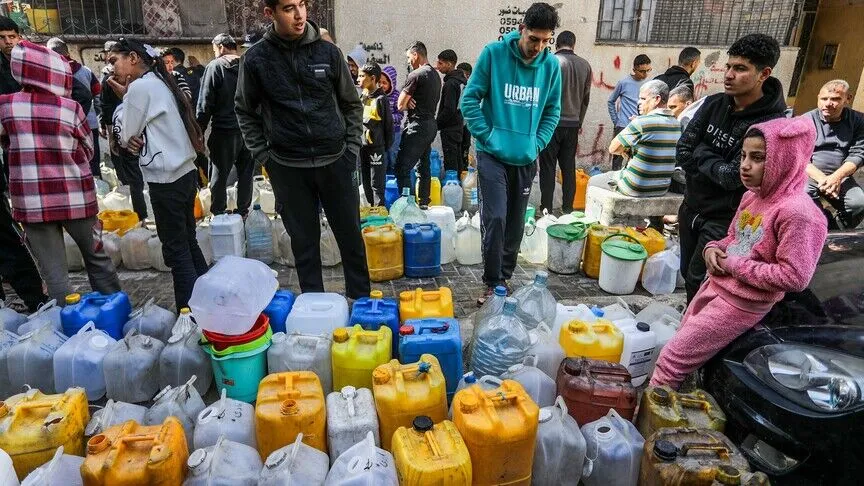
Case stories of thick swarves of displaced people speak of hellish conditions as they can be seen on the Al Rasheed Road connecting the north of the Gaza Strip to its southern side. If people can afford they can use transport but many, including whole families of men, women and children  are moving on foot, hungry, with no water and many collapsing on the road as some have been moving for hours on end. For night rest, they make do with resting their limbs, again with no food on the sides of the road.

The social media have been rife with stories about forcibly displaced Palestinians on the road. Many of them say they don’t know where they are going, although the end of the road is to Al Mowasi, an area to the southwest of Khan Younis and which the Israeli has designated as a “safe” place but which it keeps bombing from the air whenever it feels like it.

One elderly man called Abu Nader Siam, walks slowly holding a cane in his right hand with his wife, Zakia Siam, at his left.  He is exhausted as reported in the UN News.

“I come from the Tal al-Hawa neighborhood in Gaza City. They [Israelis] have left no house or neighbourhood except to bomb it,” he said. “The shelling continues, and they have dropped leaflets ordering us to evacuate. We walked for six hours because we couldn’t find a car or any transportation.”

Zakia Siam spoke about their non-stop journey after the shelling reduced their house to rubble. “We went to the Shujaiya neighbourhood, and then we were displaced to the Sha’af neighbourhood in Gaza City before it was bombed,” his wife said. 

“Afterwards, we went to the seashore west of Gaza City and my husband and I stayed there for two nights without a tent. We sat on the sidewalk next to the tents and hid next to one of them, then continued walking.”

Another civilian, Mrs. Um Shadi al-Ashkar, carried a bag of belongings as she headed for southern Gaza.  “There is death, shelling, bombing and destruction of houses (in Gaza City),” she said.

“Even if they had dropped leaflets, if there had been no shelling, no one would have left Gaza City, they would have stayed in their homes. But there is death and devastation.”

The fight for Gaza city is in full-swing. The Israeli army knows what its up against, adding it could take months, or even up to a year to completely take over the city from Palestinian resistance groups. Meanwhile, they know the city is a Hamas stronghold which they can’t railroad through their tanks. That is why for the time being they put the ground invasion on hold and bombing the city from the air and sea.

Continue reading