Israeli Big Guns Force 270,000 on The Move

Israel has forcibly displaced 270,000 Palestinians from Gaza City toward the south under threat of bombardment and genocide, the Gaza Government Media Office said Saturday.

In a statement, the office said more than 900,000 Palestinians remain in Gaza City and northern areas, refusing to leave despite the ongoing destruction and “crimes of permanent forced displacement.”

“While thousands have fled south due to heavy Israeli airstrikes, at least 22,000 have since returned to Gaza City after moving belongings to the south,” it said, citing the absence of basic necessities there.

The office highlighted that the Al-Mawasi area in Khan Younis and Rafah, promoted by Israel as a “safe humanitarian zone,” has instead been bombed more than 110 times, leaving over 2,000 people dead.

It said the area lacks hospitals, infrastructure, clean water, food, housing, electricity, and education, making life “almost impossible.”

According to the office, Israel has allocated just 12% of Gaza’s total area as “shelter zones” while attempting to force over 1.7 million people into them, comparing these to “concentration camps” aimed at depopulating Gaza City and the north.

The office condemned Israel’s actions as “a full-fledged war crime and crime against humanity,” blaming “Israel, its ally the US, and other states supporting the war” for the consequences.

It called on the international community, the UN, and international courts to take “serious and effective measures” to halt the crimes, hold Israeli leaders accountable, and guarantee Palestinians’ right to remain in their land with safety and dignity according to Anadolu.

Israel has been waging a devastating genocidal war on the Gaza Strip since October 2023, killing more than 65,000 Palestinians, most of them women and children, according to the Gaza Health Ministry.

Continue reading
Gaza Faces Public Health Crises

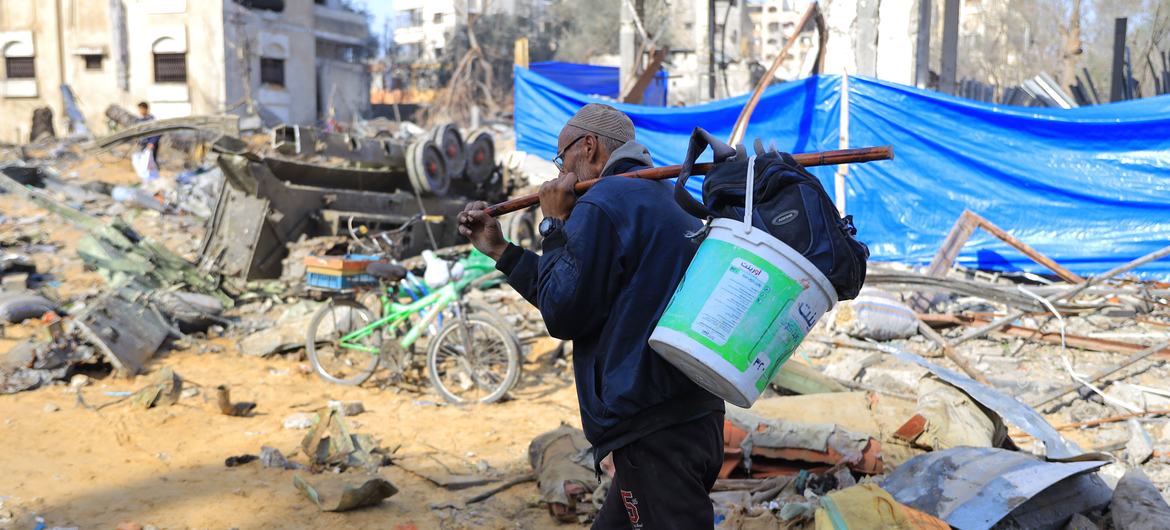
Amid sweltering heat, raw sewage and overflowing trash, displaced families in southern Gaza are facing an escalating public health crisis as aid remains blocked and medical supplies dwindle.

In the makeshift coastal encampments of Al Mawasi, families have no choice but to live in unsanitary conditions that are rapidly turning deadly, Louise Wateridge, Senior Emergency Officer at Palestine refugee agency, UNRWA, told UN News.

She described an increasingly dire situation: malnourished children and families, already worn down by months of war, battle unrelenting heat, unsanitary conditions, a lack of clean water and limited access to healthcare.

“The trash is just out of control. The sewage, the rodents, the pests, the rats, the mice – all of these animals are going between the structures that people are sheltering in,” she said.

As the days hot up, “disease is spreading. There is not enough medicine,” she added. UNRWA teams are conducting intensive clean up campaigns, but their resources are running out.

They’ve got about 10 days left of pesticides. Supplies are going to run out,” Ms. Wateridge warned.

Heavy equipment destroyed

The worsening conditions are being compounded by the destruction of Gaza’s public health infrastructure.

According to the UN humanitarian coordination office (OCHA), more than 30 vehicles essential for waste management, water supply and sewage maintenance were destroyed by Israeli airstrikes between 21 and 22 April.

In the past week alone, at least 23 reported strikes have hit tents sheltering internally displaced persons (IDPs), killing dozens of civilians – including women, children, and persons with disabilities.

Health system under strain

OCHA also noted that Gaza’s health system is continuing to collapse.

Over half of the remaining health facilities are located in zones under evacuation orders, posing serious access challenges for communities in urgent need. There are also widespread shortages of medicine, equipment and medical staff.

As of 15 April, an estimated 420,000 people have been displaced – many for the second or third time.

Shrinking humanitarian space

Humanitarian space continues to be shut down. Vital humanitarian aid has not entered Gaza for 52 consecutive days.

OCHA noted that between 15 and 21 April, nearly half of the planned humanitarian movements were denied or impeded.

It reported that out of 42 planned aid missions across the Gaza Strip that were coordinated with the Israeli authorities, 20 were denied, two faced impediments, 19 were facilitated and one was cancelled.

Meanwhile, UN agencies also have to contend with lack of funds to sustain their programmes.

As of 22 April, donors have disbursed about $569 million out of the $4.07 billion (about 14 per cent) required to meet the most critical humanitarian needs of three million people requiring assistance in Gaza and the West Bank, including East Jerusalem.

UN News

Continue reading
How Israel Destroyed Rafah?

Israeli forces continue to attack Gaza residents in violation of the terms of the ceasefire agreement, the first phase of which took effect on 19 January. Airstrikes and gunfire targeting civilians and their property continue in various areas of Gaza, resulting in hundreds of deaths and injuries. Meanwhile, the entry and distribution of humanitarian aid – particularly medical equipment, hospital supplies, tents, mobile homes, and essential machinery for rubble removal and body recovery – remains severely hampered. As a result, civilians face deteriorating humanitarian conditions due to the widespread destruction of infrastructure and essential services. In Rafah, displaced residents continue to be prevented from returning to their homes, while Israeli forces are systematically demolishing both private and public buildings in the city.

Israeli forces redeployed along Gaza’s borders in the first phase of the ceasefire agreement continue to maintain absolute control and a heavy military presence in most areas of Rafah in southern Gaza for the 10th consecutive month. Field reports indicate that since the invasion of Rafah in early May 2024 and the seizure of the Palestinian side of the Rafah crossing, the Salah al-Din axis (Philadelphi Corridor), and other parts of the city, Israeli forces have systematically destroyed infrastructure. Explosions and the sound of military machinery remain constant on the outskirts of the city, while residents are still barred from returning to most areas. The majority of Rafah’s displaced population remains in makeshift tents in central Gaza and in Al-Mawasi, Khan Younis.

According to information gathered by Al Mezan, Israeli forces have not kept within the designated areas outlined in the ceasefire agreement and continue to maintain positions deep inside Rafah – more than one kilometer inside the city center, extending to the eastern garage area, the Palestinian-Egyptian border to the south, and the eastern perimeter fence. These areas remain highly dangerous, where any movement is met with artillery fire, sniper attacks, and aerial bombardment.

According to the Rafah Municipality, 200,000 of the city’s 300,000 residents are still unable to return. No organizations have been able to access many of the areas that are still under Israeli control, including Abu Al-Saeed in Tal Al-Sultan – stretching from the coast to the Rafah Crossing – as well as neighbourhoods deep within the city, such as Al-Awda and Al-Najma squares. Of Rafah’s total area of 60,000 dunams, 60% has been declared a restricted and highly dangerous zone.

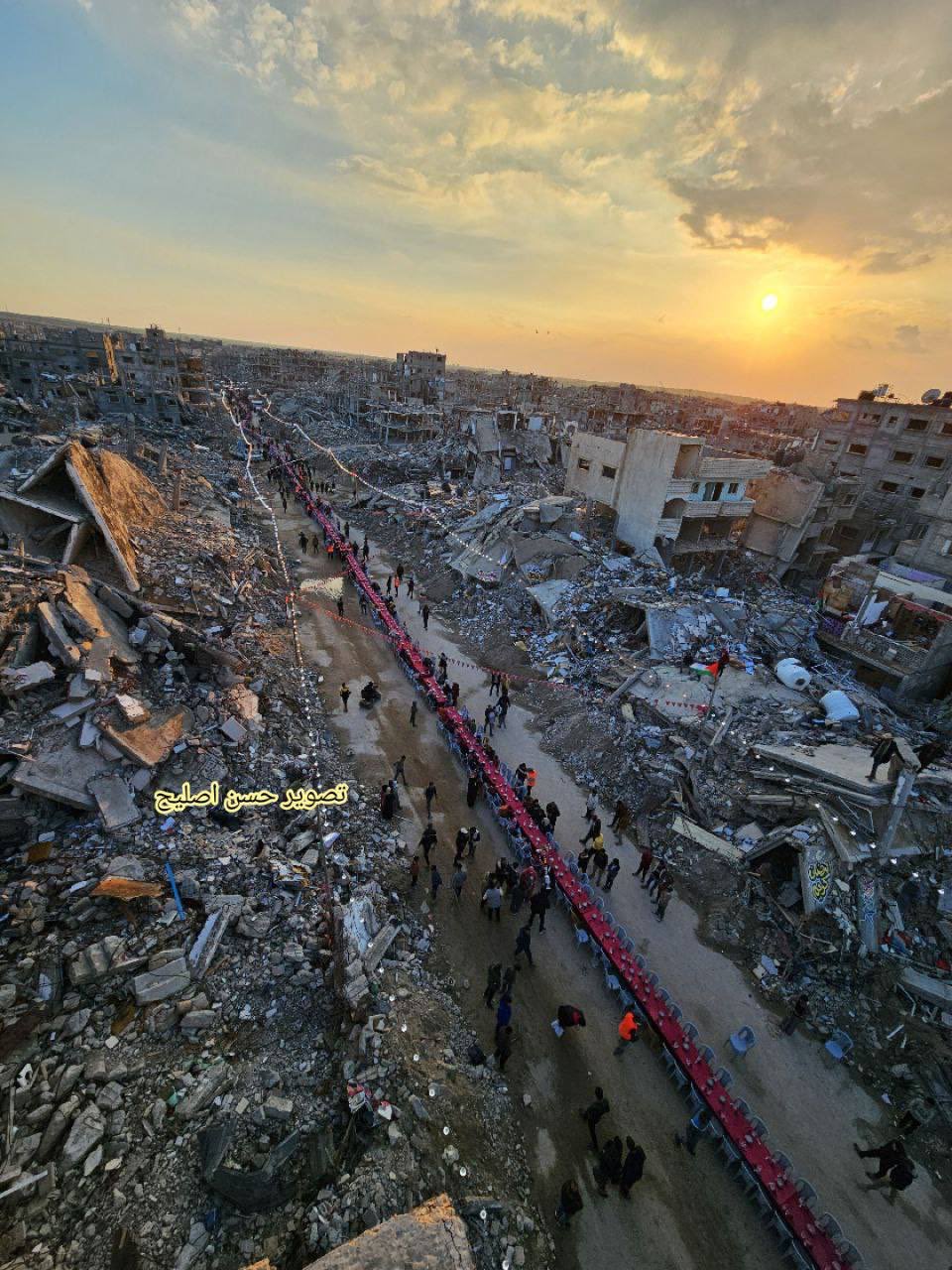
More than 90% of Rafah’s neighbourhoods have been completely or partially destroyed, with severe damage to residential buildings, roads, and essential public infrastructure – including health, government, and commercial facilities. The damage is particularly concentrated in the southern and western parts of the city, where six out of fifteen neighbourhoods and five refugee camps have been completely levelled. In addition, nine medical centers were destroyed, including the Abu Yousef Al-Najjar Hospital – the only government hospital in Rafah – the Kuwaiti Hospital, and the Indonesian Field Hospital. Approximately 70% of sewage and water pumps have been destroyed, while electricity and communications networks have nearly totally collapsed. The amount of rubble in Rafah is estimated at 20 million tons, with many bodies still believed to be trapped beneath it.

According to the Gaza Ministry of Health, Israeli forces have killed 111 civilians and injured 916 others since the ceasefire came into effect. The Rafah Municipality reports that approximately 40% of these casualties occurred in Rafah, as residents attempted to check on their homes and agricultural lands. The most recent victim, Hanaa Tawfiq Suleiman Hassanein (Al-Ghouti), was killed on 21 February 2025 when an Israeli tank fired at her home in the Al-Jeneina neighborhood, in the eastern part of Rafah, shortly after she returned home.

Mr. Mohammed Hassan Abu Sultan, 35 years old, married and a father of two, shared his experience of attempting to return to his home in Rafah:

“In early May 2024, my family and I were forced to flee to Deir al-Balah, and later to Al-Mawasi, Khan Younis, where we struggled to live in a tent with meager resources. When the ceasefire was announced on 19 January 2025, I was overjoyed, believing that I could finally return home and leave the hardships of displacement behind. But the next day, I discovered that the Israeli forces had not completely withdrawn from Rafah. A few days later, I tried to check on my house in the Al-Jeneina neighbourhood. When I arrived in Rafah, I was shocked by the extent of the destruction. Before I even reached my neighbourhood, I and others who were going to inspect our homes came under fire. I barely escaped. I later learned that the gunfire came from an Israeli crane positioned south of Al-Jeneina, with tanks stationed on nearby sand dunes. Every day I hear of more civilians being killed or injured as they try to check on their homes. I am still living in a tent in Al-Mawasi, Khan Younis, enduring the bitter cold and poor conditions, waiting for the full withdrawal of Israeli forces so that I can return to my home – even if it has been destroyed.”

Similarly, Mohammed Mahdi Mousa Al-Dawoudi, 38 years old, married and a father of four, recounted his attempt to return to his home in Rafah after the ceasefire took effect:

“On 28 May 2024, my family and I, like many others, were forced to flee our home in the Tal Al-Sultan neighbourhood of Rafah due to intense bombardment and the advance of Israeli forces. We took refuge in a small tent in Al-Mawasi, Khan Younis, where we endured displacement and harsh living conditions. The ceasefire was announced on 19 January 2025, after we had waited for several months to return home. I finally went back to check on my home, but when I arrived in Tal Al-Sultan, I was horrified to see entire neighbourhoods reduced to rubble. As we inspected the aftermath of the bombardment in the area, Israeli forces positioned along the Philadelphi Corridor (the Egyptian-Palestinian border) opened fire on us. I barely made it back to Al-Mawasi. I later learned that most Rafah residents are unable to return due to Israeli gunfire and military presence in the eastern and southern parts of the city. Many civilians have been killed trying to reach their homes. I remain displaced in a tent, struggling to survive the freezing temperatures, waiting for the Israeli forces to completely withdraw so that I can return to what remains of my home.

As of the time of this press release, Israeli forces continue to maintain control over most areas of Rafah, attacking residents with gunfire and other weaponry, particularly those attempting to return to their homes. The ongoing Israeli operations include the widespread demolition of homes and infrastructure, especially in the Al-Awda and Tal Al-Sultan neighbourhoods, in what appears to be a deliberate effort to alter the city’s landscape and render it uninhabitable.

Al Mezan unequivocally condemns Israel’s ongoing crimes, perpetrated in furtherance of the continuing genocide in Gaza, particularly in Rafah. We call on the international community to take urgent and concrete measures to end the genocide, stop the systematic destruction of Rafah, and ensure the safe return of displaced residents. Immediate steps must be taken to hold those responsible accountable, including full support for the International Criminal Court and other accountability mechanisms, the imposition of a two-way arms embargo on Israel, and targeted sanctions against individuals and entities complicit in these crimes. The international community must also review and suspend bilateral agreements and diplomatic ties that enable Israel’s violations, work toward dismantling the unlawful occupation, and uphold the Palestinian people’s right to self-determination.

Reliefweb

Continue reading
Mawasi: Latest Israeli Massacre With US Bombs

 The Israeli army’s horrific massacre of displaced families living in ramshackle tents in a so-called “humanitarian zone” in the southern Gaza Strip is further proof that the international community’s silence during the 11-month genocide is encouraging Israel to carry out its crimes.

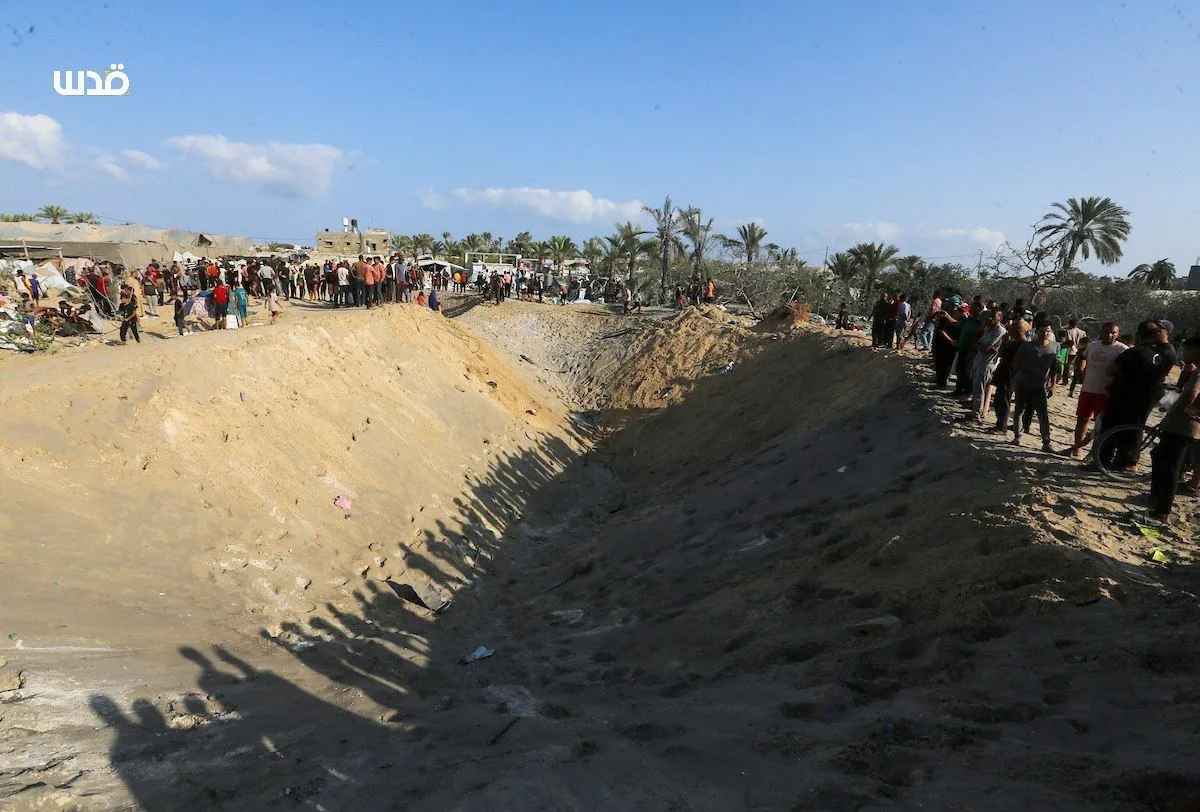
The latest mass killing fuelled by the international community’s refusal to act occurred in the Strip’s al-Mawasi Khan Yunis area, which the Israeli army had designated a “safe zone”. Initial investigations conducted by Euro-Med Monitor reveal that on Tuesday 10 September, after midnight, Israeli warplanes dropped three American-made MK-84 bombs on a group of displaced people sleeping in their tents in the Mawasi area. The explosions created three holes several metres deep and in diameter, burying about 20 tents with the families still inside. 

Israel’s use of multiple highly destructive bombs on a densely populated area full of displaced people—and its consequent killing of sleeping civilians—is unjustifiable, whether or not its claims of the presence of armed factions in the area are accurate.

Since the displaced people’s tents were situated in a region with sandy dunes, many of them—including tents with entire families inside—were buried beneath the sand. The initial casualty toll, counting both the dead and the wounded, is over 60.

The Israeli army’s intention to kill the greatest number of Palestinian civilians possible is evident in its use of American bombs with a wide destructive capacity in an area full of tents housing displaced people. It should be noted that no evacuation warnings were issued prior to the bombing.

This massacre comes only one month after Israeli forces bombed Gaza City’s Al-Tabi’in School, killing over a hundred Palestinians.

Israel remains bound by the regulations of international humanitarian law, particularly the requirements to protect civilians and adhere to the principles of distinction, proportionality, and military necessity, i.e. to take necessary precautions. This involves deciding how military operations are to be conducted and what kind of weaponry is to be employed in order to reduce the number of civilian casualties.

The shameful silence and indifference surrounding these unprecedented massacres, which blatantly and repeatedly target civilians with the clear intention of exterminating Palestinians in large numbers, serves as a green light for Israel to continue committing such atrocities.

The United States is complicit in this individual crime, as well as in Israel’s genocide of Palestinians, because it continues to supply Israel with weapons, despite knowing that the Israeli army uses these massively destructive weapons to regularly kill hundreds of civilians.

Israel’s bombing strategy reveals a deliberate policy to target Palestinian civilians across the entire Gaza Strip; spread fear among them; deny them stability or shelter, even for brief periods of time; force them to repeatedly relocate to new shelters; subject them to life-threatening conditions; and ultimately destroy them. The bombing continues throughout the entire Strip, with Israel targeting places designated as humanitarian areas, mainly shelter centres, including those set up in UNRWA-run schools.

Civilians in the Gaza Strip are paying the price every day for Israeli military attacks that seriously violate the rules of international humanitarian law, especially the principles of distinction, proportionality and military necessity.

As part of their international obligations, all nations must put an end to Israel’s war crimes and crimes against humanity in the Gaza Strip; safeguard civilians there; ensure that Israel abides by international law and the rulings of the International Court of Justice; and impose effective sanctions on Israel by halting all forms of military, financial, and political cooperation and support. This includes an immediate stop to all arms sales, exports, and transfers to Israel, including export licences and military aid.

All nations that cooperate with Israel in committing crimes by providing it with any kind of direct support or assistance must be held accountable, most notably the United States. Giving aid and engaging in contractual agreements with Israel relating to the military, intelligence, politics, law, finance, and the media, among other domains that might help its crimes continue, is enabling Israel to commit its atrocities against Palestinians.

Continue reading
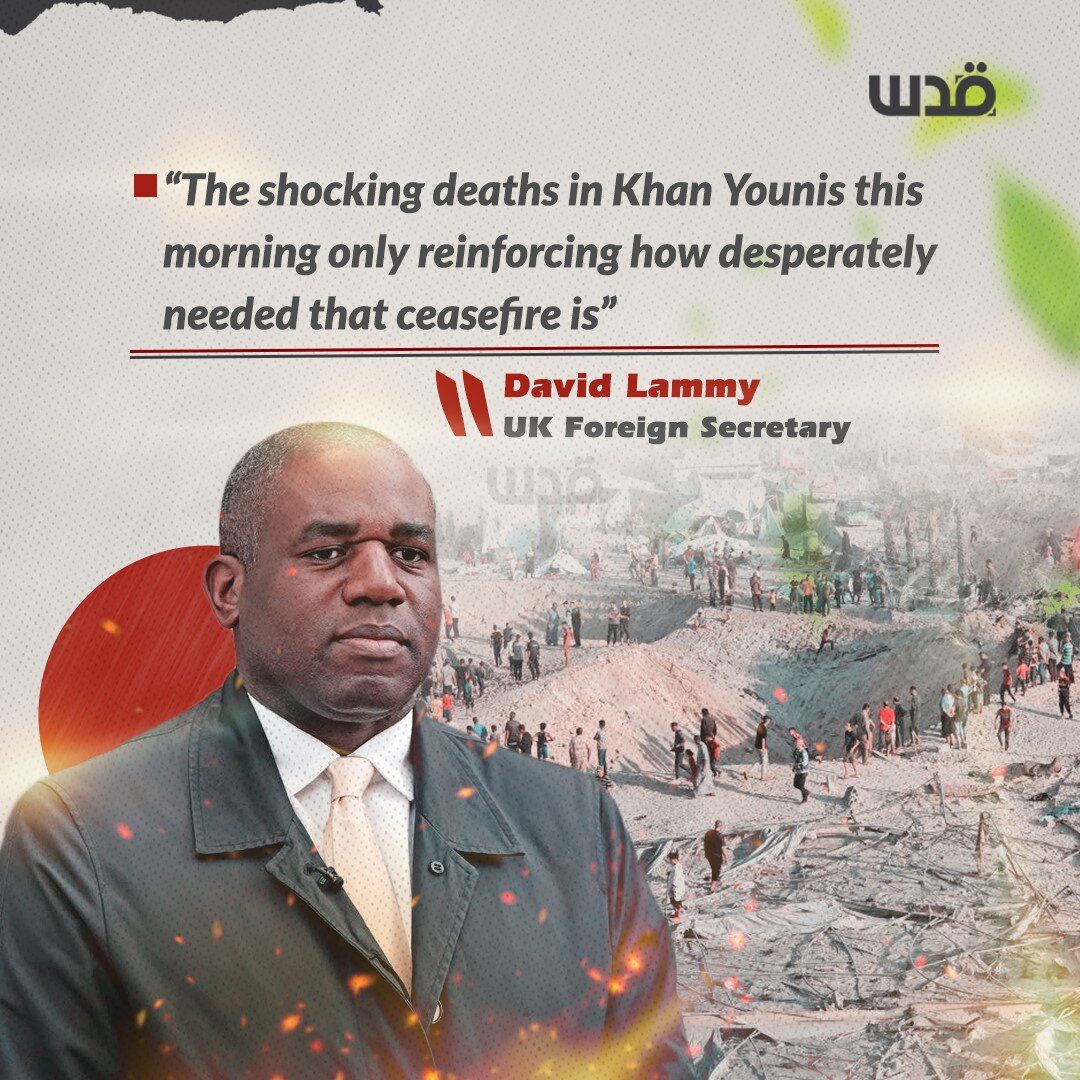
UK Condemns Al Mawasi Massacre

Following the UK’s announcement to halt 10% of arms sales to Israel, the new UK government has condemned the Israeli massacre of displaced Palestinians in the al-Mawasi area, which Israel had designated as a “safe zone.”

Norwegian Foreign Minister Espen Barth Eide has also condemned the deadly airstrike. In a statement on X, Eide criticized the attack on the so-called safe zone and stressed that all parties in the war must protect civilians and adhere to international humanitarian law.

Continue reading