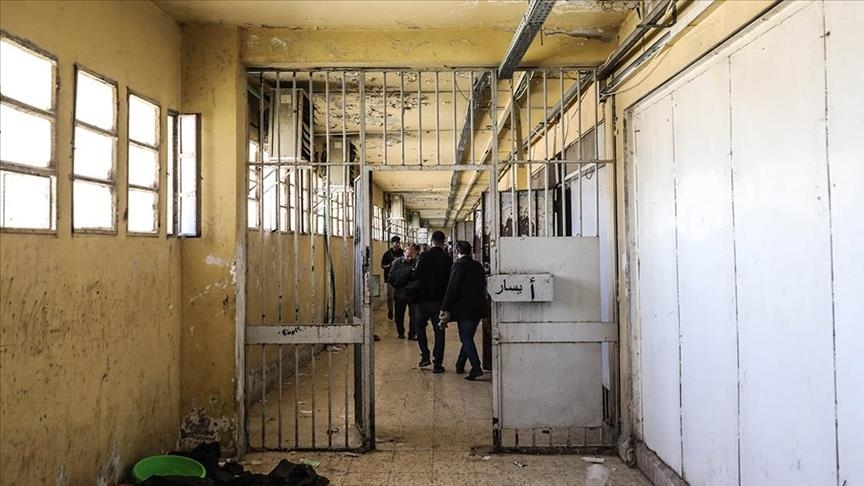
During the rule of the collapsed Baath regime in Syria, thousands were subjected to torture in dozens of centers beyond Sednaya prison.
Since the uprising began in March 2011, the fallen Baath regime reportedly tortured and killed thousands. However, it is feared that the undocumented numbers reach tens of thousands.
According to the Syrian Network for Human Rights (SNHR), regime forces detained at least 1.2 million Syrians during the civil war and subjected them to various torture methods.
Although the regime announced over 20 so-called amnesty decisions during the war, international human rights organizations state that the regime continued detaining Syrians.
Numerous reports from international organizations emphasize that detainees were killed through torture.
Anadolu compiled details of torture centers and methods under the collapsed Baath regime, which ruled Syria for 61 years.
According to an exclusive SNHR report for Anadolu, the regime’s torture centers were categorized as civilian prisons, military prisons, secret unofficial detention centers, and security unit interrogation centers.
There were more than 50 such centers across almost all provinces in the country.
Prisons under Interior Ministry
In cities taken over by groups that toppled the Baath regime, their first action was to rescue detainees, most of whom were opposition members.
Prisoners were freed from major prisons, including Aleppo Central Prison, Hama Central Prison, Adra Central Prison in Damascus, Homs Central Prison, and Suwayda Central Prison.
Prisoners in the central prisons of Tartus and Latakia, however, are still awaiting release.
Centers of crime
Tens of thousands of people were tortured for years in military prisons under the Defense Ministry.
Among these, Sednaya, Mezzeh, and Qaboun in Damascus, and Al-Balloon and Tadmur in Homs, stood out as centers of severe torture. Many detainees held there were never heard from again.
After armed groups brought down the regime, prisoners in Mezzeh and Kabun were also freed.
Mezzeh prison, located at the military airport in Damascus’s Mezze district, was managed by military intelligence units under the Defense Ministry.
Secret and unofficial detention centers
There were also centers where the regime detained its opponents, but these centers were practically secret.
According to SNHR and other human rights organizations, the purpose of establishing these secret detention centers was to carry out even more severe torture. Those who ended up in these torture dens had no chance of survival.
These facilities operated under the Fourth Division, commanded by Assad’s brother, Maher Assad.
In early 2012, the regime also turned houses, villas, and stadiums into detention centers. One such facility was Deir Shmeil Camp in northwestern Hama.
Detention, torture centers
Security units tied to the regime also played an active role in operating interrogation and detention centers.
The security apparatus consisted of four main intelligence services: the Military Intelligence Service (known as “military security”), the Political Security Service, the General Intelligence Directorate (known as “state security”), and the Air Intelligence Directorate.
The Military Intelligence Service, with the largest network in the country, had at least 20 branches.
The Political Security Service maintained branches in most provinces, while the General Intelligence Directorate operated six main headquarters in Damascus.
The Air Intelligence Directorate ranked second in detentions after the Military Intelligence Service. With branches in nearly every province, the directorate was particularly active in areas with military airports.
These units were placed under the Syrian National Security Bureau, established in 2012. The Military Intelligence Service, under the Defense Ministry, functioned as the primary body responsible for detentions.
Those detained in these branches were typically transferred to main centers in Damascus after several days, where they could be held for years.
Across the country, security units operated more than 45 detention branches, with 18 of them located in Damascus.
Regime used 72 different torture methods
According to the SNHR report, the Baath regime employed 72 torture methods involving physical, psychological, and sexual violence.
The regime also subjected detainees to forced labor and solitary confinement, violating basic human rights.
Physical torture included pouring boiling water on victims’ bodies, simulating drowning by submerging heads in water, electrocuting individuals with electric batons, and placing them naked on electrified metal chairs. Other inhumane practices involved melting plastic bags onto bodies, extinguishing cigarettes on skin, and burning fingers, hair, and ears with lighters.
The regime also used brutal methods such as pulling out fingernails with pliers, tearing out hair, amputating body parts—including ears and genitalia—with sharp tools, and driving nails into sensitive areas like hands, tongues, and noses.
Spotlight on Sednaya prison
Sednaya prison, where tens of thousands are believed to be held, has the worst reputation of all.
After protests in March 2011, Sednaya became a center of torture, holding tens of thousands of political detainees.
Following the collapse of the 61-year-old Baath regime on 8 December, 2024, attention turned to the situation of prisoners in Sednaya.
Some detainees reportedly appeared on security cameras but could not be found in accessible areas, raising the possibility that they may be in secret compartments underground.
As teams continue to dig tunnels and break down walls, Syrians who have not heard from loved ones for years are flocking to the prison, searching for traces of their relatives.

 CrossFireArabia