War-torn Gaza: Either Walking or The Cart!

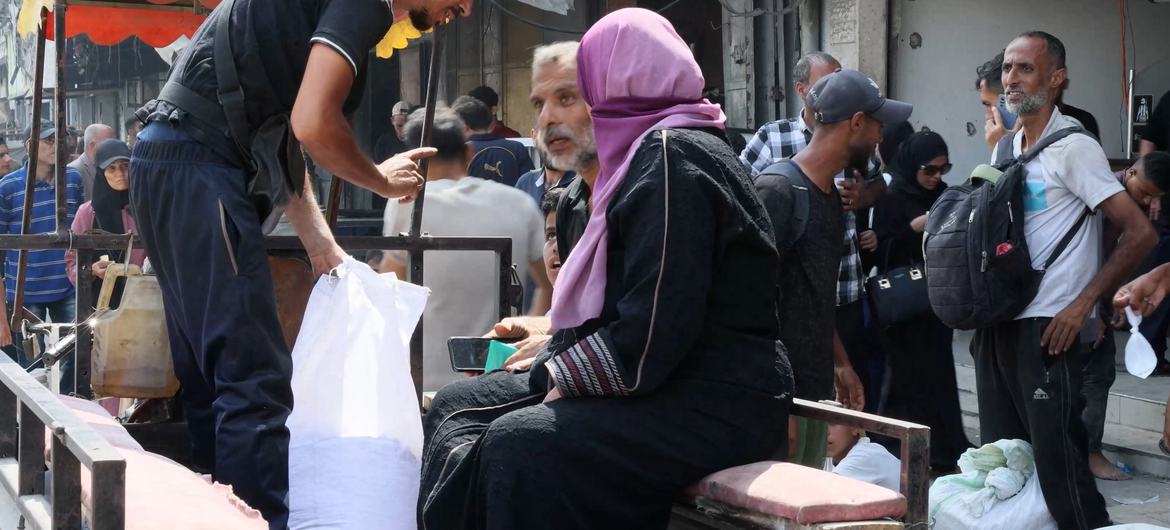
Mohammed Saad sits with others inside a homemade cart pulled by a car carrying several passengers, waiting to travel to Gaza City in one of the “uncomfortable and extremely expensive” means of transportation used to get around the Strip.

Moving around Gaza has become ever more difficult amid the ongoing 21-month-long war.

Mr. Saad, who was displaced from the town of Beit Lahia in the northern Gaza Strip, was waiting for the vehicle pulling the cart he was sitting in to move.

“Transportation is very difficult and unsafe,” he told UN News. “The roads are exhausting. We pray to God to grant us patience and to return home.”

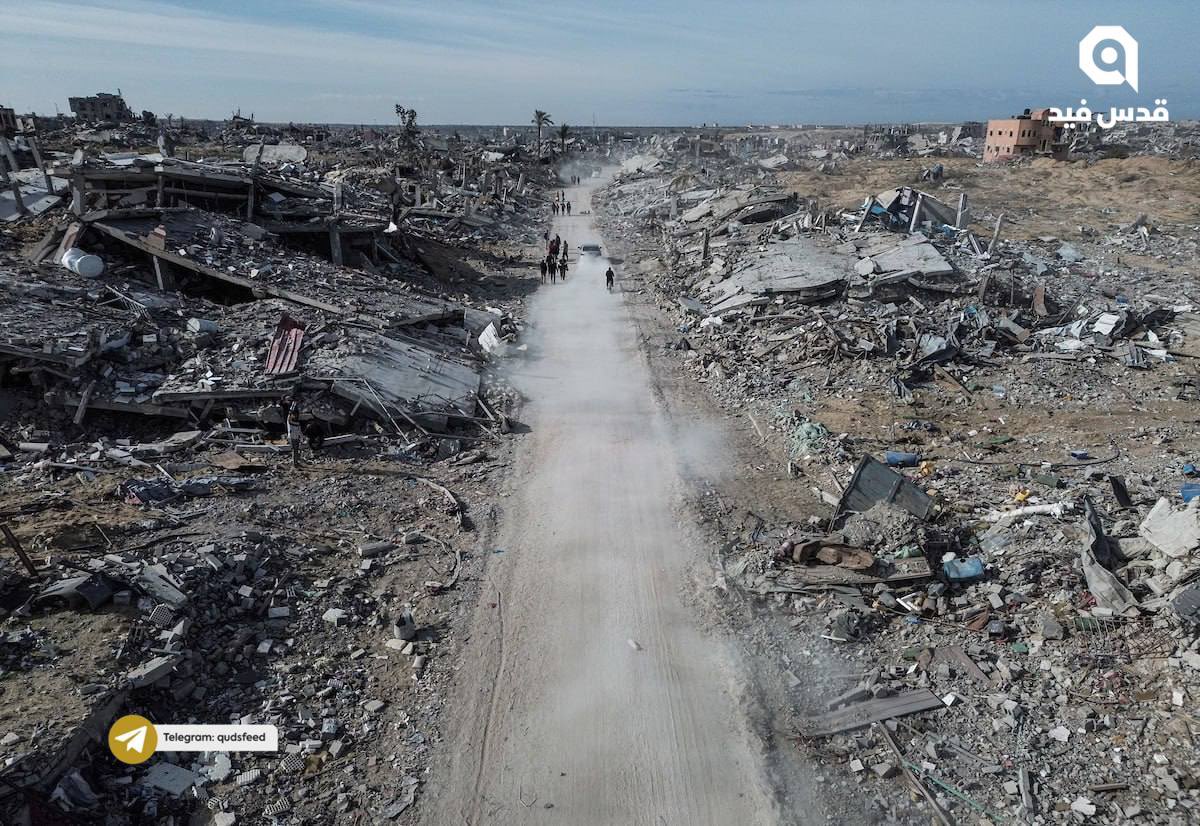
This was on Rashid Street, west of the city, which connects the north and south of the Strip. It is crowded with carts, cars and three-wheeled motorcycles that have also been converted into means of transportation.

The area is interspersed with tents of displaced people, all surrounded by the rubble of buildings destroyed by war on both sides of the road.

War and evacuation orders have left many in Gaza scrambling for transportation to safety.

UN News

War and evacuation orders have left many in Gaza scrambling for transportation to safety.

A luxury not for everyone

“People can barely find enough to eat, so how will they pay for transportation?” Umm Haytham Al-Kulak asked while waiting in a passenger compartment attached behind a motorcycle,

“We walk mostly; we can’t take public transportation,” she said.

“May God help the drivers. Fuel prices are high, and all the people are exhausted and overwhelmed.”

In Gaza, many people have no choice but to use risky ways to get around during the ongoing war.

UN News

In Gaza, many people have no choice but to use risky ways to get around during the ongoing war.

Sky high fuel costs

Drivers are paying skyrocketing prices for fuel, which is a heavy burden, Abdel Karim Abu Asi said as he waited for his car to be fully loaded with passengers.

“The price of a litre of diesel has reached 100 shekels [around $27],” he said. “What should we do? We’re trying to use locally produced fuel, but it causes significant damage to cars and a lot of problems.”

This isn’t the only problem facing drivers. Mr. Abu Asi said the prices of spare parts are very high. A part that used to cost around 100 shekels now sells for around 2,000 shekels, or around $560.

“We also suffer from the destruction of the streets, and no matter how hard the municipalities try to repair them, the problem is not solved because they require a large number of bulldozers to clear them,” he said.

“People must be helped with transportation costs and many other aspects.”

Fuel vendors sell their products at sharply inflated prices, with a litre of fuel reaching around 100 shekels.

UN News

Fuel vendors sell their products at sharply inflated prices, with a litre of fuel reaching around 100 shekels.

Only option

Despite all the challenges, people there continue to go about their daily lives, even if it takes all day to get from one place to another. That’s what happened to Hussein Al-Hamarneh, who was waiting in a car to travel to the southern Gaza Strip.

Mr. Al-Hamarneh believes that most of these means of transportation are “uncomfortable, such as tuk-tuks [three-wheeled motorcycles] and carts pulled by cars, which are primarily designed to transport goods or animals, not people”.

“This is the only option for those who do not own cars,” he said.

Tayseer Abu Asr, who arranges for passengers to board a cart pulled by a car, stood on the section of the road.

“We’re trying to help people get around,” he said. “These carts have become our only means of transportation after the destruction of buses and taxis.”

On top of these challenges during the ongoing war, the Gaza Strip is facing a fuel crisis.

UN agencies warned earlier this week that the fuel shortage in Gaza has reached critical levels. They said if supplies run out, it will place an unbearable new burden on the population.

UN News

Continue reading
Israel Intensifies Genocidal Campaign in Gaza

Israel has intensified its genocidal campaign in Gaza through one of the most extensive and lethal assaults since the beginning of its offensive, committing massacres and adopting a scorched-earth policy involving the total destruction of remaining neighbourhoods and infrastructure. 

This approach follows a pattern sustained for over 19 months, characterised by mass killings, starvation, and the systematic destruction of all means of survival, with the deliberate targeting of Palestinian civilians in their homes, shelters, and vital facilities, all aimed at erasing Palestinian society in Gaza and eliminating any prospect of its return or reconstruction.

In recent days, Israeli occupation forces have escalated their assault across various areas of the Gaza Strip, carrying out systematic destruction of what remains of homes and civilian infrastructure, and committing mass killings of the population. This forms part of a policy designed to destroy all aspects of life, depopulate the area, and prevent the continued existence of its residents— a prelude to the imposition of a colonial reality by force, based on the erasure of the indigenous population and the de facto annexation of the territory to Israel, in grave violation of international law, including the prohibition on annexing land by force.

Euro-Med Monitor’s field team documented the killing of more than 115 Palestinians in the northern Gaza governorate alone in less than 12 hours since dawn on Friday. The casualties followed Israeli airstrikes on at least 10 residential homes in Tel al-Zaatar (Jabalia) and Al-Salatin neighbourhood (Beit Lahia).

These homes were completely destroyed with residents inside, resulting in the deaths of dozens of civilians, including women and children, in what amounts to a series of mass killings reflecting an escalating pattern of systematic violence against civilians in the Strip.

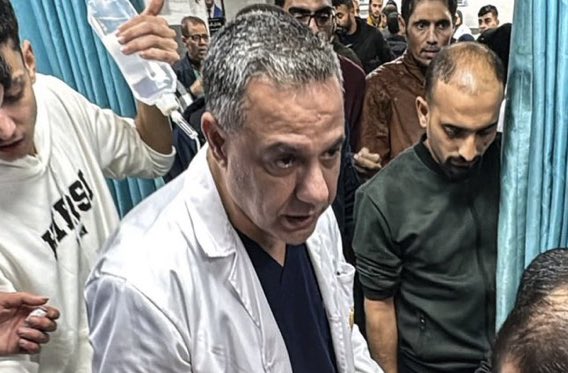
More than half of the victims remain trapped beneath the rubble, as rescue and civil defence teams are unable to reach them due to the lack of resources and equipment. Meanwhile, dozens of bodies and wounded individuals have overwhelmed the corridors of the Indonesian Hospital and Al-Awda Hospital, highlighting the complete collapse of Gaza’s healthcare system.

Limited incursions by Israeli ground forces were reported from two directions, north of Beit Lahia and east of Jabalia, under heavy artillery and air cover. There is growing concern that these ground operations could expand, placing hundreds of thousands of civilians, already living in tents under continuous bombardment, hunger, and daily violence, at even greater risk.

In addition, Israeli artillery targeted Palestinian civilians as they attempted to flee and search for shelter following repeated waves of bombardment. These attacks resulted in the killing of 10 people in the Al-Dur al-Gharbi area of Beit Lahia, and 8 more in the Azbet Abd Rabbo area of Jabalia.

Over the past two days, Israeli forces have systematically destroyed a large number of partially damaged residential buildings in northern Gaza, in what appears to be a continuation of a broad campaign to obliterate entire urban areas, specifically targeting civilian population centres.

In recent days, the Israeli army has adopted a scorched-earth policy east of Khan Younis, while continuing its destruction of entire neighbourhoods in Rafah. Civilian Israeli contractors have also taken part in this effort, reflecting a deliberate intent to erase the city from the map.

These developments represent the practical implementation of Israeli Prime Minister Benjamin Netanyahu’s recent statements, in which he declared: “We will continue destroying Gaza’s homes until the Palestinians have no shelter left, and nothing remains but for them to leave. The only problem is finding countries willing to take them.”

This statement constitutes a clear admission from Israel’s highest political authority of an intent to uproot an entire population, an intent now being realised on the ground through the systematic destruction of all means of survival.

The recent massacres, particularly in Khan Younis and northern Gaza, mark a dangerous escalation in the targeting of civilians. Israel is deploying overwhelming and indiscriminate firepower without justification or the presence of active combat, strongly indicating that civilians themselves are the direct targets— a grave violation of international law.

The widespread destruction policy carried out by Israel cannot be classified as serving any legitimate military objective. Rather, it constitutes part of a deliberate and systematic approach to genocide, aimed at dismantling Palestinian society in Gaza,physically and demographically, by stripping it of the means to survive, eliminating it entirely, and preventing any future return.

The international community must act urgently to stop this ongoing genocide, initiate serious investigations into the crimes committed, and take effective measures to ensure the protection of civilians and bring an end to the culture of impunity that has emboldened Israel to commit grave violations without accountability.

The international community must impose economic, diplomatic, and military sanctions on Israel for its systematic and grave violations of international law. This includes banning the export of weapons or dual-use items to Israel, prohibiting the purchase of such items from it, halting all forms of political, financial, and military support and cooperation, freezing the financial assets of officials involved in crimes against Palestinians, imposing travel bans on them, and suspending trade privileges and bilateral agreements that grant Israel economic advantages enabling it to continue committing crimes against the Palestinian people.

States must also launch criminal investigations into Israeli and international companies involved in supplying the Israeli military with weapons and heavy equipment used in carrying out acts of genocide. This includes bulldozers, surveillance systems, and spyware used to track and target civilians. Public and private investments in these companies must be withdrawn, and the companies themselves must be blacklisted nationally and internationally.

States with universal jurisdiction laws must issue arrest warrants for Israeli political and military officials implicated in the crime of genocide and initiate legal proceedings — even in absentia — under their international legal obligations to prosecute such crimes and combat impunity.

An independent international mechanism must be established to preserve evidence related to the crime of genocide in Gaza. This body should document and safeguard digital evidence, satellite imagery, and testimonies from victims and survivors for use before international judicial bodies, particularly the International Criminal Court (ICC).

The ICC must expedite its investigations and issue arrest warrants for Israeli officials responsible for international crimes committed in the Gaza Strip. It must acknowledge and treat Israel’s actions as acts of genocide without equivocation. Member states of the Rome Statute must be reminded of their legal obligations to fully cooperate with the Court, ensure the enforcement of its arrest warrants, bring the perpetrators to international justice, and end the cycle of impunity.

EuroMed Human Rights Monitor

Continue reading
‘I Demolished 50 Buildings a Week’

An Israeli soldier who is a bulldozer operator, was interviewed on Hebrew Kan and said:

“I told the officer that I perform a symphony with a D9 bulldozer, demolishing 50 buildings a week by myself,” said Rabbi Avraham Zarbib who served in the Israel army for the whole duration of the war on Gaza.

“A two-story house means nothing to us. We completely destroyed Jabalia and Rafah, and we were on our way to destroying Beit Hanoun and Beit Lahia, but the [ceasefire] agreement didn’t give us enough time, so we settled for destroying half of them,” he added.

https://twitter.com/SuppressedNws/status/1882111750293930199

Continue reading
Israel Drops 100,000 Tons of Explosives on Gaza

After more than 15 months of the bloody Israeli genocide, the Gaza Strip appears as if it has just emerged from a devastating earthquake due to the massive destruction of buildings, facilities and streets.

The destruction of infrastructure, including homes, buildings, facilities, streets, water and sewage networks, stands unprecedented in modern history.

This destruction, halted for the time being by a ceasefire agreement that went into effect between Hamas and Israel last Sunday morning, days after it was reached through US, Qatar and Egypt mediation has left a stark and harsh humanitarian reality.

Gaza Government Media Office figures released Tuesday, states the Israeli army dropped over 100,000 tons of explosives on the Strip causing the destruction of about 88 percent of the infrastructure, homes, water and sewage networks, electricity and the economy.

The cost of the initial direct losses from this  war of extermination exceeds $38 billion.

The first phase of the agreement is scheduled to last for 42 days, during which negotiations will be held to start a second and then a third phase.

Between October 7, 2023 and January 19, 2024, the Israeli genocide left more than 157,000 Palestinians dead and wounded, most of them children and women, and more than 11,000 missing. This is one of the worst humanitarian disasters in the world.

Continue reading