Arab World Condemn But Smotrich Not Listening!

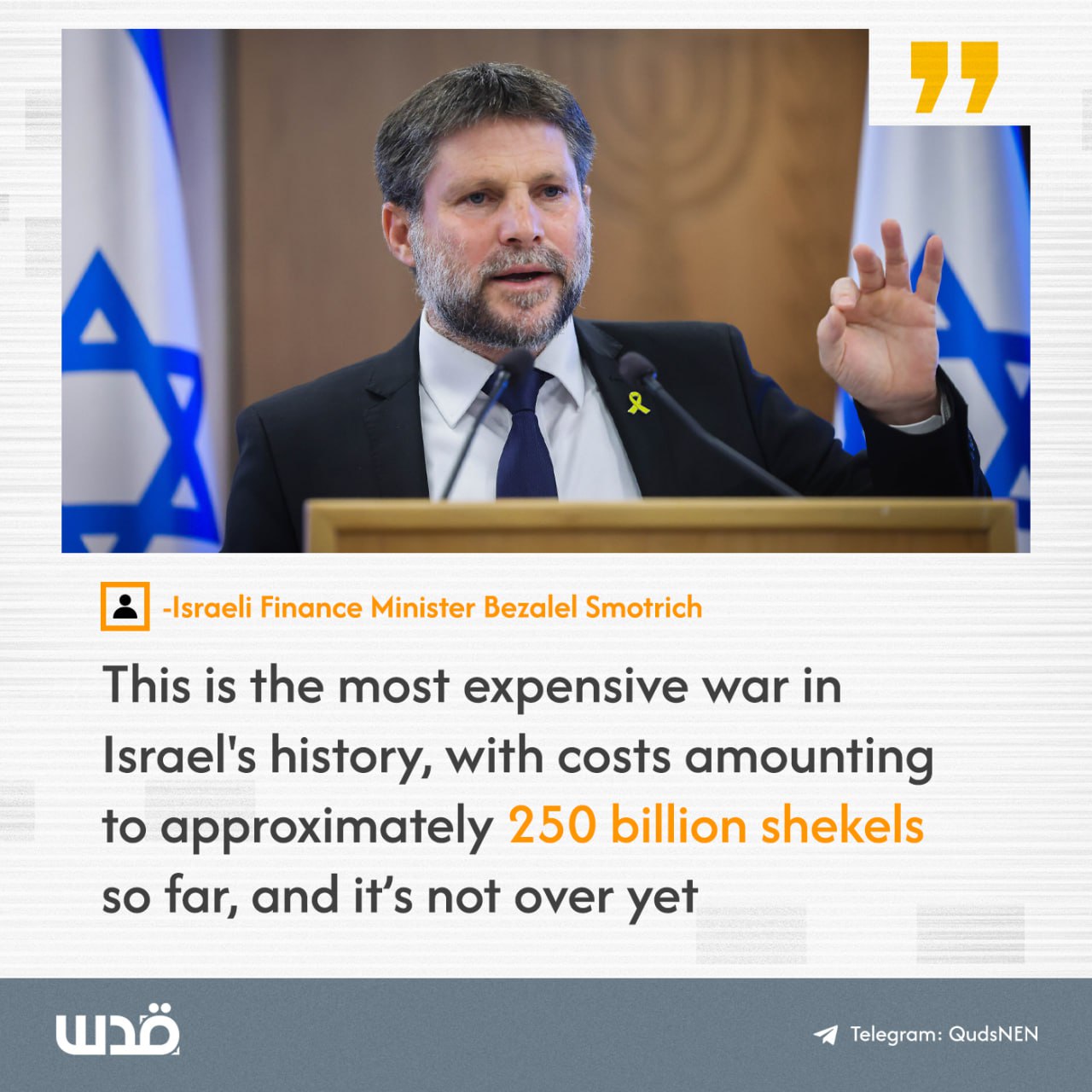
A call by Israel’s far-right Finance Minister Bezalel Smotrich to annex the occupied West Bank has drawn a wave of condemnations across the Arab world.

On Monday, Smotrich said he instructed Israel’s Settlement Division and Civil Administration to initiate the groundwork for infrastructure to “apply sovereignty” in the West Bank.

The Qatari Foreign Ministry called the Israeli minister’s call a “blatant violation of international law.”

A ministry statement denounced the call as a “dangerous escalation that would hinder the chances of peace in the region, especially with the ongoing brutal war on the Gaza Strip and its horrific repercussions.”

It called on the international community “to stand firmly against the occupation’s settlement, colonial and racist policies, and its repeated attacks on the Palestinian rights, especially its ongoing crimes in the West Bank.”

“The repeated Israeli statements that violate international laws and resolutions clearly reveal that the occupation is the obstacle to any efforts for peace and stability” in the region, the ministry said.

The Egyptian Foreign Ministry decried Smotrich’s call as a “flagrant violation of international law and international humanitarian law.”

“The irresponsible and extremist remarks by a member of the Israeli government clearly reflect Israel’s rejection of adopting the peace option in the region,” the ministry said in a statement.
Jordan termed the Israeli minister’s call “racist” and “extremist”

It called Smotrich’s statements a “blatant violation of international law and the inalienable right of the Palestinian people to establish their independent state with sovereignty along the June 4, 1967 borders and its capital in occupied Jerusalem.”

This June, Smotrich confirmed reports from The New York Times that he had a “secret plan” to annex the West Bank and thwart any efforts to incorporate it into a future Palestinian state.

In July this year, the International Court of Justice (ICJ) issued a landmark opinion that declared Israel’s decades-long occupation of Palestinian land “illegal” and demanded the evacuation of all existing settlements in the West Bank and East Jerusalem.

According to the Israeli public broadcaster KAN on Tuesday, Israeli Prime Minister Benjamin Netanyahu plans to reintroduce the annexation of the West Bank to the agenda of his government when US President-elect Donald Trump takes office.

In 2020, Netanyahu planned to “annex” the illegal Jewish settlements in the West Bank and the Jordan Valley, based on the so-called Middle East peace plan announced by Trump in January of the same year.

Territories Netanyahu planned to annex at that time constitute about 30% of the West Bank. His plan, however, wasn’t launched under international pressure and lack of US approval.
International law views both the West Bank and East Jerusalem as “occupied territories” and considers all Jewish settlement-building activity there as illegal according to Anadolu.

Continue reading
UK Sanctions…

British Prime Minister Keir Starmer said he is “looking at” sanctioning Israel’s finance minister, Bezalel Smotrich, as well as the national security minister, Itamar Ben Gvir.

The sanctions come in response to Smotrich’s remarks that “starving two million people in Gaza might be justified and moral,” while Ben Gvir described settlers who killed a 19-year-old in the West Bank as “heroes.”

Continue reading
Don’t Forget The West Bank Slaughter!

By Imran Khalid

Amid the ongoing violence and devastation in Gaza, much of the world has turned a blind eye to the equally volatile but less overt conflict simmering in the West Bank. While not as brutally visible as Gaza’s plight, the situation in the West Bank is equally dangerous, threatening to ignite unrest that could destabilize the Palestinian Authority and fuel ethnic cleansing.

Israel has steadily expanded settlements, demolished homes, and seized large swaths of land, targeting civilians in the process. Yet, global attention remains fixated on Gaza and Israel’s escalating war with Hezbollah in Lebanon. It is as if the world has forgotten that just a year ago, many feared the West Bank, not Gaza, would become the primary battleground between Israelis and Palestinians. Over the past two decades, the nature of the Israeli-Palestinian conflict has diverged significantly between Gaza and the West Bank. After Israel’s 2005 unilateral disengagement from Gaza, the region was left without Jewish settlers, creating a different kind of friction compared to the West Bank. [1]


Settlements are expanding day by day

On March 22, Israel’s Finance Minister Bezalel Smotrich announced the largest West Bank land seizure since 1993, setting a new course for Israeli settlement policy [2]. The move by Smotrich to declare 800 hectares in the Jordan Valley as state land paves the way for further development of settlements in this area sharing some 50 kilometers with Jordan.

For the Palestinians, who distrust such moves, seeing them as serious threats to the creation of an independent Palestinian state — this feels like a knife in their back. It is the latest land grab that Palestinians see as a last step before creating an independent and contiguous state. Settlement expansion — which set a record last year, according to Israeli monitoring group Peace Now — has cast doubts over the feasibility of a two-state solution. The largest threat to the long term stability of the land is that, with each designation of land as state property, the probability of having peace shrinks. The ongoing expansion of settlements, land confiscation, and rising settler violence — often carried out with impunity — only compound the difficulties. In some cases, this is further exacerbated by the incident in which the Israeli army is providing either direct or tacit support.

The Palestinian Authority’s Ministry of Health has stated that 716 Palestinians have died in the West Bank from Israeli military and settler violence since Oct. 7, including 160 children. Today, more than 5,750 have been wounded and over 10,000 detained in siege [3]. Nearly all arrests take place without going through a proper legal process, with the detainees imprisoned under Israel’s “administrative arrest” system – a method that bypasses international standards and in many cases denies those held the right to see either an attorney or even forthright details of the charges against them.

The two-state solution is being destroyed by Israel

The Israeli government is being accused more and more of implementing an annexation plan in the West Bank. The ramifications of this should alarm all nations that have historically supported a two-state solution, as verbal assurances and well wishes do little to mitigate the reality that Israeli security forces now operate at will in Area A — sovereign Palestinian Authority territory under the Oslo Accords [4].

Adding to this escalating tension are the inflammatory statements from Israeli officials. Israeli Foreign Minister Israel Katz over the weekend compared the military operations in Jenin and Tulkarm to those in Gaza, saying that we are at “war in every sense.” [5] His proposal of a similar evacuation process along the frontier where Palestinian civilians could be temporarily moved will only serve to add further fuel to the fire in an already volatile region.

Despite domestic political turmoil, Israeli Prime Minister Benjamin Netanyahu has artfully dodged blame as violence in Gaza and the West Bank rumbles on. He has practically dismissed calls for a two-state solution and openly defied the International Court of Justice. Netanyahu refuses to yield, a position that has crippled the fragile peacekeeping efforts in Gaza and aggravated fears of renewed violence in the West Bank. Netanyahu has now many excuses that could provide convenient cover for changes aimed at further entrenching Israeli control over the region.

The fate of the major part of the West Bank is crucial; without it, any prospective two-state solution will be dashed. Within Netanyahu’s ruling coalition are elements who seem intent on this very outcome, exerting considerable influence over the prime minister. In this context, Israeli Foreign Minister Israel Katz’s inflammatory rhetoric about the West Bank is more than just careless language — it may be a deliberate signal of the government’s intentions. As Netanyahu’s administration edges closer to what appears to be a calculated annexation strategy, the international community should question whether this is not only a consequence of policy but its very purpose.

[1] https://www.ndtv.com/world-news/israel-palestine-gaza-hamas-explained-israels-2005-gaza-disengagement-plan-and-full-siege-order-4466132

[2] https://www.aljazeera.com/news/2024/3/22/israel-seizes-800-hectares-of-palestinian-land-in-occupied-west-bank

[3] https://www.unocha.org/publications/report/occupied-palestinian-territory/humanitarian-situation-update-204-west-bank

[4] https://www.france24.com/en/middle-east/20240326-israel-s-largest-land-seizure-since-oslo-accords-deals-fresh-blow-to-palestinian-statehood

[5] https://www.timesofisrael.com/katz-slams-borrell-for-saying-he-called-for-displacement-of-west-bank-palestinians/

This opinion is reprinted from the Anadolu news agency.

Continue reading
Where do Israeli Leaders Come From?

The current Israeli leaders come from everywhere around the world but not from these indigenous lands: Collectively termed Palestine! Theses immigrants have no connection to these territories, yet they are forcing themselves here as if they are the owners while colonizing its real people which include Muslims, Christians and Jews.

Continue reading