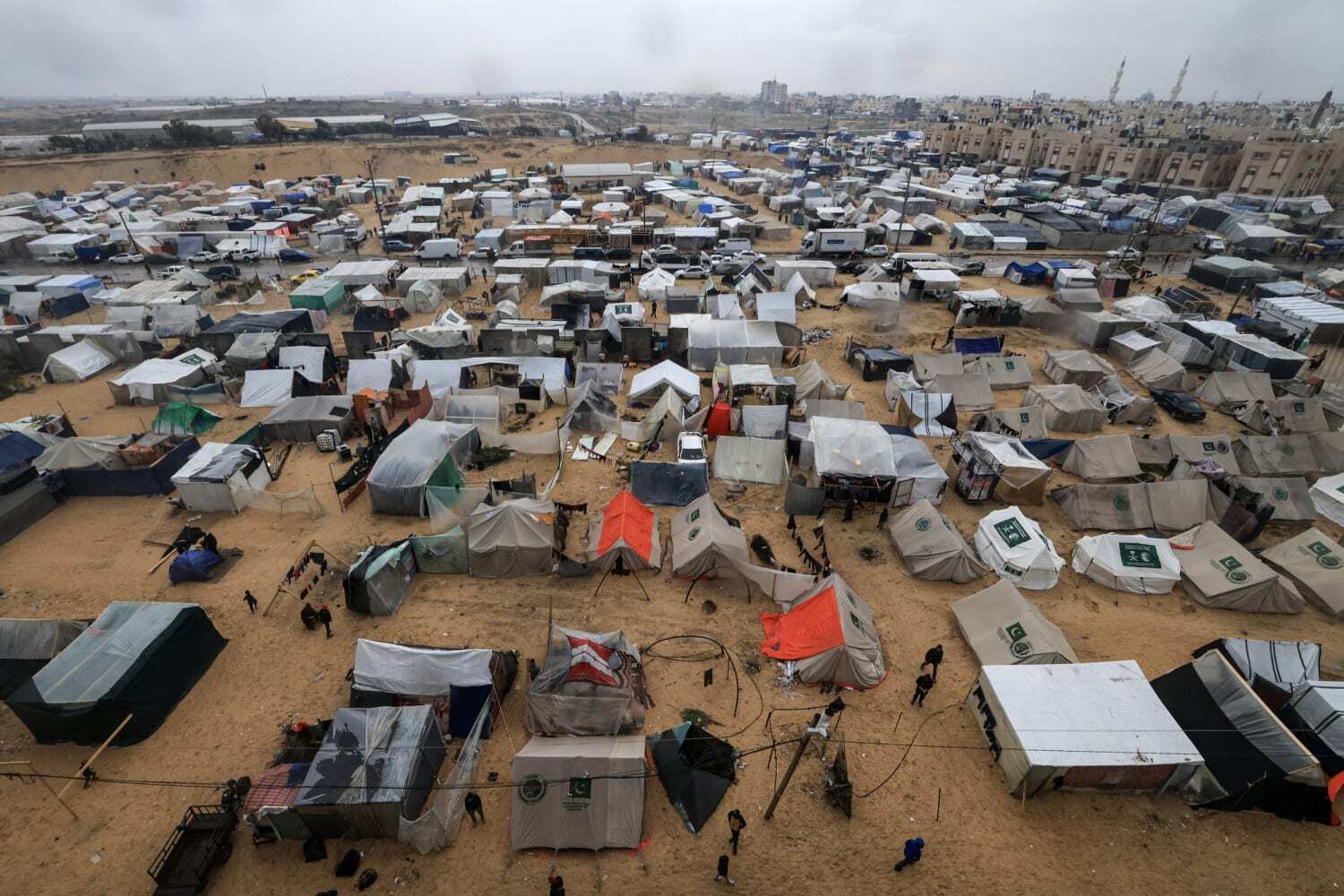
Across vast agricultural lands and along the coast in central and southern Gaza, tens of thousands of tents have become shelters for hundreds of thousands of Palestinians displaced by the ongoing, bloody Israeli war for the 10th consecutive month.
Once a symbol of the Nakba (catastrophe) and displacement for more than seven decades, the tent has now become a dream for thousands of displaced families in Gaza, despite the harsh living conditions it imposes.
What is it like to live in a tent? This question might seem devoid of emotions and disconnected from the harsh realities of Gaza amid the Israeli genocide that has taken many Palestinian lives but failed to break their will and determination to cling to their land. However, the question is crucial to understand the extent of the Palestinian tragedy and resilience.
The Palestinian Information Center (PIC) interviewed some of those that were displaced and are now living in tents to see the harsh situation they are now under.
Quest for a tent
Whilest all those interviewed speak of the difficulty of living in a tent – suffering the harsh hot summers and cold winters – for many of the displaced, the tent has become a dream come true as it is easily hoisted and dismantled quickly. This is important for those displaced who needed to move more than once because of the Israeli army gunfire, tanks, drones and warplanes.
Mohammed Said said he bought a tent for 1,200 shekels ($330) after he could no longer bear living in a “khas,” a makeshift shelter made of wooden sticks covered with nylon or any other available material.
He explained a khas provides no privacy because of the mostly nylon material its made of and its impossible to move when forced to relocate. Thus, he went for a tent, having relocated at least twice already.
Various NGOs provide tents for free, but with demand shooting up some of the tents have started to be sold, forcing people to buy them due to the lack of alternatives. Today tents vary in shape and size, according to how much you want to pay.
Finding a place to set up the tent
After getting a tent, the second challenge is to find a place to set it up. Such areas are currently limited to around Khan Yunis and Deir al-Balah.
Khaled Al-Masri said he had to move his tent several times to be close to water sources and/or the scarce aid.
“Today, there are camps made up of a group of tents overseen by an association or individuals’ initiatives to provide some aid, ensure water access, and establish shared bathrooms. Other tents are set up randomly on agricultural land and near destroyed homes,” he said.
Life in the tents
Living in tents are tales of pain and suffering, varying according to the family’s resources, number size, tent location and the supervising entity.
A small family with a tent in an area receiving aid can adapt better and suffer less compared to an extended family with a small tent in an area lacking in services.
With the scorching summer heat, living in a tent among hundreds of others in Gaza feels like a living hell said Amani Hamdan.
Hamdan told PIC she was forced to live in a tent on a land of a friend of her husband. She is joined by her mother-in-law, disabled sister-in-law and her four children.
“We relocated at least seven times from Khan Yunis since our house was bombed. Initially, we had no tent and suffered much until we managed to obtain one, and its only advantage is it can be unhooked easily if we need to move again.
Living in a tent is harsh and difficult, a primitive life. And with no walls, and privacy, our voices reach the people in the tent next door and theirs reach us,” she added.
Suffering in tents
“We can hardly move around inside the tent, some sleep on mattresses, some without, part of the tent holds food supplies. The temperature is scorching, forcing us out of the canvas. In winter, we were drenched by rain; now, the heat is unbearable, but we thank God for what we have,” Hamdan added.
“We cook on fire outside the tent, bake bread in a shared oven, share a bathroom, and bathe rarely, needing prior coordination with the other tent partners. The children start their morning search for wood, while my husband travels long distances for water that is sometimes brought by volunteers. Life has become primitive with no kitchen, bathroom, or water faucets.”
What is a tent?
After enduring the harsh tent life for months, engineer Mohammed Munir wrote about its meaning, “To burn while sitting inside, to suffocate with no air or cooling. It’s like a greenhouse during the day.”
“A tent means living on the ground, separated only by fabric, coexisting with all the insects of the earth as you are now their guest,” He wrote on Facebook.
“Normal activities become complicated, like taking a nap or a bath, walking comfortably, sitting peacefully, feeling safe, or sleeping without back pain from the hard ground, all of our dreams are now out of reach.
A tent means no privacy, speaking in whispers inside your tent while your neighbor hears you. With tents set up on sand and agricultural land, it means living with all types of insects and with no hygiene,” Munir concluded.
The meaning of a tent
“A tent means having no wall to lean on, no private life,” Sama Hassan wrote.
“Displacement means not to live in safety or stability. We first moved from Gaza City to the north in search of ‘fake’ safety until the missiles to land on us. We then fled to southern Gaza in the first Friday of the war and stayed in Khan Yunis for two months, then moved to Rafah when the city was invaded in early December 2023.
With each relocation, I lost a thread of my privacy, becoming more displaced and homeless like thousands in Gaza. A tent is harsher than a shared room in a stranger’s house as the bathroom is either within the tent, set up primitively, or shared, half a kilometer away, established by a charity. If a woman needs to use it at night, she must wake a man to escort her,” she ended by saying.
Life in a tent is hard for women, who must fully dress as they usually do when they go out of the house. She maintains dressed at all time despite the heat, lack the freedom of movement. In the tent, fires are lit, cooking is made, washing dishes, with large water containers placed in the corner.
Bathing in a tent involves women surrounding the one washing with thick blankets, like forming a small tent within the main tent, with the woman hurrying before the others tire of holding the blankets.
If living in a tent is already insufferable, doing so amid the ongoing Israeli genocide and bombings is even more so, because the strikes continue targeting as what happened to us in Rafah and Khan Yunis. This is beyond words.
In recent months, Israeli bombs have burned tents and killed dozens, leaving survivors to search for the remains of their their loved ones before finding a new place to set up another tent if one is available, continuing their struggle.

 CrossFireArabia