‘All Attempts at Displacing Gazans Failed’ – A Historical Outline

By Ismael Al Sharif

One of the most widely circulated press items in the Gaza War was a photo in Al-Dustour daily in its 11 March, 1971 edition under an “Evacuation of the Gaza Strip Begins,” headline. This image traveled around the world, confirming the importance of print journalism and its continued role as a primary source of information for documenting events, and its enduring presence despite digital developments.

Al-Dustour witnessed pivotal moments in the repeated attempts to empty Gaza of its population. The idea of ​​displacing the residents of the Strip began in the early 1950s, when a number of military personnel, bureaucrats, and senior UNRWA officials met and took out old maps to discuss possible displacement destinations. After lengthy discussions, it was decided to push Gaza’s residents toward the vast, sparsely populated Sinai Desert.

The plan targeted the displacement of approximately 60,000 people, equivalent to a quarter of Gaza’s population at the time. Despite the start of preparations, the idea was met with categorical rejection by the residents of the Gaza Strip, who clung to their land and refused to leave.

In 1956, the Zionists occupied the Gaza Strip during the Tripartite Aggression against Egypt. David Ben-Gurion, along with senior military commanders, attempted to forcibly displace the population of the Strip to the West Bank and Sinai. However, pressure from the United States prevented the plan from being implemented and the attempt was foiled. A year later, the occupation was forced to withdraw from Gaza.

In 1967, Moshe Dayan devised a plan aimed at forcing as many residents of the Gaza Strip as possible to emigrate to the West Bank and Egypt. Some residents were eventually deported to the West Bank, but the plan did not achieve the desired results, as relatively few residents left Gaza.

In 1971, while the late Yitzhak Shamir was serving as military governor of the Gaza Strip, he decided to forcibly displace the population. He bulldozed thousands of homes and forced a number of residents onto buses and transported them to the city of Al-Arish. But the plan failed, as the population quickly returned to Gaza, supported by pressure from Arab countries and major powers, which prevented the plan from being fully implemented.

With all attempts at direct displacement having failed, the Zionists found themselves in a predicament; neither killing nor enticement persuaded the people of Gaza to leave their homeland. The occupation then changed its strategy, devising a plan to systematically and slowly destroy Gaza through siege, starvation, and repeated military escalation. Once again, however, the Gazans foiled the plan and held their ground, refusing to leave.

In 1992, the “Greater Gaza” project was proposed during the term of Yitzhak Rabin. Secret plans were drawn up to impoverish the Strip, making life there nearly impossible, and drive its residents to emigrate to Sinai. However, this plan, too, failed.

In 2004, then-Shin Bet chief Avi Dichter devised a plan bearing his name, believing he had found the ideal solution to displace the population of Gaza by encouraging what he called “voluntary migration,” particularly to European and Gulf countries. However, this plan also failed, and the people of Gaza remained steadfast in their land, refusing to leave.

In 2014, the Israeli occupation relaunched its first plan, seeking to remove the border between Egypt and the Gaza Strip and push the population of the Strip toward Egyptian territory. However, Egypt confronted and thwarted this plan, preventing it from achieving its goals.

Then came the Trump administration’s so-called “Deal of the Century,” which included unofficial clauses regarding the transfer of Palestinians from Gaza to Sinai. The US administration exerted pressure on Cairo to implement this plan, but Egypt categorically rejected it, also leading to its failure.

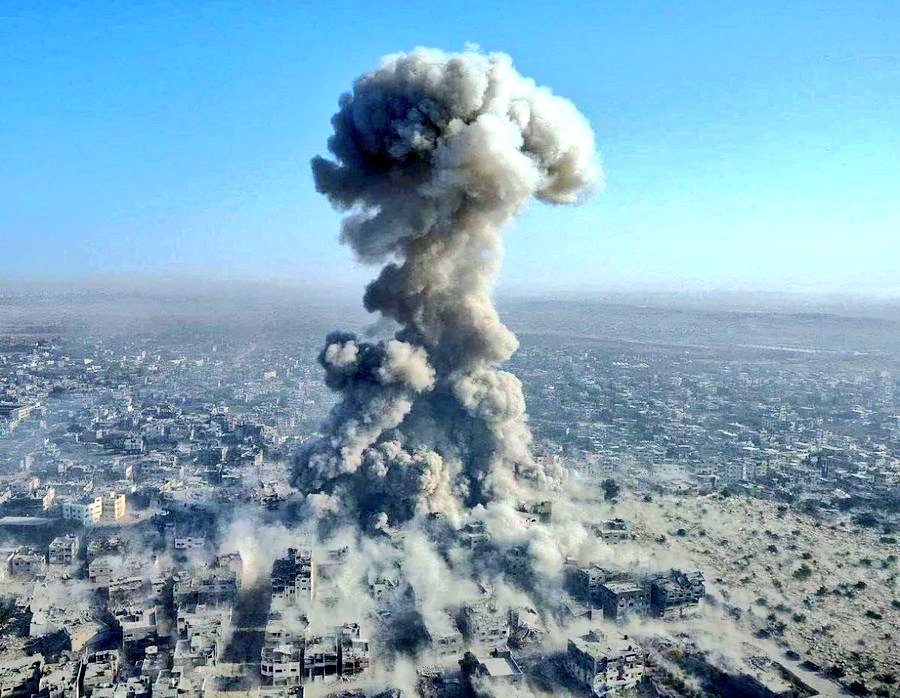
Then came the Al-Aqsa Intifada, which Israel exploited to carry out the largest genocide ever carried out, with the aim of displacing the people of Gaza. It practiced murder and siege, cutting off their basic necessities of life, hoping to force them to leave. However, despite the brutality of the aggression, Gaza stood firm, thwarted the plan, and emerged victorious with its unbreakable will.

Trump returned once again to revive his plan, this time attempting to displace the people of Gaza through what he called “soft displacement.” However, he clashed with a tough king who firmly confronted this plan and rejected it without hesitation.

The Zionist entity, with American support, failed to adhere to the temporary truce with Hamas, and the war of extermination resumed, amid a stifling siege, famine, and a scarcity of water and medical services.

Over the decades, the Zionist entity attempted to exterminate and displace the people of Gaza, sometimes by force and sometimes by enticement. But Gaza stood firm, and the banner of steadfastness was passed down from generation to generation. Just as this banner was passed down from generation to generation, so too was the banner of defending the holy sites, passed from one Hashemite king to the next.

The commandments of our forefathers became ingrained in our conscience: to always stand with Palestine. Over these long years, Al-Dustour newspaper has stood with the Palestinian cause, exposing the enemy’s schemes and mobilizing support and backing for justice. Al-Dustour has been a witness to history, conveying Gaza’s voice and echoing its steadfastness. At every critical moment, it was present, documenting, exposing, and defending the truth without hesitation.

A day will come, decades from now, when future generations will pass on images from Al-Dustour’s editions that documented this phase of the conflict with the enemy, testifying to Gaza’s steadfastness and the resilience of its people in the face of attempts at genocide and displacement. Just as Al-Dustour has always been present in the battles of steadfastness, Gaza will remain engraved in its conscience: An immortal story and an indelible symbol.

Ismael Al Sharif is a columnist in Ad Dustour newspaper in Jordan.

Continue reading
S. African Ambassador Gets Huge Welcome After Expulsion by Trump

The South African ambassador, expelled and declared persona non grata by the Trump administration, received a hero’s welcome upon his return to Cape Town on Sunday, with hundreds of supporters waving Palestinian flags and chanting “Free Palestine.”

The crowds at Cape Town International Airport surrounded Ebrahim Rasool and his wife as they emerged in the arrivals terminal in their hometown.

“A declaration of persona non grata is meant to humiliate you,” Rasool told the supporters as he addressed them with a megaphone. “But when you return to crowds like this, and with warmth… like this, then I will wear my persona non grata as a badge of dignity.”

“It was not our choice to come home, but we come home with no regrets.”

Rasool also said it was important for South Africa to fix its relationship with the US after President Donald Trump punished the country and accused it of taking an anti-American stance even before the decision to expel Rasool.

Rasool was previously declared persona non grata. His return comes as US President Donald Trump has cut all funding to South Africa, a move widely seen as retaliation for Pretoria’s case at the International Court of Justice (ICJ), where it has accused Israel of genocide in Gaza.

They were the ex-ambassador’s first public comments since he was declared persona non grata, removed his diplomatic immunities and privileges, and gave him until this Friday to leave the US. It is highly unusual for the US to expel a foreign ambassador.

Rasool was declared persona non grata by US Secretary of State Marco Rubio in a post on X on March 14. Rubio said Rasool was a “race-baiting politician” who hates the US and Trump.

Rubio’s post linked to a story by the conservative Breitbart news site that reported on a talk Rasool gave on a webinar organized by a South African think tank. In his talk, Rasool spoke in academic language of the Trump administration’s crackdowns on diversity and equity programs and immigration and mentioned the possibility of a US where white people soon would no longer be in the majority.

“The supremacist assault on incumbency, we see it in the domestic politics of the USA, the MAGA movement, the Make America Great Again movement, as a response not simply to a supremacist instinct, but to very clear data that shows great demographic shifts in the USA in which the voting electorate in the USA is projected to become 48% white,” Rasool said in the talk.

On his return home Sunday, he said he stood by those comments, and characterized them as merely alerting intellectuals and political leaders in South Africa that the US and its politics had changed.

“It is not the US of Obama, it is not the US of Clinton, it is a different US and therefore our language must change,” Rasool said. “I would stand by my analysis because we were analyzing a political phenomenon, not a personality, not a nation, and not even a government.”

He also said that South Africa would resist pressure from the US — and anyone else — to drop its case at the ICJ accusing Israel of genocide. The Trump administration has cited that case against US ally Israel as one of the reasons it alleges South Africa is anti-American.

South Africa filed a case at the ICJ in December 2023, which accuses Israel of violating its obligations under the Genocide Convention in its war on the Gaza Strip. More than 10 countries have since joined South Africa in the genocide case.

Some of the supporters welcoming Rasool, who is Muslim, waved Palestinian flags and chanted “free Palestine.”

“As we stand here, the bombing (in Gaza) has continued and the shooting has continued, and if South Africa was not in the (International Court of Justice), Israel would not be exposed, and the Palestinians would have no hope,” Rasool said.

“We cannot sacrifice the Palestinians… but we will also not give up with our relationship with the United States. We must fight for it, but we must keep our dignity,” according to the Quds News Network.

Continue reading
Saudis Say No to Israeli Displacement Agency

Saudi Arabia on Monday condemned Israel’s announcement of establishing an agency aimed at displacing Palestinians from the Gaza Strip.

In a statement, the Saudi Foreign Ministry also denounced “the approval of the separation of 13 illegal settler neighborhoods in the West Bank, paving the way for their legitimization as colonial settlements.”

Saudi Arabia reiterated its “unwavering rejection of Israel’s continuous violations of international law and international humanitarian law.”

The Kingdom further stressed that “lasting and just peace cannot be achieved without the Palestinian people obtaining their legitimate rights in accordance with international legitimacy resolutions, and the establishment of an independent Palestinian state on the 1967 borders, with East Jerusalem as its capital.”

Israel’s Security Cabinet has approved the formation of a directorate to encourage what it called the “voluntary departure” of Palestinians from the war-ravaged Gaza Strip.

Defense Minister Israel Katz said in a statement late Saturday that the new directorate will work to “prepare for and enable safe and controlled passage of Gaza residents for their voluntary departure to third countries.”

Katz’s office said the new administration will be responsible for establishing movement routes, checking pedestrians at designated crossings in Gaza, and coordinating the provision of infrastructure that will enable passage by land, sea, and air to the destination countries.

Trump has repeatedly called to “take over” Gaza and resettle its population to develop it into a tourist destination. His plan was rejected by the Arab world and many other nations, who say it amounts to ethnic cleansing according to Anadolu.

The Israeli army launched a surprise aerial campaign on the Gaza Strip on March 18, killing at least 730 people and injuring nearly 1,200 others despite a ceasefire and prisoner exchange agreement that took hold in January.

Over 50,000 Palestinians have been killed, mostly women and children, and more than 113,000 injured in a brutal Israeli military onslaught on Gaza since October 2023.

The International Criminal Court issued arrest warrants last November for Israeli Prime Minister Benjamin Netanyahu and his former Defense Minister Yoav Gallant for war crimes and crimes against humanity in Gaza.​​​​​​​

Israel also faces a genocide case at the International Court of Justice for its war on the enclave.

Continue reading
Netanyahu’s Trap!

The already fragile ceasefire in Gaza was further shattered as Israeli Prime Minister Benjamin Netanyahu declared that Israel had “resumed combat in full force” against Hamas in the Gaza Strip on March 18, during the Muslim holy month of Ramadan. In the hours following Netanyahu’s announcement, Israeli airstrikes – which had already been routinely violating the ceasefire in recent weeks – killed more than 400 Palestinians, including a significant number of children. Later that day, Israeli forces launched a new ground offensive, reportedly killing at least 48 more Palestinians, according to local health workers.

Vowing to eradicate Hamas, Netanyahu described the renewed phase of state terrorism as “just the beginning”. Meanwhile, Israeli sources confirmed that the assault was conducted in “full coordination” with the United States. Also on Wednesday, Israel carried out an attack on a UN facility in central Gaza City, killing a foreign staffer and wounding five others. Jorge Moreira da Silva, Executive Director of the UN Office for Project Services, condemned the strike, stating: “Israel knew this was a UN compound where people were living and working. It is a well-known location.”

From the outset, Netanyahu’s office has justified the assault by accusing Hamas of preparing new attacks, refusing to release hostages, and rejecting all proposals put forward by US presidential envoy Steve Witkoff and other mediators. At the UN Security Council meeting on Gaza, convened just hours after the renewed Israeli offensive, the US envoy placed exclusive blame on Hamas for the collapse of the ceasefire. According to the Israeli government, approximately 59 Israeli captives remain in Gaza, with fewer than half believed to be still alive. Hamas, however, denied rejecting the US envoy’s proposal, accusing Netanyahu of deliberately resuming hostilities to sabotage the ceasefire agreement. The group characterized Israel’s actions as a “unilateral” annulment of the existing deal.

Arab countries, including Egypt and Qatar – both key mediators in the peace negotiations – have strongly condemned Israel’s latest military escalation. On March 20, the US State Department reaffirmed the “bridge proposal” put forward by the US President Donald Trump’s administration last week. It aims to extend the first phase of the ceasefire and hostage release agreement between Israel and Hamas, and remains on the table. Given this backdrop, the question arises: What is driving Netanyahu’s genocidal ambitions?


A zero-sum game?

Netanyahu appears to be maneuvering to reduce the original multiphase ceasefire agreement to just its first phase, securing the release of all Israeli hostages before resuming his military campaign in Gaza. Hamas, however, recognizes the trap. At present, neither the US nor mediators like Egypt and Qatar can offer Hamas any guarantees that if it releases all remaining hostages – both dead and alive – Israel will commit to entering the second phase of the agreement.

It is worth recalling that Israel had already delayed negotiations for the second phase, which was initially scheduled to begin 16 days after the agreement took effect. By the time phase one was set to conclude on March 1, Israel had refused to advance talks, effectively stalling the diplomatic process.

Since March 2, Israel has taken increasingly punitive measures against Gaza. According to the UN, it has blocked the entry of all lifesaving supplies, including food, medicine, fuel, and cooking gas, affecting 2.1 million people. It has also sealed off all crossing points and, on March 9, ordered a complete shutdown of Gaza’s electricity supply. The blackout has severely impacted desalination plants, which provide clean drinking water to some 600,000 people. Yet, despite these actions, Israel continues to evade accountability for its collective punishment of Gaza’s population.

What is Israel’s endgame for Gaza?

Israel appears to be accelerating efforts to implement what some critics describe as a plan to radically reshape Gaza’s demographic and political future. Netanyahu, frustrated by his failure to eliminate Hamas and achieve clear strategic objectives, is pampered by Trump’s proposal to “take over” and “own” the Gaza Strip. At present, Netanyahu is exploiting the geopolitical status— including high-level talks between Trump and Russian President Vladimir Putin over Ukraine and the US military campaign against the Houthis in Yemen—which have diverted international attention away from Gaza. This distraction provides him with an opportunity to escalate the attacks with fewer diplomatic constraints.

However, Netanyahu’s thirst for blood is not only deepening the humanitarian catastrophe in Gaza but also exacerbating regional tensions, pushing the Middle East toward prolonged instability. His actions risk triggering wider spillover effects, particularly in Lebanon and Syria, and further escalating an already volatile landscape. The pressing question remains: does Israel have a long-term strategy for Gaza, or is it merely waging a campaign of destruction with no viable political exit strategy? Another crucial consideration is, following their emergency summit in Cairo on March 4, how will the Arab League reconcile Egypt’s reconstruction plan with Israel’s relentless aggression?

The urgency of a concerted diplomatic and strategic effort to curb Israeli aggression and expansionism cannot be overstated. Without immediate intervention, the entire region will bear the long-term consequences of unchecked military escalation and political destabilization.

Serhan Afacan is associate professor at Marmara University’s Institute for Middle East Studies and president of Center for Iranian Studies (İRAM).

Continue reading
In a Psychedelic Arab World

Dr Khairi Janbek

The Arab world has been for some time now like a theme park with all the trappings. There are zones of fun and entertainment, with bright lights, cafes and restaurants with people living in them whilst other zones stand like halls of mirrors with distort images, chambers of horror, and ghost trains with their own population.

The ones who run both zones tend to be standing outside them frequently greeting each other. But the people of the entertainment zone are always wary that the people of the other zone may envy them, so they give them enough to let them carry on with their lives as best as they can.

The obsession with the geographical and civilizational unity of the Arab world has always inflated expectations of Arab solidarity as a tool to solve the problems of Arab societies ranging from economic development and good governance, to conflict resolution.

As the expectations go unmet, popular frustration at the weakness of one nation, prompt further calls for solidarity accompanied with anger from the other Arab people, however, it seems, and for all intents and purposes, the pan-Arab hopes seem to be always unreasonable. In fact when the colonialists thought that the Arab peoples should be grateful to each have their own nation-states across the geographical span, the Arab peoples, as a whole, felt cheated for not having a single, one-state to represent them.

As for the current Palestinian tragedy, its roots in recent terms have been planted in 1974, when the late King Hussein was put under extreme pressure to accept the notion that, the PLO, being the sole representative of the Palestinian people, in other words transferring the Arab burden of the Palestinian problem to the shoulders of the late Yasser Arafat.

Of course, one is not going to repeat the horrors which came after that regarding this issue, but the idea that the Palestinian issue being an Arab cause, ended there and then. The Palestinian issue went from being a political issue, to a mere human rights concern, with the option for the Arab states to support according to the levels of anger expressed by their own populace regarding the Palestinian people’s plight.

It was Saddam Hussein’s invasion of Kuwait in 1990 that struck the final nail in the coffin of the illusion that there can be an Arab solution to Arab problems, but even this illusion did not apply to the Palestinian problem, because that concern was gone almost two decades earlier.

So today, it is natural for sympathy for the Palestinians to direct its call to the international community to react, because frankly this is the only quarter which can do something, whatever it may be, because the realization had set in from before that the Arabs will not do anything.

We live in times now, in which no Middle Eastern regime, in addition to those having a state within a state inside them, will be ever permitted to ever threaten Israel by the Trump administration, be that through the threats of dividing countries, or in throwing them to the jaws of poverty and destruction through economic extortion; in fact, we are in the era of enforced ugly peace.

Dr Janbek is a columnist based in Paris France.

Continue reading