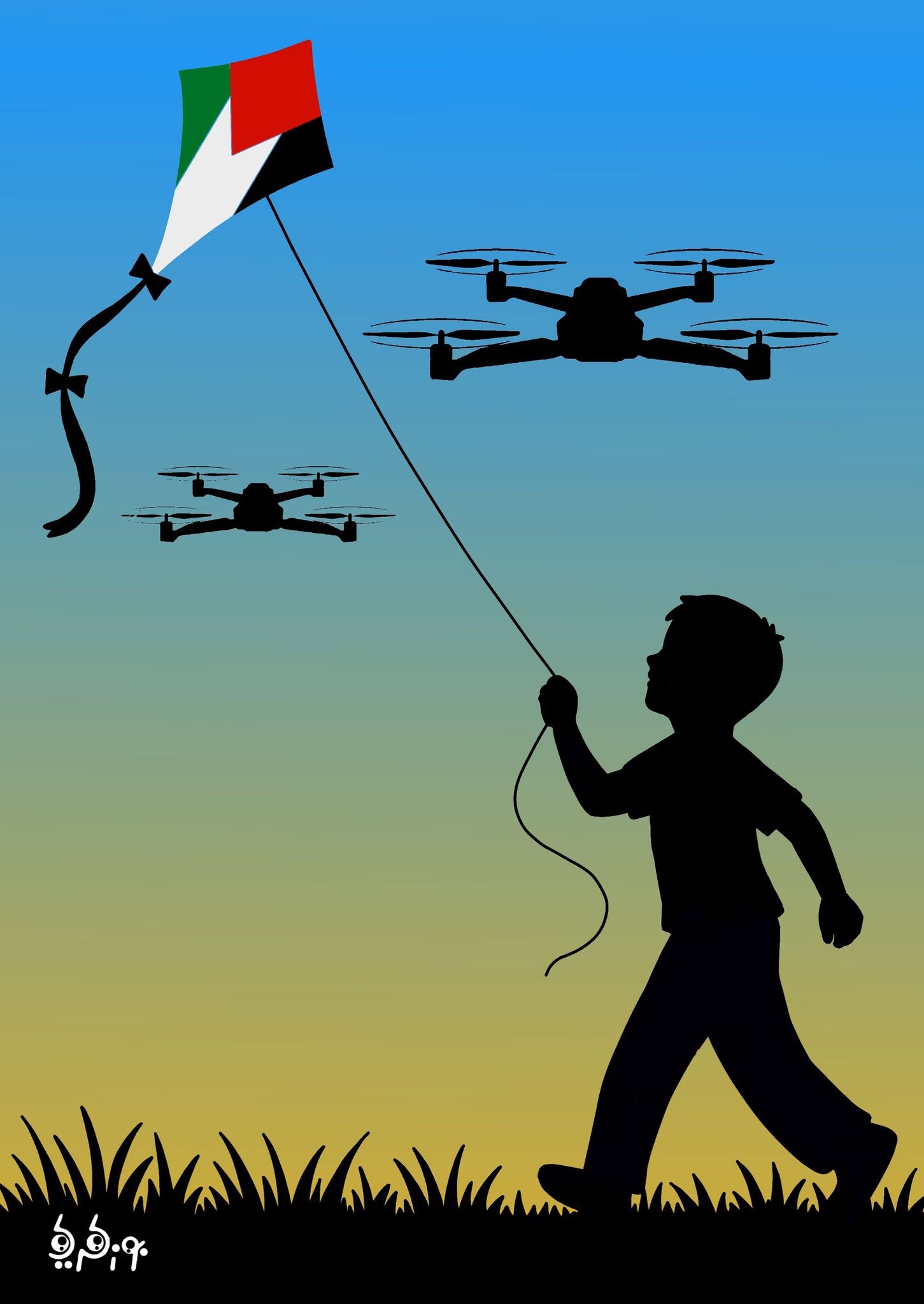
Trump and The Oil Jar  

By Rashad Abu Dawood 

 A long time ago when our mom wanted to send us to sleep she would always tell us the story of the ‘oil jar’.

She would start by saying: Should I tell you about the oil jar? We’d say in one voice: Yes, tell us. She would repeat: Should I tell you it or not…the story of the oil can and we would plead again: Yes. But every time, the affirmation would sink lower as we would yawn incessantly till we fell sleep.

https://www.addustour.com/articles/1521982

As we grew up we found there was no story to tell, she would repeat the oil jar tale so that we forget and go to sleep. I remember the story as I follow the news on the Trump’s mysterious 20-point plan on Gaza; there is no point among the 20 that are clear except the one on the handover of the hostages. The rest need astrologers and psychologists to decipher.

And there are others that say the plan is a “Trumpian trap” coordinated with Benjamin Netanyahu to free the hostages from the grip of Hamas while there there is no exact date for the Israeli withdrawal from Gaza, no time detail for the entry of aid to the enclave to help the starving people and most important there are no guarantees to the Palestinian side that everything would be ok.

The only guarantee is that of Trump; there is no UN, no Russia, no China, the biggest powers on the international scene. There is no Security Council whose Article 7 emphasizes the use of military force against the party that opposes the execution of the agreement.

Unfortunately, the US president is not a man of his word. He says something and says the exact opposite the same day and even in the same sentence. This what is the meaning of “peace through strength?” We understand that peace is derived through negotiations; And what about the meaning of “Hamas must agree are face the gates of hell”.

Gaza has experienced: Trump has not kept to his promises for when the US hostage Eidan Alexander was released last May Trump praised the Hamas step, regarding it as a goodwill gesture towards the US. He saw the release as a “historic day” on the way to end the barbaric war on Gaza.

But what happened to this historic day as described by the US president? The Netanyahu government become a wild beast with the Israeli army killing on average 100 Palestinians a day and with those injured double that number not to say anything about the starvation of tens of thousands.

The Israeli army increased its force on the enclave, invaded Gaza City and today it controls 80 percent of the enclave. We have no choice but to pretend that we believe in Trump and see what’s going to happen next and have to wait to see the outcome of his statements as the fairytale about the oil jar.

This opinion was written by originally written in Arabic.

Continue reading
Hamas, Trump and The Gaza Gamble

By Dr Khairi Janbek

One can only have a distant view of the current developments regarding the war on Gaza, and consequently in all honesty, a bird’s eye view of the situation. For all intense and purposes, one assumes the Hamas acceptance of plan presented by US president Donald Trump would represent extremely high-stakes gamble for them.

On the one hand it offers a pathway to end the bloodshed and set the road for reconstruction of the bludgeoned Gaza Strip. On the other hand, the plan demands existential concessions, loss of armaments, leverage, and an an end to the movement’s future. If Hamas accepts with sincerity, and the plan is implemented faithfully, it could mark a turning point towards stabilization, but also with risks of breakdown, backlash, internal splits, and which carry the warnings of a precarious road ahead.  

It is important in the meantime to advise against the search for victors and/or the vanquished, because in this time and age, wars do not seem to be launched in order to be decisive, and the view of the Gaza war is no different.  Essentially it is to be believed and cardinal to the Trump administration, the issue of arms pertaining to Hamas and Hezbullah are seen as obstacles to peace and to Israel’s normalization with the Arab world. Therefore, the objective, one imagines, is to eliminate those arms to the American administration which has wider objectives in this crucial region of the world.

Here, as well, one has to be careful with words. Is Hamas supposed to surrender all of its weapons, or will there be an accommodating plan for the Islamic movement to keep some of its weapons, so long as it is not seen to constitute any future threat?

On the other side of the equation, are we really at the juncture of seeing the total end of Hamas as an organisation? In other words, are we about to see an amnesty for the Hamas fighters, especially those who surrender their weapons and are willing to partake in the future plans for Gaza away from those who wish to leave and to be provided with a safe passage outside the Gaza enclave?

Or is there a plan within the plan. if indeed, the Trump plan is not in essence a diktat, will there be long and tedious negotiations that will accept a form of political participation for a future-transformed Hamas into less than a political organization and more than an NGO?

Then what about the role of the Arab and Islamic countries, whose leaders met with Trump during the last UN General Assembly and who subsequently welcomed Hamas acceptance of the Trump plan? After all, there is the supposition that Arab and Islamic countries will provide, if not brain, then money and brawn. Essentially, without Arab and to a lesser extent Islamic involvement, no plan will have a leg to stand on. But to what extent the Arabs are willing to get involved still remains to be seen.

Dr Janbek is a Jordanian writer based in Paris.

Continue reading
Trump: ‘This is a Great Day’

The White House broadcast a recorded clip of US President Donald Trump commenting on the statement by the Islamic Resistance Movement (Hamas) agreeing to a proposal to cease the war on the Gaza Strip.

Trump said: “This is a great day, and we’ll see how things play out, and I very much look forward to the return of the hostages to their families.”

Trump added: “I want to thank the countries that helped with the Gaza issue, such as Qatar, Turkey, Saudi Arabia, Egypt, Jordan, and others. I thank the great countries that helped with Gaza, and we received a tremendous amount of support.”

Trump emphasized that “everyone was united in their desire to end the war and see peace in the Middle East, and we are very close to achieving that.”

Jo24

Continue reading
Released Captive Edan Alexander Rejoins Israeli Army

Edan Alexander, an Israeli-American soldier released from imprisonment, announced he will return to Israel next month to rejoin the Israeli military as it continues its genocide in Gaza.

Alexander spent 584 days in inprisonment, which he called “the hardest period of my life.” At a press conference, he said, “My story does not end with survival, it continues in service until victory!”

He added, “Next month, God willing, I will return to Israel and once again wear the IDF uniform, and I will proudly serve alongside my brothers.”

Alexander’s release came as part of mediation efforts to reach a ceasefire, open Gaza’s crossings, and allow humanitarian aid into the besieged territory. Hamas resistance movement had described the release as a gesture of “positivity and high flexibility” and urged international actors, including the US, to build on it to secure a full agreement.

Alexander grew up in the United States and joined the Israeli military at 18. He volunteered as a colonizer and served in the Golani Brigade out of ideological commitment according to the Quds News Network.

Continue reading
Israel’s Mideast Message

By Dr Maisa Al Masri

“This is a message to the entire Middle East,” Israeli Knesset Speaker Amir Ohana said in response to the Israeli airstrike that targeted Hamas leaders in the heart of the Qatari capital, Doha.

However, this statement is not merely a comment on the military operation strike into a declared strategic message, telling the entire region, and primarily the Gulf, that Israel, in partnership with Washington, has become the master of the decision-making process in the region.

Ohana’s statement is an explicit and direct threat that leaves no room for interpretation,  reflecting the new deterrence doctrine adopted by Tel Aviv: No red lines, no geographical immunities, and no Western allies outside the confines of Israeli dictates. Simply put, anyone who disagrees with us becomes a legitimate target, even if they are in the heart of a friendly capital that hosts the largest American military base.

This makes for a dangerous conclusion: Israel no longer views the Gulf states as partners in stability, but rather as “open arenas for fiery messages.” Washington is blessing the silence, participating in complicity, and mocking the Arabs.

Naked dominance

And don’t forget the Israeli crime in the heart of the Gulf marks the beginning of a new era of naked dominance. It’s not a traditional security operation, but a pivotal turning point in the rules of regional engagement, in which Qatar has been embarrassed both on the Arab level and internationally.

Israel has now publicly placed itself in a circle (no longer concealing its intentions) – through bombing and military strikes – that it no longer sees a distinction between political geography and the theater of operations. More dangerously, the heart of the Gulf today has become openly subject to Tel Aviv’s fire. And who can challenge it?

The strike wasn’t an intelligence leak or a silent targeting, but a direct airstrike in an area teeming with embassies, schools, and residential buildings, in a country that is a major ally of Washington and a pillar of American security in the Middle East.

Thus the message has become clear to everyone: No one is above attack… no state, no sovereignty, no partnership.

The US administration, led by Donald Trump, evaded with a series of conflicting statements about its prior knowledge of the operation. But whether it knew and blessed it, knew and remained silent, knew too late, or did not know at all, the outcome is the same: The American cover was removed, Gulf confidence eroded, and billions perished. The statements of the US embassy in Doha did not go beyond expressions of caution to American citizens, while White House statements swayed between “regret over the location” to “understanding the goal of eliminating terrorism.”

I believe the opposite message was conveyed to the Gulf capitals: Your security is not a priority, and your sovereignty does not equate to a clear position from Washington. The question that now arises however is: Why Qatar? Why now? Why was the strike carried out in Qatar and not in Turkey, or Iran for example? This is despite the fact that the Hamas leaders that were targeted had just returned from Istanbul, suggesting Tel Aviv chose the location not arbitrarily but with deep political awareness. Tel Aviv did not pull the trigger in Istanbul, even though the targeted leaders passed through it only hours earlier.

Turkey, with all its military, political, and international complexity, is not a testing ground for Israeli madness. There are red lines that even Tel Aviv dares not cross… and Turkey is one of them. The potential Turkish military response, the internal Turkish explosion during a highly sensitive election season, and the delicate balance of power within NATO rendered Turkish territory “operationally closed” even to the most violent wings of Israeli decision-making. But when the targeted figures left Istanbul for Doha, everything changed.

Qatar, like other threatened Arab states, in the Israeli security and intelligence mindset, is merely an intermediate gray area, neither neutral nor classified as an “enemy,” potentially a shocking target at a low cost. This is something all Arab decision-makers should be aware of.

From Tel Aviv’s perspective, Qatar is balancing contradictory roles, managing mediation, funding aid, and hosting parties that anger Israel without possessing a genuine deterrent umbrella. There are no international calculations that could prevent a surgical strike carried out within hours. Merely hosting an American base does not make Doha “immune,” but may even further tempt Tel Aviv, proving that decision-making in the region is no longer solely in Washington’s hands but in Tel Aviv as well.

In short, Israel needed a platform to send the biggest message since the Gaza war… so it chose the weakest link, amid the silence of its strongest ally.

Here, we can pause a moment at the Knesset member’s statement that the operation was “a message to the Middle East.” This is not a slip of the tongue, but a strategic doctrine upon which future decisions are based. Israel is telling all countries in the region that whoever harbors Hamas, or even engages in dialogue with it, will be next.

If the Arab states fail to take a firm political stand, the Doha precedent will be repeated elsewhere. It may not be Hamas’s mediation that stands accuse but rather the concepts of neutrality, balance, and even dialogue with parties Tel Aviv disapproves of and which then could become sufficient justification for a strike. It’s a policy of punishment.

This scene is posing existential questions for Arab capitals. If Qatar, Washington’s most important ally, is being bombed over the heads of its own people, after Syria, Lebanon, and Gaza… should we wait for Iraq’s turn? Riyadh? Abu Dhabi? Kuwait? And others? Does the American umbrella truly protect us, or is it used only when our interests intersect with Israel’s?

And what is the point of hosting American bases if they do not prevent airspace violations? Or provide protection?

What happened in Doha is pushing the region to crossroads: Either continuing its position of dependency and timid mediation, or repositioning strategically and developing independent air defenses, which is logistically difficult, or seeking alternative alliances (Ankara, Beijing, Moscow, Tehran?), and establishing red lines that Tel Aviv will not cross.

Qatar now faces difficult choices: Will it withdraw from the Hamas mediation? Will it demand real security guarantees? Will it go further, toward symbolic deterrence or unconventional partnerships? Or will it pay the price of protection once again?

Beware: A war of wills is beginning now. The Israeli airstrike in Doha was not just a blow to Hamas, but also a slap in the face to the sovereignty of the Gulf and the region, an undermining of the prestige of international law and its signed, ratified, and binding agreements, and an insult to the concept of the alleged strategic partnership with America.

This is the beginning of a new era, one in which Israel and Washington declare that the security of the region is no longer an Arab decision. The question now is: Will the Arabs as a whole wake up before “Ohana’s message” reaches other capitals? Perhaps.

The author is a political writer based in Amman Jordan and contributed this article to the Al Rai Alyoum Arabic website

Continue reading