The Cold Kills 11 Children in Gaza

The UN on Friday said the winter conditions in the Gaza Strip are turning deadly as 11 children have died of hypothermia, and renewed calls to lift Israeli restrictions on humanitarian operations.

Citing the Office for the Coordination of Humanitarian Affairs (OCHA), UN spokesperson Farhan Haq said at a news conference that “families in Gaza continue to face harsh winter conditions.”

He reported that “on Tuesday, another child reportedly died from hypothermia,” adding: “This is the eleventh child who has died this way since the beginning of the winter season, according to the Ministry of Health in Gaza,” according to Anadolu.

Noting that since October, “the UN and our partners have distributed tens of thousands of tents, providing shelter to over half a million people,” Haq stressed that “tents provide limited protection, especially during the rainy season.”

“We continue calling for more durable shelter solutions to limit people’s dependency on tents,” he added.

Haq also warned that food access remains fragile, saying: “Even with the improvements in food consumption this month, humanitarians stress that the entry of aid and commercial supplies must be sustained and further diversified.”

He said that efforts to address malnutrition have expanded, adding: “Humanitarians have expanded services through dozens of facilities established since the ceasefire.”

“We reiterate that restrictions on humanitarian operations must be lifted,” Haq said, calling on Israel to end “the ongoing ban on UNRWA” and urging that humanitarian partners be allowed to operate “without hindrance across the Gaza Strip and the West Bank, including East Jerusalem.”

Continue reading
‘Aid Trickle’ Mean People Die Before Reaching Hospitals

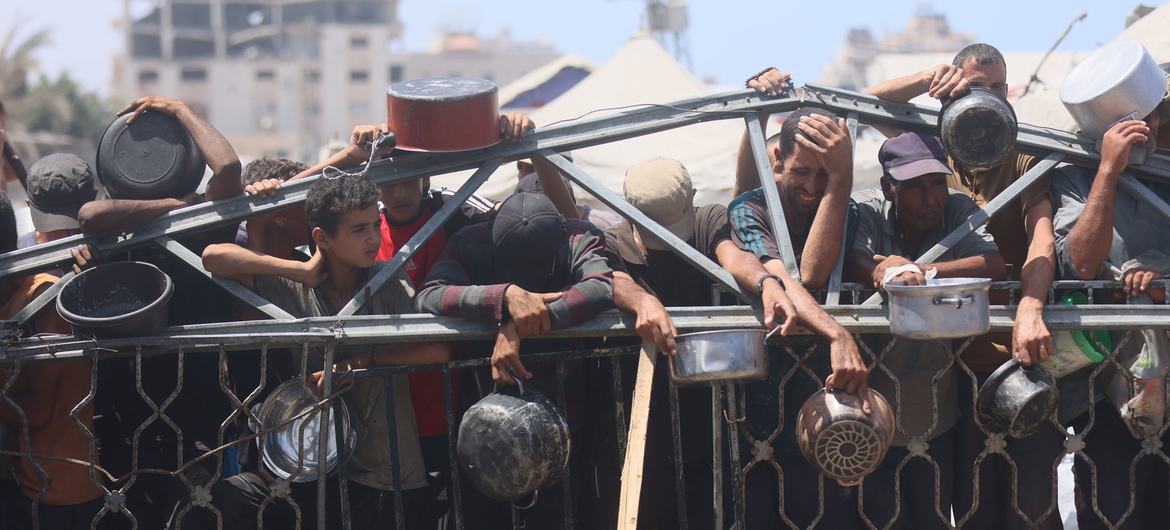
Children in Gaza are dying not just from hunger, but from the total collapse of the systems meant to protect them, UN agencies warned on Tuesday.

With 96 per cent of households lacking clean water, many malnourished children are not surviving long enough to receive hospital care.

James Elder, Spokesperson for the UN Children’s Fund (UNICEF), told a media briefing in Geneva that it would be a mistake to assume that the situation was improving.

There’s a sense through the world’s press that things are improving,” he said. “But unless there is sustained humanitarian aid…there will be horrific results.

He emphasised the scale of need: “When food comes in which supports 30,000 children, there are still 970,000 children not getting enough. It is a drop in the ocean.”

Aid still a trickle

The UN relief coordination office, OCHA, said that although unilateral pauses have allowed some aid into Gaza, the current trickle is vastly insufficient.

“There should be hundreds and hundreds of trucks entering Gaza every day, for months or years to come,” said Jens Laerke, OCHA spokesperson. “People are dying every day. This is a crisis, on the brink of famine.

Thousands of tons of pre-funded aid remain stuck just outside the enclave, he added, as bureaucratic delays and lack of safe access continue to block distribution.

Urgent scale-up needed

In New York, UN Deputy Spokesperson Farhan Haq also noted the impediments to bringing in and distributing sufficient aid.

“Massive food shortages continue to impact people’s chances for survival,” he said. “As malnutrition levels rise, children’s immune systems are weakened, hindering their development and growth far into the future.”

Last Thursday alone, 71 kitchens delivered over 270,000 hot meals across Gaza, including 10,000 to health facilities. But that figure falls far short of what’s needed to feed more than two million people.

We need an urgent scale-up of supplies, as well as an environment that allows humanitarians to reach people in need safely, rapidly and efficiently,” Mr. Haq added.

Health challenges continue

Some medicine has entered Gaza in recent days, but supplies remain limited. Health workers continue to operate under extreme pressure and shortages.

The World Health Organization (WHO) reported 46 cases of Guillain-Barré syndrome in July, including two deaths. The condition, which affects the nervous system, has been linked to compromised immunity, poor nutrition and hygiene-related infections.

The situation of pregnant women and nursing mothers is equally alarming. The UN reproductive health agency, UNFPA, said that 40 per cent of pregnant or breastfeeding women are suffering from severe malnutrition, with newborn deaths and stillbirths on the rise.

Meanwhile, three UN fuel tankers reached Gaza City on Monday. The fuel will power critical health, water and sanitation services, but OCHA stressed this only allows operations to run at “bare minimum” capacity according to UN News.

Continue reading