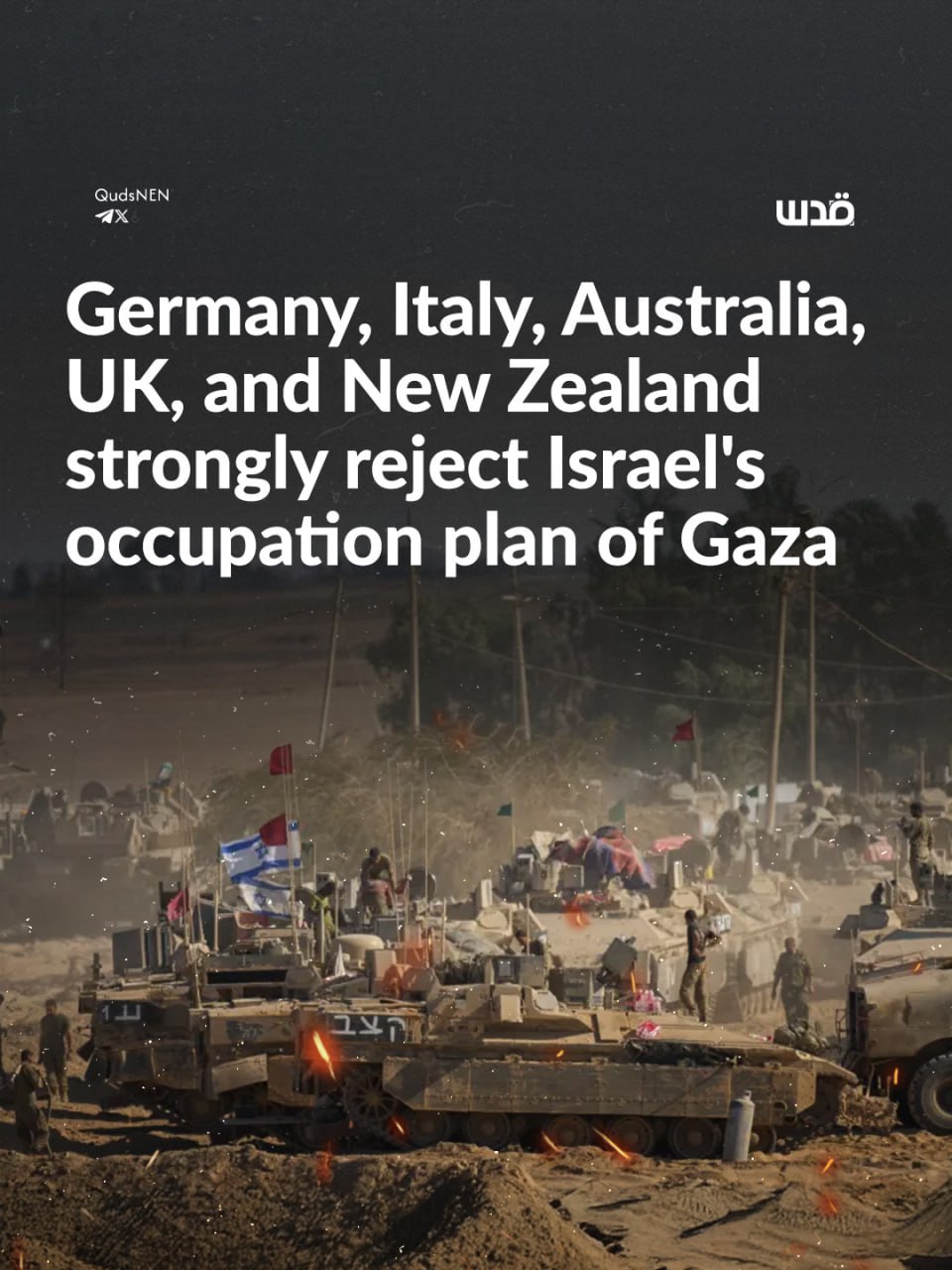
In a joint statement, the foreign ministers of Australia, Germany, Italy, New Zealand, and the United Kingdom strongly condemned Israel’s decision to occupy the Gaza City.
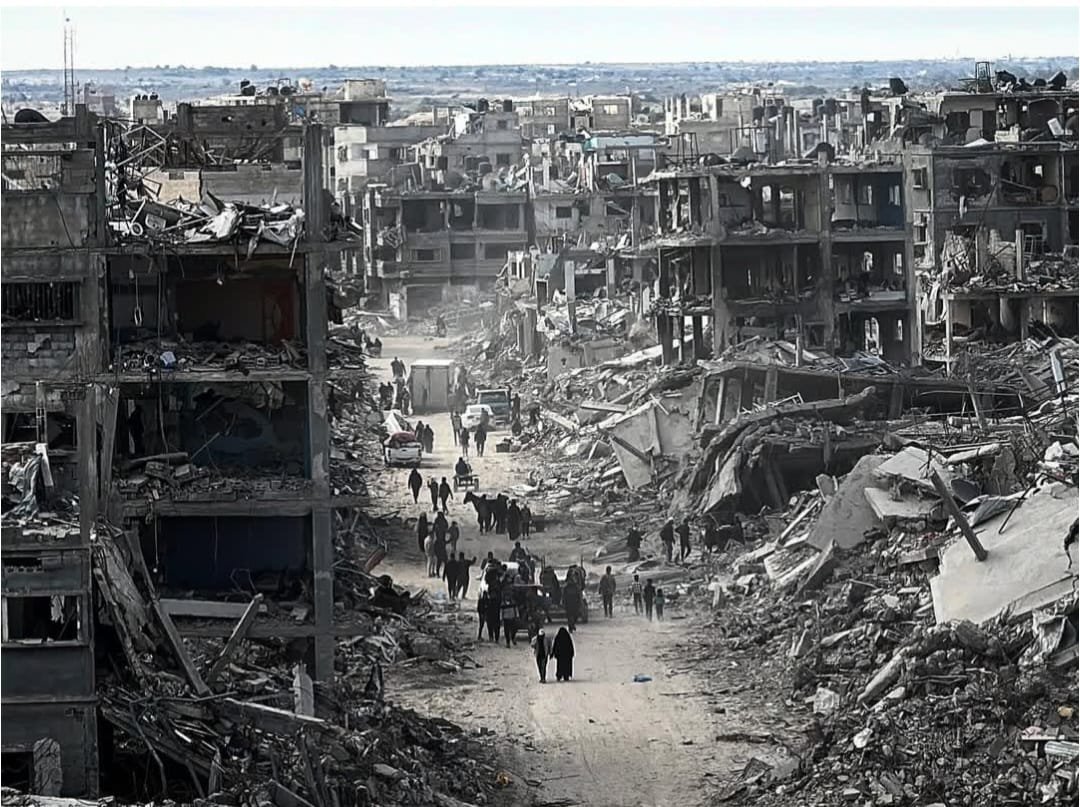
They warned that the move would exacerbate the already dire humanitarian crisis, endanger the lives of hostages, and increase the risk of mass civilian displacement.
The statement emphasized that any attempts at annexation or settlement expansion would constitute a violation of international law.
The ministers called for the immediate release of all captives by Hamas and urged Israel to take concrete steps to facilitate the delivery of humanitarian aid to those in need.
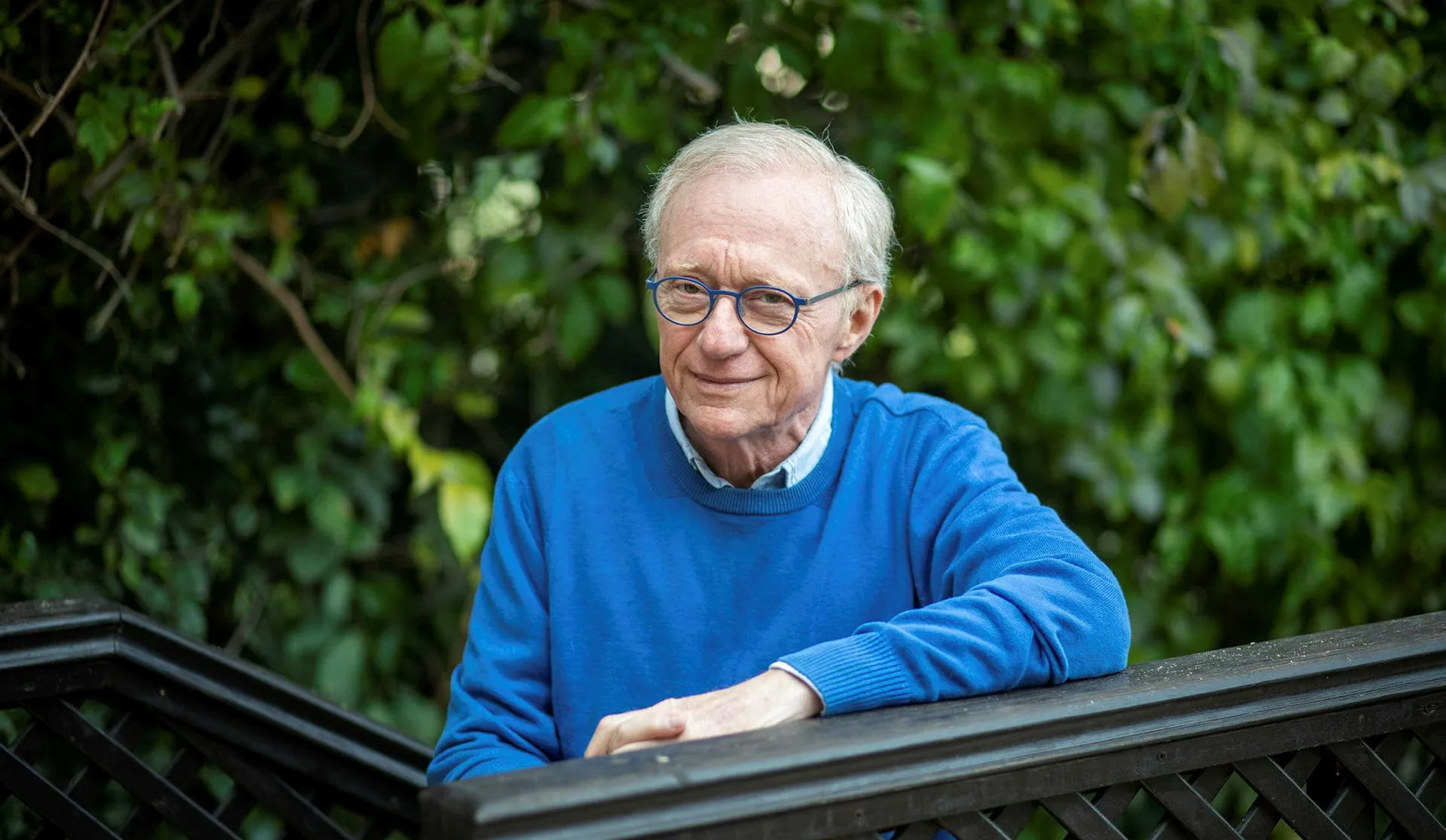
David Grossman, one of Israel’s most prominent authors, told Italian daily La Repubblica he has decided to start using the word “genocide” to describe the situation in Gaza.
“For years, I refused to use the word ‘genocide.’ But now I can’t hold back from using it, after what I’ve read in the newspapers, after the images I’ve seen and after talking to people who have been there”, he said in the interview published in the paper’s print edition on Friday.
Grossman said coming to the realization that Israel is committing genocide in Gaza was an extremely painful process on a personal level, but that he now found such conclusion inescapable.
“I want to speak as a person who has done everything he could to avoid having to call Israel a genocidal state. And now, with immense pain and a broken heart, I have to say that it is happening before my eyes. Genocide,” he said.
The Israeli writer went on to say he now feels a moral obligation to speak up. “I feel an inner urgency to do the right thing, and now it is the time to do it,” Grossman said.
Asked by the journalist about the spiraling death toll in Gaza, he said: “I feel sick. Even though I know that those numbers are controlled by Hamas and that Israel cannot be solely responsible for all the atrocities we are witnessing. Nevertheless, reading in the newspaper or hearing in conversations with friends in Europe the juxtaposition of the words ‘Israel’ and ‘hunger’; to do so starting from our history, from our supposed sensitivity to the suffering of humanity, from the moral responsibility we have always claimed to have towards every human being and not only towards Jews… all this is devastating”, he said.
Grossman’s words come amid growing condemnation of Israel for its actions in Gaza on the international stage, and as several countries, including France and Britain, have pledged to recognize a Palestinian state in the near future.
The use of the word genocide to describe Israel’s war in Gaza is also becoming more common in international intellectual circles.
In mid-July, an opinion piece titled “I’m a Genocide Scholar. I Know It When I See It” in the New York Times by Professor Omer Bartov, an Israeli professor of Holocaust and genocide studies at Brown University, made the case for the use of the word genocide.
Grossman, who is one of Israel’s most well-known writers abroad, has long been a vocal critic of Israel’s occupation of Palestinian territories. The editor of The New Yorker, David Remnick, recently described him as “the only [living Israeli] novelist with comparable moral authority” to that of the late Amos Oz. In the interview in La Repubblica, he reiterated that he considers Israel’s occupation of the West Bank and Gaza after the Six-Day War as a key watershed moment in the country’s history.
“I am absolutely convinced that Israel’s curse began with the occupation of the Palestinian territories in 1967. Perhaps people are tired of hearing about it, but that is how it is,” he said.
Grossman also noted it is critical to ensure those harboring antisemitic sentiments do not “use and manipulate” the word genocide. He also criticized Hamas for turning Gaza into a base for launching rockets into Israel in the aftermath of Israel’s withdrawal in 2005.
“The Palestinians’ big mistake is that they could have turned the Strip into a thriving place, but instead they gave in to fanaticism and used it as a launching pad for missiles against Israel”, he said.
“If they had made the other choice, perhaps this would have prompted Israel to also give up the West Bank and end the occupation years ago”, he said.
Grossman also added that many around the world still fail to understand the magnitude of the trauma of October 7 for Israelis.
“Many people still don’t understand what it meant for us. Many people I know [in Israel] have abandoned our common left-wing values since that day; they have given in to fear, and suddenly their lives have become easier, they feel accepted by the majority, they no longer need to think,” he said.
Grossman considers resettling Gaza, as some Israeli ministers advocate, wrong and self-defeating. “I hear people like Smotrich and Ben-Gvir saying that we must rebuild settlements in Gaza, but what are they saying? Don’t they remember what happened when we were there, with Hamas killing hundreds of Israeli civilians, women and children, without us being able to protect them? We did not leave Gaza out of generosity, but because we could not protect our people”, he argued.
Looking forward, Grossman said he remains a believer in the two-state solution. As such, he praised French President Emmanuel Macron’s decision to recognize a Palestinian state, that was followed by similar statements by other leaders. “I don’t understand the hysteria it has provoked here in Israel”, he said.
Finally, Grossman rejected accusations that Israel’s cultural elites should have taken a stronger stance on what is happening in Gaza a lot faster. “I believe that targeting those who have fought the Occupation for 70 years, who have invested most of their lives and careers in this battle, is unfair”, he concluded.
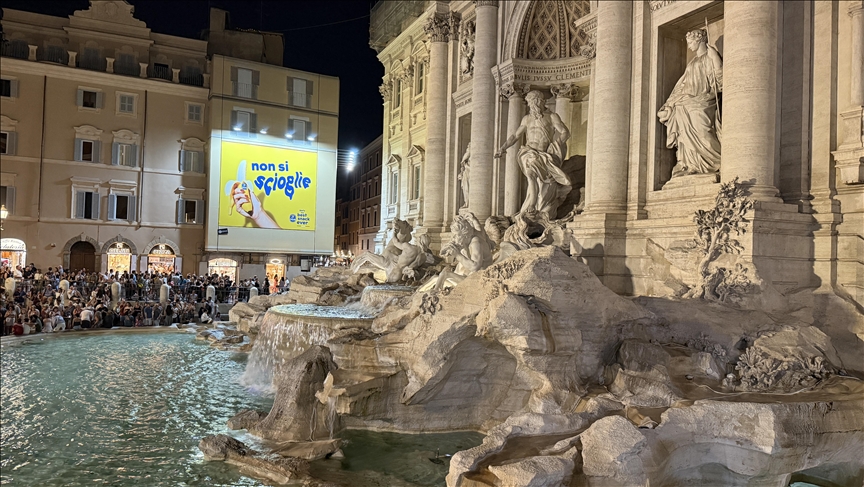
Rome dimmed the lights of the iconic Trevi Fountain for one hour Friday night in a symbolic call for a ceasefire in the Gaza Strip, following a city council resolution last month that was titled, “Rome will not remain silent.”
“Let’s stop the war in Gaza” was also projected onto the front facade of the historic Palazzo Poli, which is behind the fountain, in a symbolic demand for a ceasefire.
A group of pro-Palestinian demonstrators gathered in front of the fountain and waved Palestinian flags in protest of what they described as genocide by Israel in Gaza.
The projected message referenced “war,” but demonstrators held signs that read: “What’s happening in Gaza is not a war, it’s genocide.”
Some chanted slogans accusing Israel of committing atrocities against Palestinians worse than those perpetrated by Nazi Germany against Jews during World War II.
They also criticized the US and the EU for being complicit in their silence.
The group shouted “Free Palestine”, “Stop the genocide” and “From the river to the sea, Palestine will be free.”
The demonstration drew attention from tourists, with some showing support with the pro-Palestinian group according to Anadolu.
With the conclusion of the first meeting between President Donald Trump and His Majesty King Abdullah, Jordan finds itself facing a real political test. The strategy of buying time with an administration that has been in office for only a few weeks may not offer much room for maneuvering, making it increasingly difficult to navigate the direction of US policy. Jordan has sought to carve out a space for itself by engaging with the American president and promoting an alternative that has broader Arab support. However, this approach requires swift action and the presentation of practical alternatives that could gradually shape Trump’s perspective.
Jordan now needs to build strong alliances to manage the next phase and counter the looming threat of forced displacement of Gaza’s population—a proposal that Trump has openly suggested as the only solution. Regionally, Jordan finds itself alongside Egypt as both countries face direct pressure from the US displacement plan. This shared challenge has reinforced their cooperation on various regional issues over the years, yet expanding the Arab alliance has now become an urgent necessity. The multiple forms of US pressure on Egypt make it crucial to establish a stronger, more resilient Arab coalition, with Saudi Arabia playing a central role.
Trump views Saudi Arabia as a gateway to regional peace and a key economic partner, not only for the United States, but also for a major strategic project aimed at linking India to Europe through the Arabian Peninsula, the Mediterranean, and Italy. This highlights the importance of Saudi Arabia’s role in Trump’s vision. At the same time, Jordan’s southern geography is closely tied to Saudi Arabia within this ambitious economic corridor, which strengthens shared economic interests between the two countries. This growing economic partnership could lay the groundwork for deeper political coordination, including a potential Jordanian-Saudi understanding regarding the proposed displacement policy.
On the international level, Jordan can work to rally support for its political stance, which enjoys broad consensus among key global actors. However, at this stage, prioritising Arab alliances and maintaining effective communication channels with the US administration is far more critical than merely seeking international backing.
Domestically, Jordan’s internal front remains the most crucial. The current climate presents an opportunity for the state to reinforce national unity, as growing regional instability has heightened public awareness of external threats. This requires decisive steps to foster genuine political participation and address long-standing grievances of exclusion and marginalization. A shift in political discourse, engagement strategies, and governance methods is necessary to strengthen national cohesion. Uniting Jordanians under an inclusive and representative state framework will be vital in shaping a new phase in the country’s history.
What remains striking is how Jordan was suddenly thrust into the equation of resolving the Gaza crisis. From the outset of the war, discussions primarily centered around Egypt due to its direct geographical connection to Gaza. However, Trump’s unexpected move to involve Jordan has now exposed the country to two major risks: the potential displacement of Gaza’s population and, more alarmingly, the forced displacement of West Bank residents. The push to make Jordan part of the US plan for Gaza raises concerns that this could lead to an imposed reality in which Jordan is expected to absorb West Bank residents as well.
Categorically rejecting forced displacement must be Jordan’s top priority. However, achieving this requires a high level of political agility and the ability to engage in direct negotiations with all relevant stakeholders. This approach would strengthen Jordan’s regional role at a time when further Israeli escalation across multiple fronts, including Gaza and the West Bank, seems increasingly likely. Such an escalation could be used by the Israeli government to block political maneuvering and impose new realities on the ground. A military confrontation could shift the issue of displacement from a political debate to an unavoidable reality, forcing all parties to confront its consequences.
The author is an academic writing for The Jordan Times.
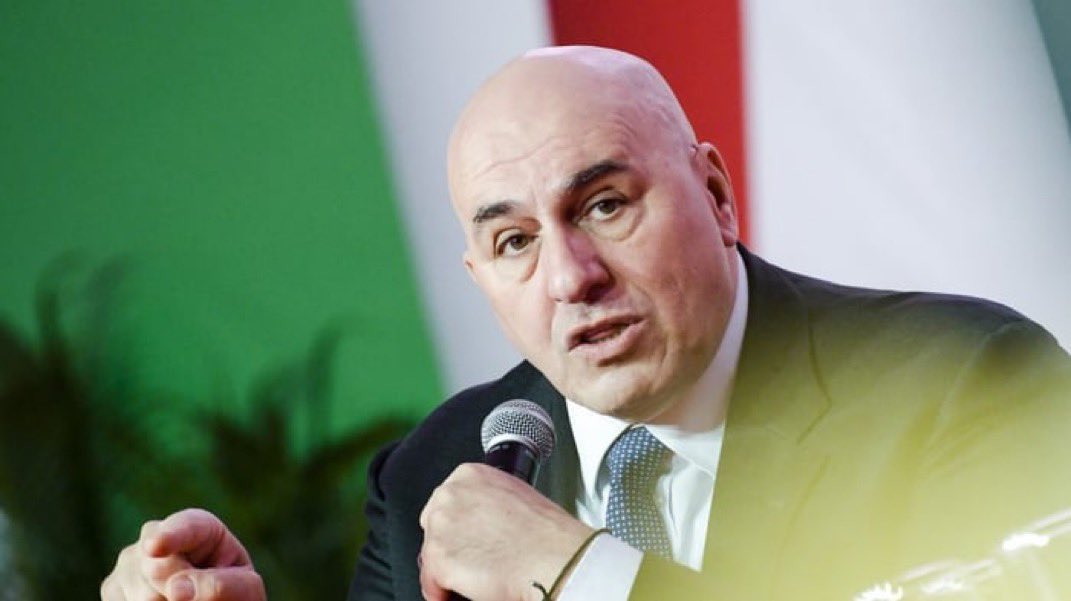
Italian Defense Minister Guido Crosetto on Thursday expressed reservations about the International Criminal Court’s (ICC) arrest warrants for Israeli Prime Minister Benjamin Netanyahu and former Defense Minister Yoav Gallant but confirmed that Italy would be obligated to enforce the warrants if they entered the country.
Speaking during a televised interview, Crosetto remarked that while he believes the ICC’s decision is “wrong,” as a signatory to the Rome Statute, Italy must comply with international law.
“Since we are a party to the ICC, if Netanyahu and Gallant come to Italy, we will have to arrest them. This is not a political decision but the enforcement of international legislation,” he stated according to Anadolu.
In a landmark move, the International Criminal Court on Thursday announced it had issued arrest warrants for Netanyahu and Gallant over war crimes in Palestinian territories, including Gaza.
The warrants come as Israel’s genocidal offensive in Gaza recently entered its second year, having already killed some 44,000 Palestinians, most of them women and children, and injured over 103,000 others.
Italian Deputy Prime Minister and Foreign Minister Antonio Tajani echoed a more cautious tone.
“We will review the content of the decision and the reasons behind it,” Tajani said, emphasizing that the ICC should maintain a strictly legal role, free from political influences.
“Together with our allies, we will assess what will happen and determine what actions to take and how to proceed.”
Tajani’s remarks provoked backlash from the opposition Five Star Movement (M5S), whose parliamentarians called his comments “shocking and shameful.”
In a joint statement, M5S members noted that the EU’s foreign policy chief Josep Borrell affirmed the binding nature of ICC decisions on EU member states.

 CrossFireArabia