Is The West Turning Against Israel?

By Dr Ramzi Baroud

Is it finally happening? Is the West turning against Israel? Or are we, whether motivated by hope or driven by despair, simply engaging in wishful thinking? The matter is not so simple.

Last July, a significant number of countries and organizations signed the ‘New York Declaration,’ a strong statement that followed a high-level meeting titled, “Conference on the Peaceful Settlement of the Question of Palestine.”

The conference itself and its bold conclusion warrant a deeper conversation. What matters for now, however, is the identity of the countries involved. Aside from states that have traditionally advocated for international justice and law in Palestine, many of the signatories were countries that had previously supported Israel regardless of context or circumstance.

These mostly Western countries included Australia, Canada, and the United Kingdom, among others. Some of these nations are also expected to formally recognize the state of Palestine in September.

Of course, one has no illusions about the hypocrisy of supporting peace in Palestine while still arming the Israeli war machine that is carrying out a genocide in Gaza. That notwithstanding, the political change is too significant to ignore.

In the case of Ireland, Norway, Spain, Luxembourg, Malta, and Portugal, among others, one can explain the growing rift with Israel and the championing of Palestinian rights based on historical evidence. Indeed, most of these countries have historically teetered on the edge between the Western common denominator and a more humanistic approach to the Palestinian struggle. This shift had already begun years prior to the ongoing Israeli genocide.

But what is one to make of the positions of Australia and the Netherlands, two of the most adamantly pro-Israel governments anywhere?

In Australia’s case, media accounts argue that the friction began when the federal government denied an Israeli extremist lawmaker, Simcha Rothman, a visa for a speaking tour.

Israel quickly retaliated by ending visas for three Australian diplomats in occupied Palestine. This Israeli step was not just a mere tit-for-tat response but the start of a virulent campaign by Israeli Prime Minister Benjamin Netanyahu to wage a diplomatic war against Australia.

“History will remember Albanese for what he is: a weak politician who betrayed Israel and abandoned Australia’s Jews,” Netanyahu said, again infusing the same logic of lies and manipulation tactics.

Israel’s anger was not directly related to Rothman’s visa. The latter was a mere opportunity for Netanyahu to respond to Australia’s signature on the New York Declaration, its decision to recognize Palestine, and its growing criticism of Israel’s genocide in Gaza.

Though Albanese did not engage Netanyahu directly, his Home Affairs Minister, Tony Burke, did. He answered the accusations of weakness by boldly arguing that “strength is not measured by how many people you can blow up.”

This statement is both true and self-indicting, not only for Australia but for other Western governments. For years, and numerous times during the genocide, Australian leaders have argued that “Israel has the right to defend itself.” Since blowing people up hardly qualifies as self-defense, it follows that Canberra had known all along that Israel’s war is but an ongoing episode of war crimes. So, why the sudden, though still unconvincing, shift in position?

The answer to this question is directly related to the mass mobilization in Australia. On a single Sunday in August, hundreds of thousands of Australians took to the streets in what organizers described as the largest pro-Palestinian demonstrations in the country’s history. Marches were held in more than 40 cities and towns, including a massive rally in Sydney that drew a crowd of up to 300,000 people and brought the city’s Harbour Bridge to a standstill. These protests, which called for sanctions and an end to Australia’s arms trade with Israel, demonstrated the immense public pressure on the government.

In other words, it is the Australian people who have truly spoken, courageously standing up to Netanyahu and to their own government’s refusal to take any meaningful step to hold Israel accountable. If anyone should be congratulated on their strength and resolve, it would be the millions of Australians who relentlessly continue to rally for peace, justice, and an end to the genocide in Gaza.

Similarly, the political crisis in the Netherlands, starting with the resignation of Foreign Minister Caspar Veldkamp on August 22, 2025, is indicative of the unusually significant change in European politics toward Israel and Palestine.

“The Israeli government’s actions violate international treaties. A line must be drawn,” said Eddy van Hijum, the leader of the country’s New Social Contract Party and deputy prime minister.

The “line” was indeed drawn, and quickly so when Veldkamp resigned, ushering in mass resignations by other key ministers in the government. The idea of a major political crisis in the Netherlands sparked by Israeli war crimes in Palestine would have been unthinkable in the past.

The political shift in the Netherlands, much like in Australia, would not have happened without the massive public mobilization around the Gaza genocide that continues to grow worldwide. While pro-Palestine protests have occurred in the past, they have never before achieved the critical mass needed to compel governments to act.

Though these governmental actions remain timid and reluctant, the momentum is undeniable. People’s power is proving more than capable of swaying some governments to impose sanctions and sever diplomatic ties with Israel, not only through pressure in the streets but also through pressure at the ballot box.

While the West has not yet fully turned against Israel, it may only be a matter of time. The precious blood of hundreds of thousands of innocent Palestinians in Gaza deserves for history to be finally altered. The children of Palestine deserve this global awakening of conscience.

Ramzy Baroud is a journalist, author and the Editor of The Palestine Chronicle. He is the author of six books. His forthcoming book, ‘Before the Flood,’ will be published by Seven Stories Press. His other books include ‘Our Vision for Liberation’, ‘My Father was a Freedom Fighter’ and ‘The Last Earth’. Baroud is a Non-resident Senior Research Fellow at the Center for Islam and Global Affairs (CIGA). He contributed this article to the Jordan Times.

Continue reading
Israel: A Bad Brand in World Markets

By Ramzy Baroud

In an important step toward the economic isolation of Israel due to its genocide in Gaza, Norway’s Government Pension Fund Global has decided to divest from yet more Israeli companies.

Norway’s sovereign wealth fund is the world’s largest, with total investments in Israel once estimated at $1.9 billion. The decision to divest was taken gradually but is consistent with the Norwegian government’s growing solidarity with Palestine and rising criticism of Israel.

Taking a leading role along with Spain, Ireland, and Slovenia, Norway has been a vocal European critic of the Israeli genocide and man-made famine in Gaza, actively contributing to the International Court of Justice’s investigation into the genocide, and formally recognizing the state of Palestine in May 2024. This diplomatic and legal stance, coupled with its financial divestment, represents a coherent and escalating effort to hold Israel accountable for the ongoing extermination of Palestinians.

The Israeli economy was already in a state of free-fall even before the genocide. The initial collapse was related to the deep political instability in the country, a result of Israeli Prime Minister Benjamin Netanyahu and his extremist government’s attempt to co-opt the judicial system, thus compromising any semblance of “democracy” remaining in that country. This resulted in a significant lowering of investor confidence.

The war and genocide, beginning on October 7, 2023, only accelerated the crisis, pushing an already fragile economy to the brink. According to reports from the Israel Ministry of Finance, foreign direct investments in Israel fell by an estimated 28 per cent in the first half of 2024 compared to the same period in 2023.

Any supposed recovery in foreign investments, however, was deceptive. It was not the outcome of a global rallying to save Israel, but rather a consequence of a torrent of US funds pouring in to help Israel sustain both its economy and the genocide in Gaza, along with its other war fronts.

Israel’s Gross Domestic Product was estimated by the World Bank to be around $540 billion by the end of 2024. The war on Gaza has already taken a considerable bite out of Israel’s entire GDP. Estimates from Israel itself are complex, but all data points to the fact that the Israeli economy is suffering and will continue to suffer in the foreseeable future. Citing reports from the Bank of Israel and the Ministry of Finance, the Israeli business newspaper Calcalist reported in January 2025 that the cost of the Israeli war on Gaza had already reached more than $67.5 billion. That figure represented the costs of the war up to the end of 2024.

Keeping in mind that the ongoing war costs continue to rise exponentially, and with other consequences of the war, including divestments from the Israeli market by Norway and other countries, future projections for the Israeli economy look very grim. The Israeli Central Bureau of Statistics reported that the Israeli economy, already in a constant state of contraction, shrunk by another 3.5 per cent in the period between April and June 2025.

This collapse is projected to continue, even with the unprecedented US financial backing of Tel Aviv. Indeed, without US help, the precarious Israeli economy would be in a much worse state. Though the US has always propped up Israel, with nearly $4 billion in aid annually, the US help for Israel in the last two years was the most generous and critical yet.

Israel is the recipient of $3.8 billion of US taxpayer money per year, according to the latest 10-year Memorandum of Understanding signed in 2016. Equally, if not more valuable than this large sum are the loan guarantees, which allow Israel to borrow money at a much lower interest rate on the global market. The backing of the US has, therefore, enabled investors to view the Israeli market as a safe haven for their funds, often guaranteeing high returns. This applies to the Norwegian sovereign wealth fund as it did to numerous other entities and companies.

Now that Israel has become a bad brand, affiliated with unethical investments due to the genocide in Gaza and growing illegal settlement expansion in the West Bank, the US, as Israel’s main benefactor, has stepped in to fill the gaps.

The US emergency supplemental appropriations act of April 2024 allocated a total of $26.4 billion for Israel. While much of the money was earmarked for defense expenditures, in reality, most of it will percolate into the Israeli economy. This amount, in addition to the annual military aid, allows the Israeli government to minimize spending on defense and allocate more money to keep the economy from shrinking at an even faster rate.

Additionally, it will free the Israeli military industry to continue producing new, sophisticated military technology that will ensure Israel’s continued competitiveness in the arms market. The military-industrial complex, a significant part of the Israeli economy, is thus not only sustained but given a fresh impetus by American aid, ensuring the war machine continues to function with minimal financial disruption.

All of this should not diminish the importance of divestment from the Israeli financial system. On the contrary, it means that divestment efforts must increase significantly to balance out the US push to keep the Israeli economy from imploding.

Moreover, this should also make US citizens, who object to their government’s role in the genocide in Gaza, more aware of the extent of Washington’s collaboration to save Israel, even at the price of exterminating the Palestinians. Indeed, the flow of funds from the US is not a passive action; it is an active collaboration that directly enables the Israeli genocide in Gaza.

Ramzy Baroud is a journalist, author and the Editor of The Palestine Chronicle. He is the author of six books. His forthcoming book, ‘Before the Flood,’ will be published by Seven Stories Press. His other books include ‘Our Vision for Liberation’, ‘My Father was a Freedom Fighter’ and ‘The Last Earth’. Baroud is a Non-resident Senior Research Fellow at the Center for Islam and Global Affairs (CIGA). His website is www.ramzybaroud.net

Jordan Times

Continue reading
Norway FM Snubs Netanyahu, Says Palestine is Homeland of Palestinian People

Norway on Friday rejected Israel’s argument that countries opposed to its actions in Gaza should take in displaced Palestinians, stressing that the forced transfer of civilians is prohibited under international law.

In response to an Anadolu email, Norway’s Deputy Foreign Minister Andreas Kravik noted that Palestine is the homeland of the Palestinian people.

“The Palestinian people have a fundamental, independent right to self-determination and their own state,” he said, adding that this was the basis for the UN Partition Plan in 1947, after which Israel was recognized by Norway and a number of other countries in 1949.

Kravik added that this stance on Palestinian self-affirmation is confirmed in several UN resolutions as well as the International Court of Justice (ICJ).

Israeli Defense Minister Israel Katz on Thursday said nations such as Spain, Ireland, Norway, and others, which he alleged have made “false accusations and claims against Israel for their actions in Gaza,” are legally obliged to allow Gazans to enter their territory. The three countries recognized the state of Palestine last May, and have criticized Israel’s war on the enclave.

But Kravik rejoined: “The forced transfer of civilians from occupied territories to other countries is prohibited under international law.”

Spain and Ireland also criticized Katz’s controversial comment, stressing that the objective must be the safe return of the people of Palestine to their homes.

The controversy follows US President Donald Trump’s widely condemned remarks that the “US will take over the Gaza Strip” advocating a permanent resettlement of Palestinians outside Gaza.

“The US will take over the Gaza Strip, and we will do a job with it too,” he told a news conference with Israeli Prime Minister Benjamin Netanyahu.

Forcibly displacing a population without justification under international law constitutes a war crime under the Rome Statute of the International Criminal Court.

A Gaza ceasefire and prisoner exchange agreement took effect on Jan. 19, suspending Israel’s genocidal war on the enclave that has killed over 47,000 Palestinians – mostly women and children – and injured over 111,000 since Oct. 7, 2023.

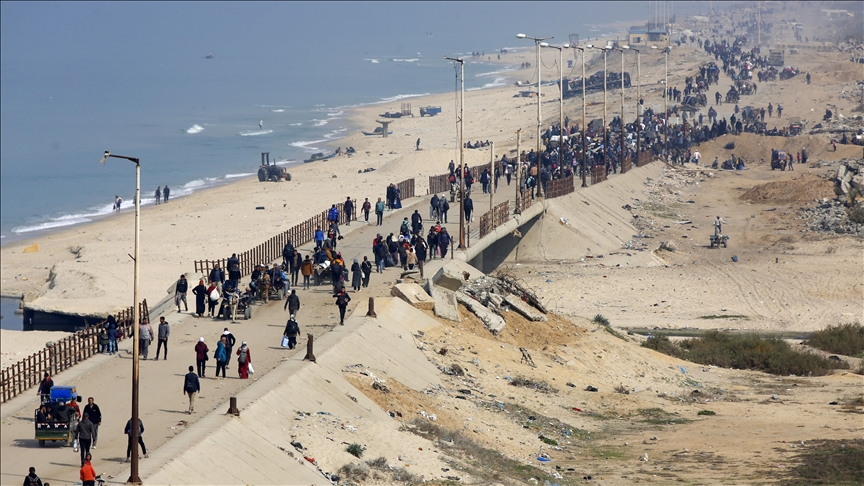
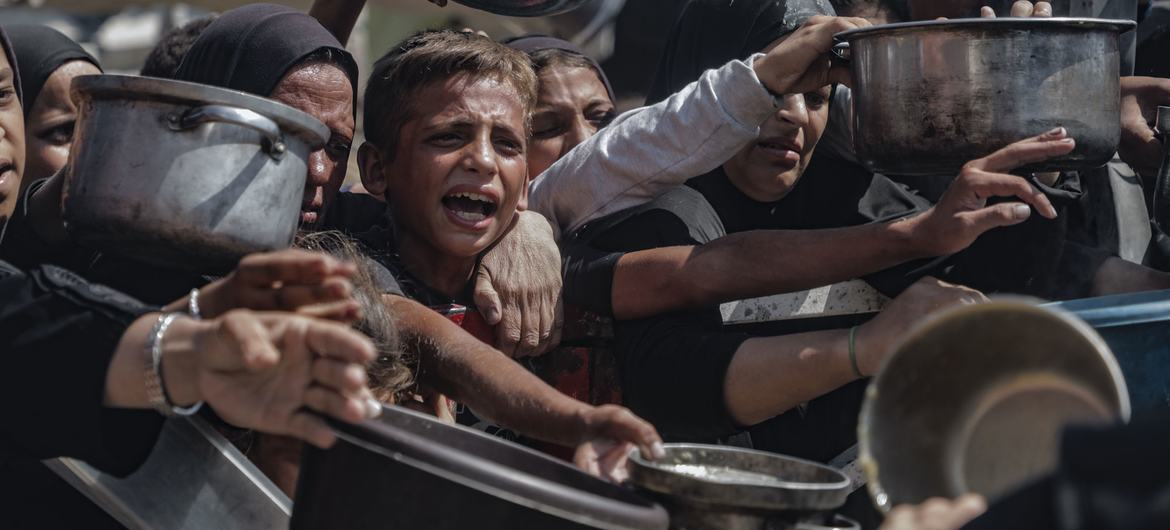
Israel’s war on Gaza has left the besieged enclave in ruins, with half of its housing damaged or destroyed and nearly 2 million people displaced amid severe shortages of sanitation, medical supplies, food, and clean water.

In November, the International Criminal Court (ICC) issued arrest warrants for Israeli Prime Minister Benjamin Netanyahu and former Defense Minister Yoav Gallant, citing war crimes and crimes against humanity in Gaza. Separately, Israel faces a genocide case at the International Court of Justice.

Continue reading
Trump Goes Rogue

Donald Trump has gone rogue during the first days of his second residence in the White House. His executive decrees have upset US global relations and threaten US short, medium and long-term interests.

Trumps’ actions have unsettled this already tense region. His call 2.3 million Palestinians to be expelled from Gaza to Egypt and Jordan and for the US to take-over and develop the Strip as a tourist destination has been rejected by Gazans, Hamas which rules Gaza, the West Bank-based Palestinian Authority, Egypt, Jordan, Saudi Arabia, Qatar, the United Arab Emirates and the Arab League. They have rejected any attempt to displace Palestinians from their land and called on Trump to support “a just and comprehensive peace in the Middle East based on the two-state solution.” This is, of course, rejected by Israel which has colonised the West Bank and annexed East Jerusalem to pre-empt the emergence of a Palestinian state in this territory illegally occupied by Israel since 1967.

Trump’s administration has backed Israel’s January 30th ban on UNRWA, the UN agency caring for Palestinian refugees, which is meant to end its operations in East Jerusalem, the West Bank and Gaza. The UN Palestinian Rights Committee condemned the ban as a “direct violation of the General Assembly mandate [resolution 302 of December 1949] and the resolution [supporting UNRWA’s mandate] recently adopted by the General Assembly by an overwhelming majority.” The ban has also been condemned by Britain, Belgium, Ireland, Luxembourg, Malta, Norway, Slovenia and Spain. Belgium’s foreign ministry said the Israeli action “sets a disastrous precedent that deeply undermines the multilateral system and the United Nations itself.”

As soon as he took office, Trump ordered a 90-day halt to US foreign and military aid except for Israel (of course) and Egypt. Secretary of State Marco Rubio subsequently issued a waver allowing for “life-saving humanitarian assistance” programmes.

The US gives Israel $3.8 billion a year in military aid and Israel has received an additional $17.9 billion during its genocidal and devastating war on Gaza, according to Brown University’s Costs of War Report. The US has given Egypt $1.2 billion in military aid since the 1978 negotiations which led to the 1979 peace treaty with Israel.

His ignorant and destructive decree has frozen $95 million allocated mainly for Lebanon’s military as the country’s troops deploy in the south to secure Israel’s withdrawal under the fragile ceasefire between Hizbollah and Israel. This sum had previously been earmarked for Israel and Egypt, the Associated Press reported.

The non-governmental organisation managing Syria’s Al-Hol camp has said it will have to end operations without US funding. Controlled by US-sponsored Syrian Democratic Forces. Al-Hol houses more than 40,000 wives and children of Daesh fighters.

The freeze could negatively impact Jordan ($770 million in 2023) and Yemen ($35.9 million) which receive economic aid through the $95 million provided by the US Agency for International Development. The lion’s share of $14.4 billion has been allocated for Ukraine which is fighting the US-led Western war against Russia.

UN and other humanitarian agencies promptly responded to the freeze by ordering reductions in programmes to cut spending. UN Secretary General Antonio Guterres called for exemptions to “ensure the continued delivery of critical development and humanitarian activities for the most vulnerable communities around the world.” Committed to his “America First” policy, Trump cares little for such communities.

Trump has paused for 30-day his imposition of 25 per cent tariffs on imports from Canada and Mexico which have threatened to launch a North American trade war. Canadian Prime Minister Justin Trudeau said he would impose tariffs on $106.6 billion worth of US imports to his country. These include beer, wine, fresh fruits and vegetables, processed food, seafood, vehicles, dairy, and spare parts, crude and refined petroleum.

Trump justified his tariffs on Mexico by accusing government of being in league with drug cartels which smuggle drugs into the US, an allegation hotly denied by President Claudia Sheinbaum. She charged the Trump administration of “slander” and told the US to cut the illegal southward flow of guns arming the cartels. She asked her trade minister to respond with 25 per cent tariffs and non-tariff measures. the main goods Mexico exports to the US are computers, cars and vehicles, spare parts and accessories.

Trump justified announced tariffs by saying, “This was done through the International Emergency Economic Powers Act because of the major threat of illegal aliens [crossing into the US] and deadly drugs killing our citizens, including [the addictive drug] fentanyl.” 

During the pause, Trump can be expected to use tariff leverage to compel Canada and Mexico to capitulate to his demands on border security and other issues.

Beijing said it would lodge a complaint with the World Trade Organisation as Trump levied a blanket 10 per cent tariff on Chinese goods. Combined, China, Mexico and Canada accounted for more than 40 per cent of imports into the US last year.

He has also threatened tariffs on the European Union which he claims is taking advantage of the US. Trump stated, “They don’t take our cars, they don’t take our farm Products, they take almost nothing, everything from them.”

The Washington Post reported Trump’s tariffs could cost every US household $1,200 which could be ignored by the wealth and absorbed by the middle class while stressing the working class and driving the poor into debt.

Trump has not forgotten his determination to transform Canada into the 51st US state despite overwhelming Canadian rejection and to buy or occupy Greenland which belongs to Denmark. In Panama on his first trip abroad Secretary of State Marco Rubio said the US could take action to reassert control over the waterway if the Panamanian government does not exclude Chinese presence around the canal which connects the Caribbean Sea with the Pacific Ocean. The US considers the operations of canal, built by the US between 1904-1914 but ceded to Panama in 1999, a national security issue.

Trump’s ill considered transactional pronouncements and policies have rattled close allies and created global concern over the stability and reliability of the US as the world’s hyperpower.

Michael Jansen is a columnist in the Jordan Times.

Continue reading