‘Aid Trickle’ Mean People Die Before Reaching Hospitals

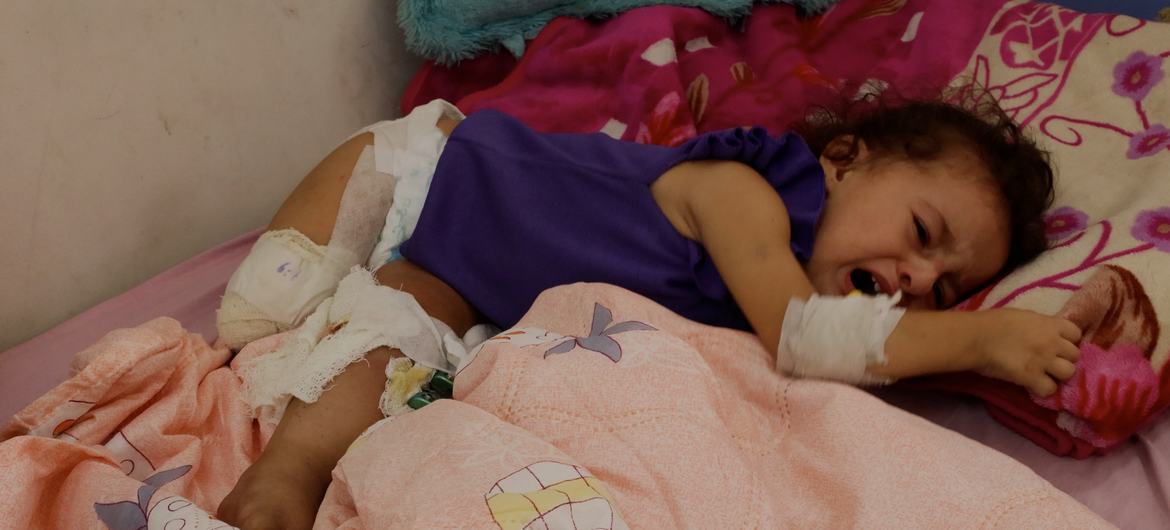
Children in Gaza are dying not just from hunger, but from the total collapse of the systems meant to protect them, UN agencies warned on Tuesday.

With 96 per cent of households lacking clean water, many malnourished children are not surviving long enough to receive hospital care.

James Elder, Spokesperson for the UN Children’s Fund (UNICEF), told a media briefing in Geneva that it would be a mistake to assume that the situation was improving.

There’s a sense through the world’s press that things are improving,” he said. “But unless there is sustained humanitarian aid…there will be horrific results.

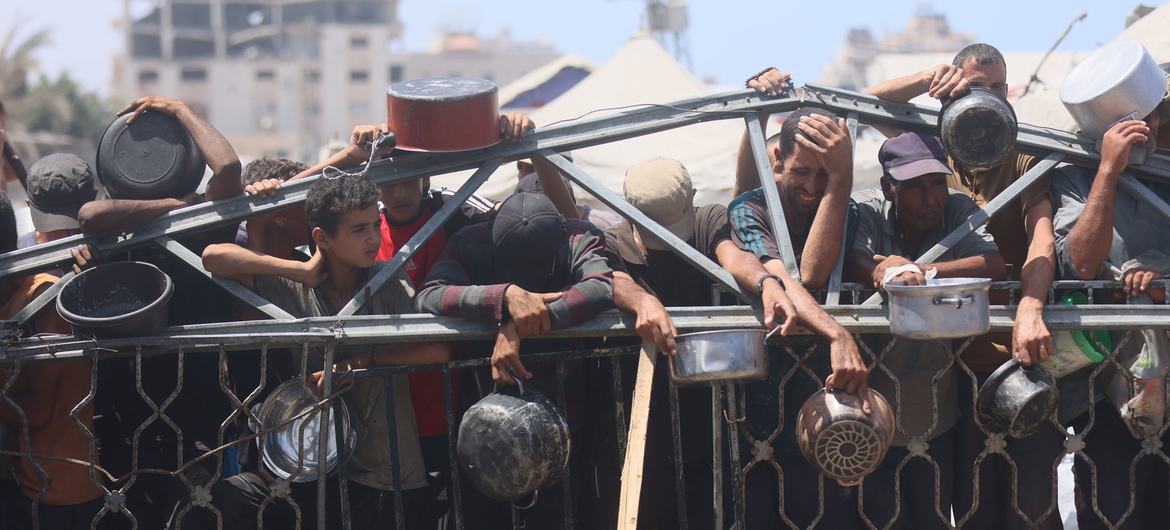
He emphasised the scale of need: “When food comes in which supports 30,000 children, there are still 970,000 children not getting enough. It is a drop in the ocean.”

Aid still a trickle

The UN relief coordination office, OCHA, said that although unilateral pauses have allowed some aid into Gaza, the current trickle is vastly insufficient.

“There should be hundreds and hundreds of trucks entering Gaza every day, for months or years to come,” said Jens Laerke, OCHA spokesperson. “People are dying every day. This is a crisis, on the brink of famine.

Thousands of tons of pre-funded aid remain stuck just outside the enclave, he added, as bureaucratic delays and lack of safe access continue to block distribution.

Urgent scale-up needed

In New York, UN Deputy Spokesperson Farhan Haq also noted the impediments to bringing in and distributing sufficient aid.

“Massive food shortages continue to impact people’s chances for survival,” he said. “As malnutrition levels rise, children’s immune systems are weakened, hindering their development and growth far into the future.”

Last Thursday alone, 71 kitchens delivered over 270,000 hot meals across Gaza, including 10,000 to health facilities. But that figure falls far short of what’s needed to feed more than two million people.

We need an urgent scale-up of supplies, as well as an environment that allows humanitarians to reach people in need safely, rapidly and efficiently,” Mr. Haq added.

Health challenges continue

Some medicine has entered Gaza in recent days, but supplies remain limited. Health workers continue to operate under extreme pressure and shortages.

The World Health Organization (WHO) reported 46 cases of Guillain-Barré syndrome in July, including two deaths. The condition, which affects the nervous system, has been linked to compromised immunity, poor nutrition and hygiene-related infections.

The situation of pregnant women and nursing mothers is equally alarming. The UN reproductive health agency, UNFPA, said that 40 per cent of pregnant or breastfeeding women are suffering from severe malnutrition, with newborn deaths and stillbirths on the rise.

Meanwhile, three UN fuel tankers reached Gaza City on Monday. The fuel will power critical health, water and sanitation services, but OCHA stressed this only allows operations to run at “bare minimum” capacity according to UN News.

Continue reading
UN: Gaza Aid is ‘Drop in The Bucket’

The UN humanitarian affairs chief has welcomed Israel’s decision to allow limited aid to cross into Gaza after 11 weeks of complete blockade – but significantly more is needed “starting tomorrow morning”.

Tom Fletcher said in a statement on Monday that nine UN trucks were cleared to enter the southern Kerem Shalom crossing earlier in the day.

“But it is a drop in the ocean of what is urgently needed…We have been reassured that our work will be facilitated through existing, proven mechanisms. I am grateful for that reassurance, and Israel’s agreement to humanitarian notification measures that reduce the immense security threats of the operation.”

Alarm over Israeli bombardment: UN chief

The UN Secretary-General on Monday expressed his alarm over the intensifying air strikes and ground operations in Gaza “which have resulted in the killing of hundreds of Palestinian civilians in recent days, including many women and children, and, of course, large-scale evacuation orders.”

António Guterres reiterated his call for the rapid, safe, and unimpeded delivery of humanitarian assistance at scale directly to civilians, in order to avert famine, alleviate widespread suffering, and prevent further loss of life.

Briefing reporters on Monday, UN Spokesperson Stéphane Dujarric said Mr. Guterres “welcomes the ongoing efforts by the mediators to reach a deal in Gaza. He has repeatedly warned that the continued violence and the destruction will only compound civilian suffering and heighten the risk of a broader regional conflict.”

He added that the Secretary-General “firmly rejects any forced displacement of the Palestinian population.”

Minimise risk of aid theft

Relief chief Fletcher said in his statement that he was determined to ensure UN aid reaches those in greatest need and make sure that any risk of theft by Hamas or other militants battling Israeli forces in the Strip amid a new offensive, would be minimised.

He said the UN aid coordination office, OCHA, had realistic expectations: “Given ongoing bombardment and acute hunger levels, the risks of looting and insecurity are significant.”

UN aid workers are committed to doing their jobs, “even against these odds,” he said, thanking humanitarian colleagues for their courage and determination.

Practical plan

“The limited quantities of aid now being allowed into Gaza are of course no substitute for unimpeded access to civilians in such dire need,” Mr. Fletcher continued.

The UN has a clear, principled and practical plan to save lives at scaleas I set out last week.”

He called on Israeli authorities to:

  • Open at least two crossings into Gaza, in the north and south
  • Simplify and expedite procedures together with removing quotas limiting aid
  • Lift access impediments and cease military operations when and where aid is being delivered
  • Allow UN teams to cover the whole range of needs – food, water, hygiene, shelter, health, fuel and gas for cooking

Ready to respond

Mr. Fletcher said to reduce looting, there must be a regular flow of aid, and humanitarians must be permitted to use multiple routes.

“We are ready and determined to scale up our life-saving operation Gaza and respond to the needs of people, wherever they are,” he stressed – calling again for the protection of civilians, a resumption of the ceasefire and the immediate and unconditional release of all hostages.

He concluded saying the operation would be tough – “but the humanitarian community will take any opening we have.”

UN News

Continue reading
Using Starvation as a Weapon of War

By Professor Mutaz M. Qafisheh and Manal Radaydeh

The famine raging in Gaza is not a side effect of war. It is the outcome of a willful and publicly declared plan aimed at displacing and destroying Gazans by starving the entire population. This is not a natural disaster— it is the systematic denial of access to food in a tiny, resource-scarce strip of land. Starvation is being used as a weapon—to break people’s will, force surrender, collectively punish, and carry out ethnic cleansing.

Nearly two months after the ceasefire collapsed, Israeli forces tightened the blockade on Gaza, sealing border crossings and halting all entry of food, water, medicine, and fuel. According to the World Food Program (WFP), food stocks had already run out by April 2024, and conditions have worsened significantly since March. Even modest charity kitchens that once served over a million meals daily have now ceased operations. WFP reported that the prices of the few remaining food items have surged by over 1,400%.  

Malnutrition and imminent death

This crisis is affecting everyone, but children are paying the heaviest price. UNICEF reported that over 60,000 children are suffering from severe malnutrition. As a result, thousands face imminent death. Most children survive on a single meal a day—or less. The lack of proper nutrition is damaging their bodies and minds in ways that may never be reversed. Satellite footage shows infants drinking water instead of milk. Many have withered to skeletons.

It is crucial to underline that this man-made hunger is not accidental. It is the explicit outcome of political decisions targeting civilians. Under international humanitarian law—particularly Article 23 of the Fourth Geneva Convention—all parties in a conflict must allow the free flow of humanitarian aid to civilians. The UN Office of the High Commissioner for Human Rights has described this famine as “cruel collective punishment.”

On Nov. 21, 2024, the International Criminal Court issued arrest warrants for Israeli Prime Minister Benjamin Netanyahu and former Defense Minister Yoav Gallant, accusing them of war crimes, including the use of starvation as a method of warfare—characterized as a war crime. This came after a unanimous order by the International Court of Justice on March 28, 2024 in the genocide case brought by South Africa against Israel. The ICJ ordered Israel to take all necessary and effective measures without delay to ensure the unhindered, large-scale provision of urgently needed services and humanitarian aid—food, water, electricity, fuel, shelter, clothing, hygiene, sanitation, and medical care—to Palestinians throughout Gaza. Yet Israel continues to act as if it were above the law.

Today, Gaza’s food system is completely destroyed: bakeries bombed, farms bulldozed, fishing boats burned, livestock killed, warehouses flattened, shops emptied, and aid trucks blocked or turned away. OCHA warns that famine is either imminent or already unfolding. And yet, the siege continues—on top of systematic daily bloodshed.  

Collapse of health care

The suffering is not only physical. As hunger spreads, so does the risk of disease, especially among children, the elderly, and the chronically ill. The health care system has collapsed. People with chronic diseases—cancer, diabetes, high blood pressure, heart and kidney failure—are dying. Euro-Med Human Rights Monitor recently documented the deaths of 14 elderly people due to malnutrition, among many others who perish in silence, with no one to record their plight.

The coming months and years will reveal the far-reaching consequences of the famine that struck Gaza in full view of world leaders—some of whom encouraged or were complicit in the starvation of 2 million innocent civilians. The world—particularly Europe and the Arab nations—can, if it chooses, put an end to these genocidal acts against children, the elderly, the sick, and the exhausted.

It is unimaginable. How is it possible that in the 21st century—an age of smartphones and social media—the international community watches a live-streamed famine unfold and does nothing? What has brought us to this moral and legal vacuum? If famine is tolerated this time, it will be normalized and replicated elsewhere. That would mean the erosion of values humanity has struggled for centuries to uphold.

It’s time for action, not just words. History will judge. History is here. And history is now.  

Mutaz M. Qafisheh is Professor of International Law at Hebron University. Manal Radaydeh is a Researcher in International Diplomacy at Hebron University and this article was published in Anadolu.

Continue reading
Gaza Faces Public Health Crises

Amid sweltering heat, raw sewage and overflowing trash, displaced families in southern Gaza are facing an escalating public health crisis as aid remains blocked and medical supplies dwindle.

In the makeshift coastal encampments of Al Mawasi, families have no choice but to live in unsanitary conditions that are rapidly turning deadly, Louise Wateridge, Senior Emergency Officer at Palestine refugee agency, UNRWA, told UN News.

She described an increasingly dire situation: malnourished children and families, already worn down by months of war, battle unrelenting heat, unsanitary conditions, a lack of clean water and limited access to healthcare.

“The trash is just out of control. The sewage, the rodents, the pests, the rats, the mice – all of these animals are going between the structures that people are sheltering in,” she said.

As the days hot up, “disease is spreading. There is not enough medicine,” she added. UNRWA teams are conducting intensive clean up campaigns, but their resources are running out.

They’ve got about 10 days left of pesticides. Supplies are going to run out,” Ms. Wateridge warned.

Heavy equipment destroyed

The worsening conditions are being compounded by the destruction of Gaza’s public health infrastructure.

According to the UN humanitarian coordination office (OCHA), more than 30 vehicles essential for waste management, water supply and sewage maintenance were destroyed by Israeli airstrikes between 21 and 22 April.

In the past week alone, at least 23 reported strikes have hit tents sheltering internally displaced persons (IDPs), killing dozens of civilians – including women, children, and persons with disabilities.

Health system under strain

OCHA also noted that Gaza’s health system is continuing to collapse.

Over half of the remaining health facilities are located in zones under evacuation orders, posing serious access challenges for communities in urgent need. There are also widespread shortages of medicine, equipment and medical staff.

As of 15 April, an estimated 420,000 people have been displaced – many for the second or third time.

Shrinking humanitarian space

Humanitarian space continues to be shut down. Vital humanitarian aid has not entered Gaza for 52 consecutive days.

OCHA noted that between 15 and 21 April, nearly half of the planned humanitarian movements were denied or impeded.

It reported that out of 42 planned aid missions across the Gaza Strip that were coordinated with the Israeli authorities, 20 were denied, two faced impediments, 19 were facilitated and one was cancelled.

Meanwhile, UN agencies also have to contend with lack of funds to sustain their programmes.

As of 22 April, donors have disbursed about $569 million out of the $4.07 billion (about 14 per cent) required to meet the most critical humanitarian needs of three million people requiring assistance in Gaza and the West Bank, including East Jerusalem.

UN News

Continue reading
‘Its as Bad as Ever in Gaza’ – UN Workers

Lifesaving supplies in Gaza continue to run dangerously low, nearly four weeks into the total aid blockade and deadly bombardment of the enclave by Israel, UN humanitarians said on Friday.

According to local health authorities in Gaza, 830 people were killed between 18-23 March, including 174 women and 322 children. A further 1,787 were injured.

“The acts of war that we see bear the hallmarks of atrocity crimes,” said Jens Laerke, spokesperson for the UN aid coordination office, OCHA. “Hundreds of children and other civilians have been killed in health and Israeli airstrikes. Intensely populated areas hospitals are once again battlegrounds; patients killed in their beds, ambulances shot at, and first responders killed.”

It has been 10 days since Gazans woke up to renewed Israel bombing, abruptly ending the two-month ceasefire.

“It has been 10 days of witnessing – because the UN remains on the ground in Gaza – a callous disregard for human life and dignity,” Mr. Laerke maintained.

No to evacuations

Maryse Guimond, UN Women Representative for the Occupied Palestinian Territory, relayed testimonies of Palestinians in Gaza who say they will not heed new evacuation orders issued by the Israeli military, on the grounds that “there are no safe places anyway”.

Speaking from Amman, she added: “It is a situation of pure survival and survival of their families because, as they say, there is simply nowhere to go…”

“As a woman recently said to us from Deir al Balah, ‘My mother says death is the same whether in Gaza City, or in Deir al Balah; we just want to return to Gaza.’”

Echoing those concerns, Dr. Margaret Harris, spokesperson for the UN World Health Organization (WHO) said that the situation “is as bad as it ever was”. A new ceasefire is needed immediately for the sake of all Gazans, she insisted.

“We knew it was bad before the ceasefire, when we were constantly begging to be allowed to do our job just to help the ordinary people. No, they can’t keep going.”

Healthcare in the enclave is also suffering from the aid blockade, with supplies dwindling dangerously low since the cut-off began on 2 March.

“The key supplies now for safe labour and delivery…will be running out soon,” said Dr Rik Peeperkorn, WHO representative in the OPT.

A dozen ambulances have also been put out of action through lack of fuel, the veteran humanitarian medic said, speaking from Jerusalem.

Collective punishment warning

Sparked by Hamas-led terror attacks in Israel, the war in Gaza has devastated the enclave and prompted widespread international condemnation over its impact on civilians, who should be spared from violence in times of war.

Nothing can justify the collective punishment of the Palestinian people,” OCHA’s Mr. Laerke insisted.

“International law is clear, it prohibits indiscriminate attacks, obstruction of life saving aid, destruction of infrastructure indispensable for civilian survival and hostage-taking.

“The International Court of Justice’s provisional measures on the application of the Genocide Convention remain in place; yet the alerts that we issue in report after report reveal an utter lack of respect for the most basic principles of humanity.”

UN News

Continue reading