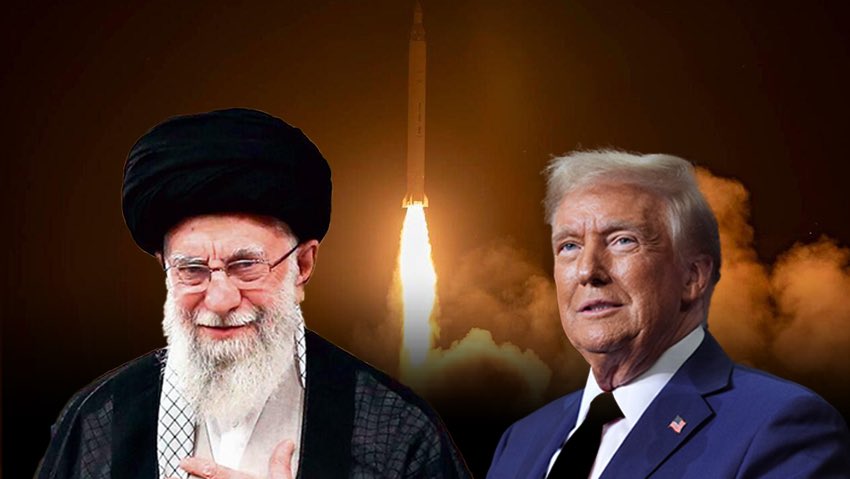
Why Doesn’t Trump Want Netanyahu to Strike Iran?

By Dr Marwan Asmar

CROSSFIREARABIA – United States president Donald Trump seems to be a very happy man these days. He says he is about to reach a deal with Iran on its nuclear file very soon.

Israeli Prime Minister Benjamin Netanyahu on the other hand is particularly worried, concerned, frustrated and even downhearted. He says ‘we need to strike Iran now before it’s too late and it goes ahead and develops a nuclear bomb’. 

But, and on the contrary, Trump believes that it’s because Iran is still at a weak stage before reaching nuclear  weapons capability, the US can force a deal that would make sure it checks its nuclear arsenal and would submit to the American will.

To prove his point, Trump through his US negotiating team led by Steve Witkoff, is continually talking to the Iranian team through Oman, now in their fifth mediating session about ironing out a new deal that would satisfy the US point of view and give the Iranians peace of mind and something to look forward to like lifting sanctions on the country.

To that extent, and no doubt for public relations, Trump is never short these days on complementing the Iranians with his glowing uttrances on the country and how it can become “great” again.

By their own accord however, both teams who are talking indirectly through the Omanis, say that negotiations is tough and may even going through a rough patch.

The Iranian delegates are sticking to their position, they want a deal but not at any price. They want to continue to pursue their uranium enrichment program believing this is a question of state and national sovereignty. They say they haven’t reached such a local, indegenous breakthrough in order to give it, whilst praising their scentific and technological advancements in this area of power.

The Americans on the other hand insist that Iranian divest itself from this nuclear process for uranium enrichment is a ‘redline’ as it leads to the possession of a nuclear weapon. To the Trump administration, this point is intractable which Iran has to give up on. 

But if this is the case why is the US continuing to talk to Iran? Further still, why should Trump be happy and talk about an impending deal that would lock the hands of the Iranians? Clearly, the American president is happy despite the murky regional waters.

Back to Israel. Netanyahu is deeply worried and wants to frustrate any impending nuclear deal. But he was always frustrated about Iran and argued, well, at least for the last 10 years, against talking to Iran and placating it. It was argued he was the person to convince Trump to leave the international JCPA treaty signed between the five-members of the UN Security Council and Iran in 2018.

Today however, and for Netanyahu, its “horrors” on the horizons. Leaked newspaper reports in The New York Times suggest there is deep tension between Trump and Netanyahu on this issue for the US president doesn’t want the later to embark on any action such as military strikes that would jeopardize any upcoming deal.

That is why Israeli Strategic Affairs Minister Ron Dermer and Mossad Chief David Barnea are being invited to Washington to the White House to impress upon them not to embark on a drastic Israeli action and bomb Iranian military and nuclear sites whilst negotiations are going on.

Many US and European experts however are fearful that Netanyahu wouldn’t be able to be controlled and if he embarks on striking Iran he would do so without consulting the Americans and go it alone and in spite of the ‘talked-about” pressure that is being exercised by the White House on Tel Aviv.

Regardless however, Trump wants a deal come what may for he believes this would be a great achievement for America and would vindicate his earlier action when he got the US out of the deal in 2018 and now in return for a better accord, and moving his own view to create a safer world and enforce his image that he is a man of peace and doesn’t support world wars like his recent attempt to stop the Ukraine War.

If Israel does strike Iran, in theory that would make Trump very unhappy because it would mean the United States is no longer able to control its strategic ally, or it could mean that behind the international and regional diplomatic chit-chat, the US is not too bothered about striking Iran.

But there are also other problems to consider: Wouldn’t a strike on Iran, especially on its nuclear sites, produce a spiral and a slippery-slope in which the latter would surely retaliate and be capable of doing so, with vehement force.

Apart from what that would do to the region, ie, “nuclear catastrophe”, would Netanyahu go along that road and risk annihilation for Israel and its surrounding areas.

These are tough questions to consider and may force Netanyahu to back down and listen to the US.

Continue reading
Reshuffling Cards: Trump and Netanyahu’s Nightmare

(Crossfirearabia.com) – Benjamin Netanyahu hadn’t finished patting himself on the back for destroying the Sanaa International Airport – after all Israeli warplanes hit the country twice in less than 24 hours – before US President Donald Trump dramatically announced he had just reached a deal with the Houthis to stop striking Yemen. Shock, surprise, horror!

Trump added the Houthis promised in turn they would halt targeting all ships, including US vassals and tankers entering the world-trade-crucial Bab El Mandeb Straits, the Red Sea and presumably the Arabian Sea, just off the tip of the country in the south.

Thus, in one full swoop and at a strike of a pen, the war between the US and the Houthis, started in earnest since 15 March had come to an end in a mesmerizing fashion. During this time, the Americans had made at least a total of 1300 air-raids on Yemen in a bid to end the Houthis who had been striking Israel with ballistic missiles on a regular basis since 7 October, 2023 when Israel started bombarding Gaza.

The country that was behind the deal was Oman who had indeed announced, Tuesday, that an agreement between the United States and the Houthis, the effective but not internationally recognized government in Yemen, was reached to stop the war.

Omani Foreign Minister Badr Albusaidi said in a statement on X that: “Following recent discussions and contacts conducted by the Sultanate of Oman with the United States and the relevant authorities in Sana’a, in the Republic of Yemen, with the aim of de-escalation, efforts have resulted in a ceasefire agreement between the two sides,” as carried by Anadolu.

Analysts since suggested that the deal was reached because the two sides had wanted to end the open-ended escalation that was proving very costly not least of all to the United States which hiked the US treasury bill to about $1 billion dollars since its campaign, mostly to support Israel, in less than one month of military action.

The Houthis on the other hand didn’t want to fight on two fronts, the Americans and the Israelis. For them ending one front was perfectly logical to focus on strikes against Israel in a bid to end the latter’s war on Gaza, and which Israel has promised to step up soon and added to the misery and genocide of Palestinians in Gaza.

In agreeing to stop attacking shipping in the area they were of the firm belief that Trump had not meant that no firing against Israel as part of the deal which meant they would continue to strike Jewish cities, airports areas and military installations, more than 2000 kilometers away, until Israel ends its war on Gaza.

It is still too early to read into how things will unfold, especially since Trump is coming to Saudi Arabia and the Gulf in mid-May, but everyone is seeing the deal as creating a wedge between the US-Israeli alliance on matters relating to US security in the region and especially on the Iran nuclear file, where incessant negotiations – now in their third and fourth rounds -are taking place for the first time between Washington and Tehran in Muscat and through an Omani team lead by their formidable Omani Foreign Minister Albusaidi as mediator.

These are developments that are clearly upsetting Netanyahu who is dead against any nuclear deal that may be reached between the White House and Tehran and wants to strike Iran’s nuclear facilities regardless of the dangerous consequences. But this is seen as a critical line between Trump and Netanyahu while the former is determined to initial a new nuclear deal which he would see as a great US success and for his diplomacy in checking Iran’s nuclear weapon.

International issues as they stand are still fluid for Trump is looking for certain objectives most of all includes his slogan of “Make America Great Again”, focusing on his domestic scene, and not getting involved in unnecessary war around the globe, hence his wish to end the Ukraine War, the war on Gaza and achieve a new nuclear deal with Iran; these are objectives, especially they last two, are not at all in line with the Netanyahu who is attacking Syria, Lebanon, Iraq and occasionally Yemen.

Thus the last deal between Trump and the Houthis, regardless of whether it would stick in the end, is surely likely to be a “splitting headache” for Netanyahu, from a man who was once seen as great friend to Israel.

But the Israeli Prime Minister must not forget that Trump is no pushover, he is a broker who likes to do things his own way.

This analysis is written by Dr Marwan Asmar, chief editor of the crossfirearabia.com website. 

Continue reading
Oman Mediates US-Houthi Ceasefire

Oman on Tuesday announced that its mediatory efforts led to a ceasefire between the US and Houthis in Yemen, after President Donald Trump said the group will not be carrying out attacks on commercial ships.

“Following recent discussions and contacts conducted by the Sultanate of Oman with the United States and the relevant authorities in Sana’a, in the Republic of Yemen, with the aim of de-escalation, efforts have resulted in a ceasefire agreement between the two sides,” Foreign Minister Badr Albusaidi said in a statement on X.

“In the future, neither side will target the other, including American vessels, in the Red Sea and Bab al-Mandab Strait, ensuring freedom of navigation and the smooth flow of international commercial shipping,” he added.

Expressing appreciation for both parties’ cooperation, Albusaidi said: “The Sultanate of Oman expresses its gratitude to both parties for their constructive approach that led to this welcome outcome, and hopes that it will lead to further progress on many regional issues towards achieving justice, peace, and prosperity for all.”

Houthis started attacking shipping lanes in the Red and Arabian seas after Israel’s war in Gaza, in solidarity with the Palestinians.

In March, Trump launched a military operation against the Yemeni group.

Earlier, during a meeting with Canadian Prime Minister Mark Carney in the White House, Trump said Houthis informed them they will not be carrying out additional attacks on commercial ships, and the US will reciprocate by halting attacks on Yemen, according to Anadolu.

Continue reading
Rehabilitating Iran?

By Dr Khairi Janbek

All eyes now are on the new game in the Middle East: The US-Iran negotiations. One would say the aim here is far more advanced than the Iranian nuclear programme when the agreement was torn up by US President Donald Trump himself who was more concerned with details which would eliminate all threats against Israel, and would that in all liklihood, transform the whole region.

It seems that in this early intense stage, the ambiance is for reaching an amicable agreement through the recognition that no matter of the outcome, there will be nothing divisive. Trump will continue creating crisis just for the sake of showing that he can control those crises, and act in the manner of the old Arabic adage, for neither the wolf to die nor the sheep to parish. While for the Iranians, they have everything to gain from a positive outcome to those negotiations.

Of course, the Iranian nuclear programme is an important component of these negotiations, and most often than not, at times Iran and at times its enemies, exaggerate the potential of the country to making nuclear weapons for political purposes.

Yet the fact remains that despite the possibility of Iran being still far from creating weapon-grade enrichment programme, if carried on unchecked, it is inevitable that at one point in the future it will have nuclear weapons. Consequently the fact remains, the onus is on Iran to prove credibly that its nuclear programme is for peaceful purposes, and accept periodically, the checks of the international nuclear inspectors.

The other dimension is the relationship of Iran with its proxies in the region, which falls under the category of threats to Israel. Well, and under the circumstances, Iran has to decide the reasons for its continued alliances with its proxies – whether such alliances served their purpose, or have become a burden than an asset – or if it can maintain these alliances with definte no threat commitment Israel but with political clout in Arab world affairs, which incidentally may not seem such a bad idea for Trump.

After all eliminating the threat against Israel is the primary concern, while at the same time his rich Arab allies buy their protection from him, a protection which Iran cannot dare to test.

But what is in it for Iran to reach an accord with the United States? One would say plenty. For a start it’s reintegration back into the region. After all it kept claiming it’s nuclear programme, is in reality, a peaceful programme and Tehran never had the intention of enriching weapons grade uranium.

Well, and with an accord it can now easily prove, and then can start dealing with the issue of not being a threat to Israel by either dissociating itself from these proxies which have become costly to its image and/or work in their transformation to political, unarmed forces and parts of the political structures wherever they exist in the Arab region.

Essentially if the sanctions against Iran are lifted and its assets are no longer frozen, Iran will be able to assume a very strong position in the Middle East region based on its economic strength and its enormous trade potential. In fact, Trump knows that any military action he takes against the Iranian nuclear installations, and any possible response will not have a decisive result. Therefore, the most likely decisive result will be, a new Iran, big in the region as well as moreover, that will owe him a favour.

In the meantime , we are still at the very early stage to even try to guess, but we can safely assume, that no matter how those negotiations proceed, nothing tangible is likely to happen before the visit of President Trump to the Gulf region in May.

Dr Khairi Janbek is a Jordanian analyst based in Paris, France

Continue reading
Iran-US Talks in Muscat: Winners and Losers

EDITOR’S NOTE: This editorial, written by Abdul Bari Atwan, chief editor of the Arabic Al Rai Al Youm website, on Saturday, 12 April, relates to the first talks of the Tehran-Washington negotiations that started in Muscat, Oman relating to the Iran nuclear file.

Iran succeeded in scoring a major goal against the United States in the clash of wills that began today, Saturday, in the Omani capital, Muscat, by insisting that the negotiations be “indirect,” contrary to what its American adversary wants: Namely “direct” negotiations as announced by US President Donald Trump at the White House in his meeting with Israeli Prime Minister Benjamin Netanyahu last week, who was surprised by this shocking announcement.

The US delegation, led by Trump’s Advisor Steve Witkoff, is participating in these talks from a weak and defeated position, especially after the failure of the US plan to impose tariffs on more than 200 countries worldwide. America has become friendless, and even turned its friends into enemies, especially in Europe and Southeast Asia like South Korea and Japan.

Strategies of negotiations

Iran, represented in the negotiations by veteran Foreign Minister Abbas Araqchi, the man who led the negotiations for the first nuclear agreement with the six major powers in 2015 and possesses extensive experience in the art and strategies of negotiation, did not submit to the “threats and intimidation” adopted by President Trump.

They imposed their conditions in full on their American opponents and insisted on limiting the negotiations to the nuclear issue, not addressing other issues such as missile and drone systems, and severing ties with the arms of the resistance in Gaza, Lebanon, Yemen, and Iraq. And they got what they wanted.

The one who called for a return to a diplomatic solution to the Iranian-American crisis and backed down from his threats of a devastating military strike was President Trump. This happened when he realized the threats of military strikes, coupled with the dispatch of three American aircraft carriers and squadrons of giant B-52 bombers, backfired.

These did not intimidate the Iranians, but prompted a response from Iran’s Supreme Leader Ali Khamenei, who declared a state of emergency in the Iranian military, placed giant missile platforms, advanced submarines, and ground and naval forces on high alert, and threatened to destroy all of the 10 military bases surrounding his country and housing 50,000 soldiers, close the Strait of Hormuz, and prevent Gulf oil exports to the entire world.

The Iranians do not trust President Trump, who tore up the nuclear agreement in 2018, and is well aware he has become an Israeli puppet. He also realizes that America, defeated in Ukraine, did not simply march to Moscow waving white flags, ready to sell Ukraine and its people to the Russians and surrender to all of its conditions, including the annexation of a fifth of Ukrainian territory to Russia, without consulting its European allies, whom it has become embroiled in this war.

When President Trump demands that the Muscat negotiations reach a quick agreement within two months, this is due to his bitter experience in the Vienna negotiations, which lasted a year-and-a-half and ended in failure due to Iran’s cunning use of the “yes, but” theory, without offering any concessions.

Globally hated…

We do not believe that this theory will be abandoned in the Muscat negotiations, especially since America, which is now globally hated and has lost all of its allies in the West and the East, has become weak, and is on the brink of bankruptcy due to the huge deficit in its annual general budget ($1.4 trillion) and its public debt that has reached more than $42 trillion.

What will encourage Iran to harden its position in these negotiations is China’s strong and defiant stance in the trade war against the United States. Its president, Xi Jinping, declared he will respond in kind to America and its president, and will fight this war to the end, no matter how costly the results.

He has decided to raise customs duties on American goods by a historic rate of more than 125 percent, and has given the green light to his allies in the BRICS group to declare war on the dollar and the global SWIFT financial system, through which America controls the global economy and financial movement.

Trump, wounded by the failure of his gamble to ignite a trade war, and the internal and global revolt against it, with the beginning of the decline in the value of the dollar and the escalation of the recession in the American economy as its first fruits, was forced to stop this war less than three days after its announcement under the cover of a three-month freeze on the application of customs duties.

Crushing military strike

Hence, his threats, i.e. Trump’s necessity of quickly to reach a nuclear agreement didn’t have any effect despite the threat of a crushing military strike. Iran’s respond to Trump forced him to make a major, unprecedented concessions to save face.

Iran, which has suffered significant losses in Lebanon, with the weakening of its powerful military arm in that country (Hezbollah), and in Syria with the fall of the President Assad’s regime, undertook rapid reviews internally and regionally, abandoning many of its policies pursued in recent years, after realizing that the knife is approaching its neck, and that the American-Israeli conspiracy does not only seek to destroy it and remove its military claws and fangs, but also to change the Islamic regime there.

The results of these reviews reflected in the transition from a phase of patience and long-suffering to a phase of confrontation in its military and political aspects, and the strengthening of its allied military arms, starting with the striking Yemen whose arm there is waging heroic wars not only against aircraft carriers and American warships in the Red and Arabian Seas, but also by intensifying ballistic missiles and drone bombardment of the occupied Palestinian interior in Jaffa, Haifa, and Eilat, accelerating the recovery process for Hezbollah in Lebanon, and finding other ways to deliver military supplies to it.

After the historic Syrian corridor was closed with the fall of the Assad regime, America became a farce in the first months of Trump’s rule. It’s no surprise that Iran and its allied proxies are among the biggest beneficiaries and gloaters. He who laughs last laughs loudest… and the days will tell!

Continue reading