Netanyahu is ‘Enslaving The National Interest’ – Ex-Security Chief

Prime Minister Benjamin Netanyahu is “enslaving Israel’s national interest in the service of his own political, personal and criminal interests,” according to a former member of Israel’s National Security Council.

Most Israelis believe Netanyahu is “operating for his own political interests and not for the national interest,” Eran Etzion, former deputy head of the council, told Anadolu.

“I’m one of those in the majority who believe that this is the case.”

This is evident in how the Netanyahu government has “deliberately” failed in achieving its war goals, he said, adding that Israel has made some progress but remains far from eliminating all of Hamas’ military capabilities and governmental abilities in Gaza.

“I, as an analyst, cannot say that Israel achieved its goals, and I can say that the fact that Israel did not achieve its goals is by design,” said Etzion, a non-resident scholar at the Middle East Institute in Washington.

This government “deliberately did not want to achieve all those goals because they want to extend the war for the political reasons,” he asserted.

On Israel’s recent assassinations of Hamas and Hezbollah leaders, Etzion emphasized that “targeted killings are not an alternative for a real political strategy.”

Hamas’ political chief Ismail Haniyeh was killed on 3 August while visiting the Iranian capital Tehran for the inauguration of President Masoud Pezeshkian, a day after Hezbollah commander Fuad Shukr was targeted in an Israeli airstrike in a southern suburb of Lebanon’s capital Beirut.

While Hamas and Iran have blamed Israel for Haniyeh’s killing, Tel Aviv has not confirmed or denied its responsibility.

A day later, the Israeli military claimed it had intelligence that Hamas military commander Mohammad Deif was killed in a July 13 airstrike in Gaza’s Khan Younis area.

The Palestinian group, however, has not confirmed Deif’s death, while it announced Yahya Sinwar as Haniyeh’s successor on Tuesday.

“Personally, I don’t think they (the assassinations) were strategically effective. They might have been effective tactically … but they’ve proven that they can recuperate pretty quickly,” said Etzion, who also served as the head of policy planning at the Israeli Foreign Ministry.

“This is certainly not a strategy,” he added.

‘Acting for the instigation of a wider regional war’

Regarding the future course of Israel’s war on Gaza, Etzion pointed out that there is a split within the country and its leadership.

The public and the “wider defense establishment” are in favor of signing a deal for a cease-fire and the release of hostages, he said.

However, Netanyahu and some of his ministers, notably the far-right extremist ministers, are openly advocating for and “acting for the instigation of a wider regional war,” he added.

“Most Israelis are ready to sign the deal as it is. The negotiators themselves are ready to sign. The minister of defense, head of the IDF, head of the Shin Bet, they’re all saying let’s sign,” Etzion said.

This position, according to the former government official, reflects “both the genuine Israeli national interest and the will of the majority of Israelis.”

“But Netanyahu is putting up new obstacles because his personal interest … is to prevent the deal, rather than to sign it.”

He pointed out that public opinion regarding the war on Gaza has changed over the past 10 months “as the actual situation on the ground turned out to be not as favorable as they hoped.”

Most Israelis, around 60% or 70%, now want to end the war, although they are still divided over the long-term solution, he said.

“I share the conclusion that the national interest dictates ending the war, releasing the hostages, going for elections, replacing our political leadership and our military leadership that failed catastrophically on Oct. 7 … going for a national reconstruction on multiple levels. That’s what we need in the coming years,” Etzion added according to the Turkish news agency.

Continue reading
Netanyahu: Tough But on Shaky Grounds

Despite his tough and uncompromising stands Israeli Prime Minister Benjamin Netanyahu stands on shaky grounds.

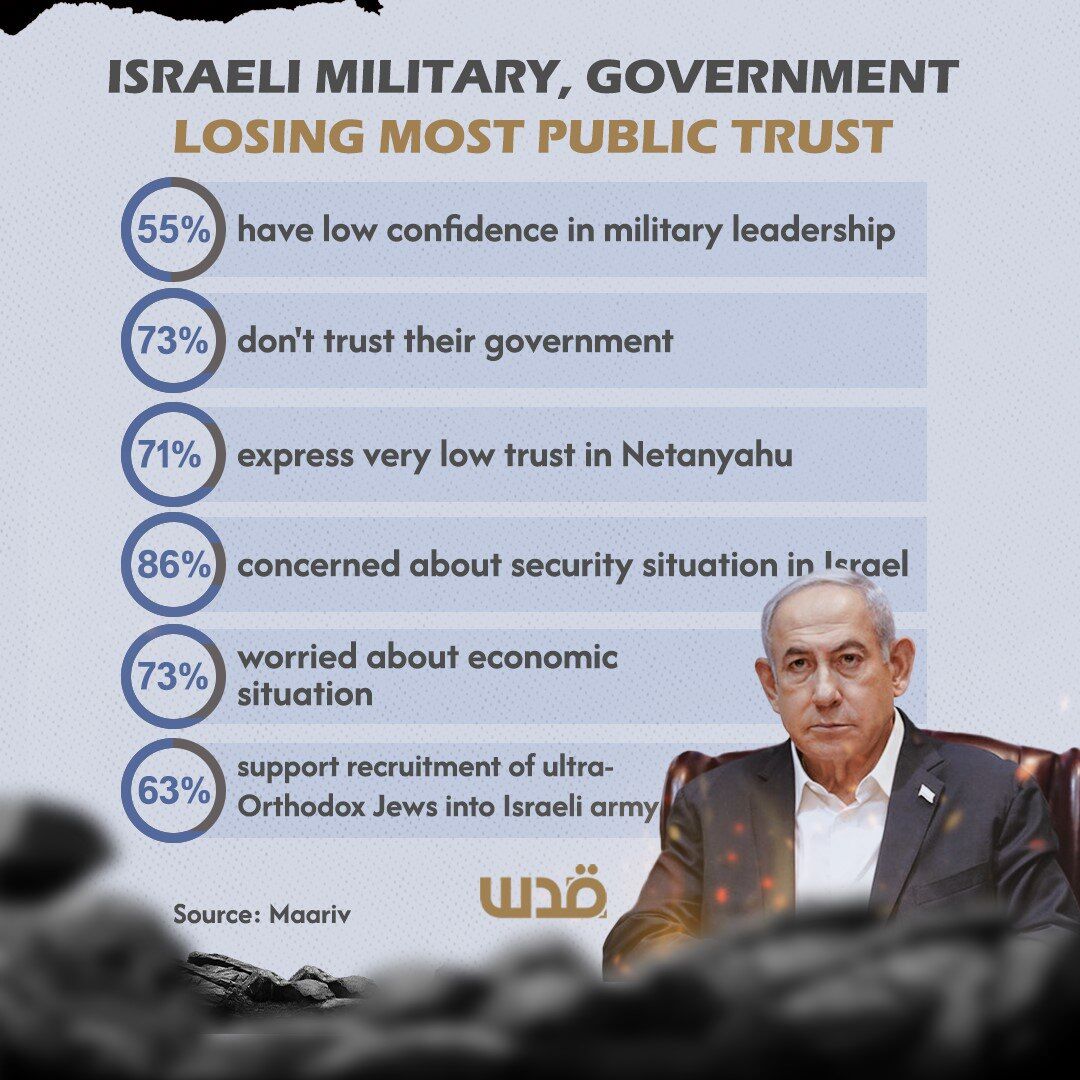
As reported in the Jewish Maariv daily and highlighted in the Quds News Network, his teflon-factor toughness is dented domestically and daily, as characterized by the popular opposition against his rule, in the street and the Knesset.

Around 55% of Israelis have low confidence in the current military leadership of the country; 73% don’t trust the government and 71% express very low trust in Netanyahu.

Further, 86% are concerned about the security situation in Israel; 73% worried about the economic situation of the country and 63% support the recruitment of ultra-Orthodox Jews into the army.

Around 500,000 Israelis have left the country since 7 October, 2023, and the Ben Gurion Airport is already packed with travelers wanting to leave following Friday’s Houthi drone attack on Tel Aviv.

Netanyahu is visiting the United States with all these statistics staring him in the face.

He is addressing the US Congress and meeting US President Joe Biden amidst a declining trust among Israelis in his leadership.

This is particularly due to his failure to secure a ceasefire that could facilitate an exchange deal with the resistance in Gaza. At the same time the fate of 120-plus Israeli hostages hang in the balance.

At the same time, he is facing intense pressure from far-right ministers who threaten to dissolve the government if he agrees to a deal.

They are insisting that he initiate an all-out war against Lebanon—a conflict that, according to the U.S., could escalate into a regional war, which the U.S. has warned against.

But the US is worried also because Hezbollah is proving a very strong match in the north whilst the Houthis are prepared for an all out war which would disruptive globally.

Continue reading
Yaffa Drone Travels 2000 KM to Reach Tel Aviv

Yedioth Ahronoth revealed new details about the “Jaffa” drone that attacked Tel Aviv leading to the death of an Israeli and the injury of at least 10 others.

The Israeli newspaper reported the drone attack on a residential building in central Tel Aviv killing Yevgeny Perder show it was launched from Yemen and traveled about 2,000 kilometers.

“Some of the fly routes taken by the drone were new compared to previous trajectories to make the matter difficult and confusing for the detection systems in the Israeli army,” the paper said.

It stated  the Jaffa drone warhead was “relatively small and contained several kilograms of explosives,”. This “allowed for a long flight, and the extent of damage limited.”

“The full flight path is still under investigation, but according to preliminary assessments of the Israeli army, the drone passed through Sinai and crossed the Mediterranean Sea off the southern coast,” according to Yedioth Ahronoth.

The explosion occurred at dawn on Friday, about 100 meters from the US Embassy’s branch office complex.

The Yemeni “Ansar Allah” movement – Houthis – stated “the Yemeni Armed Forces’ air force carried out a qualitative military operation targeting one of the important targets in the occupied Jaffa region, the so-called Israeli Tel Aviv.”

The Houthis explained the operation was carried out “with a new drone called “Yafa” capable of bypassing the enemy’s interception systems and being unable to be detected by radars. The operation successfully achieved its goals.”

Israeli Prime Minister Benjamin Netanyahu made an assessment of the situation after such targeting, with officials confirming “there will be a reaction, and that a response within the territory of Yemen is on the table” according to Jo.24 website.

Continue reading
Yemeni Drone Baffles Israelis as it Strikes Tel Aviv

In the light of the Houthi drone that hit Tel Aviv early morning Friday, one of which landed on an apartment building and killed 1 Israeli and injured 10 others, the Israeli army have been on high alert.

The Houthis drone took the Israeli air force by surprise. They said whilst they saw and detected the drone coming, they didn’t move to activate the red alerts and that is why it was not intercepted.

Israeli military officials admit “human error among their defenses to stop the drone that landed between Shalom Aleichem and Ben Yehuda Streets in Tel Aviv, hundreds of meters away from the American Embassy,” as reported by the Turkish news agency, Anadolu.

This was according to the Israeli Public Broadcasting Corporation  (KAN) which stated it was a “bomb-laden drone that exploded  at the intersection” of these streets at about 3:10 am Friday were large explosions were heard and reported.  

Following the attack the Israeli army claimed over 200 drones and cruise missiles were fired from Yemen towards Israeli locations since the start of the Israeli war on Gaza on 7 October, 2023. 

Experts say the drone is adding further fears among Israelis, a large number of whom are reported to be leaving the country.

The Houthi attack which is the first of its kind on the city to come from all the way from Yemen is a major embarrasment for Prime Minister Benjamin Netanyahu and the Israeli army.

Analysts have said it is Israel that is no longer safe being hit from the south, all the way to Eilat, settlements sorrounding Gaza, north of the country by Hezbollah in Lebanon and now its center, in major cities like Tel Aviv.  

In March, the Israeli army reported for the first time a cruise missile fired from Yemen entered Israeli airspace and exploded in an open area in northern the Port of Eilat that is about to declare its bankruptsy because Israeli ships make their way there were targetted by the Houthis.

This type of drone, named Haifa, was not detected by radars and other surveillance systems whilst flying all the way from Yemen along the Red Sea and towards Tel Aviv.

Continue reading
Israel Economy Dives as 46,000 Firms Close

About 46,000 Israeli companies closed down since the war began on 7 October, 2023, with expectations the number will rise to 60,000 firms by the end of 2024 according to the Israeli Hebrew daily Maariv.

It stated 46,000 companies closed down since the beginning of the war on Gaza according to Coface Bdi, a credit risk business information agency for Israeli companies.

“This is a very high number that includes many sectors,” Yoel Amir, CEO of Coface Bdi, was quoted as saying.

He explained 77% of the companies that closed down since the war beginning – that’s about 35000 companies, are small firms and are the most vulnerable in the Israeli economy.

The sectors suffering most are  the building and construction industry, and other related industries such as ceramics, air conditioning, aluminum, and building materials.

Amir added other sectors were also severely affected such as the trade sector, which includes the fashion, shoe, furniture, and household appliances industry, and the service sector, cafes, entertainment and entertainment services, and transportation.

He said this includes the tourism sector which is today non-existent, the tourist areas that have become combat zones, and the agricultural sector, most of which is located in the combat zones in the south and north, and suffers from a shortage in workforce.

Statistics show the abysmal state of the Israeli economy with the building and construction sector down by 27%, services sector by about 19%, while the industrial and agricultural sector by about 17%, and the trade sector by about 12%.

The high-tech and advanced technologies industry was affected by about 11%, and the food and beverage industry was affected by about 6%, according to official statistics.

“The damage in combat zones is more serious, but the damage to businesses is across the country, with almost no sector spared,” Amir noted.

“The damage is very great in all aspects of  the Israeli economy,” the Coface Bdi CEO noted, explaining “in the end, when companies close their doors and do not have the ability to repay debts, there is also peripheral damage to customers, suppliers and companies that are part of Its working system.

He added, “…there has been a sharp decline in corporate activity in various sectors since the beginning of the war.”

Amir confirmed that in a recent opinion poll made by his company, about 56 percent of commercial company managers in Israel said there was a significant decline in the scope of their activities since the beginning of the war.

“We estimate that by the end of 2024, it is expected that about 60,000 companies will close in Israel. For comparison, in 2020, the year of the Corona crisis, about 74,000 companies were closed,” he said.

Today Israeli companies face “very difficult challenges represented by a labor shortage, declining sales, a high interest rate environment and high financing costs, transportation and logistics problems, a shortage of raw materials, and inaccessibility to agricultural lands in combat zones,” as well as “the lack of Availability of customers involved in combat, flow difficulties, and increases in acquisition costs,” he added.

The war left more than 126,000 Palestinian martyrs and wounded, most of them children and women, and more than 10,000 missing amid massive destruction and famine that claimed the lives of dozens of children.

Tel Aviv continues the war, ignoring the UN Security Council resolutions to stop it immediately, and the orders of the International Court of Justice to take measures to prevent acts of genocide and improve the catastrophic humanitarian situation in Gaza.

Continue reading