In Washington: Trump, Zelenskyy, Vance Locked in Verbal Fight

READ the Full transcript of heated exchange at the Oval Office in the White House.

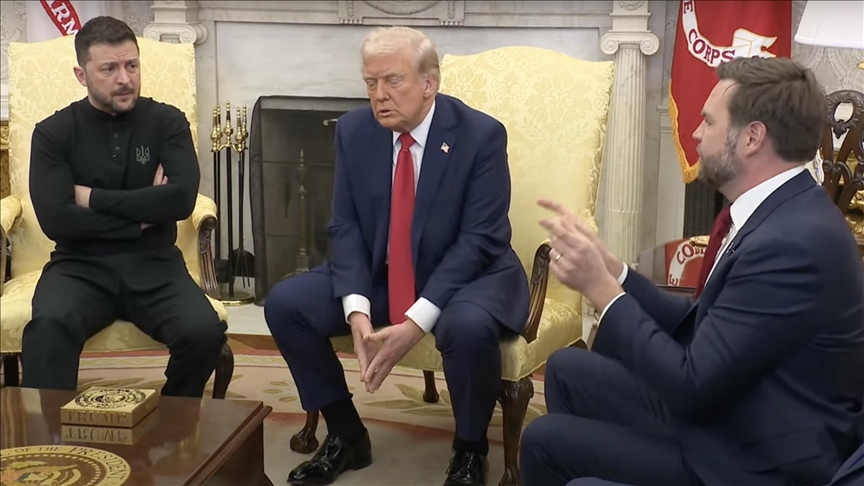
Ukrainian President Volodymyr Zelenskyy on Friday got in a heated war of words with US President Donald Trump and Vice President JD Vance Friday during a critical meeting at the White House.

The public spat was over Zelenksyy’s doubts that Trump’s efforts to broker a deal to end the three-year-long war with Russia may not yield lasting peace.

Zelenskyy departed the White House following the argument, and a planned signing ceremony for a deal on critical minerals and press conference were canceled. ​​​​​​  

Here is the full transcript of the heated exchange at the White House:

Reporter: Poland was under Russian control for decades after the Second World War. When I was a kid, I looked at the United States not only as a most powerful country, richest country in the world, the country that has great music, great movies, great muscle cars, but also as a force for good. And now I’m talking with my friends in Poland, and they are worried that you align yourself too much with Putin. What’s your message for them?

Trump: Well, if I didn’t align myself with both of them, you’d never have a deal. You want me to say really terrible things about Putin and then say, hi, Vladimir. How are we doing on the deal? It doesn’t work that way. I’m not aligned with anybody. I’m aligned with the United States of America, and for the good of the world, I’m aligned with the world, and I want to get this thing over with. You see, the hatred he’s got for Putin that’s very tough for me to make a deal with that kind of hate. He’s got tremendous hatred, and I understand that, but I can’t tell you the other side is exactly in love with you know him, either. So it’s not a question of alignment. I have to I’m in line with the world. I want to get the thing said. I’m aligned with Europe. I want to see if we can get this thing done. You want me to be tough? I could be tougher than any human being you’ve ever seen. I’d be so tough, but you’re never going to get it done that way. So that’s the way it goes. One more question.

Vance: I will respond to this. So look, for four years, the United States of America, we had a president who stood up the press conferences and talked tough about Vladimir Putin, and then Putin invaded Ukraine and destroyed a significant chunk of the country. The path to peace and the path to prosperity is maybe engaging in diplomacy. We tried the pathway of Joe Biden of thumbing our chest and pretending that the President of the United States’ words mattered more than the President of the United States’ actions. What makes America a good country is America engaging in diplomacy. That’s what President Trump’s doing.

Zelenskyy: Can I ask you?

Vance: Sure? Yeah.

Zelenskyy: He (Putin) occupied our parts, big parts of Ukraine, part of East and Crimea. So he occupied in 2014. so during a lot of years. So I not speaking about just President Obama, then President Trump, then President Obama, now President Trump, God bless now President Trump will stop him. But during 2015 nobody stopped him. He just occupied and took. He killed people.

Trump: I was not here.

Zelenskyy: Yes. But during 2014 till 2022. The situation the same that people are been dying on the contact line. Nobody stopped him. You know that we have conversations with him, a lot of conversation, many bilateral conversation, and we signed with him.. In 2019 I signed with him, the deal, I signed with him, Macron and Merkel, we signed ceasefire. Ceasefire. All of them told me that he will never go. We signed him, gas contract. Gas contract, yes, but after that, he broke the ceasefire. He killed our people and he didn’t exchange prisoners. We signed the exchange of prisoners, but he didn’t do it. What kind of diplomacy JD you are speaking about? What do you mean?

Vance: I’m talking about the kind of diplomacy that’s going to end the destruction of your country, Mr. President, Mr. President, with respect. I think it’s disrespectful for you to come to the Oval Office to try to litigate this in front of the American media. Right now, you guys are going around and forcing conscripts to the front lines because you have manpower problems, you should be thanking the president for trying to bring it into this.

Zelenskyy: Have you ever been to Ukraine that you see what problems we have?

Vance: I have been to.

Zelenskyy: Come once.

Vance: I’ve actually, I’ve actually watched and seen the stories, and I know what happens is you bring people. You bring them on a propaganda tour, Mr. President. Do you disagree that you’ve had problems bringing people in your military? and do you think that it’s respectful to come to the Oval Office of the United States of America and attack the administration is trying to prevent the destruction of your country?

Zelenskyy: A lot of questions. Let’s start from the beginning. First of all, during the war, everybody has problems, even you, but you have a nice ocean and but don’t feel now, but you will feel it in the future.

Trump: You don’t know that.

Zelenskyy: God bless, you will not have a war…

Trump: Don’t tell us what we’re going to feel. We’re trying to solve a problem. Don’t tell us what we’re going to feel, because you’re in no position to dictate that exactly.

Zelenskyy: I am not telling you.. (inaudible) I am answering… question…

Trump: You’re in no position to dictate what we’re going to feel. We’re going to feel very good.

Zelenskyy: You will feel influence…

Trump: You’re right now not in a very good position. You’ve allowed to be in a very bad position, and it happens to be….

Zelenskyy: From the very beginning of the war.. (inaudible)…

Trump: You’re not in a good position. You don’t have the cards right now. with us, you start having problems right now.

Zelenskyy: I’m not playing cards…

Trump: You are playing cards. You’re gambling with the lives of millions of people.

Zelenskyy: I am the president of.. (inaudible)

Trump: You’re gambling with World War II. You’re gambling with World War III, and what you’re doing is very disrespectful to the country, this country, that’s back to you far more than a lot of people say they should..

Vance: Have you said thank you?

Zelenskyy: A lot of times…

Vance: No, in this entire meeting?

Zelenskyy: Even today…

Vance: You went to Pennsylvania and campaigned for the opposition in October, offer some words of appreciation for the United States of America and the president who’s trying to save your country.

Zelenskyy: Please, you think that, if you will speak very loudly about the war…

Trump: He is not speaking loudly, your country is in big trouble.

Zelenskyy: Can I answer?

Trump: No, no, you’ve done a lot of talking. Your country is in big trouble.

Zelenskyy: I know…

Trump: You’re not winning. You’re not winning this. You have a damn good chance of coming out okay, because of us.

Zelenskyy: We are staying in our country, staying strong, from the very beginning of the war, we’ve been alone, and we are thankful. I said, thanks…

Trump: You haven’t been alone…

Zelenskyy: I said thank you…

Trump: We gave you, through this stupid president, $350 billion we gave you military equipment…. if you didn’t have our military equipment, if you didn’t have our military equipment, this war would have been over in two weeks…

Zelenskyy: In three days. I heard it from Putin in three days. This is something…

Trump: Maybe less…

Zelenskyy: in two weeks.. of course.

Trump: It’s going to be a very hard thing to do business like this.

Vance: You said thank you.

Zelenskyy: I said… (inaudible)…

Vance: Except that there are disagreements, and let’s go litigate those disagreements, rather than trying to fight it out of the American media, when you’re wrong, we know that you’re wrong.

Trump: You see, I think it’s good for the American people to see what’s going on. I think it’s very important. That’s why I kept this going so long. You have to be thankful you don’t have the cards. You don’t have the cards..

Zelenskyy: I am thankful…

Trump: You’re buried there.

Zelenskyy: I can tell you again…

Trump: People are dying. You’re running low on soldiers.

Zelenskyy: Listen…

Trump: You’re running low on soldiers. It would be a damn good thing. Then you tell us, I don’t want to ceasefire. I don’t want to ceasefire. I want to go and I want this… Look, if you could get a ceasefire right now, I tell you, you take it so the bullets stop flying and your men stop being killed…

Zelenskyy: Of course, we want to start the war, but I …

Trump: You are saying you don’t want to ceasefire. I want a ceasefire because you get a ceasefire faster than…

Zelenskyy: Ask our people about ceasefire. What they think… (inaudible)…

Trump: That wasn’t with me, that was with a guy named Biden who was not a smart person.

Zelenskyy: It was your president…

Trump: That was with Obama who gave you sheets and I gave you javelins. Yes, I gave you the javelins to take out all those tanks. Obama gave you sheets. In fact, the statement is Obama gave sheets and Trump gave javelins, you got to be more thankful, because, let me tell you, you don’t have the cards. With us, you have the cards, but without us, you don’t have any cards.

Anadolu

Continue reading
Seismic Shift Across The Atlantic

By Dr Khairi Janbek

Even before Trump’s coming of age, which is a long way away, or  more accurately so, coming to power, one often wondered about the status of the European Union (EU) in the world of changing circumstances and the existential meaning of its presence on the world power map among the increasing differences among its member states.

Although and frankly, differences always existed within the Union, the Russian invasion of Ukraine made those differences more acute, sharper and penchant materializing between those Europeans fearing being next on the Russian menu, those who want an assertive position against Moscow, those reluctant either way, and those who are out rightly pro-Russia.

Evidently, having unity among the 27 European countries which are not necessarily different in their political structures, yet having necessarily different strategic interests end up with infighting, recriminations and threats.

As well what makes things near-impossible, is that the EU does not have a mechanism to expel a fellow-member from the Union, so one is always beleiving that there is hope that an obtrusive member of the Union would walk out voluntarily in the manner made by the British Brexit.

Now it is more complicated. Not only the EU is having to deal with a possible Russian threat, but also a looming trade war with the US that is compounded with the distinct possibility that America may be withdrawing its protection umbrella from Europe.

Of course, this legitimately raises the question about the future of NATO; a question which was raised before especially after the demise of the Soviet Union in the early 1990s. This ultimately means a new form of a military alliance will be required for the EU.

Ideally, one would have thought a smaller EU entity, leaner and meaner, with incorporation of Britain in it, would the best option, while the rest of Europe, from its center to its eastern side, hitched by accords with Russia and the USA.

This would be far better instead of the current large European crippled Levathian with Britain running like a headless chicken proposing to be the bridge between the USA and EU, a link both sides of the Atlantic believe it’s too far a gap for any meaningful effect.

Having said all that, there is a window of opportunity now with the new government in Germany, showing more courageous initiatives in wanting to see a reset of the Atlantic relationship, which falls well with President Macron of France, the other core member of the EU which has the idea of creating a single European army to protect the EU and its interests.

When it comes to transnational trade, the absurdity of the war of tariffs will hurt all including the American economy, though European companies whose main market is in the USA will go and invest in America, but those US companies whose main market is Europe, will invest in the EU.

Essentially, the seismic shift in relations across the Atlantic is set to commence with most probably less profits but more fairness.

Dr Khairi Janbek is a Jordanian writer based in ParisFrance

Continue reading
Is America Abandoning Europe?

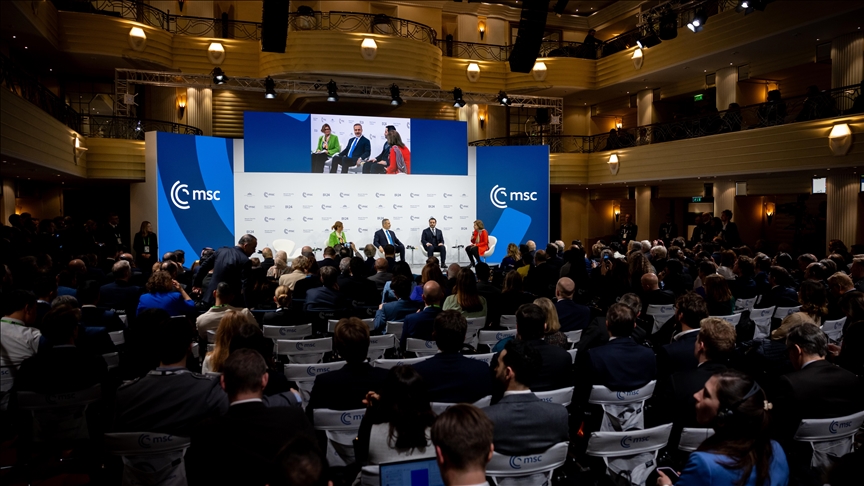
In 2007, Russia’s President Putin gave a now-infamous speech at the Munich Security Conference (MSC), announcing Russia’s new posture of hostility towards the US and Europe. In 2022, when Russia invaded Ukraine, many looked back at Putin’s 2007 Munich speech as a revealing moment of his intentions.

This year’s MSC could be a similar watershed. This time, the warning bells ring from across the Atlantic. US Vice President JD Vance delivered one of the most hostile speeches by a US official to Europe in decades. Rather than addressing the Russian or Chinese threats, Vance argued that Europe faced a “threat from within,” accusing the EU and national governments of censorship and ignoring popular demands on issues like illegal migration.

Meanwhile, away from Munich, US President Donald Trump held a phone call with Putin, setting the stage for negotiations between the US and Russia for a peace agreement in Ukraine – without involving European counterparts in the discussions. The day before, Defence Secretary Pete Hegseth announced some of the US expectations from this deal: Ukraine should drop its NATO membership bid, European countries would need to provide the forces to enforce the agreement, and these forces would not be covered by NATO’s Article 5 guarantees.

The transatlantic picture in which the MSC took place was even bleaker. Since Trump’s inauguration one month ago, the new president had promised (and now imposed) tariffs against countries across the world, including Europe. He has threatened to annex the territory of allies like Canada and Denmark.

Normally, the MSC is an opportunity for the United States to reaffirm its commitment to Europe and the Atlantic alliance. This year, it could be remembered as the time when the US started the process of abandoning Europe – or even going aggressively after it.   

An attack on Europe

Vance’s speech and the reactions to it have dominated the discussions at the MSC. Although the conference theme was “multilateralization”, the real topic on everyone’s mind was: how would Trump’s second administration approach Europe?

As the pre-conference report argued: “Donald Trump’s presidential victory has buried the US post–Cold War foreign policy consensus that a grand strategy of liberal internationalism would best serve US interests.” That this consensus was gone was clearly visible in the conference. Despite perfunctory references to shared values, Vance’s speech did not talk about the alliance between Europe and North America, nor about the common threats and how to face them.

And he has voiced support for anti-EU parties. Vance pronounced his speech in Germany, just weeks before federal elections, and argued that there should not be “firewalls” in government – a clear reference to the far-right Alternative für Deutschland (AfD) which has so far been kept out of governing coalitions. After the speech, Vance met with the AfD leader.

Additionally, Vance criticized Romania for canceling its 2024 elections and accused the EU of censoring free speech. But Vance failed to acknowledge that the very election that brought Trump and him to power in November was the subject of major foreign interference by Russia, China, and Iran. Rather than sitting idly by, US agencies took active measures to counter these malign actions and prevent disruptions – like raising awareness, coordinating with the media, and keeping politics out of the fight. With his speech, Vance seems to be arguing for the exact opposite approach.

All these issues did not touch on security and defense, the core of the MSC’s discussions. But they did lure in the background of Vance’s speech. A few months ago, Vance argued that the EU should not regulate tech companies owned by Elon Musk. If the Europeans did so, he argued, the US should reduce its security commitments to NATO. Hence, American assurances could become bargaining chips to resolve other issues.   

How will the EU respond?

Vance’s Munich speech marks a new era in US relations with Europe. While the themes are not new – Trump has never been a fan of NATO, and enjoys courting Europe’s far-right – the extent of the rhetorical change cannot be understated. Ukraine’s President Zelensky, speaking in Munich the day after Vance, spelled out the challenge in clear terms: “We can’t rule out the possibility that America might say ‘no’ to Europe on issues that threaten it.”

The reaction from European leaders has been strong so far. EU Commission President Von der Leyen called for an emergency clause in the EU treaties to allow member states to boost defense spending [8]. French President Macron called for a summit of European leaders in Paris on Monday, February 17 – to sketch out a common position on the upcoming negotiations over Ukraine, and on making up for US security guarantees from Europe.

The greatest challenge, however, will be transforming outrage into meaningful action. Europeans have long ignored calls to take charge of their own security. Domestic constraints over spending, divisions and the continued belief that Uncle Sam will have their back have stood in the way of ambitious choices. Will this time be different?  

This opinion was written by Giuseppe Spatafora for the Anadolu news website.

Continue reading
Europe Says No to Trump’s Plan to Take Over Gaza, Transfer its People

Several European leaders, Wednesday, rejected US President Donald Trump’s controversial plan to “take over” Gaza and forcibly resettle its Palestinian population in other countries.

Germany

Dismissing the proposal, German Foreign Minister Annalena Baerbock said that the only way forward for peace is a negotiated two-state solution.


“It is clear that Gaza—like the West Bank and East Jerusalem—belongs to the Palestinians,” Baerbock said, warning that forcibly expelling the civilian population would violate international law and fuel further hatred.

She stressed that the UN, EU, and G7 have consistently opposed Israeli settlements on Palestinian territories.

France

France also swiftly rejected Trump’s proposal, reaffirming that Gaza should remain part of a future Palestinian state.


“The future of Gaza must be inscribed not in the perspective of control by a third State but in the framework of a future Palestinian State, under the aegis of the Palestinian Authority,” a French Foreign Ministry statement said.

“France reiterates its opposition to any forced displacement of the Palestinian population of Gaza, which would constitute a serious violation of international law, an attack on the legitimate aspirations of the Palestinians, but also a major obstacle to the two-state solution,” it added.


Britain

Responding to a question on Trump’s Gaza remark, UK Prime Minister Keir Starmer said Palestinians in Gaza “must be allowed home, they must be allowed to rebuild, and we should be with them in that rebuild on the way to a two-state solution”


Spain

Spain also joined the chorus of disapproval, with Foreign Minister Jose Manuel Albares firmly rejecting the idea of US control over Gaza.

“Gaza is the land of the Palestinian Gazans. The Palestinian Gazans must stay in Gaza,” Albares said.

Spain reaffirmed its commitment to a future Palestinian state that includes Gaza as part of its territory.


Poland

Poland’s Deputy Foreign Minister Andrzej Szejna expressed support for a two-state solution and emphasized the need for Palestinian involvement in the peace process.

“Just like in the case of Ukraine, where we say that you can’t decide about Ukraine without Ukraine, if we’re talking about the peace process. Similarly, you can’t decide about Palestine without the Palestinians. This is Poland’s position,” Szejna said.

Slovenia

Slovenian Foreign Minister Tanja Fajon criticized Trump’s comments as reflective of a “deep ignorance of Palestinian history.”


Speaking from Lebanon, Fajon warned that such proposals could lead to further unrest and violence and stressed that Palestinians completely reject the idea of being displaced from their homeland.


Scotland

Scottish First Minister John Swinney also condemned the proposal, calling any suggestion of displacing Palestinians “unacceptable and dangerous.”

Swinney emphasized that the suffering of the people in Gaza must not be exacerbated by plans for forced relocation, following months of intense violence and loss of life in the region.

Further reaction

The Palestine Solidarity Campaign (PSC) condemned Trump’s remarks, describing them as “illegal” and part of a “grotesque plan” that would lead to the mass ethnic cleansing of 2.3 million Palestinians.

“This is a blueprint for a crime of historic proportions,” said the PSC, highlighting that the plan would violate the Geneva Convention’s prohibition on the forcible transfer of populations.

The Muslim Council of Britain has criticized Trump’s plan, urging international action for Gaza’s reconstruction that is led by the Palestinian people themselves.

Wajid Akhter, Secretary General of the Muslim Council of Britain, warned that any attempt to reconstruct Gaza through displacement would amount to ethnic cleansing.

“Reconstruction without displacement is not only possible – it is the only acceptable path forward,” he stated.

Amnesty Denmark

Amnesty Denmark echoed the widespread rejection, with spokesperson Vibe Klarup drawing a stark comparison between Trump’s plan and Russia’s invasion of Ukraine.

” (What) Trump is advocating here is, first of all, a real invasion of another people’s country,” Klarup said, adding that any US takeover of Gaza would be criminal and a grave breach of international law.

During a news conference with Israeli Prime Minister Benjamin Netanyahu in Washington on Tuesday, Trump said that the US “will take over” Gaza after relocating Palestinians elsewhere under a redevelopment plan that he claimed could turn the enclave into “the Riviera of the Middle East,” according to Anadolu.

Continue reading
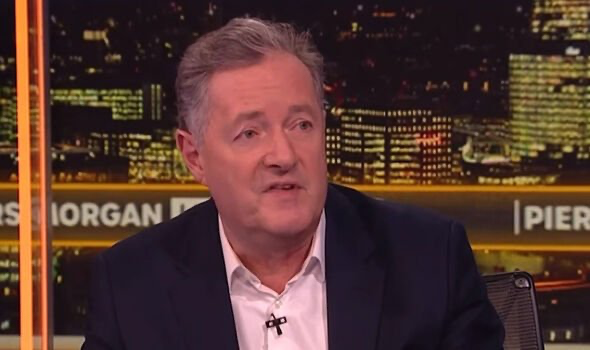
To Piers Morgan: How Can The Killing of Women Children Be Justified as a ‘Moral Right’

British broadcaster and journalist Piers Morgan said Israel’s killing of Palestinian civilians in Gaza, including women and children, could be justified as a “moral right.”

In an interview this week with journalist Tucker Carlson on a rooftop in Saudi Arabia’s capital, Morgan discussed several topics, including the Israeli assault in Gaza and whether the U.S. should be funding it.

Carlson condemned Israel’s bombardment of civilians for over a year, which Morgan questioned as he said such bombing ‘wasn’t evil.’

Carlson said: ‘If you’re intentionally killing civilians, you probably shouldn’t beat your chest and brag about it… maybe you can make the case that you had to do it, but you should weep.’

‘Is it evil though?’ Morgan responded, to which Carlson argued: ‘To kill civilians on purpose? I think it is. Kids and children? Yeah.’

Morgan said he could see there being a ‘moral right’ to civilian deaths in wartime, saying: ‘If there is a world war that threatens the entire world, yes.’

When Carlson called his view ‘disgusting’, he walked back and said it could be justified ‘in a pure defensive action’ as the two journalists sparred over the assault.

‘To intentionally kill noncombatants, women and children, I think we can say that’s wrong,’ he concluded.

The two journalists moved onto the issue of whether the US should continue funding Israel’s assault in Gaza, after former President Joe Biden sent at least $17.9 billion in military aid since the start of the Israeli genocide in October 2023.

After Carlson repeated his calls for the US to stop supplying aid to Ukraine in its conflict with Russia, Morgan questioned: ‘Why do you support Israel against Hamas? Why do you support giving them billions of dollars?’

‘I don’t,’ Carlson snapped back.


‘I support Israel in the sense that I really like Israel, I brought my family on vacation there… but (I support Israel) only to the extent that it helps the United States.’

Morgan said this was a hypocritical stance given his criticism of aid to Ukraine, saying his support merely ‘depends on which country’.

‘I don’t see a difference between (Israel’s bombing of Gaza) and what is happening in Ukraine,’ Morgan continued.

‘This is a long way away from America, there is no direct involvement with America or no mainland involvement, and yet you think it’s right that America supports Israel, but you don’t think it’s right that America supports Ukraine.’

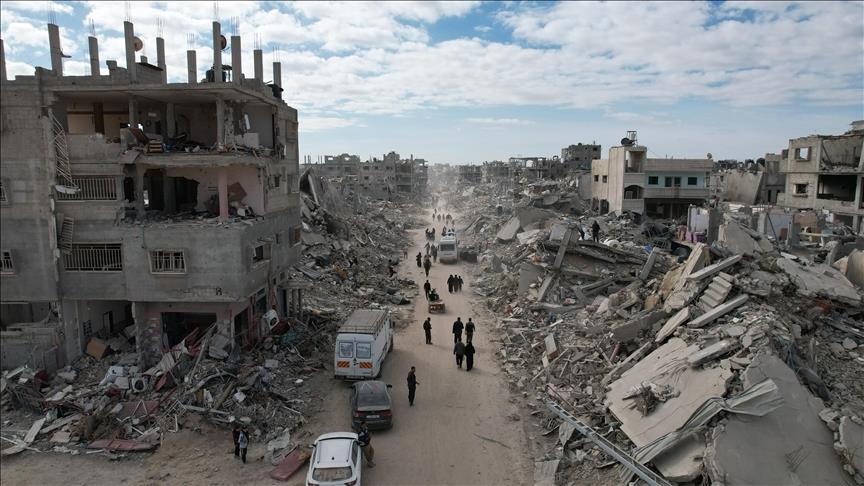
Fifteen months of Israeli bombardment have reduced buildings to rubble and ash, leaving large areas of Gaza uninhabitable. More than 47,400 Palestinians were killed during the Israeli assault, with 70 percent of the victims being women and children, according to Gaza’s Health Ministry.

Continue reading